For the past seven-to-ten years, European and Japanese interest in American skiing has been high, at least as evidenced by the annual visits of ski and travel journalists from Japan and England, and to a lesser extent, from the European continent. Supported by carriers such as United Airlines, TWA and Pan Am, foreign press have visited Colorado, Utah, New England and High Sierra destination resorts. Some of the frequent participants have included Arthur Sandles and Harold Evans, editors of the prestigious Financial Times and London Sunday Times, and of extensive guidebooks on skiing.
But, although American skiing has been quite visible in the international press for a number of years now—the Financial Times even carries U.S. ski condition reports—there has not been a huge volume of travel by skiers to U.S. ski resorts. Only recently, with the devaluation of the dollar on the international money markets, have U.S. winter holiday destinations come within financial reach of more people. Tour operators from Sweden, Germany and England have done some packaging of the Rockies resorts in the past on an experimental basis, but business volume was minimal. Trans-oceanic communications and reservations were definitely a problem, since none of the resorts had Telex equipment and telephone communication costs were prohibitive. Even participating airlines with Telex facilities ran into delays on reservation confirmations at the resort end.
Furthermore, up until now, U.S. ski resorts have spent relatively few marketing dollars in cultivating the foreign customer. Ski The Rockies in its heyday did participate in some group sales promotions in Mexico and Europe, in conjuction with the U.S. Travel Service, and was seriously considering some in Japan until the yen fell on the money market. Vail, and STR members, even went so far as to print informational brochures for in-resort distribution in French, German, Spanish and Japanese one year. Still, funds weren’t available for launching any major campaigns to bring overseas skiers to this continent.
This appears to be changing now. Sensing that this is the year when they might reap a decent return on sales and promotional expenditures, a number of ski industry entities have efforts underway, seeking out partners in the government and in the travel industry in order to raise the visibility of U.S. skiing in European and Mexican/South American markets.
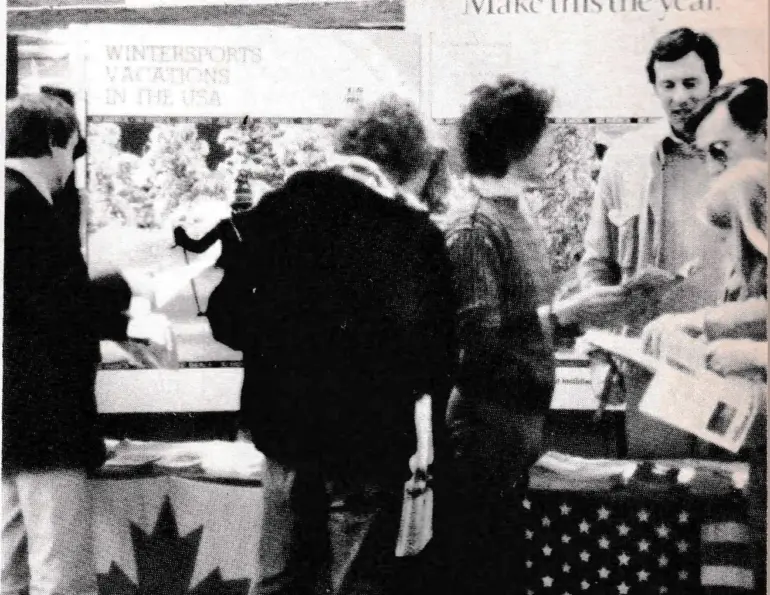
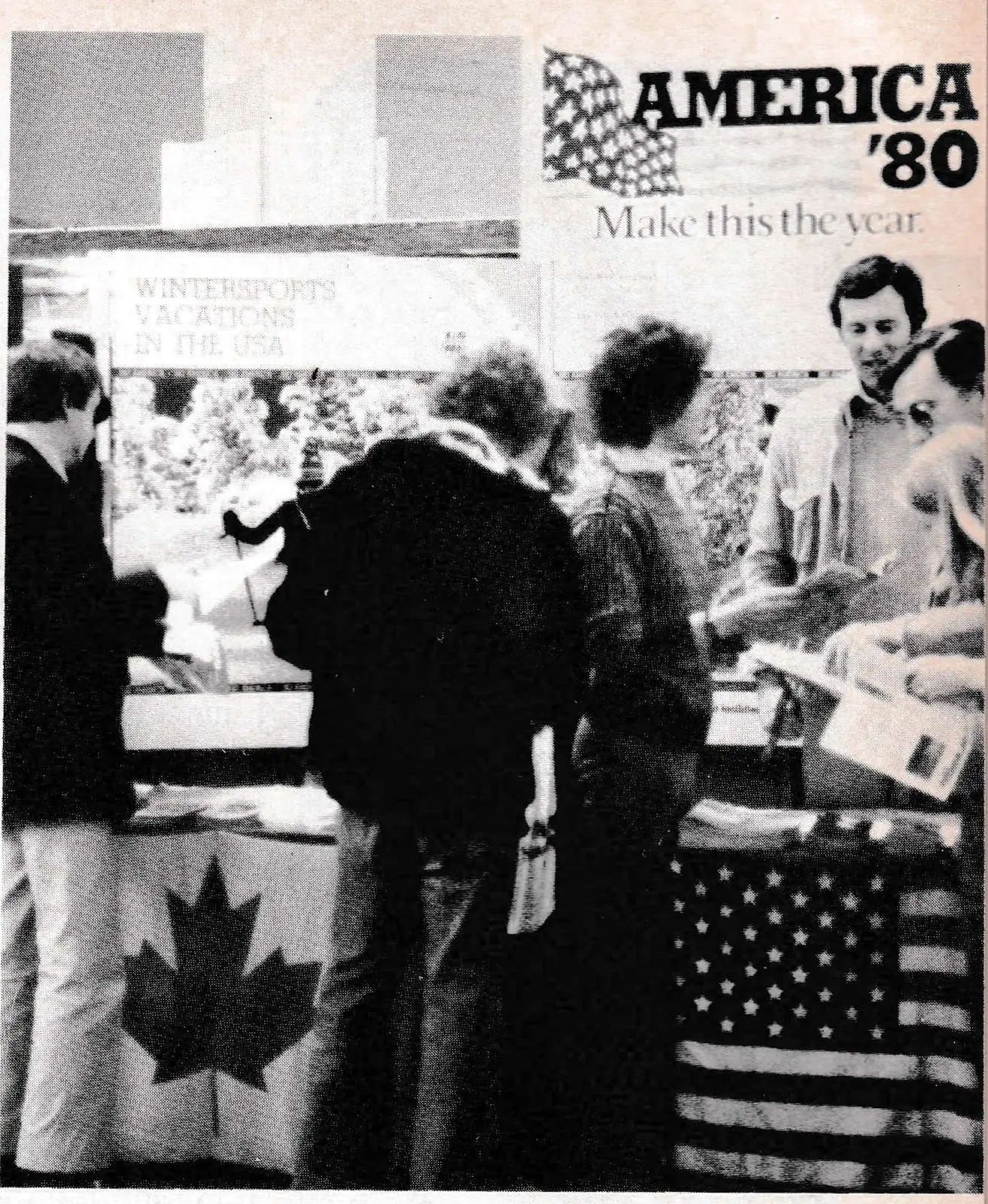
Last year, under the auspices of Ski America, a London based tour operator, and with assistance from the U.S. Travel Service, independent entrepreneur Bernie Weichsel organized and participated in a Ski America exhibit at the annual Daily Mail International Ski Show in London in November. The eight-day show attracted 102,000 people.
London is a great “ski town” and, says Weichsel, there are 67 ski tour operators in that city alone. Stressing that the impact of participating in a November consumer show couldn’t be measured before this coming winter, Weichsel reports that Ski America did experience a growth in U.S. ski packages from 150 two years ago to 2,000 last season. Ski America also organized a writers’ tour that included eleven journalists from England, France and West Germany. The group visited Alta, Snowbird, Park City, Keystone, Vail, Lake Placid and the SIA Show in Las Vegas in March.
Weichsel and Ski America are planning a much more ambitious program this year. Two exhibition tours are proposed: a major one involving Stockholm, Munich, The Hague, Paris, London and Frankfurt; and a smaller one involving Dusseldorf, West Berlin and Hamburg in West Germany, and Arnhem, Amsterdam and Rotterdam in the Netherlands. The exhibits will either be part of a consumer ski show, or will be staged at a major ski shop in each city. The tours begin at the end of September and continue until Thanksgiving.
Weichsel estimates that the cost of the complete tour will be around $100,000 and he is seeking participation by a number of travel entities to help underwrite the tour. The American Express card division has already committed some monies and, through its offices in the various cities, possibly will supply support personnel as well. Other potential participants include hotel chains, an airline company, ski equipment and clothing companies and regional resort groups, specifically Ski Lake Tahoe (already committed), Ski Utah, Ski the Wild West, Colorado Ski Country USA, New York State/Lake Placid and Ski New England. The groups are asked to ante up $12,000 each as their share of the cost.
The display, 13 meters x 3 meters, will feature a big map of the United States, highlighting the participating regions and familiar American travel features. Trade displays will be on both ends of the exhibit. The cost of the display is estimated to be $20,000 and it will be utilized on the major city tour. (Last year’s Ski America display will be used in the minor tour.) One hundred thousand copies of a generic American ski brochure will be printed in French, German and English. The information will include details on the scope of U.S. skiing, a map, distances (kilometers and miles); brief descriptions of resort facilities; gateway cities; and price comparisons. Additionally, participants can distribute their own literature at the shows.

Weichsel hopes to re-enlist the support of the U.S. Travel Service as the “sanctioning body” for the project this year, and to provide support for press functions, receptions, seminars and support services in the various cities. To that end, he has sought the help of American Ski Federation president, Joe Prendergast, who says he’ll help where he can, but is less than sanguine about the chance that the U.S.T.S. will participate again this year. “The U.S.T.S. got involved with Bernie’s effort last year but, typically, lacks enthusiasm after one year’s involvement,” says Prendergast. “They usually get into a program for one year and then say, ‘O-K, you’re on your own’.” (This probably reflects the limited amount of funds available to the agency and the demand for their support in a number of areas.)
Prendergast points out that the American Ski Federation is also actively developing programs through his involvement in the House Tourism Caucus. The effort is a twopronged one, focusing both on 1. exports of U.S. manufactured goods and 2. ski travel to the U.S. With regard to the latter, he is trying to convince the U.S.T.S. to make a long-term (three-year) commitment to a ski-the-U.S. travel program. The ASF plans to work through American embassies and the U.S.T.S., scheduling ski travel presentations in various countries (possibly including Japan and Mexico).
Until recently, Vail with its trail and information signs in both English and Spanish, seemed to have cornered the Mexican and South American (primarily Venezuela) skier market. However, other Colorado resorts are interested in that market and, in April, Colorado Ski Country USA, the U.S.T.S. and Mexicana Airlines sponsored a promotion in Mexico, including meetings with major wholesalers and individual sales calls to set the groundwork for separate packages with wholesalers. Cush Tours, a wholesaler based in San Diego, and Mexicana Airlines are following up on this, according to Dave Greenberg, CSCUSA director of marketing, who adds that Mexico/ South America is the number one priority foreign market for Colorado resorts this year. Europe (England and West Germany) is second and Japan third.
“For the past 5-7 years, a majority of Japanese skiers have gone to Mt. Alyeska in Alasks,” says Mel Borgersen, executive director of the Pacific Northwest Ski Areas Association, who noted that the gateway cities of Vancouver and Banff, serve large Japanese tour groups on their way to Whistler Mountain, Sunshine and Lake Louise ski areas. “We have no real destination resorts in Washington and Oregon,” says Borgersen. “Timberline and Crystal Mountain come the closest.” He hopes that the Early Winters resort will eventually “go”—”That’s step number one to having a real destination resort in the Pacific Northwest,” he says. In the meantime, very little promotion for foreign skiers is underway in that region at this time.
“Heavenly Valley sees a few Japanese skiers because of the combined San Francisco/Lake Tahoe and Disneyland tour packages,” says Bob Roberts of the Sierra Ski Areas Association. “Otherwise, there’s very little group tour activity and no organized regional effort to promote same.”
“Japan is a bit more difficult for us to approach,” says CSCUSA’s Dave Greenberg. “The U.S. mode of travel is to ‘do your own thing’, whereas the Japanese want and expect a structured package, a la Club Med. This might change when Club Med opens at Copper Mountain this winter.”
Bernie Weichsel, who accompanied the European press group during their March visit said the group really liked a lot of things about the U.S. ski areas. “We have a Western ambience that we ourselves don’t even notice,” says Weichsel. “The group recognized the value of our ski product from the standpoint of resort accommodations, the professional operation of our resorts, amenities like the host programs and they liked the all-day lift ticket.”