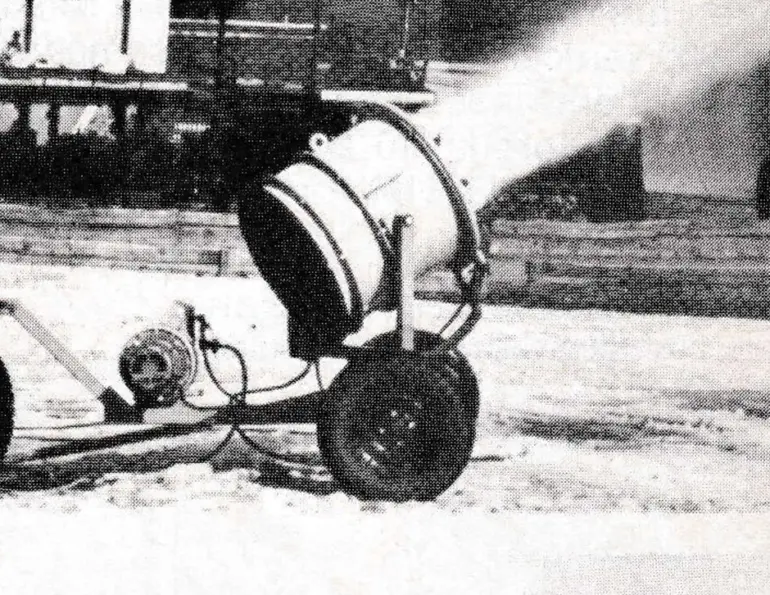
For answers, SAM looked at seven major systems—the most recent or the favorite system of each of seven different designers and suppliers.
Certain it is that the personal preference of the area decision-maker has a great deal to do with influencing the type of system designed and installed, and salesmanship undoubtedly plays a role here. Universally, though, the name of the game is cost efficiency—minimizing energy and labor costs, maximizing effective snow output.
Airless Systems
The really new development since the advent of air/water snowmaking 30 years ago, is the “airless” system. Although there is only one truly airless snowmaking unit, the SMI, Hedco can also be considered airless for all practical purposes because it does not depend on an outside source of compressed air to operate, only its small 12-15 cfm internal compressor.
The development of airless guns began in 1968 when SMI took out a license under the Hanson patent to manufacture their airless snowmaker. It wasn’t long before Linde in Europe and Hedco in the U.S. also filed for patents. The airless race was on. Linde has since stopped selling in the U.S., while Hedco and SMI have continually made improvements and expanded into Europe.
It is fair and safe to say that, generally speaking, airless snowmaking is more efficient than using compressed air. At an outdoor temperature of 20 degrees F and roughly 65% humidity, a 20 horsepower airless snowmaker will convert about 40 gallons per minute to snow weighing 25 pounds per cubic foot. With an air/water system even using equipment that is very efficient and runs on a 5 to 1 air water ratio at 20 degrees F, 45 horsepower would be required to convert the same amount of snow. (No water horsepower is included since it is assumed both units require or can use the same supply pressure.)
Air Water Systems
If airless type snowmaking is so efficient, then why doesn’t every ski area use it? In many cases, snowmaking is a very personal not a factual proposition, for area owners and managers. In addition, the distinct advantage of airwater systems is the capability of varying the amount of energy used to manufacture snow.
Airless snowmakers essentially have a fixed quantity of energy available regardless of temperature. Although water flow can be reduced, the energy input used to convert that water to snow cannot be changed. But with the compressed air systems (and this is especially true at marginal temperatures above 26 degrees), not only can water flow be reduced, air flow can be increased to the point where it is easier to manufacture snow at higher temperatures, albeit more expensive. Also, in most cases the air/water guns are easier to handle than their larger (1000 lbs.) cousins. Weighing between 25 and 50 lbs. the guns can normally be repositioned by one man, although two are handier. Total relocation from one slope to another is quickly and easily accomplished with either a snowmobile or small grooming vehicle. Other advantages are: 1. ease of maintenance; 2. durability; and 3. low initial cost.
Ironically the major drawback to this type unit are problems associated with the use of air and the related supply/distribution network.
Cost of operation is rapidly becoming more competitive with improved air/water ratios, as is the capital investment needed for air piping, hydrants, compressors, aftercoolers, etc. However, because only a small percentage of the existing systems benefit from the use of aftercoolers, freezing of air lines, hoses, hydrants and guns is not uncommon. In addition, there is the problem of questionable reliability associated with the portable rented diesel air compressors and their negative impact on the skiing environment. General appearance, smell, spilled fuel and noise combined with the need for 24 hour maintenance, availability and related labor costs are factors that must be cranked in to the bottom line formula.
Although new cleaner-burning and less noisy units are available, the enormous rise in fuel costs makes diesel expensive and stationary electric compressors more competitive, even considering the higher front cost. For about $30 a cfm you can buy a new electric screw type compressor (40% less than recips) and eliminate most of the above objections. Also, some areas are finding that they can negotiate reasonable rates for “off peak” electric power with local utilities. With the addition of after-coolers to the system, which in themselves require very little power, it is now possible to run a compressed air system with less discomfort.
Regarding the cost of air/water systems, note that some figures employed for system comparison have not changed much over the years. For example, a simple change in the air/water efficiency from 10/1 to 5/1, brings the installation costs of the two competing system types very close together. Although a national testing program does not yet exist hard data is available indicating that air/water guns are readily available in 5/1 ratios. This doesn’t mean that air/water operations are now more efficient than airless, it does mean that the gap is closing rapidly.
Combined Systems
There are currently three units which fit this “combined” category of compressed air, water, and electric: Boyne, Snowmaster and Fan Jet. The original and perhaps best known is the Boyne Snowmaker handled by SMI. Using three sources of energy may sound complicated but it isn’t although maintaining three different lines for each snowgun gets a bit testy at times.
Aside from the extra cost of power installation and some operational inconveniences, the combined systems offer impressive claims in overall efficiency. For instance, the Boyne unit at 20 degrees converts 100 gpm into snow, utilizing 15 hp each for the fan and remote compressed air at 60 cfm for a total of about 3.3 gpm/hp (pump not included). An air/water unit that runs at a 5/1 ratio at 20 degrees converts a little less than 1 gpm/hp. Extrapolating that into a 1/1 ratio, the output changes dramatically to about 4 gpm/hp. As always, keep a sharp pencil handy when comparing data. For example, using published data on the Snowmaster unit, the SM 300 (20HP) will produce 1.6 gpm/hp while the smaller model 175 will yield 1.75 gpm/hp.
System Refinements
The benefits of the increasingly reliable and functional automated systems are being studied as are several money-saving refinements. For example, through the use of after-coolers on air compressors, the high exit air temperatures (up to 350 degrees) can be reduced dramatically, thus saving tremendous inefficiencies at the gun. Based upon testing conducted by Ratnik Industries, when the outdoor temperature is 20 degrees F, and the compressed air temperature is reduced from just 90 degrees to 40 degrees, there is a 41% increase in efficiency of the system. Or put another way, a 41% decrease in energy for the same amount of snow produced. In addition, after-coolers can be installed on almost any air system, even one of poor design, and still yield the same results if installed properly.
Another money-saving device is the variable speed pump, which only uses the horsepower required at the moment, as opposed to using throttling valves or pressure relief valves to control the flow of water to the slopes.
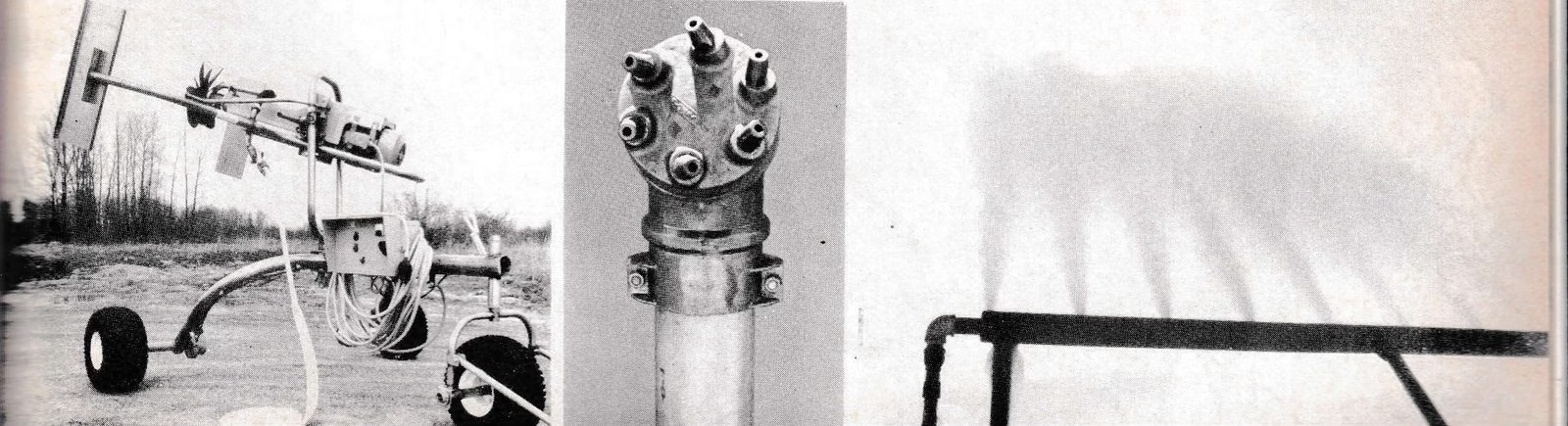
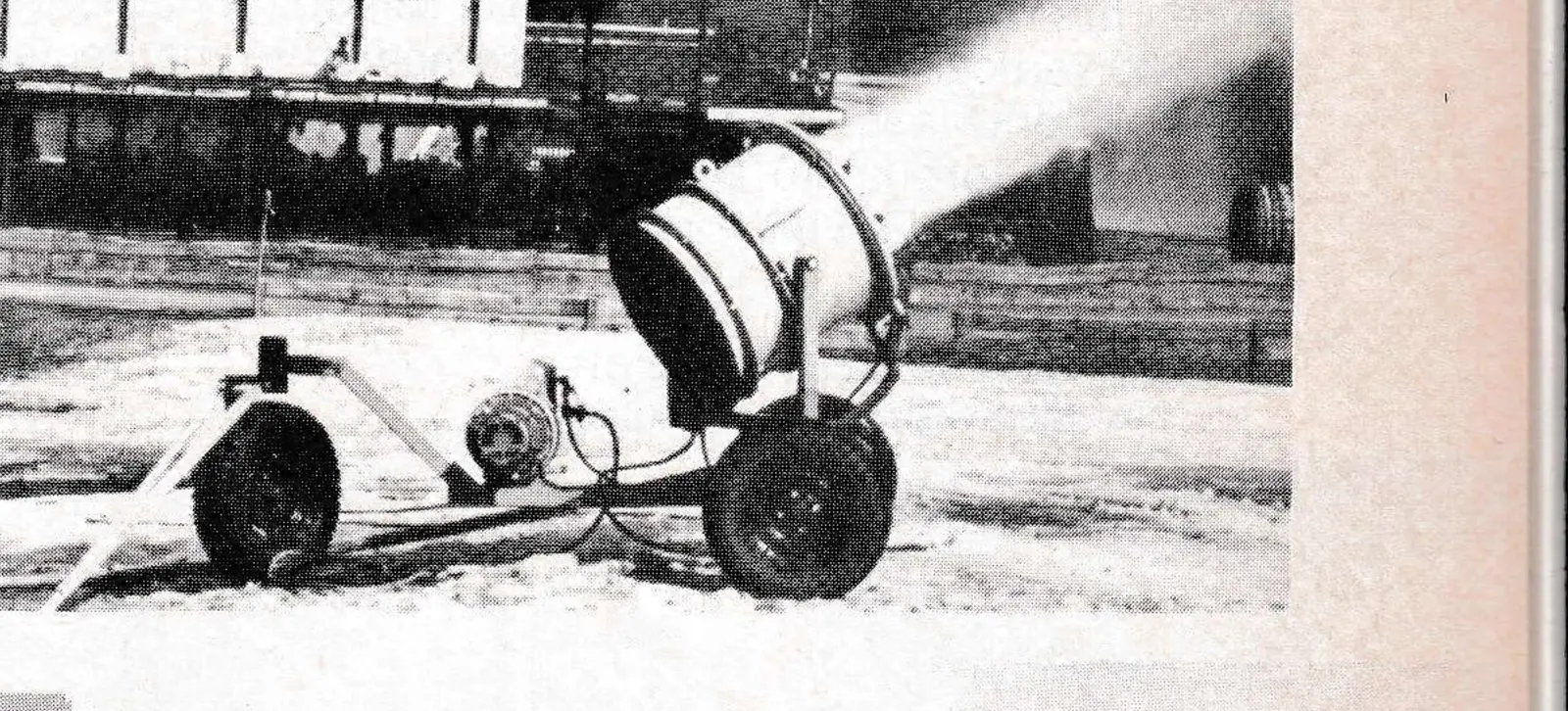
Thirdly—a labor-saving format—there is the use of automatic valves in the main pumphouse as an easy way to reduce crew size by one person or more. Besides this labor saving there is a pleasant side benefit in that automatic controls allow for a constant “hill pressure” even when adding or removing guns from the system. Thus, the water pressure and gun adjustments always remain in balance.
Finally, by tower mounting various units, the water output or snowmaking capability can be almost doubled. Not only are the tower mounted airless systems more efficient, but air/water is also. Recently, SAM visited Seven Springs, Pa., which uses 40-foot towers exclusively, and witnessed a one-to-one air/water ratio at 20 degrees F. Most suppliers offer tower mount equipment for their snow guns, although tower mounting hasn’t been extremely popular over the years. Early objections were the problem of maintenance of freezing or frozen equipment that high off the ground. With this problem essentially eliminated, the only major ojbection left for many operators is the appearance or presumably negative aesthetic effect on the mountain-scape. Perhaps, in view of the current energy situation, you may want to review your aesthetics and operating costs for last season and reconsider, based upon a projected savings of 50%.
Now, if you take all of the above refinements and add them to a totally monitored system offered by many suppliers, and throw in a comprehensive testing program such as that done at Aspen by Peter Alford, you have the ingredients for a finely tuned, well-controlled, energy-efficient system. The comprehensive testing program tests different gun and nozzle combinations under various weather conditions—and we know they vary extensively—producing hard data on the characteristics of each combination. At the same time, the guns can be adjusted for their maximum operating efficiency. Combine this data with flow measurement and temperature sensing devices and a computer package from Jeff White of Delta Associates and it may be we’re getting closer to removing the judgmental factor in making individual snow gun adjustments. Perhaps we are approaching an on-off system that produces, on demand, the quality and quantity of snow necessary for all given situations.
On the other hand, it must be acknowledged that many consider this approach as idealistic and impractical—at least for some time to come. They feel that snowmaking remains an “art,” and that the experienced snowmaking hand on a valve will always get better results than the most sophisticated control console. In addition, a totally automated system is questionable from a cost efficiency point of view.
As you read through the system summaries that follow, keep in mind that some have grown through a natural evolutionary process while others were designed and built for a particular purpose.
The vital statistics at the start of each system description will give SAM readers a concise, quantified feel for these interesting installations. The text amplifies.
**A quick explanation of the tabulated data follows:**
- **Vertical**—maximum vertical rise of system.
- **GPM** (gallons per minute)—maximum flow available at one time.
- **CFM** (cubic feet per minute)—listed as either stationary *Electric* or portable *Diesel*.
- **Acres**—only those covered by snowmaking.
- **Crew** (size)—snowmaking only, does not include grooming.
- **PSI**—pounds per square inch.
- **HP**—system horsepower.
Paoli Peaks, Paoli, Ind.
- **Designer/Supplier:** Jim Dillworth
- **Vertical:** 300 ft. · **Acres:** 27
- **Water Gpm:** 1350 · **HP:** 300
- **CFM:** 2000 Elec. · **HP:** 500e
- **No. Stations:** 45 + · **No. Guns:** 19
- **Type of Guns:** 8 Boyne, 6 SMI, 5 Omichron
- **Aftercoolers:** · **Auto Valves:**
- **Crew Size:** 4 per 12 hr. shift · **Water Source:** River to holding pond
When first looking at the specs on this area, you might say 300 vertical feet is not much compared to the Eastern giants mentioned. However, that isn’t the figure that counts. According to Dr. Richard Graber, president of Paoli Peaks, skier visits were 80,000 this year compared to 60,000 last year. The remarkable thing is that it happened in 65 days of skiing. To confound “bottom liners” more, it was done on 27 acres of trails and slopes serviced by one quad, one triple, four rope tows and a Pony lift.
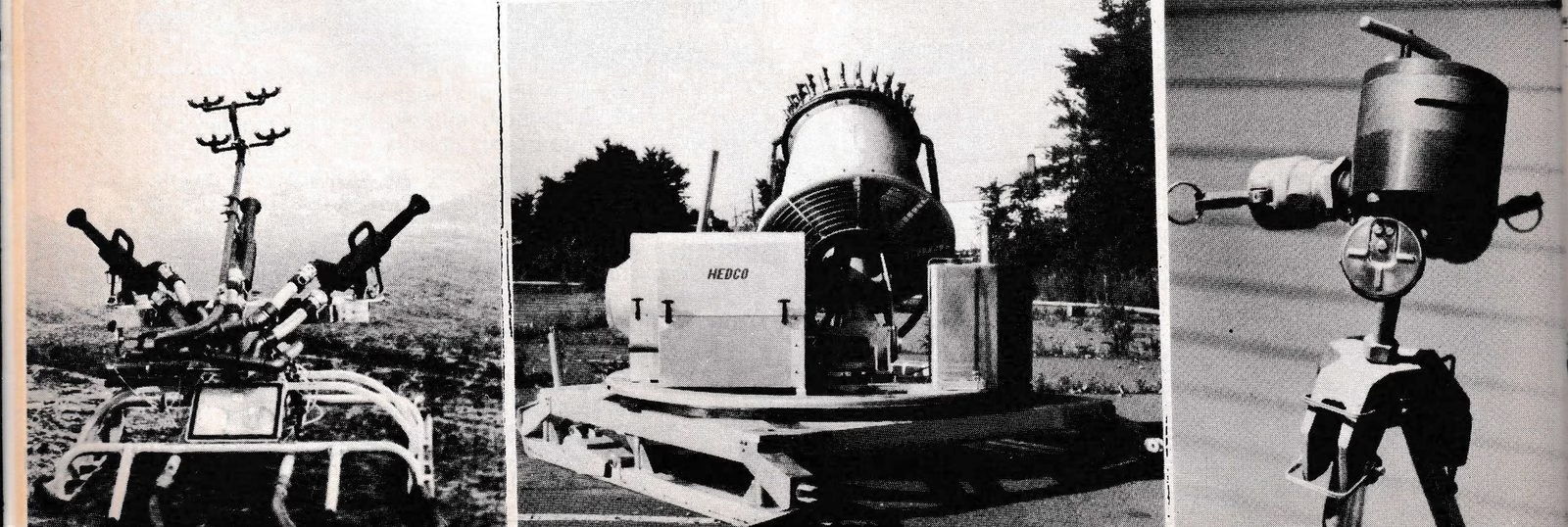
This excellent skiing occurred on machine-made snow at an area located only 35 miles northwest of Louisville, Ky., where temperatures are usually marginal and humidity is high. Graber said it requires 200 employees to run the area in the winter, and that they have round-theclock skiing Friday through Sunday—non-stop.
Two years ago, the first year of operation, the crews reported no problem with the new airless-type system. However, with last year’s marginal conditions, they found there was some benefit to a combined system and added five Omichron guns to the fleet of SMI’s and Boynes (60 cfm each).
The system, designed by Jim Dillworth, is essentially a combination of air/water and airless with the air/water portion of the system used mostly at higher temperatures. Cold water is supplied to the system via a cooling pond which recieves warmer water from a large creek near the area. The 40 degree creek water is sprayed into the air through aerating nozzles and then captured in the cooling pond at 35 degrees. During very cold weather the aerators are by-passed. Two 200 hp vertical turbine pumps draw from this pond and supply over 600 gpm each through the welded steel hill piping. The pipes are then looped back to the pump house where the overflow temperature is monitored and the flow controlled. A new style 1½” freeze-proof hydrant is used on the buried system and is rated at 600 psi.
Fourteen hundred cubic feet of air are supplied by a 300 hp rotary screw compressor through an air to water after-cooler. A small amount of anti freeze is added through an ethanol injector to the 50 degree discharge air. This prevents freezing problems with the nucleator in the 15 hp Boyne machines, which each consume about 60 cfm at 80 psi each (14 hp). Dillworth recommends that water pressures at the snow gun be monitored closely so manufacturer’s specs can be adhered to. The 1,000 pound Boyne Snow Maker works best at 200 psi and the 600 pound 20 hp SMI at 90 to 100. A higher pressure on the SMI tends to drive the water droplets through the rotating fan and thus not “impinge” on the blades, which would result in poor quality snow.
The nine trails and slopes, which are 1,500 feet to 3,300 feet in length, are easily handled by two four-man shifts of 12 hours each. Graber estimates the total investment in snowmaking to be about $400,000 which puts the cost per acre at somewhat under $15,000.
How does Paoli Peaks manage to generate such a reportedly high ROI? According to Graber, it’s in the numbers, (of people, that is), and because of snowmaking. By rough estimate, there are over one million people within a two hour drive of the area.
Stowe, Vermont (Mansfield/Spruce)
- **Designer/Supplier:** P.B. Alford, P.E.
- **Vertical:** 2150 ft. · **Acres:** 120
- **Water Gpm:** 2,100 Mansfield, 800 Spruce · **HP:** 2,050
- **CFM:** 10,400 Elec. 4,000 Diesel · **HP:** 3,500
- **No. Stations:** 200 + · **No. Guns:** 30 +
- **Type of Guns:** Larchmont, Omichron, Ratnik, Snow Storm
- **Aftercoolers:** Yes · **Auto Valves:** Yes
- **Crew Size:** 10 total · **Water Source:** 4 mg reservoir
This past summer was an extremely busy one for the Mt. Mansfield Company, at Stowe, Vermont. As part of a long range multi-million dollar expansion program for their two separate mountains (Mansfield and Spruce) the company hired Peter B. Alford and Associates to upgrade their snowmaking system on Spruce and design a totally new system for the main Mount Mansfield complex. The first of these phases was completed in time to provide over 1800 hours of use this season.
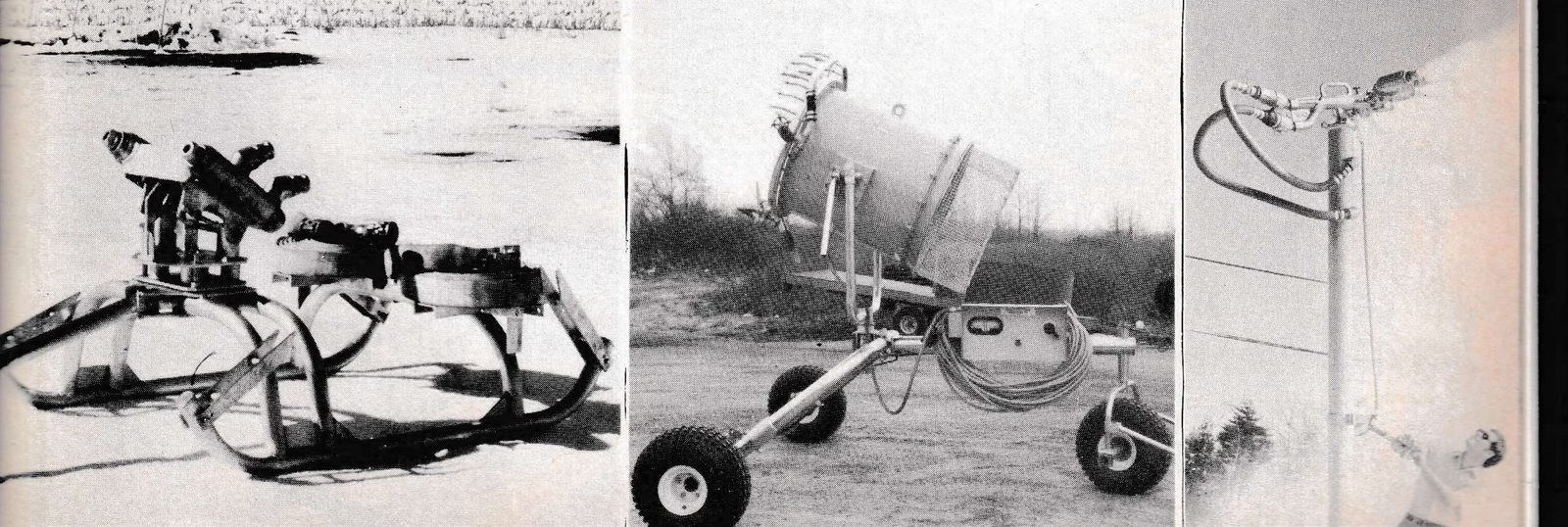
Perhaps the main ingredient in maintaining the very tight construction schedule (which is typical in our industry) was the letting of a contract for all pipe installation to Reed Engineering and Construction, Co., a pipeline contractor from Glenwood Springs, Colorado. Of the 96,000 lineal feet of pipe laid, over 8,000 feet of trench had to be dug through ledge to provide the frost-proof system that was specified by Alford. According to Larry Smith, snowmaking supervisor, who was a contractor himself for 12 years, “the pipe installation was obviously done by pros. They cold bent the welded steel pipe, using side booms on their pipe laying tractors, which saved considerable time and also yielded a very enviable record of quality control: no leaks.”
The compressor, pump, and control buildings were also contracted out to a local outfit. The advertised Phase I cost of over 2.7 million dollars for 110 acres of snowmaking yields a cost of nearly $25,000 per acre. This is high by most standards, but on the other hand much of the construction completed this year will apply towards future expansion, and will therefore ultimately reduce this ratio. In addition, the frost-proof installation obviously came at a premium due to the extensive amount of ledge excavation.
How does this whole system work? First of all, it is highly automated and has benefited from three years of extensive testing at Aspen by Alford, who believes that no “single gun suits all snowmaking conditions.” He, as do most of the other designers, believes that after-coolers for compressed air systems are mandatory. Also, he has designed a special control console in the main control building which enables one man to monitor and regulate the flow of both air and water through over 72,000 feet of pipe. It also supplies and records air, water and weather data. This is compared to the accumulated data gleaned from the Aspen testing and the system regulated accordingly for the optimum operating situation. The main control building also houses equipment that controls and monitors the booster station over 5,000 feet away. The electronically controlled, air-operated valves are designed to maintain a constant hill pressure under all conditions, in order to provide easy start-up and better quality control during operation.
How about the rumored break-downs and mal-functioning? “Like any sophisticated unit of this magnitude, it required a certain amount of time to weed out the problems,” said Henry Simoneau, operations manager for the Mt. Mansfield Co. “The greatest problem was related to pump failures and they were factory defects. When it’s time for expansion (in the gondola area), we’re going for the same system.”
Bristol Mountain, Canandaigua, N.Y.
- **Designer/Supplier:** Hedco, Inc.
- **Vertical:** 1100 ft. · **Acres:** 100 +/–
- **Gpm:** 3100 · **HP:** 1400
- **CFM:** 13,000 · **HP:** 3300
- **No. Stations:** · **No. Guns:** 6 Hedco
- **Type of Guns:** 3 Elec. 2 Gas, 1 Diesel plus A/W
- **Aftercoolers:** Yes · **Auto Valves:** No
- **Crew Size:** 3 per 12 hr. shift · **Water Source:**
Bristol Mountain in Western New York now has 6 Hedcos, some SMI’s, 13,000 feet of air and over 3,000 gpm of water available. Once billed as the largest underground snowmaking system (’63 – ’64), the steel pipe selected for that installation is epoxy coated on the inside and vinyl coated on the outside as are the airlines. Also, the entire original footage has cathodic protection to prevent electrolytic rusting, all of which has preserved the pipe in a like-new condition. At the same time, low-pressure, self-draining yard hydrants were installed using separate pressure regulators for each one. As extra protection against freezing, drainage culverts were slipped over the aboveground hydrant and then packed with a special heat generating material—horse manure. That medium was later replaced with sand.
The enlarged system is still totally frost-proof, using Ratnik hydrants with pipe burried 2 to 6 feet below ground. Water is supplied to the system through two stages of pumping. The first, located at the river intake and holding pond, consists of five 600 gallon per minute pumps, three horizontal centrifugals and two verticals, all at 200 horsepower each. Second stage pumping occurs at the midstation pumphouse where two more horizontal pumps totalling 275 horsepower push 900 gpm to the top of the eleven hundred foot vertical. Residual, or hydrant pressure must be maintained to at least 160 pounds per square inch as required by Hedco because lesser pressures will severely affect the quantity of snow produced. Compressed air, for the secondary air/water system, is furnished by eleven 300 horsepower rotary screw electric compressors and through appropriate aftercoolers. All system valving is manual because Area President Joe Kohler doesn’t like things that can’t be understood and also fixed on-the-spot.
Snowmaking philosophy at Bristol is simple; make as much as possible without moving the guns. Then use a diesel powered snow vehicle to relocate the snow, always downhill. Another vehicle is assigned for fueling the three non-electric machines (15 gph) and another for making relocations of all six machines when necessary.
Manager Art Kline assigns one man for two Hedco machines and does not mix his Hedco team with the airwater team of three men. Both teams are specialists in their own way and must be held accountable for their own operation. The snowmaking crew runs on 12 hour shifts, since this appears to be what the men prefer. Their biggest problem this season according to Kohler, was the effect on personnel and equipment from the high snowmaking temperatures. The frustration with marginal snowmaking created morale problems and loss of time from sickness that resulted from the men being wet all the time.
Manufacturers’ claims have been very realistic and perhaps understated, according to Kohler. He feels that Hedco may not make better snow, it does make it cheaper. To prove that costs count, all future expansion at Bristol will be airless. Bristol plans to keep on expanding their snowmaking system, and Hedco will be there. As Joe says, “Their service department is incredible: who else has a 24-hour answering service that is monitored by a design engineer, not an answering machine?”

Blue Mountain, Ontario
- **Designer/Supplier:** Delta Associates
- **Vertical:** 700 ft. · **Acres:** 180
- **Water Gpm.** 1300 · **HP:** 600
- **CFM:** 9600 · **HP:** 2,100
- **No. Stations:** 300 + · **No. Guns:** 35
- **Type of Guns:** Delta, Ratnik, SMI, Sno Systems
- **Aftercoolers:** Yes · **Auto Valves:** Yes
- **Crew Size:** 4 per 8 hr. shift · **Water Source:** 22mg reservoir
Blue Mountain Ski Area is located north of Toronto on the Niagara Escarpment and provides over two hundred and fifty acres of skiing on 27 trails serviced by 18 lifts. With the recent purchase of Georgian Peaks nearby, they have added 18 more trails and 7 more lifts with 84 additional acres of skiable terrain to their already large operation. With nearly 35 ski areas within the Toronto driving range, it is no wonder that the Blue Mountain management team felt the need to install snowmaking that would maximize their length of season and quality of skiing.
The first phase of a three-phase snowmaking project, provides 1350 gpm to the top of the mountain, utilizing 9600 cfm of air. This is a combination system using various air/water guns and some airless equipment.
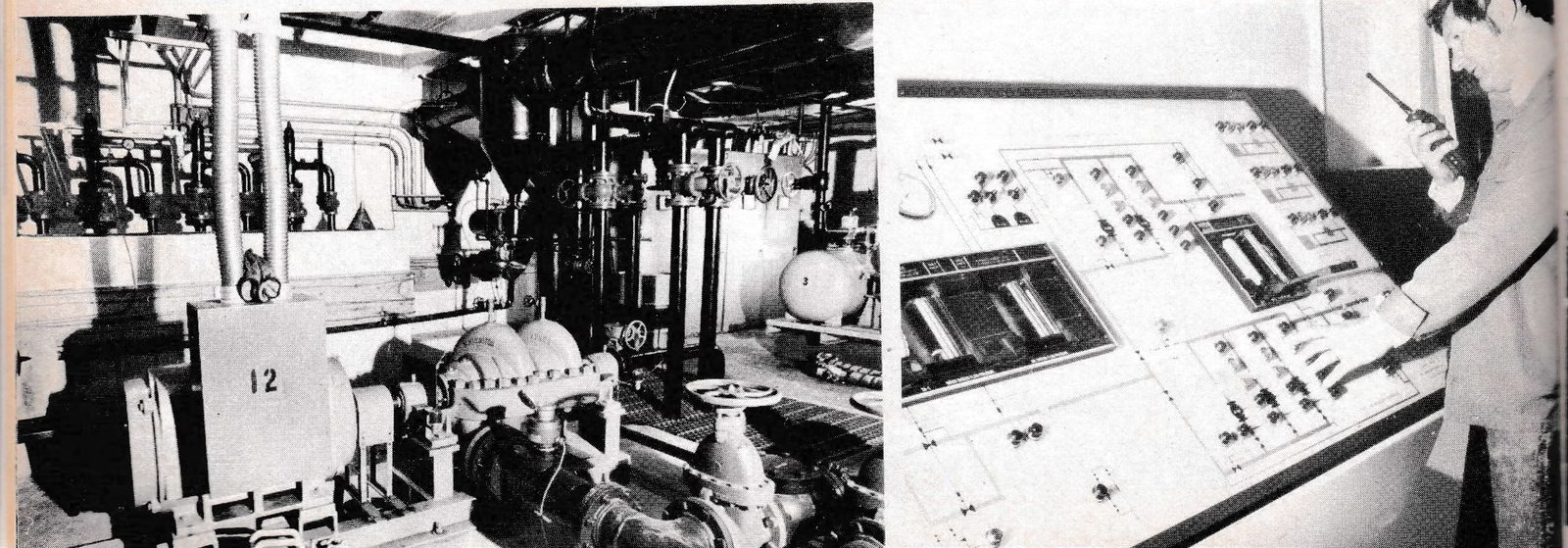
The uniqueness of this system lies in the computer control, as designed by Jeff White and his Delta Associates of Toronto.
Providing enough water and air to cover 180 acres of trails and slopes, yielded substantial residual heat that had to be transfered out of the system. It was accomplished through the use of another innovation—stripping towers, or what many of us, having read about Three Mile Island, know as cooling towers. They are of the 3-stage variety, and are totally controllable throughout each stage.
The computer controlled performance system is expandable into a total control package. Computer is not just a “buzzword” in this situation. Programs have been written and input data is provided on a continuous basis to yield operational output information that assists or directs the supervisor in maintaining the most efficient balance between air and water for any given weather situation. Input consists of meteorological equipment plus electrical, flow and temperature data. The output continuously corrects the air/water ratios against an established base by changing pressure and flow rates located at the base station.
Future expansion will allow telemetering for up to three additional locations. Then, basically, all the operator has to do is input the control console with the type of snow quality desired; dry, wet or normal. Yes, as might be guessed, there were some problems with this advanced type system, but not enough to discourage the people at Blue Mountain who intend to expand into Phase II next season. That expansion will include refinements and addition of another 35 acres of machine-made snow coverage, using a total of 16,000 feet of air and 2000gpm of water. Phase III will extend the system even further.
Because of the high profile that computerization has in many people’s minds these days, Blue Mountain has found its sophisticated snowmaking system, is a good marketing tool, not only with skiers but also ski magazines. Although they have tried two different computers this year to fit the system, they are not discouraged and intend to stick with the basic concept as is.
Sugarbush North, Warren, Vermont
- **Designer/Supplier:** Ratnik Industries
- **Vertical:** 2530 ft. · **Acres:** 40 (new)
- **Water Gpm:** 1000 · **HP:** 900
- **CFM:** 4350 Elec. · **HP:** 1050
- **No. Stations:** 114 · **No. Guns:** 19
- **Type of Guns:** Ratnik Sno Giants
- **Aftercoolers:** Yes · **Auto Valves:** Yes
- **Crew Size:** · **Water Source:** stream to holding pond
When Roy Cohen purchased the well known Sugarbush Ski Resort in northern Vermont, and later, the neighboring Glen Ellen (re-named Sugarbush North), he openly expressed his intentions to make the ski complex a major one in North America. The 40 new acres of snowmaking on Sugarbush North propelled that area into an instant winner in this past season’s snow drought.
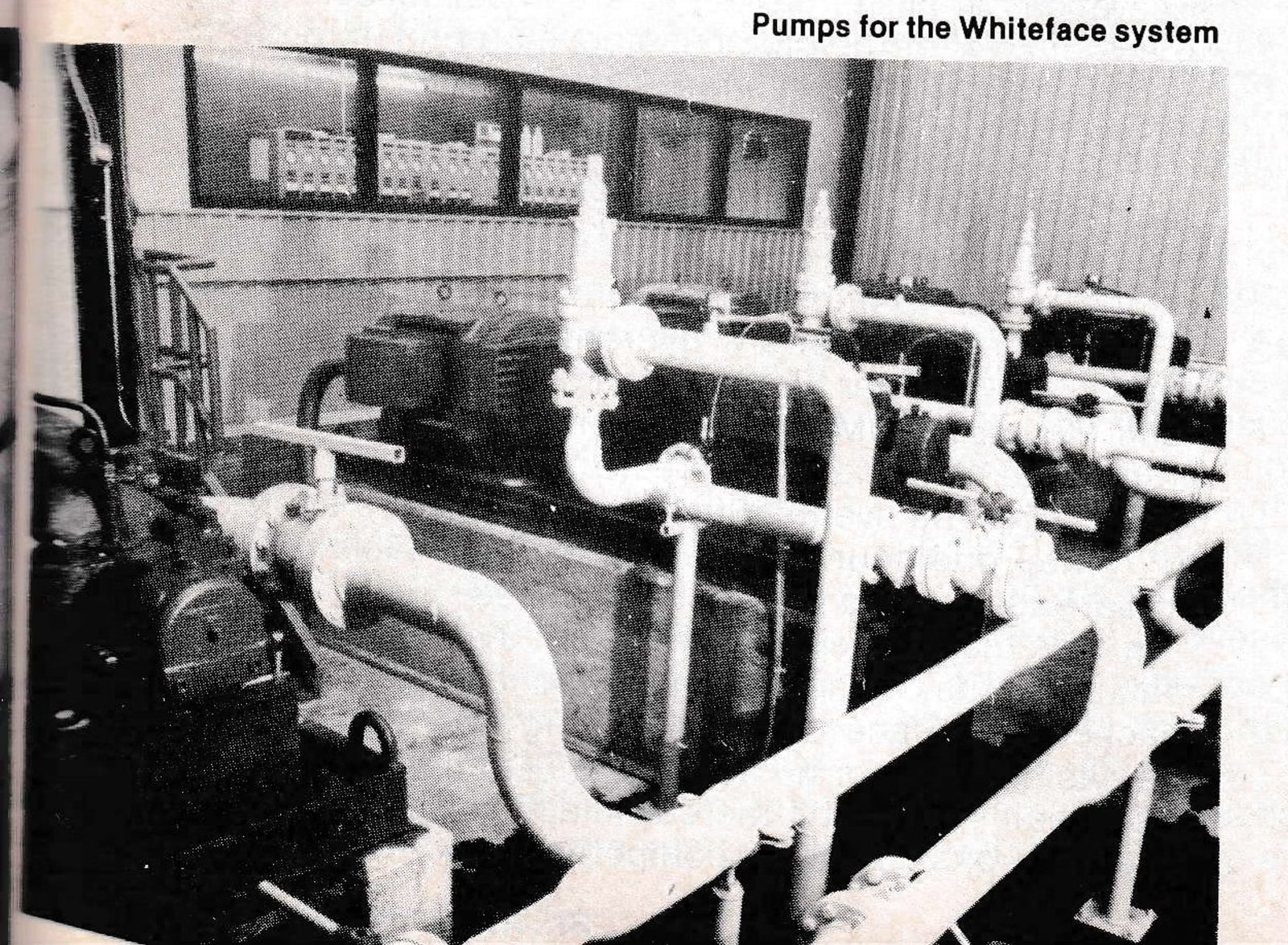
Perhaps the most distinguishing feature of this Ratnik automatic system, is the utilization of variable speed pressure pumps with variable volume. Each one—one at the base area and one at mid-station—is a 250 hp vertical turbine type pump. The control system provides continuous recording of water and air volume, temperature, and pressure, and utilizes the variable speed pumps to maintain a constant hill pressure. Thus, when the system (which is frost-proof and left fully charged all the time) is started up, the variable speed pump is the first one on line. When it has reached full capacity, a constant-volume, constantspeed pump “cuts in” and the variable speed pump returns to ‘O’ and starts over until the system is balanced. Then, as snow guns are added or removed, the variable speed pump maintains the system pressure at a constant value, and varies the volume. Over 4,000 cubic feet of air are installed at the booster station half way up the slope. Thus air can flow in both directions as needed, and is also modulated by demand. Since the sysytem design is balanced at 22 degrees F., at any temperature less than that the air volume may be reduced and the water volume held constant.
Sugarbush which provided its own construction for the Ratnik engineering, is pleased with its system. Dick Hoisington of Sugarbush says he feels that even though all but one mile of their trench was in ledge, the buried system will save money over the long run. Roger Newell, snowmaking supervisor of the North complex likes the variable speed pumps and automated controls. “The constant pressure system saves manpower, water and energy,” he says.
Is expansion in the future plans of Sugarbush? Judging from the extra space in the pump houses and the philosophy at Sugarbush to date, it’s a fair guess this may be only the beginning for snowmaking in Sugarbush Valley.
Stratton Mountain, Stratton, Vermont
- **Designer/Supplier:** Larchmont Engineering & Irrigation
- **Vertical:** 1900 ft. · **Acres:** 70
- **Water Gpm:** 1600 · **HP:** 1100
- **CFM:** 4800 Elec.-4800 Diesel · **HP:** 1200 E, 1500 D
- **No. Stations:** 200 + · **No. Guns:** 40 +
- **Type of Guns:** Larchmont Twins
- **Aftercoolers:** Yes · **Auto Valves:** Some
- **Crew Size:** 24 Men @12 Hrs. · **Water Source:** Two holding ponds
Snowmaking at Stratton is not a new experience. Their original system, designed many years ago by John Mathewson for Larchmont, covered many of the lower slopes and boasted all above-ground piping. Their current 70 acres of coverage, which extends 1900 vertical feet to the top of the mountain, still utilizes the basic concept that aboveground piping is less expensive to install and easier to maintain.
Hill pressure is maintained constant by an automatic, air-operated by-pass valve, and all 9600 feet of compressed air is run through an air-water after-cooler in the main pump house under the base lodge. According to Pat Williams, the man in charge of Stratton’s snowmaking for many years, he not only likes the above-ground piping, but also the complete monitoring panel located in a soundproof room in their main pump house. It actually ends up being a good management tool in that the operator in charge can continually monitor what activity is taking place out on the slopes.
On the subject of piping, Williams prefers steel over aluminum only in that the valve connections on the aluminum pipe are not as durable as those on the steel.
Insufficient water supply, which plagues many snowmaking systems, is not a problem at Stratton Mountain. Next to the base lodge and main pumping station is a one million gallon holding pond served by a reliable mountain stream. Nearby, but fed from another water source is a 1.5 million gallon holding pond. Just in case these supplies prove inadequate there is an additional 20 million gallon lake at the 2500 foot elevation which is served by an entirely different watershed. From there, water is pumped by a large diesel transfer pump into the main system.
Since Stratton has the majority of their piping above ground, it is imperative that the return water temperature of the loop system be constantly monitored. This is another function of their main control consol. Thus, when the return water temperature becomes critical, immediate corrective action can be taken before serious problems arise. The mid-station booster pump and piping system works in much the same manner, with a return loop emptying back into the sump and from there into the supply stream for the lake. Accoding to Williams, the system is balanced at about 15 degrees. This includes the use of two Hedco diesels also. Relative to the airless snowmaking, Pat would like to see more reliability and ease of maintenance built into what he feels otherwise is an excellent product.
Is snowmaking expansion in the future plans for Stratton? Perhaps some insight can be gained from what was contained on a sign fastened to the office door of Don Tarinelli, general manager of Stratton. Referring to the snow drought over the Christmas holidays, Don had written in big letters, “It’s not my fault!”. Shortly thereafter, there was an additional notation by the board of directors saying, “It may not be your fault, but it certainly is your problem.” More snowmaking?
Whiteface Mountain, Wilmington, N.Y.
- **Designer:** John T. Mathewson—original 1975 design
- **Vertical:** 3210 ft. · **Acres:** 103
- **Water Gpm:** 3600 · **HP:** 2950
- **CFM:** 12,000 Elec-3,200 Diesel · **HP:** 2800
- **No. Stations:** 375 · **No. Guns:** 40
- **Type of Guns:** Ratnik
- **Aftercoolers:** Yes · **Auto Valves:** Yes
- **Crew Size:** 15 total · **Water Source:** Ausable River
The Lake Placid Olympics became the snowmaking showcase of the world this past winter. What, then, of the system that produced it? We cover here just the Whiteface installation for the Alpine events, and not the separate installations for Nordic events.
Up to 15 feet of snow were manufactured on some trails, especially in the area known as the “Snowfields.” The snow called for had to have a high moisture content to provide a consistent skiing surface for all entrants. In addition to a well-maintained running surface, a side benefit of the machine-made snow was the total lack of reliance on the usual stablizing chemicals. Not only was course work minimized during the races, but also between events there was no need to regrade or make additional snow.
The system benefits from the inexhaustable water of the Ausable River at a base elevation of 1,198 feet. 3,600 gallons per minute (5mg/day) is pumped 100 feet up from the river station to the main compressor/pumphouse No. 2. From there the same quantity of water is boosted to Pumphouse No. 3 at elevation 2,079, which is located slightly below the finish line for the slalom race courses. This station also provided adequate coverage for the GS and Downhill racing which terminated at elevation 1,578.
Combined electric and diesel compressors produce 15,200 cfm of air at 100 pounds pressure, through after-coolers and onto the slope via parallel steel piping. The rotary screw electrics provide 4.4 cfm per horsepower. A control console located in Pumphouse No. 2, provides direct reading instrumentation for all pumps and compressors in this building. A similar panel is installed in pumphouse No. 3 for the pumps at that location. Although the valving at the river station is manually controlled, with pump protection provided by pressure relief valves, the remaining pumps have air-operated control valves used to yield a constant hill pressure. From Pumphouse No. 3, 1,800 gpm are supplied to Pumphouse No. 4 at elevation 3,200. This is still 1,200 vertical feet below the top of the system and 1,100 feet lower than the starting gate for the downhill and giant slalom courses.
All of the new pumps above the river station have the same characteristics in that they are all 600 gpm, horizontal centrifugal, split-case, pumps powered by 250 hp motors.
Air and water are transmitted through victaulic coupled steel pipes covering over 100 acres of skiing out of a total of 142. Also, Whiteface is a typical mountain in that most excavations at higher elevations are in solid ledge. Therefore over 80% of the piping is above ground. In order to insure a freeze-proof system, all non-buried pipes were covered with a heavy layer of sprayed-in-place foam insulation. Although the continuous layer of foam does make detection of leaks difficult, it certainly did provide the freeze protection desired.
Flow to the 40 guns was controlled through 375 sets of Ratnik freeze-proof a/w hydrants. The 15-man snowmaking crew, under the direction of Associate manager John Plausteiner, (Mount Snow fame) operated 211 ninehour shifts to produce the tremendous amount of snow required for the events. Since the shifts were designed to overlap one hour each, approximately 1700 hours of actual snowmaking were accomplished.
In case there is any question about the impact of snowmaking on the Olympics, only 17 inches of natural snow reached Whiteface up to and during the Olympics, and that yielded little or no useable accumulation. Or, more specifically, without it there would have been no Alpine, X-country, or ski jumping competition.
Whose system?
Whose system was it at Whiteface? Certainly there was plenty of glory to be generously shared by a lot of people. First off, there is John Mathewson, who designed the original system back in 1975. Although there obviously were many modifications made in the ensuing five years—courses were changed, power company requirements dictated others—the system remained conceptually very much as designed by Mathewson. As one objective observer put it, “There are thumb-prints among snowmaking system designers—individual characteristics in handling pumping and distribution problems that are like signatures. And this system remained clearly a Mathewson job.”
About the hardware there is no doubt: they were Ratnik guns and Ratnik hydrants that churned out 17,740,800 cubic feet of snow without a hitch. And it was John Plausteiner and his 15-man crew who ran the equipment. Last, but most certainly not least, it was Bill Righter and his associates at the N.Y. Department of Energy Conservation who made the snowmaking engineering decisions and bore the ultimate engineering responsibility to make it all work. They would have borne the blame if it hadn’t worked; they surely deserve the credit that crowned this snowmaking triumph.
Informing the Skier
Explaining snowmaking to the public is as much an art as snowmaking itself. However, there are certain measurements that are standard in the industry aimed to assist in comprehending the scope of creating snow for skiing.
**Snow density**—Natural snow averages about 4 to 6 pounds per cubic foot (1 foot by 1 foot by 1 foot) while machine-made snow ranges from 25 to 30 and pure water 62.4 pounds per cubic foot.
**Water**—One gallon of water weighs 8.33 pounds and there are 7½ gallons per cubic foot of space. At a “flow rate” of 200 gpm (gallons per minute) one acre-inch of snow at 27.5 pounds per cubic foot can be manufactured every hour, and one acre-inch of snow is roughly equivalent to 12,000 gallons of water. If water is stored in a lake or pond, then allow for 326,000 gallons per acre-foot of water stored. Pumping 700 gpm is equal to one million gallons per day.
**Air**—Always expressed in CFM or SCFM (standard cubic feet per minute) usually at a pressure of 100 pounds per square inch at the compressor. Air that is compressed from atmospheric pressure to 100 psi becomes very hot, sometimes exceeding 350 F, and should be cooled by running it through an “after cooler” which is like a car radiator in reverse.