


Ropeway engineers can find themselves these days in amazing situations. Accustomed as they may be to the hazards and discomforts of snow and ice for ski lifts, nothing quite prepares them for an encounter with an angry cassowary on a trail in the Northern Australian rain forest. So it was for three Poma of America (POA) engineers—Project Manager Tim Gould, J. F. Mugnier and the author—as they scrambled away from the bird into the thorns and vines, choosing a possible encounter with poisonous snakes to the wrath of the four-foot-high emu look-alike menacingly protecting its young.
This tropical project finds its way into the pages of SAM because the technological problems and their solutions are relevant as are the marketing concepts, to say nothing of some intriguing environmental challenges. —The Editors
Skyrail, a nearly five-mile-long gondola ride, is located near Cairns, in northeastern Australia, where two attractions, both designated as World Heritage Landmarks, meet: the Great Barrier Reef and the Australian Tropical Rain Forest.
Conceived by George and Dr. Ken Chapman, father-son members of a fifth generation family in the area, the project was designed to give an enhanced rain forest experience to world tourists who have long flocked to the region.
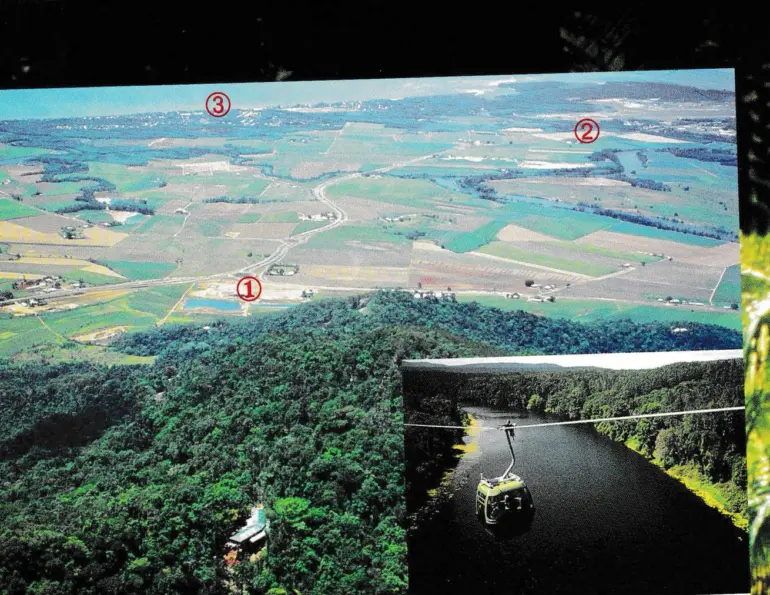
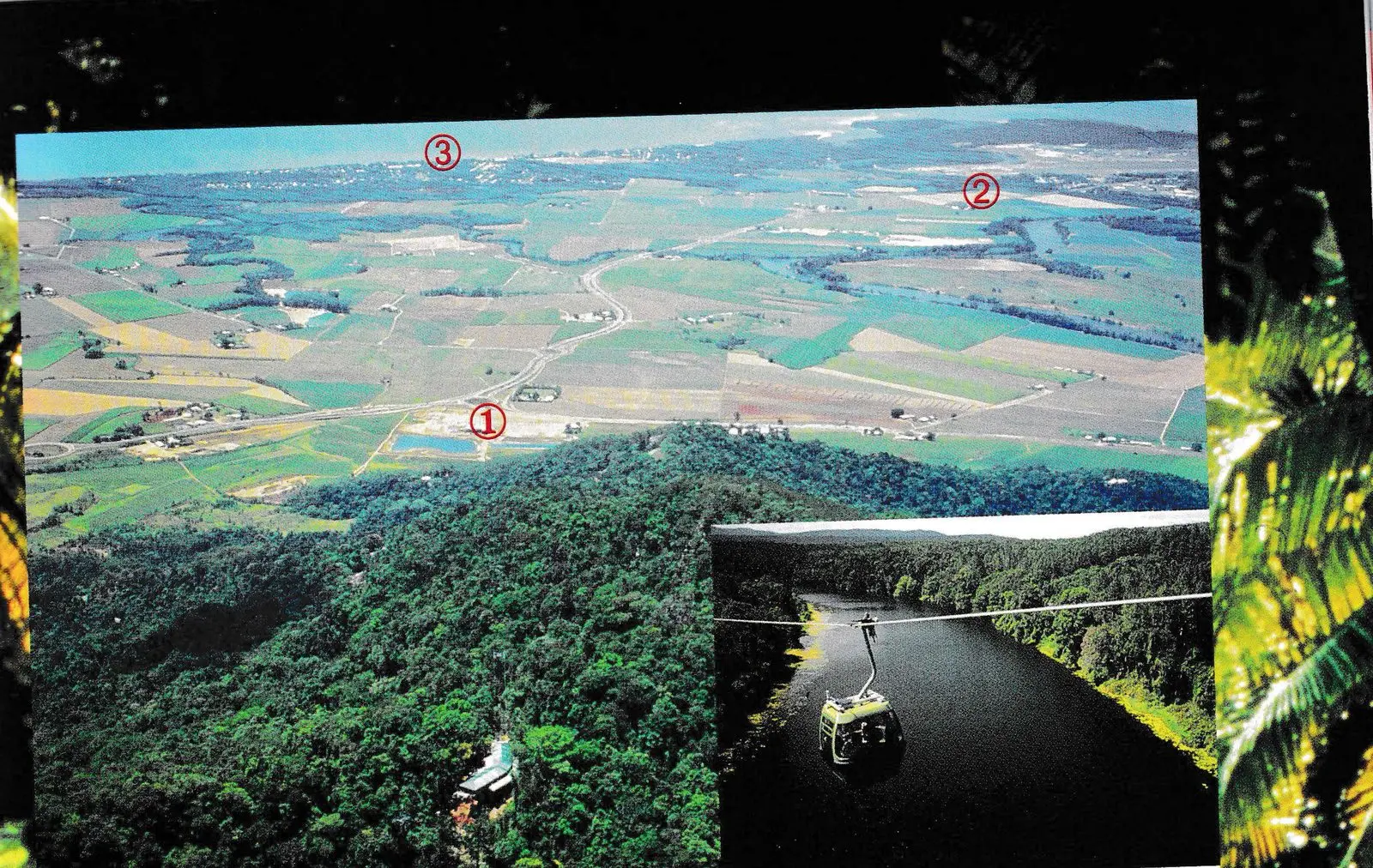
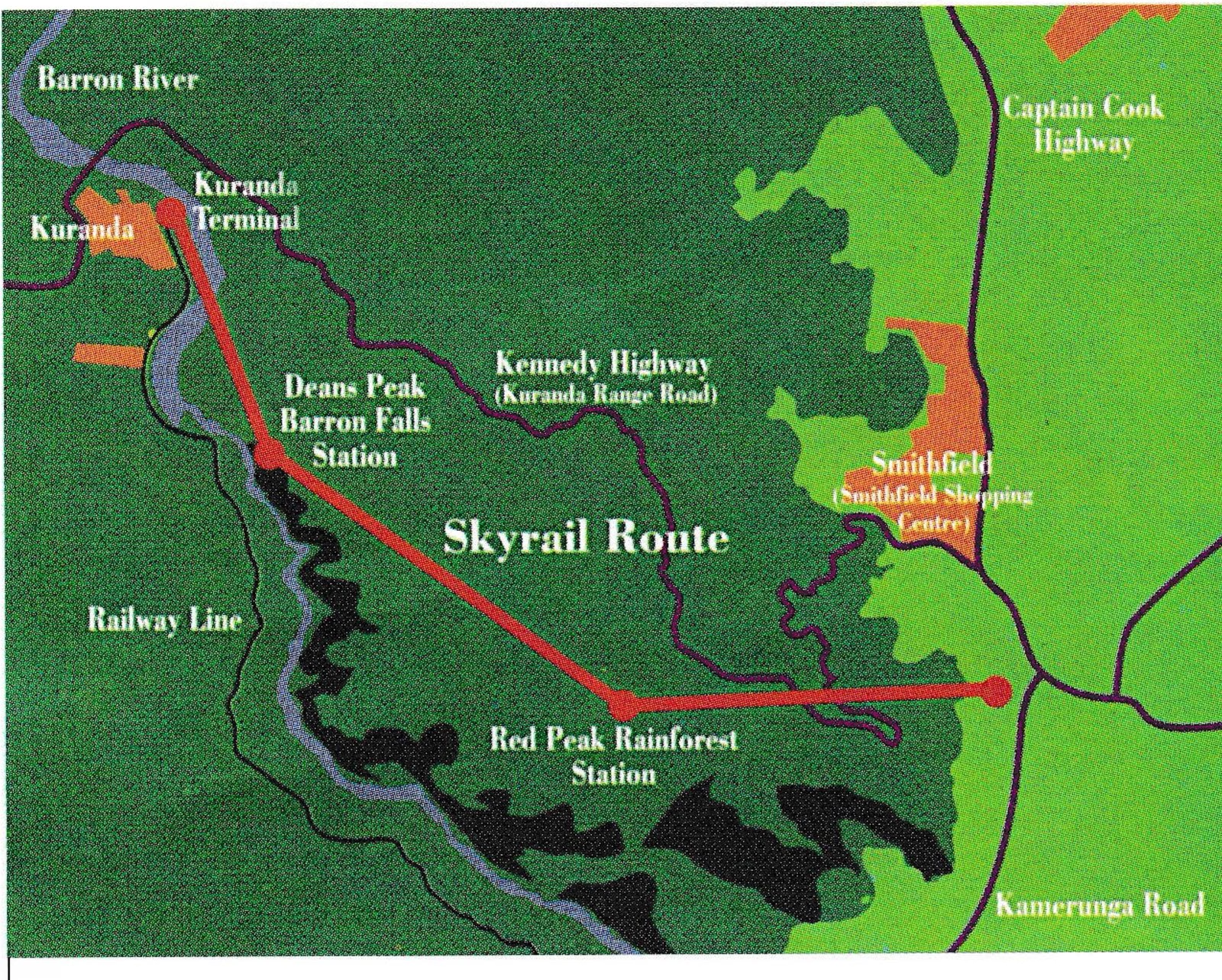
The resulting Skyrail gondola, with six sets of mechanisms, two drives, two returns, one complete angle station and 80 sets of sheave trains, has its base station at Caravonica Lakes, near the ocean and just five miles from the Cairns International Airport. It climbs 1,780 vertical feet over 8,962 slope feet to the Red Peak station, where riders disembark for a walk through the forest.
From here, the gondola climbs back over the canopy and travels over 10,100 feet to the Barron Falls angle station, where the 33-degree angle is made with horizontal 18-inch diameter sheaves. Riders may disembark here, also.
The gondola then travels 5,650 slope feet (including crossing the Barron river) to the Kuranda drive station. The single haul rope loop from Red Peak to Kuranda is 31,600 feet long, requiring two spools.
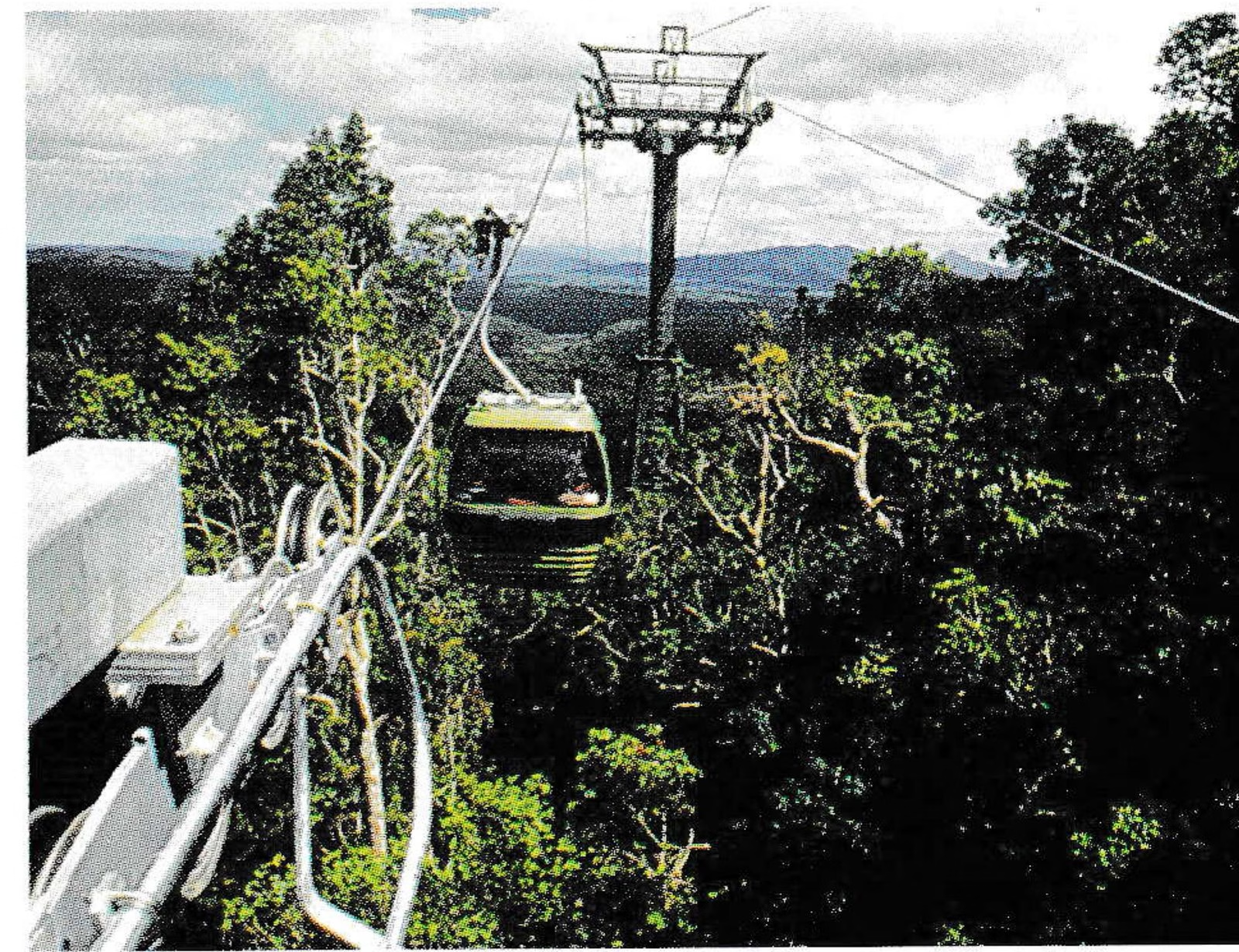
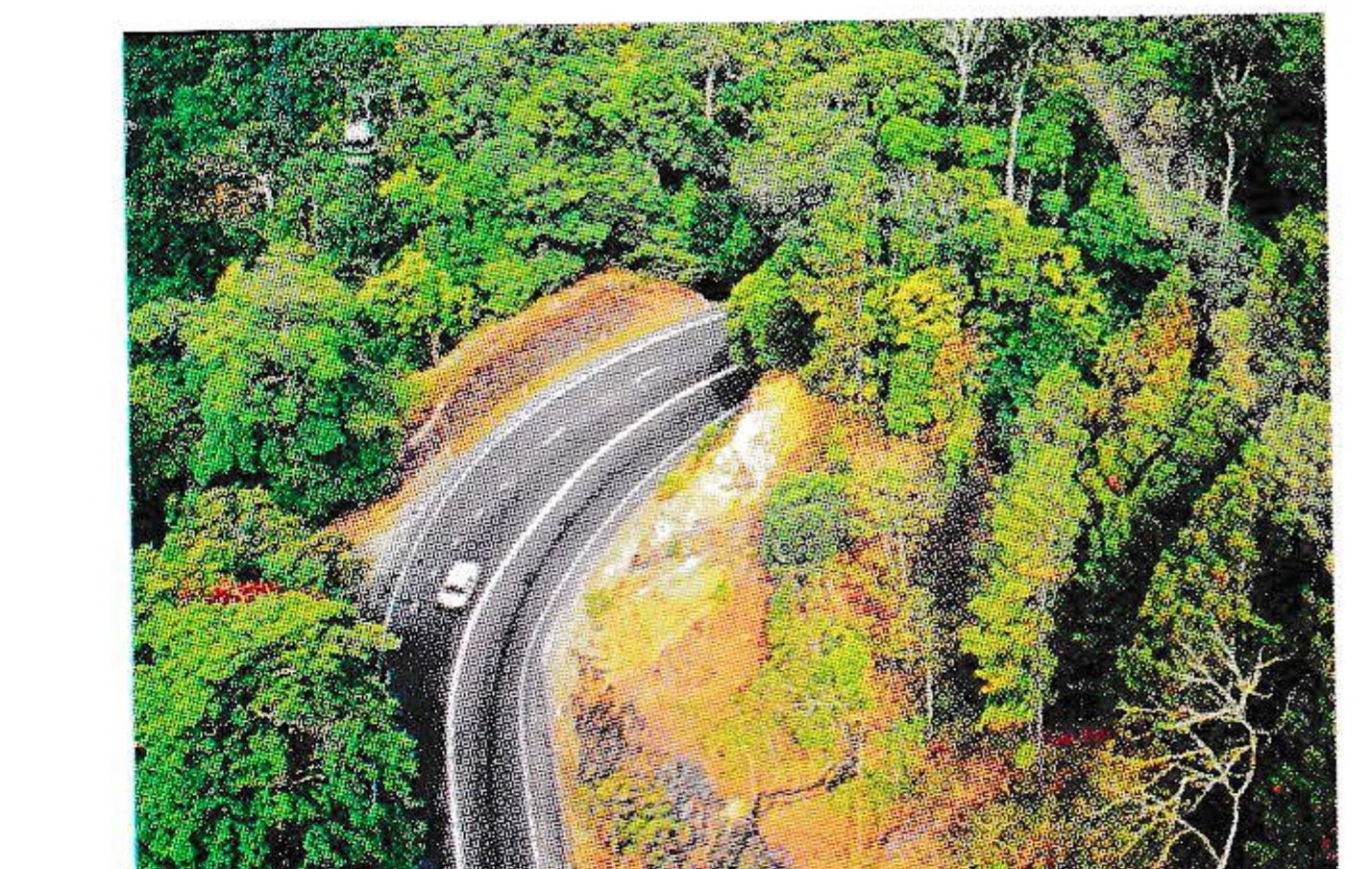
One of the biggest challenges POA faced was that no lift line could be cut and each tower was restricted to a 30-foot square opening in the rain forest. The Red Peak station was accessible by foot only, as no wheeled vehicles are allowed in the forest. Conditions varied from very nice to very wet to very hot—to just plain steamy.
The station pieces (mechanisms, carriages, frames, etc.) had been specially designed to be flown and set by helicopter—in this case a Russian Kamov with a five-ton lifting capacity. It arrived from Vladivostok, but the Russian pilots failed to show up for work for a few days and when they did, were not in the best of shape. It turned out that two of the 55-gallon fuel drums on board were full of vodka. Australian and New Zealand pilots did most of the construction flying.
POA also manufactured a special winch in order to pull the lead and haul ropes under tension so that nothing would get caught up in the rain forest below. First, the Kamov flew a 3/8-inch pilot line that was spliced into a 3/4-inch pulling line, which in turn was spliced into the main haul rope. R. J. Knight, of the Missouri-based Knight Equipment Company, handled the splicing chores.
The haul rope demanded special considerations. First, it had to be galvanized, as cable lube could not be spread over the rain forest. (For the same reason, all sheave trains are completely rubber-bushed and the sheave bearings sealed; not one grease fitting over the rain forest!)
Next, since one length of rope is over 30,000 feet long, rope stretch had to be minimized. The answer for this was a solid plastic core. TrefilArbed was selected for a total order of 51,000 feet of 1-5/8-inch rope, delivered on three separate spools. Even with these specifications, the normal rope stretch for the long section used up the 26 feet of travel after about two months, necessitating a return trip by R.J. Knight to Australia. With assistance from POA and Skyrail, he rigged, spliced and de-rigged the lift at night, thus avoiding a single minute of down time for the public operation.
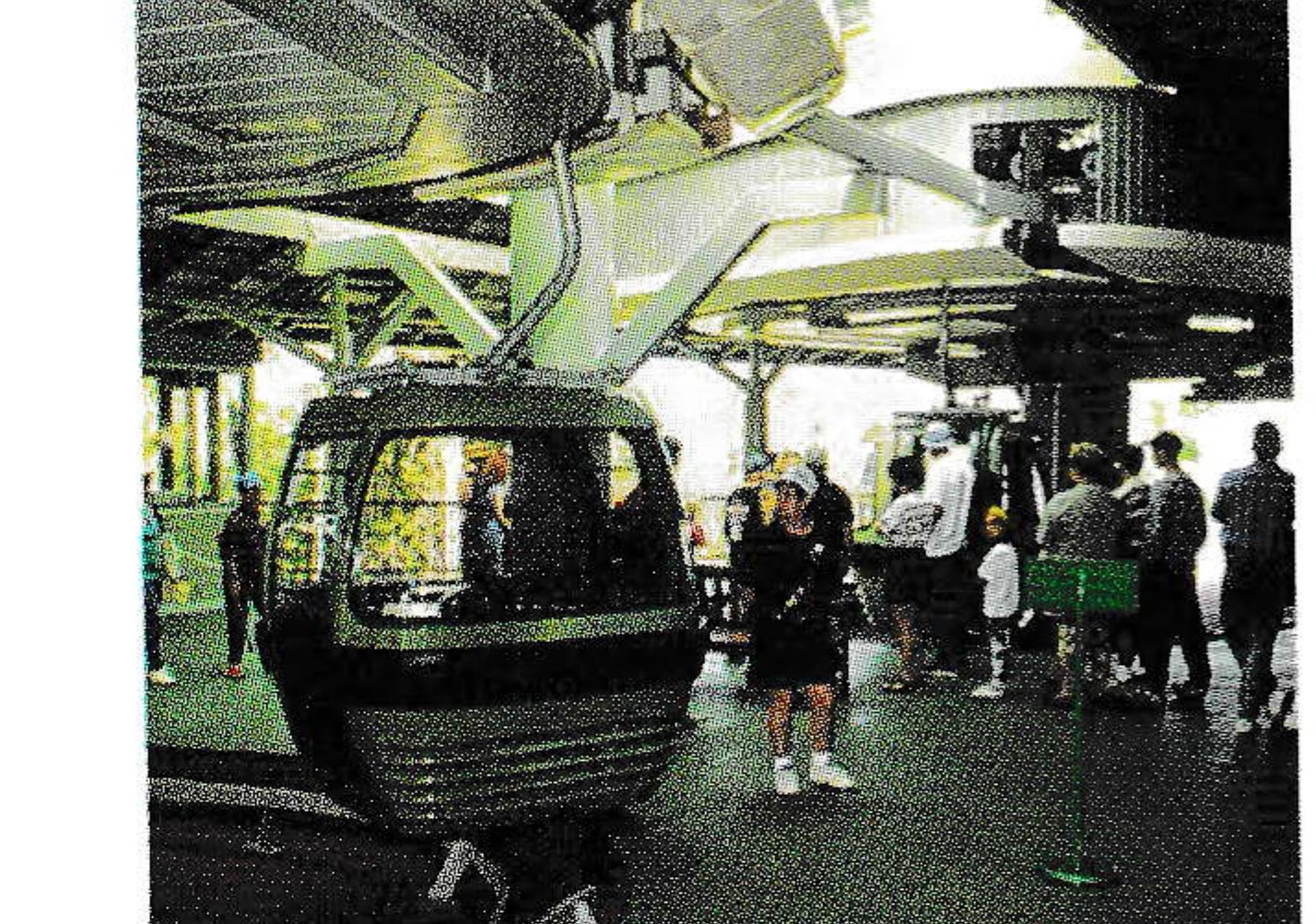
The Sigma Plastique (Poma) cabins are made of fiberglass and have ventilating louvers under the seats. A double roof keeps the passengers in the shade and protected from the heat at all times, and special vents allow fresh air to pass through this double roof. The average annual rainfall in the Cairns area is seven feet, so all louvers and ventilation must allow maximum air flow with no rainwater. During the summer months of December through February, it is not unusual for temperatures to reach 95 degrees F, with humidity frequently at 100 percent.
Given the prevalence of poisonous snakes, spiders and the like, evacuation into the rain forest was seen as a scary proposition, so redundancy was deemed very important. Each of the return bullwheels is equipped with an extra set of bearings in the hub so the bullwheel shaft can spin in the head should the normal bearings fail.
For emergency operation, each bullwheel is disengageable from the primary Poma/Kissling gearboxes. Auxiliary power can then be applied to a ring gear attached to each bullwheel.

Two Poma “buses” are available in case all else fails. These diesel/hydraulic self-powered vehicles travel on the cable by means of a plastic caterpillar-type track. The bus envelopes the cabin, allowing passengers to move from the cabin to the bus and be transported back to a safe area.
Like most other elements, the Poma buses were designed and manufactured by POA in the U.S. Only the cabins and their “T” grips, the cable and the gearboxes were imported from France.
The purchase contract between Skyrail and POA was signed on June 30, 1995. On August 31, after load testing with 40 cases of good Australian beer per cabin, the Skyrail ropeway opened to the public, and during the first 30 days of operation, over 44,800 people had paid for a one-way gondola ride.
You could say that’s bonza, mate!
What the Visitor Finds
As a tourist attraction, the rain forest had long been served by a narrow-gauge railroad going from Cairns, through the Barron Gorge, to Kuranda. It enjoyed an average 400,000 riders per year. Whereas tourists typically would ride the train for 1-1/2 hours in one direction and return by tour bus. Now, with the Skyrail gondola ride as an option, (30 minutes each direction without forest walks and other stopovers), tourists are taking the gondola in one direction and the train in the other. The price (converted to U.S. dollars) for a one-way trip on the gondola is $17.25, with round trip for $27. A round trip using Skyrail one way and the railroad for the other is $42.
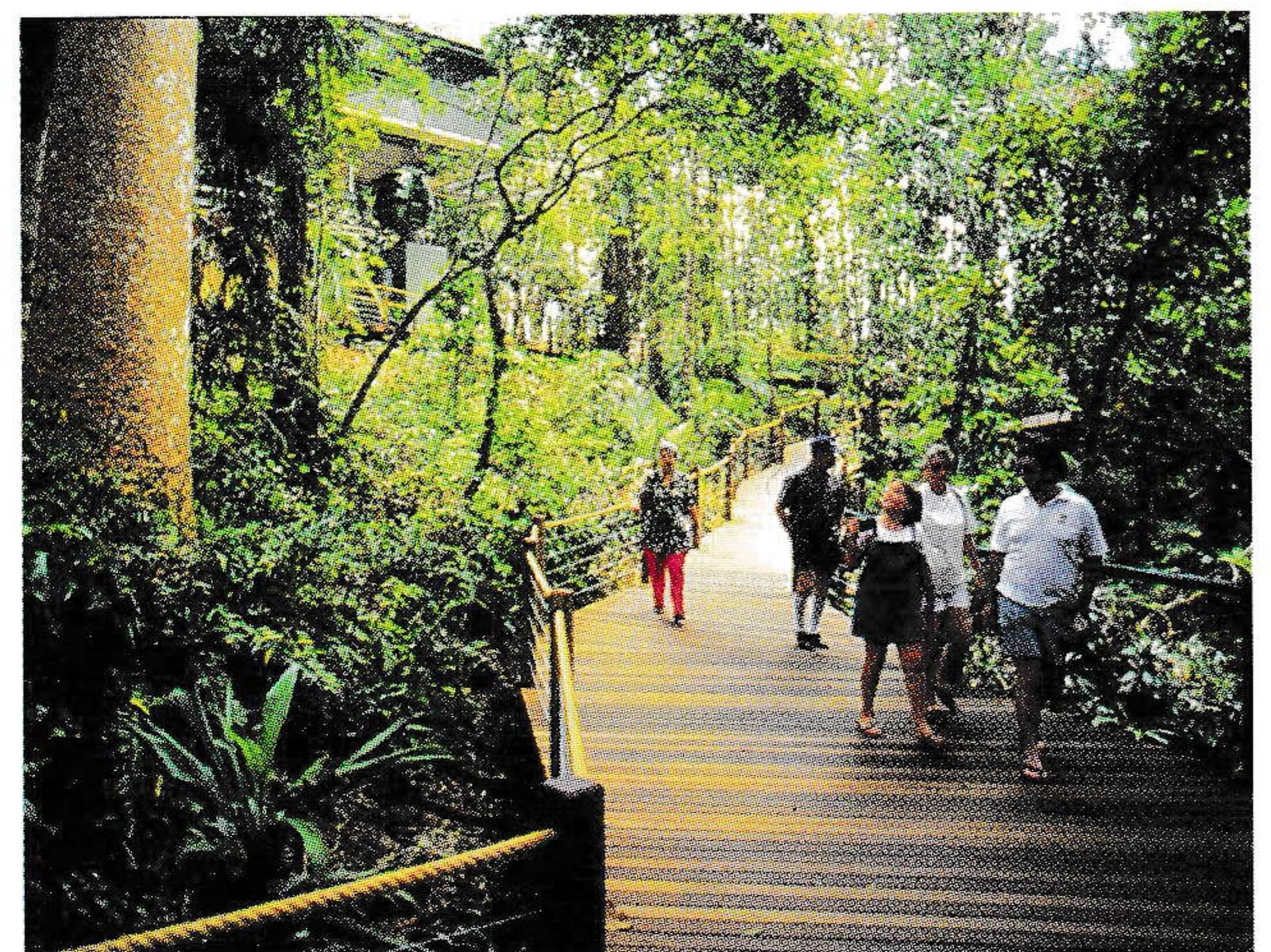
The gondola trip affords spectacular views from Read Peak Station of the Coral Sea and Green Island on the Great Barrier Reef. Riders can enjoy a walk through the forest on boardwalks, surrounded by trees, lush palms, ferns, epiphytes and a diversity of animal life that includes several flocks of white cockatoos.
At Barron Falls station riders may disembark to another boardwalk featuring a spectacular overlook of the 700-foot-deep Barron Falls gorge and waterfall. There is also a rain forest interpretive center, complete with touch screen displays and actual bird and animal sounds.
The rain forest village of Kuranda offers a variety of shops and restaurants, together with a Tjapukai Aboriginal dance theater, a butterfly sanctuary and a huge flock of fruit bats hanging in the trees.
Environmental Opposition
As in virtually every other place in the world, there was some opposition to the rain forest project, and after eight years of permitting, a small group of very vocal opponents frequented the site, typically taunting workers and filling in foundation holes at night. The police had to be called several times, but this was mostly early in the project.
One protester managed to make the front page of the newspapers by her miscalculation. Giving new meaning to the term tree-hugger, she glued her hands together after wrapping her arms around a tree. The only trouble was, the tree she hugged was outside the 30-foot area, so the crew cut their trees, packed up and left her there.
Then there was Manfred, a wiry Charles Manson look-alike, who lived in one of the tower site trees for 208 days, supplied with food and water by friends, with whom he was in contact by radio and telephone. When police approached, he would skitter out onto a small limb that would support only his own weight. Eventually, posing as television reporters, two special police officers arranged for an “in-tree” interview with the now-famous Manfred. After cuffing him they found another source of his life-support system: a generous supply of Cannabis.
| Section I (Caravonica–Red Peak) | Section II (Red Peak–Kuranda) | |
|---|---|---|
| Slope distance | 8,962ft | 15,750ft |
| Vertical rise | 1,780ft | 690ft |
| Rope speed | 1000fpm | 1000fpm |
| Design capacity | 700pph | 700pph |
| Initial capacity | 300pph | 300pph |
| Number of towers | 13 | 23 |
| Number of cabins (Initial) | 17 | 30 |
| Electric horsepower | 500 ABB | 500 ABB |
| Auxiliary horsepower | 335 C | 335 C |
| Evacuation horsepower | 157 C | 157 C |
| Auxiliary rope speed | 700fpm | 700fpm |
| Haul rope | 1 5/8″ Solid-Core Galvinized Trefil Arbed | Same |
| Tension (active) | Top–hydraulic | Top–hydraulic |
| Tension (passive) | Bottom–hydraulic | Bottom–hydraulic |
| Total carriage travel | 26ft | 26ft |
| Parking | 100% Semi-Automatic | 100% Semi-Automatic |
| Line gauge | 15ft | 15ft |
| Grips | Poma TB41 Single | Poma TB41 Single |
| Gearbox | Poma/Kissling 210 | Poma/Kissling 210 |
| Loading conditions | 100% up–100% Down | 100% up–100% Down |
| Tallest tower | 134ft | 131ft |
| Longest tower-span | 1,379ft | 1,292ft |

