


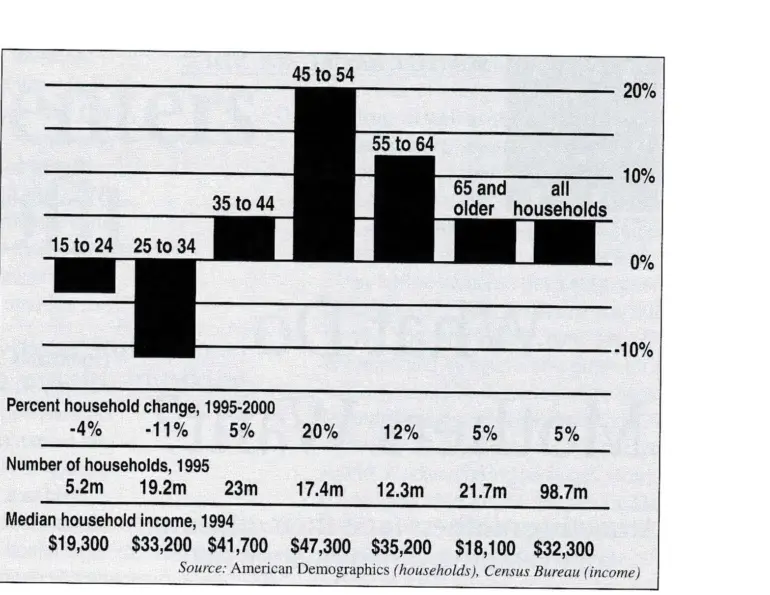
Baby boomers are the 800-pound gorillas of consumer buying. They are still the biggest market for ski areas by far and the biggest market for most other products and services as well. That’s because people aged 35 to 54 head roughly 40 percent of America’s households. This massive group will dominate population growth in the twenty-first century, especially among the most affluent segments. So if you’re marketing only to young adults, you’re missing the biggest opportunities for growth.
The future of skiing depends on keeping baby boomers on the slopes while introducing their children to the sport. Middle-aged boomer households are dominated by married couples with children, and the affluent middle-aged families that can afford to ski are likely to have two earners with demanding jobs. Ski areas will attract this crowd by marketing to working mothers, because working mothers usually have veto power over the family’s vacation choices. Young singles and men may be the industry’s best customers, but they are not the key to its future success.
Skiing to 2010
The last six years have not been particularly good for alpine skiing. Both the number of alpine skiers and the percent of Americans who ski at least once a year declined between 1988 and 1994, according to the National Sporting Goods Association’s (NSGA) annual sports participation survey. About 10.6 million people, or five percent of Americans aged seven and older, went alpine skiing in 1994. This is a decline from 12.4 million in 1988.
Young adults are the age group most likely to ski; in fact, one in 10 people aged 18 to 24 went alpine skiing in 1994, and rates were well above average for 25- to 34-year-olds. But the number of young adults is declining and will continue to decline for the next five years. As a result, ski areas must continue to depend on the baby-boom generation, now aged 32 to 50.
The problem is, boomers are less likely than younger people to ski and their skiing rates may decline slightly over the next five years. Yet they are a large enough group to precipitate modest growth in ski participation into the next century.
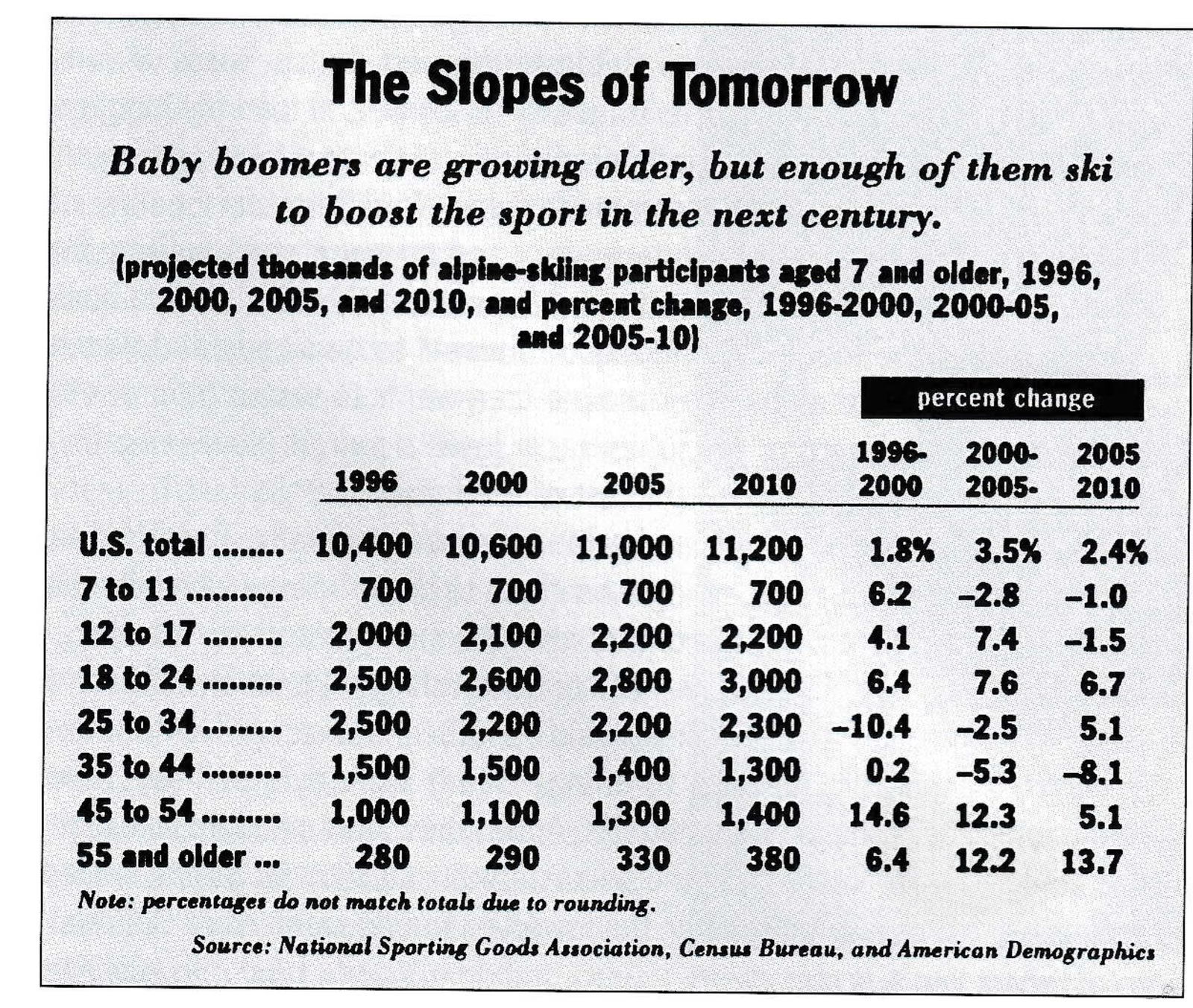
If the skiing habits of different age groups don’t change, the number of skiers will grow about two percent between 1996 and 2000. This will occur partly because of a growing number of skiers aged 45 to 54. The number of older baby-boomer skiers may increase 15 percent, to just over 1.1 million, in 2000. Skiers aged 55 and older should also grow more rapidly than average (six percent) between 1996 and 2000, to 2.9 million. Meanwhile, skiers aged 25 to 34 will decline.
This age shift will have a dramatic effect on downhill ski areas and related businesses. For example, the large size of the baby-boom generation will cancel out the tendency of an aging population to decrease the number of skiers. As a result, the proportion of skiers who are aged 35 or older should remain steady at 27 percent until at least 2010. Baby boomers are the same people many ski areas previously courted with post-ski festivities such as live rock music in the 1970s and 1980s. But in the next decade, aching boomers in their 40s and 50s will need comfort after a jarring day on the slopes. Keeping them in the lodge will mean providing cushy seating, ample heat and low-volume music.
Older skiers have different expectations than they did when they took up skiing 20 years ago, according to research conducted for the Killington, Vt., by Hill, Holliday Advertising of Boston. “This audience is more interested in comfort,” says Cindy Tungate, the firm’s associate director of research and planning. “They don’t want hassles and they want to take it more slowly when they ski.” What is Killington’s response? “We’re putting in a lot of hot tubs,” says John Clifford, vice president of marketing for S.K.I. Ltd., which owns Killington.
Middle-aged skiers are also more discriminating than younger skiers about food. They are less interested in slurping down a bowl of cafeteria chili to get in a few runs before the area closes and more interested in table-service restaurants where they can enjoy a leisurely lunch.
Snowboarding in the Future
Perhaps the biggest reason for the declining number of skiers is the increasing number of snowboarders. Snowboarding has grown rapidly since the NSGA started measuring it in 1988; about 2.1 million Americans boarded in 1994, compared to 1.3 million in 1988. Like many new products, demand for snowboarding is growing rapidly as new users flock to it. Forty percent of snowboarders have participated in the sport for one year or less, according to a study by American Sports Data.
Source: American Demographics (households), Census Bureau (income)
Much of the erosion in alpine skiing could be due to former skiers who have defected to snowboarding. Surveys of snowboarders at Mammoth Mountain, Calif., show that 70 percent were previously skiers. “That’s higher than the national average, which is probably about 50 percent,” says Pam Murphy, director of marketing.
Snowboarding is strongly favored by young men and teenaged boys. In 1994, 1.5 percent of males aged seven and older went snowboarding, compared with just 0.3 percent of females. Teenagers of both sexes have a much higher-than-average participation rate, at four percent.
The future of snowboarding is hard to predict because the sport is both new and practiced by a small group of people. Growth is likely to slow as the newness of snowboarding wears off. But even if the share of Americans who participate in snowboarding grows very slowly over the next 14 years, the number of participants could more than double between 1994 and 2010, to 4.6 million. The reason is a large new generation—the 75 million children of baby boomers, now aged 1 to 19—who will strap on their first snowboards in the next 15 years.
So far, snowboards have brought enough young adults and teenagers to the slopes to make up for the decline in alpine skiing. But in addition to their small overall numbers, teenagers and young adults also tend to have small wallets. So while ski areas must court this market, they cannot count on them alone.
Source: National Sporting Goods Association, Census Bureau, and American Demographics
Women Are Job One
Baby boomers, now aged 32 to 50, are 30 percent of population and about 33 percent of skiers. Their kids, under age 18, are another 30 percent of the total market, according to the National Skier Opinion Survey. The bottom line is that baby boomers are paying for about two-thirds of lift tickets and rentals at the average ski area.
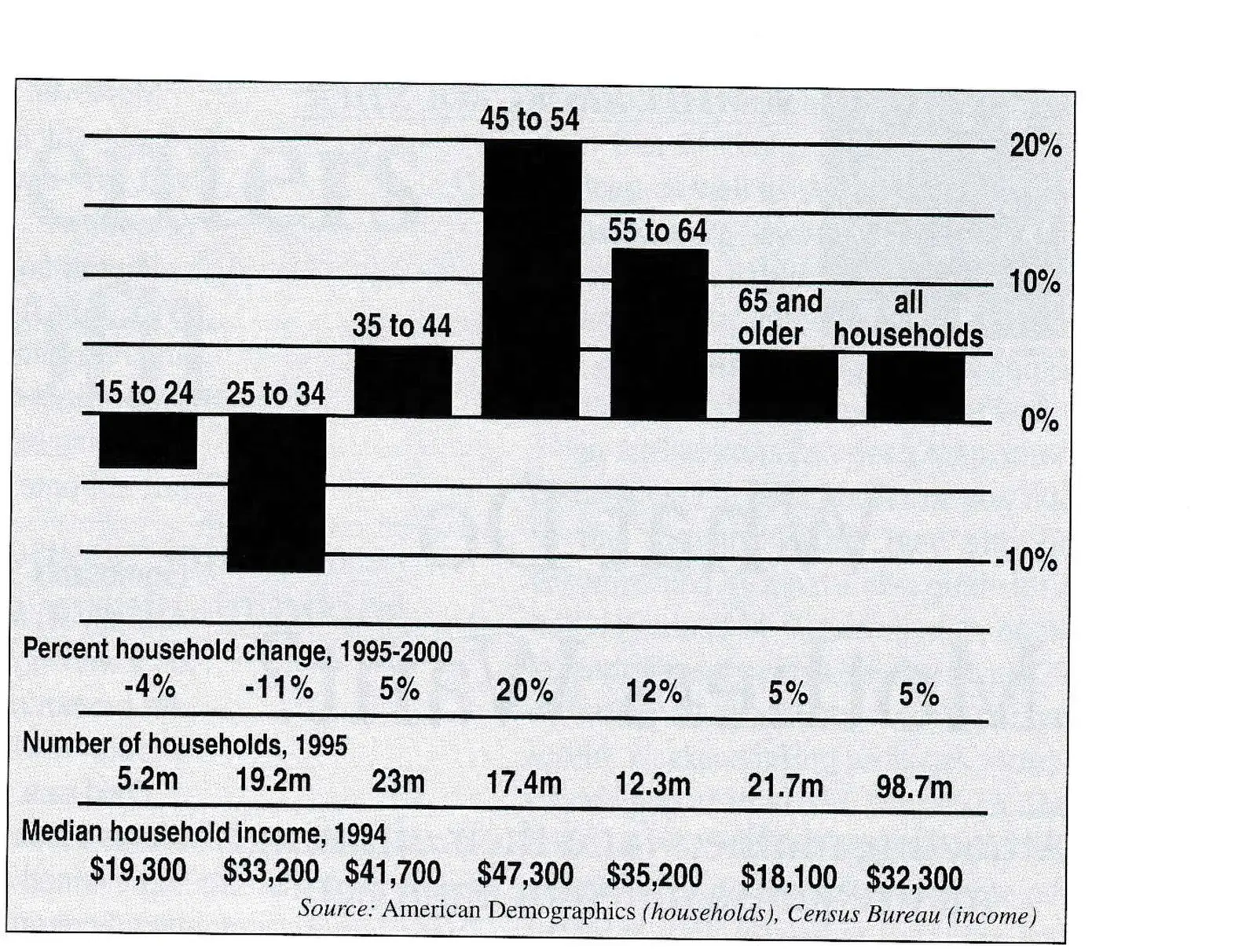
Baby boomers are paying the bills because they’re making the most money. Householders aged 45 to 54 had the highest median income of any age group ($47,300) in 1994, according to the Census Bureau, and those aged 35 to 44 were second-highest ($41,700). The median income for all households, in contrast, is just $32,300.
The reason for the boomers’ wealth is simple. Most households in the middle age groups are married couples who both work full-time. This is a significant fact for ski areas that devote most of their marketing to men. Women in dual-earner households have a great deal of influence on the family’s vacation decisions. If they don’t want to ski, the family isn’t likely to ski. And this is especially true of working mothers.
But while the economic power of women is increasing, the share of women skiers is decreasing fast. According to a National Skier Opinion Survey, women have declined from 44 percent of all skiers in 1984 to 38 percent in 1994. This is an ominous trend; no one wants to see a valuable market shrinking so quickly. But it becomes truly frightening when you consider that women, not men, are the gatekeepers to children.
According to the Survey, up to 41 percent of the bodies on the average ski slope are under the age of 16. In 1994, exactly half of skiers had children under age 16 in the household. Among children, those whose parents are skiers are most likely to ski. The main reason is that 57 percent of the parents’ ski trips include children. Jim Spring, director of the survey, said: “While other industries are wetting their lips waiting for the post baby bust to come of age, the ski industry is already catching the windfall.”

Keeping ski areas co-ed is absolutely critical for several reasons. First, you already know that in the 1970s and 1980s, the participation of Americans in all kinds of sports skyrocketed. But you may not know that the main engine of growth behind the sports boom was a rapid increase in the sports participation of college-educated baby boom women. This cohort has been celebrated by marketers and advertisers because they have been much more active in sports than any previous generation.
Three specific events created the boom in women’s sports. In 1972, a federal law called Title IX banned sex discrimination in colleges receiving federal aid, vastly increased women’s’ collegiate sports budgets. In 1973, the founding of the Association of Intercollegiate Athletics for Women standardized the growth. Third was the increasing popularity and corporate sponsorships of women’s sports events.
Hopefully, the women’s sports boom of the 1970s and 1980s made a permanent change in our society. Close to two million high school girls now play on a sports team, more than double the number in 1970. Baby-boom women will continue to stay physically active at something. How can you keep them, and their daughters, skiing?
First, give working mothers the one thing they want more than anything else: peace and quiet. Talking about working mothers in her book “The Second Shift,” sociologist Arlie Hotchchild says: “These women talk about sleep the way a hungry person talks about food.”
We’re a time-pressured society and working mothers are the most time-pressured people of them all. Among Americans aged 18 to 50, only young men have more leisure time than the national average. It should be no surprise that people who are employed full-time have less leisure. Parents of preschoolers have less free time than anyone else. Parents of older children are just about average. And fathers report having more leisure time than mothers, probably because mothers do so much more child care and housework.
Ski areas will thrive when they provide services that allow women to relax and enjoy themselves. These include day care, ski schools, nicer food and other amenities and, perhaps, women-only ski programs. Marketing and advertising efforts aimed at women should stress safety and lifestyle, not speed and acrobatics. Luring women back to the slopes is a complex job, but it’s your most important job.
Seniors as Skiers
Another key to the future of skiing is vacationers aged 50 and older. People aged 45 to 54 have an average likelihood of skiing, according to the NSGA, while those aged 55 and older are less likely to ski. But both of these groups have money to spend and the demographic tides are flowing in their direction.
Between 1995 and 2020, the number of children will increase from 69 million to 76 million, or 10 percent, according to the Census Bureau. The number of adults aged 18 to 49 will increase from 126 million to 131 million, or four percent. At the same time, the number of adults aged 50 and older will increase from 68 million to 115 million. That is an increase of 69 percent.
If you don’t think an aging population will change leisure, consider this. In 1987 and 1990, the Roper Starch Worldwide asked people which vacation option they would prefer: first, “Go away and do many things;” second, “Go away, sit and relax;” and third, “Stay home and relax.” Between 1987 and 1990, the share who want to go away and do many things dropped from 51 percent to 44 percent. The share who want to go away, sit and relax rose from 23 to 25 percent and the stay-at-home vacationers rose from 17 to 22 percent. This is a significant shift. Relaxation-oriented vacationers now outnumber active vacationers. Nine years ago, the actives were in the lead.
Moreover, the shift is entirely due to the aging of the population. The share of active vacationers increases by income and educational attainment; dual-income married couples, even the frantic ones who have children living at home, are more likely than average to want active vacations. But the share of active vacationers declines from 57 percent of those aged 18 to 29, to 42 percent of those aged 30 to 44 and 36 percent of those aged 45 or older. It’s a straight drop. And as the population ages, the share of active vacationers will drop further.
I’d like to suggest two strategies for those of you who want to attract older people to your resorts and ski areas. First, market to grandparents. Position yourself as a nice day or weekend that grandma and grandpa can spend with their kids and grandchildren in a beautiful, relaxing setting. Maybe older adults can be shown learning to ski with kids, or maybe they can be shown watching kids learn to ski. Remember that a person who learned to ski at age 30 in 1965 is now 60 years old, and is probably still fond of skiing. And even if they don’t ski, you can remind older adults of the beauty and spiritual satisfaction that comes from being in nature. Then give them ways to share that feeling with their families.
The Next Decade
The next 10 years will be critical to the long-term health of the ski industry, because they are the last years when ski areas will be able to rely on baby boomers as their best customers. In the short term, households headed by people aged 35 to 54 will be a huge and growing market. People aged 35 to 44 are higher-than-average on ski days, and those 45 to 54 earn more than any other group.
Between 2000 and 2010, however, the ski industry could go through a wrenching contraction. During that decade, American Demographics projects that the number of householders aged 35 to 44 will decline by four million, or 17 percent. Householders aged 25 to 34 will also continue their decline. All of the growth will be in households headed by people over the age of 45. People aged 45 to 54 have an average propensity to ski, but skiing drops off dramatically after age 55. So in the next decade, it is absolutely critical for ski areas to develop other customer segments.
The contraction, however, doesn’t have to happen. In fact, another golden age for skiing could be on the horizon, and ski businesses can increase their long-term profits by preparing for it now. There is a new baby boom coming. In fact, 75 million children have been born in the last 18 years, which coincidentally is the same size and cohort length of the original baby boom of 1946-1964.
The next baby boomers are being introduced to skiing now, through school programs and vacations with their parents. If they start buying their own lift tickets in great numbers some time after 2005, growth could shoot up again. Until they do, skiing will be a slow-growing or stable industry. In the next decade, the name of the game will be taking care of your best customers while cultivating the new generation.

