


A lot could.
Most ski school directors believe they can do their own instructor ratings. They think they do it when they decide whether or not to re-hire instructors A,B and C. They do it by “gut feel” and how much they liked the instructor personally and whether or not the instructor was neat and presentable when he showed up for work. It’s nice to have an instructor give the director a good gut feeling. And it’s nice if the director likes the person. And it’s super if the instructor is neat and presentable. All those things go into hiring, legitimately. But they don’t measure whether the instructor can teach or not.
So, how does a ski school get to know how well does its teachers actually teach?
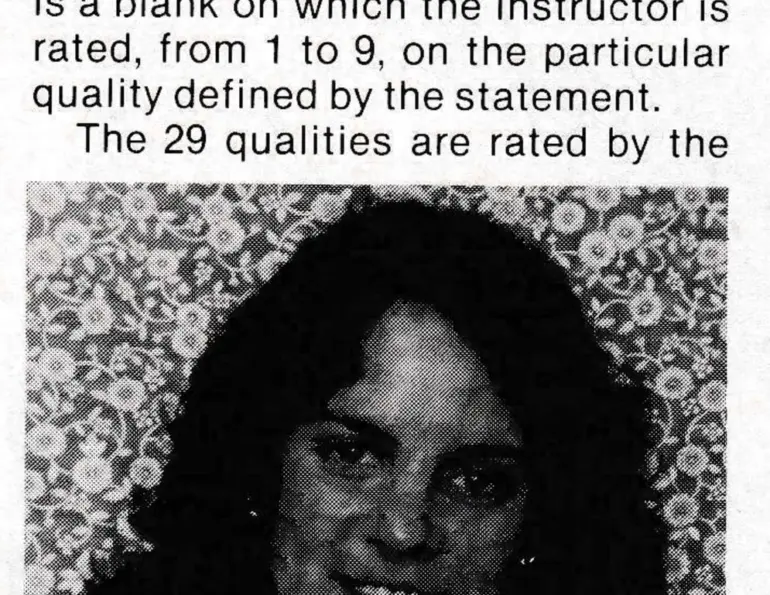
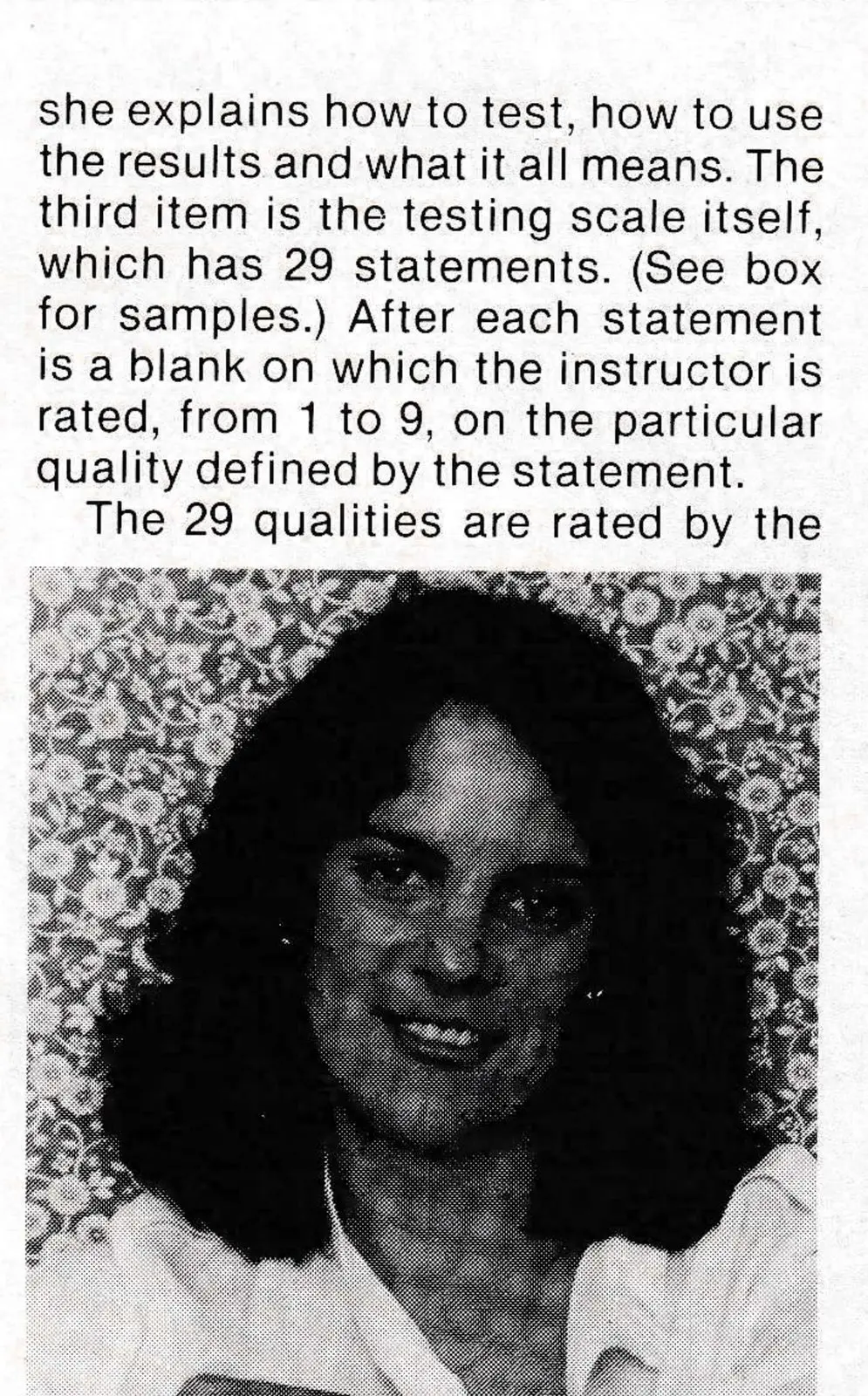
Ask Ms. Bridgwater. The lady from Missoula, Carol Bridgwater, a teacher and Ph.D. candiate at the University of Montana, is a keen researcher. She is also a hopelessly smitten skier, having paid for her college by working as a ski bum in Colorado before getting her degrees. The career she picked, happily for ski schools, was psychology. She combined career and love, psychology and skiing, to come up with BEST: The Bridgwater Evaluation Scale for Teaching.
Ski schools trying her system this season get three things; first, a sample evaluation sheet, in which Bridgwater shows how the finished product will look: all the instructors rated in order, from top to bottom, plus an evaluation of each instructor’s strong points and weak points. The second piece of material is the BEST manual, in which she explains how to test, how to use the results and what it all means. The third item is the testing scale itself, which has 29 statements. (See box for samples.) After each statement is a blank on which the instructor is rated, from 1 to 9, on the particular quality defined by the statement.
The 29 qualities are rated by the director or his assistants on this scale. Bridgwater applies mathematical formulas to the ratings and returns an accurate listing of ability, from top to bottom, of all members of the ski school.
How can this work any better than the kind of list of qualities the ski school director can make up and rate on his own without any help from Bridgwater?
That’s science.
And actually psychometrics, or rating-via-test-scores—is somewhat of a science. There are formal ways of proving mathematically whether or not a test really measures what it says it measures. BEST measures teaching ability.
The ski school director may put down “neat appearance” as part of his requirements, but Bridgwater found it, neatness does not make for teaching ability. OK, what does? Well, the most pertinent are the 29 qualities that Bridwater picked out from more than 50 different qualities that numerous ski school directors and examiners gave her when she was doing her research. Among the items which dropped out, besides neatness of appearance, were “. . . cares about the students.” For some reason caring about the students did not necessarily make for good teaching, either. It didn’t hurt, but it didn’t come out as one of the qualities that in combination with the other indicators separated the “outstanding” from the “average” from the “ineffective” teachers, to use the terminology of the rating summaries. Evidently, outstanding teachers and ineffective ones alike can look neat and care a lot about the students.
Now we can challenge Bridgwater: how did she know what makes a good teacher? The answer is that she didn’t.

In the first place, for a rating scale of any set of abilities to be possible, the researcher has to be able to identify some distinguishing qualities out of all those suggested by people in the field. With statistical methods, you can take this “pool” of qualities and finally winnow out those crucial qualities that combine into a pattern. The pattern gives the same results as the top ski school directors get, regardless of who does the rating of the crucial qualities.
Devising a scale like this isn’t always possible. For instance, no one has yet been able to create one that works for public school teachers. The reason that it can be done in ski instructing is, according to Bridgwater, that the profession is “a highly circumscribed area requiring a set of skills which are fairly specialized . . . Secondly . . . it is clear that there is a high degree of agreement among ski school directors concerning the qualities which are necessary to teaching effectiveness in ski instructors. Otherwise, the same pattern of qualities would not have emerged across ski schools.”
Eight ski schools tested Bridgwater’s final list of qualitities by having their supervisors rate the staff on a scale of one to nine. She applied mathematical formulas and ranked the instructors. The results agreed with the supervisors’ rankings, thus validating the quality selection. What do you do with this list? Fire all the “inneffective” instructors? No. The best use of BEST is educational. What Bridgwater is looking toward is the use of her scale as a way of having a productive conference between each instructor and the ski school director, a conference in which the instructor’s strong points are praised, and his less effective points are brought to his attention. The idea of an objective scale as the tool for the evaluation takes some of the curse off such a meeting, helping make it productive.
For instance, in the individual evaluation on each instructor which Bridgwater has sent back, one particular instructor might be weak in “ability to grasp and hold class’s attention when teaching.” Given this knowledge, the instructor could become more aware of his classes’ inattention and provide ways to remedy that problem. Or, the weak instructor could team-teach with another instructor who has strength in the attention-holding area.
The process of going through the rating procedure also makes the supervisors and assistant directors more aware of what they are looking for and whether or not a particular teacher has it. Good old Hans, who is a fine drinking buddy may not come off all that well, and you may wonder why you are keeping old Hans on after all. Bridgwater did discover that most of the ineffective instructors are ineffective due to inexperience, but some certified instructors also came out as ineffective.
So far the experience of schools using the BEST system is too limited for comments on how BEST works for them. Obviously BEST is a step toward making ski schools more productive. Since she has pioneered the thinking that went into it, Bridgwater—for just getting this kind of evaluative thinking started—deserves a round of applause.
She has already gotten applause from PSIA. The Vail ski school technical director, Horst Abraham, also head of the technical advisory committe of PSIA, has been working closely with Ms. Bridgwater, and PSIA has given her efforts warm endorsement. Bridgwater has also received professional kudos, having been invited last fall to present her paper—a signal honor—at the annual convention in New York of the American Psychological Association. BEST< judged such a professionally excellent research project yielding such exceptional accuracty in measuring teaching effectiveness that the honor well merited.
Resorts that want to get in touch may write Carol Bridgwater, Professional Sports Evaluations, P.O. Box 7157, Missoula, Montana 59807. Tentative price for the BEST system is $40 for the manual, which is re-usable, and $15 per instructor rating. PSIA-member schools get a 15 percent discount.
BEST Sample Rating Points
- Seems to enjoy teaching.
- Is capable of creating a relaxed atmosphere and minimizes tension in students.
- Has ability to speak clearly and distinctly in front of class.
- Encourages and is receptive to questions.
- Can choose most appropriate maneuver for a given terrain and snow condition.
- Gives adequate individual attention in group lessons when possible.
- Has knowledge of a variety of corrective exercises at all levels of skiing ability.

