


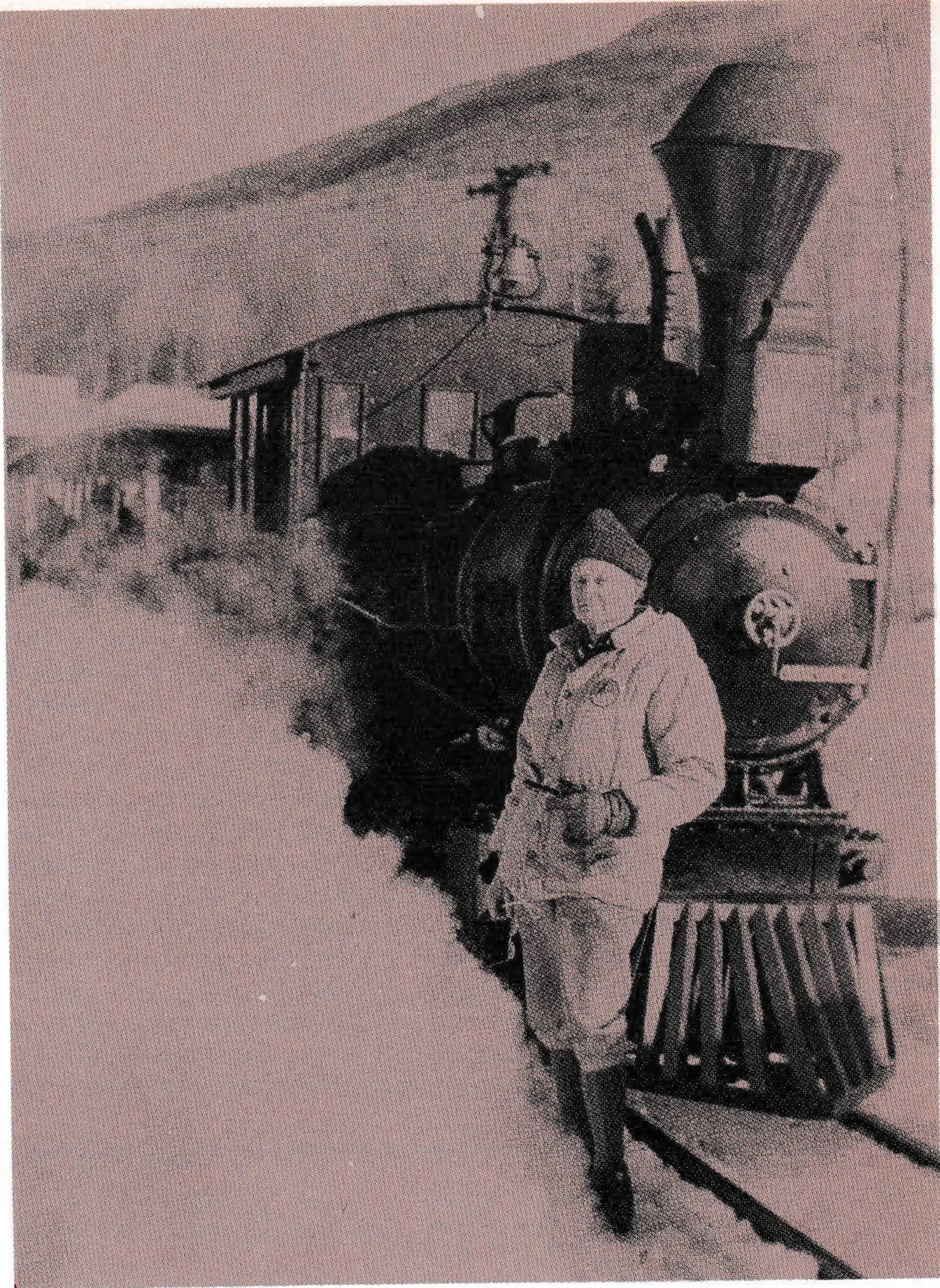
He should know. When the hot breath of federal energy policy makers first breathed down the collective neck of the ski industry two years ago, a national lobbying effort on behalf of skiing and winter tourism was hurriedly welded together. Not surprisingly, one of its key organizers emerging from New Hampshire’s White Mountains was a former politician of some note himself.
Today at 76 Sherman Adams does not look startlingly different than when they called him “the second most powerful man in Washington” two decades ago. His pants may be Kelly green rather than somber gray, but he can still outski men half his age (on skis longer than 200 centimeters). He is just as apt to tell a visitor to his corner office at the Loon Mountain Recreation Corporation to wipe his feet before entering as to warn an old friend that he will be “fined” the next time he comes up without stopping to say hello.
To the people of Grafton County, whose kin first sent him to the New Hampshire legislature in the early forties, later to the state house, and who finally saw him become the chief of staff of the Eisenhower White House, he is still “the Governor,” a principal employer and symbol of solvency in central New Hampshire.
From the beginning, says Adams, his motivation for becoming founder and chief executive officer of Loon Mountain was to provide jobs and some fun for a lot of people around the one-time mill town of Lincoln. And, of course, he wanted “to have something to show for it — not spectacular but satisfactory.” That he has achieved his initial objective is attested to by a thriving full-service resort, sitting on a picturesque edge of the White Mountain National Forest. Despite difficulties there has been solid progress. But what about the future, SAM recently asked him.
If you were to pick a point in time when the outlook for the ski industry turned to something less than optimistic, Adams says, it would begin with the shock and impact of the energy crisis. The minute that you restrict the mobility of people, you dampen the prospects of the whole ski industry, which depends upon mobility . . . And I think that is rather more disturbing than the industry would like to admit.”
Moreover, he adds, there is precious little anyone can do to improve the prospects, not while the tug of war between Congress and the President over a national energy policy remains unresolved.
“Nobody knows what the ground rules will be. Anybody can guess that transportation is going to be more expensive and somewhat constricted. But nobody is willing to admit you’re never going to be able to ski on the Sabbath. Or that there are certain (skiing) days that will have to be dropped out. Or, God forbid, you’re ever going to be limited in the amount of fuel you can buy . . .”
It is this very lack of knowledge about the future that has spurred the industry into a search for new skiers, according to Adams. “If there is any counter-revolution against the possibility of mobility being restricted,” he says, it is the industry’s “trying to build up an articulation” on the part of the public (and in turn by government policy makers and regulation writers) as to the value of the ski industry. And, he adds, he is not talking about skiing’s economic but its “therapeutic value.”
“People lose sight of the fact that skiing is exercise,” says Adams, who recalls the body-building motivation of the national physical fitness program which he helped organize in the 1950’s. Skating, cross-country skiing, alpine skiing — “if we need a defense, and I don’t think we do . . . our chief defense is that (skiing) is a body-builder. People would not have found any means of absorbing as much oxygen or clean air as they would have had skiing not be invented or grown to the extent that it has.” And he hints that he sees more potential in the age-old “joy” of getting into the mountains rather than “the competitive miasma we’ve gotten into.”
But is skiing’s market broad enough for its “therapeutic value” to merit serious consideration by government policy makers if faced with conflicting interests? Adams has no clear-cut answer. As part of the free enterprise system, skiing provides services and jobs. “Traffic flow, which is another way of saying cash flow, must be at least equal to carrying your debt service.”
Should severe restrictions on public mobility make that impossible, he shrugs, “I think the government should be told that the banking institutions throughout the country are going to be in the ski business.”
Although efficiency curves of different ski areas vary “like the value of the dollar,” Adams says that many areas are bouncing their cost head against their price ceiling. The situation, he notes, reflects a limited capacity of the skiing public to pay escalating rates. Nevertheless, he is sure “the ski industry is not going to be subsidized . . . To a rather considerable extent skiing is going to be indulged in by people who can pay for it. And that’s the hell of it because everybody ought to have the chance to ski.”
Is the high cost of ski equipment today limiting skiing’s potential to expand its market base? “To some extent,” Adams feels, “but I haven’t been able to really appraise that. I can only tell you that we’re doing more rental business. People are renting boots and skis rather than investing in the capital cost of their own equipment. Having noticed that, this will be our first year operating our own rental shop rather than leasing it out.”
At Loon, Adams says, the trend has been away from concessions and toward control of every facet of the operation, including its own slopeside inn. Both a better return and tighter quality control in services have been obvious goals.
“You work at trying to keep lift lines at a reasonable length. But you also try to feed them well, give them decent well-kept rest rooms, lifts clean and in good condition, a security officer to make sure their car isn’t rifled while they’re gone. There are a lot of components . . . besides simply reducing lift lines. I think many areas have overemphasized the . . . quantity of their product,” says the Governor, although he believes this tendency has lessened in the East, which he is most familiar.

Loon has approached the traffic flow problem by a combination of midweek packages and limited sales of lift tickets on weekends and holidays. The latter policy has enjoyed a good deal of success, but Adams does not offer it as an answer for every area. To turn away customers at 10:30 of a Saturday morning because any more would push lift lines above 20 minutes is “a frustrating experience. But for us it was a good decision,” he is convinced. (Loon’s average occupancy for last season was 43.9 per cent of capacity, 72.5 per cent on peak days. This season’s goal is to increase midweek business by 20 per cent and average peak day traffic by 10 per cent, according to marketing director Gene McMasters.)
Adams sees no immediate need for more ski areas in his section of the Northeast although he says that may not be the case elsewhere. He supports the Forest Service policy of discovering “for itself what the public demand is on its own property” and the potential effect of new utilization. “There are localities in the White Mountains that are deteriorated by overuse. And the government has seen fit to limit the use of those, which I think is necessary and good judgment.”
He indicated that the public welfare is a critical question no would-be developer can afford to ignore today. “The question, ‘If Sugarloaf was good for Maine, why isn’t Bigelow good for Maine?’ oversimplifies the problem. The problem is, Is Bigelow necessary? The use of the land on Bigelow Mountain — is it desirable for public purposes to be used for skiing or isn’t it? Have you got enough? Is this likely to succeed financially or are you likely to get into more bankruptcy trouble? That sort of thing.” In his own region he believes New Hampshire will be “far more reluctant to go as far as Vermont” in regulating land development.
Ask him about solutions to the complex problems facing the industry, and Adams can snap back with some exasperation: “There are no panaceas. I’m no medicine man . . . When Scoop Jackson and Gerry Ford on successive days can say that ‘your plan’ would wreck the economy, how do you expect people who are sitting at a desk in Grafton County, N.H., to write any intelligent or effective remedies?”
But then on a brighter note: “Things happen that enable business . . . to adjust. If they didn’t, we wouldn’t be a democracy. We’d be something else. And I’m not trying to make any political speeches . . . but I think conditions have to be maintained and promoted in this country in order that a business like this — along with businesses that are similar — can live and earn enough to eventually pay a little something for the use of the money besides paying the interest on the debt.”
Adams observes there are probably some beacons that would be helpful along the way. Small day areas can learn sometthing from “the corner grocery store, which has held out for a long time . . . When you get bigger than the capacity of family, relatives and friends to operate a small ski area — 100 to 200 per hour uphill capacity — . . . I think the difficulties are too great.”
When an area is faced with staggering electric costs, as is Loon, and the capital cost of converting to diesel is prohibitive, “you say, ‘we’re going to have to pay through the nose until we can see what our next crisis is.’ “
And when you support industry-wide organization as “highly desirable,” you nevertheless count the ever-growing dues and requests for passes as “one more cost factor that must be watched and evaluated as time goes on.”
Does he get discouraged? The Governor muses, “I’m too old to be discouraged. I’ve had too much experience and adversity to be discouraged . . .” Now that he hs brought in Corky Cayton (from Bristol Mountain, N.Y.) as general manager, Adams says he will continue to keep his eyes on things until assured “the future, as well as I can provide for it, is in good hands.”
But he and his wife, Rachel, have no intention of leaving these granite mountains, where he began over 50 years ago as a timber land manager (and Dartmouth Outing Club skier and first trail crew boss of the Appalachian Mountain Club). He’s had his traveling days, and “this North country environment is hard to beat . . . Oh, I expect I probably shall live until I’m about between 91 and 93. That’s the way I’ve got it figured out.”
Few would bet against him.