
Photos courtesy of Tremblant
It was a grand time and a time of nostalgia, of reacquaintance with old cronies, of golf and tennis tournaments, of river rafting the rapids of the Riviere Rouge, of banquets and speeches and awards. And, of course, skiing.
The idea for the gathering came from Jane Chisholm, a long-time part-time Tremblant ski teacher and a full-time designer and importer of tennis and golf wear. Three years ago, she realized that Tremblant would be ready to celebrate its sixtieth season in 1998-99, and that the much older Gray Rocks Inn could celebrate the same sexagenarian for the founding of its Snow Eagle Ski School.
Chisholm contacted the directors of the ski schools and proposed a gathering of as many as possible of their own past ski teachers, plus those from three other schools that at one time regularly brought their students to Tremblant’s slopes. This included the Mont Tremblant Club resort (still in operation), the Manoir Pinoteau (now a condo development) and the about-to-be condo-ized Villa Bellevue.
A committee was formed, old payroll records were researched, letters were mailed, sponsors were procured and brochures were printed. In all, some 1,200 former teachers were contacted.And 600 showed up on July 1 for four days of festivities. They came from Australia, California, Austria and many parts of North America.
The banquets, at about $70 CDN a pop, were superb. One night, nearly 300 people went to the Grand Manitou on Tremblant’s summit, while some 300 other alumni gathered at Gray Rocks. The Tremblant group largely feted its past reminiscing about their former leader and renowned racer, the late Ernie McCulloch. The Gray Rocks group—perhaps somewhat more sedately and seriously as is in keeping with the tone of its ski school—feasted extravagantly and toasted its long-time director Réal Charette, who is very much alive.
On another gala banquet evening, at the CP Hotel Chateau Mont Tremblant, Mike Desbrissay, president of the Canadian Ski Instructors Alliance presented Legends of Skiing awards to more than a dozen instructors who had taught for 50 years or more. Yours truly, who taught at both major resorts from 1946 to 1950, received a Lifetime Achievement award.
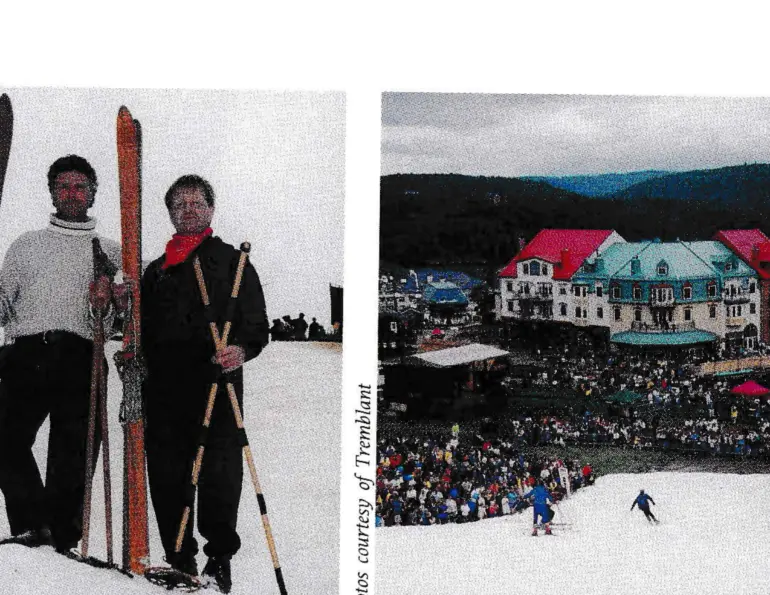
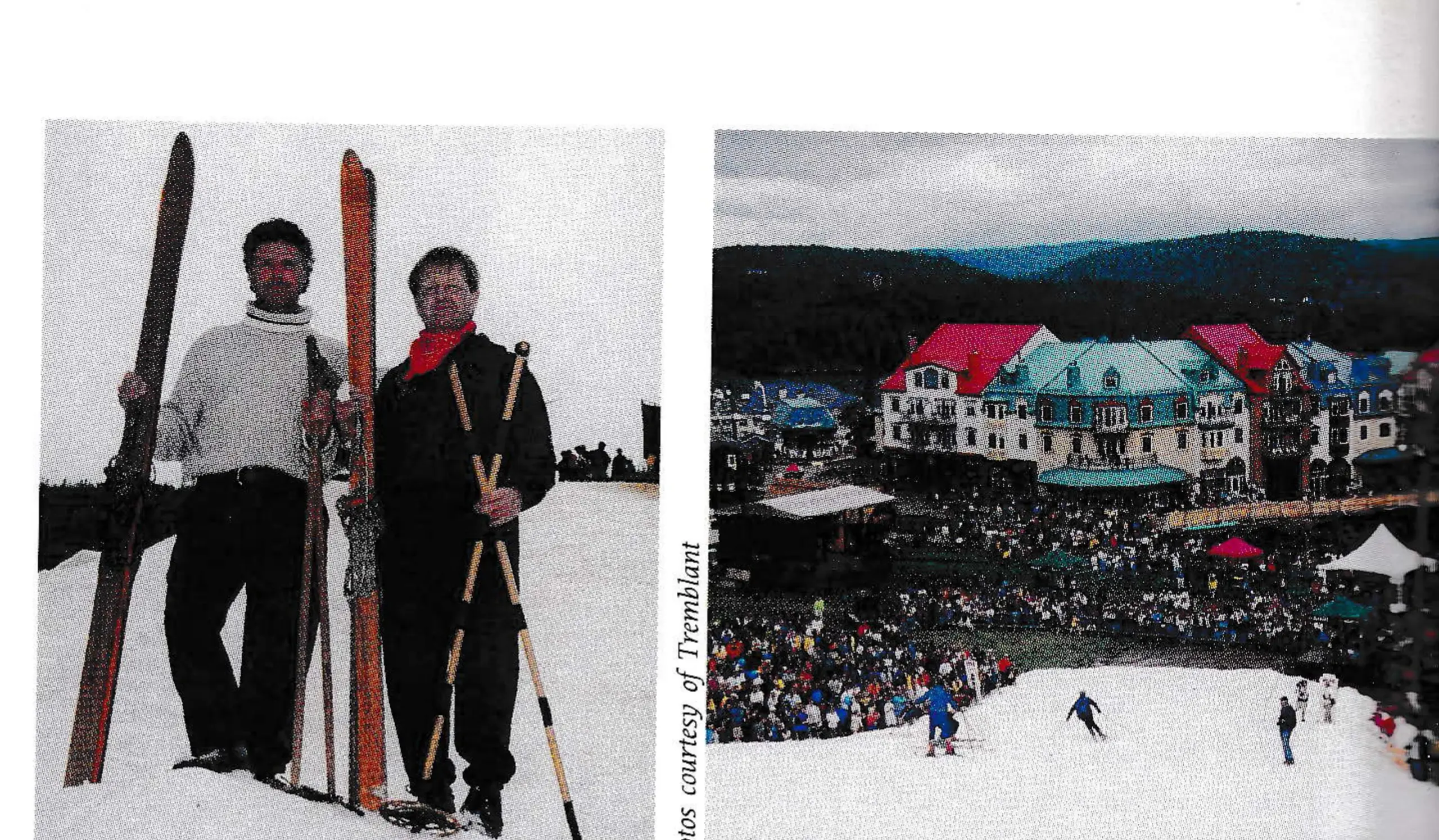
Saturday, after a mountain crew practiced sawdust grooming (see sidebar), was skiing day. Peter Duncan, former Canadian Olympic alpine ski team member and Tremblant native son, presented a chronological retrospective of the region’s celebrities and ski school personnel. First, slithering down the still-frozen granular on old skis without steel edges, came project manager and head coach, Jacko Gratton. He was impersonating the gruff founder of the resort back in 1938, Joseph Bondurant Ryan. Then Michel Beaulieu, Tremblant’s co-director last year with Michel Lemothe, did a stand-up stand-in for Lowell Thomas. (Thomas, a tireless on-air supporter of the sport of skiing and a good friend of Joe Ryan’s, did several live radio broadcasts directly from the Mont Tremblant Lodge back in the late 30s and 40s.)
This was followed by a progression of former school directors, including surrogate performers for Hans Falkner, Tremblant’s first, then Hannes Schneider, disciple Benno Rybizka, and Johnny Fripp. Funny thing about Fripp’s surrogate. He skied fine, but as a surprise the real 75-year-old Fripper came down next, skiing solidly on what seemed like parallel railroad tracks, and looking better than his surrogate. Then a surrogate Ernie McCulloch arced down and bobbled here and there. Duncan, said on the PA, “Hah! We never saw the real McCulloch make even an unintended wobble.”
There were others. A surrogate for Réal Charette made a suitably solid, but staid descent. Charette does not ski anymore because of tired legs, though his mind is keener than ever on the intricacies of ski school operation. Another octogenarian, no surrogate she, Peggy Austin, daughter of a great pioneer in skiing, Herman Smith-Johannsen, cut up the slope with some beautiful curves on a pair of markedly shaped skis.
Of course, there was more. You can’t put together 600 people used to being the center of attention without a lot happening. There were fireworks, the outdoor display kind. And there was a closing barbecue dinner where all the revelers were served in line, buffet style in less than an hour. A fitting finale for a finely-tuned fete.
The secret to snow in July
The main road from St. Jovite, Quebec T-bones into the shore road at Lac du Mont Tremblant. Hang a hard right and you are driving directly toward the new Intrawest condo village cum ski resort bulging out at the base of the once notorious Flying Mile ski run. There, above the bright roofs of a replica Quebec City, snaking down the lower half of the run, is an orange blight on the green grass. Is it some sort of saprophytic blight? Or a giant orange caterpillar?
No. It is a dream come true for two of Tremblant’s leading ski luminaries, noted ski school director Michel Beaulieu and head coach Jacques “Jacko” Gratton. It is a 600-foot-long ski swath. But orange, an orange ski hill?

“When we first proposed the idea, the bosses at Intrawest thought we were crazy,” said Jacko, a can-do kind of a guy. The rhythm of his words were unmistakably Quebec. “But we were confident we could do it with no snow guns, no chemicals, no harm to the environment.”
Gratton reminisced how, in winters past, his parents—who owned the nearby Manoir Pinoteau—would cut ice from the lake, haul it to store in sheds and then used it late into the next fall. The secret—sawdust.
“So we got permission to carry on, along with promises of snowcats and expenses. In late April, for two weeks we scraped all the snow that we could on the Flying Mile into one big pile, 600 feet long by 23 feet high. And then we covered it with an 18-inch-thick coating of sawdust.
“It took a 10-wheeler truck some 20 loads of this brin-de-scie, which was dumped at the base of the pile and which we pushed up with the cats,” says Gratton.
“Then, early Saturday morning on July fourth, we went back with cats and scraped off the sawdust. Then we bladed the pile down to 10 feet thick and widened the swath to 60 feet.
“The snow underneath was great. We knew it would be. Even though May and June were unusually warm, we never saw more than a trickle of melt water. Skiing it was like being on a perfect glacier of frozen granular. Great, as long as you had steel edges.”
“The snow lasted almost until August. Days after our event, young skiers and, especially, snowboarders had their fun on it. It melted away gradually without any erosion problems and no pollution was involved. In the end, we scraped up the sawdust, trucked some back to the mill and used some for mulch and fill on rough spots on the mountain. So much for your big orange chenille.
“Tremblant spent approximately $20,000 CDN dollars on the project. They were happy, we were very happy and the 600 ski teachers participating in the affair had a grand time. And that’s not counting the thousands who witnessed the occasion. Too bad more of the public didn’t know about it. Nevertheless, skiing in July at Mont Tremblant might become an annual affair.”
—dp