

Since its opening, Whitetail Ski Resort in south central Pennsylvania has established a reputation for environmentalism. The resort has won awards for such environmental deeds as setting aside land for wildlife and wetlands protection, building a state-of-the-art wastewater reclamation system and installing an energy-efficient snowmaking control system. Not resting on any laurels, Whitetail management has gone a step further, implementing geothermal heating and cooling in new townhomes and becoming one of first ski areas in the country to use geothermal on a large scale.
One of America’s newest ski resorts, Whitetail opened in 1991 on Two Top Mountain in the Tuscarora range with the purpose of attracting skiers from the Washington/Baltimore area 90 minutes away. As a reflection of its slow-growth, minimal-impact approach to development, the resort built no overnight lodging facilities in the first five years. Instead, resort owners arranged package deals for skiers at hotels and inns in nearby towns.
However, after the area had operated a few years and developed a skier following, the demand for on-premise lodging became apparent. In response, Whitetail management developed a master plan calling for 1,450 housing units and a golf course, with the goal— after a $10 million expansion—of becoming a four-season resort.
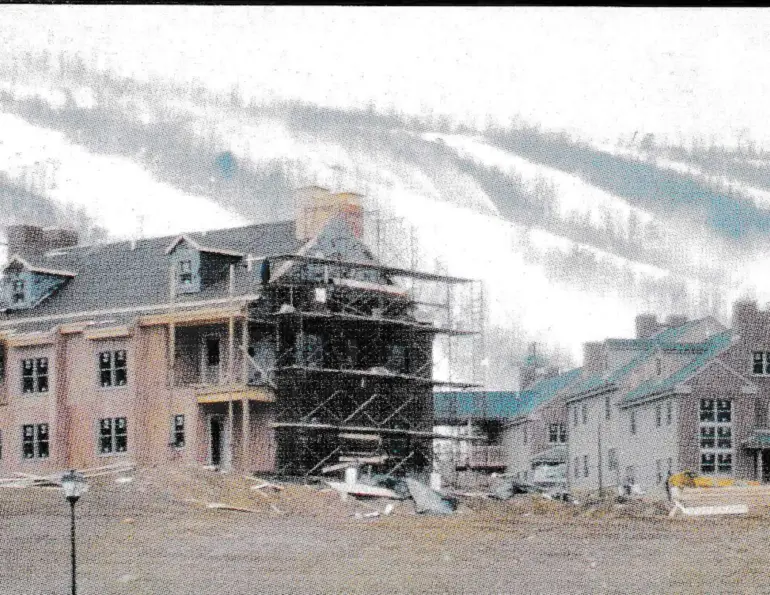
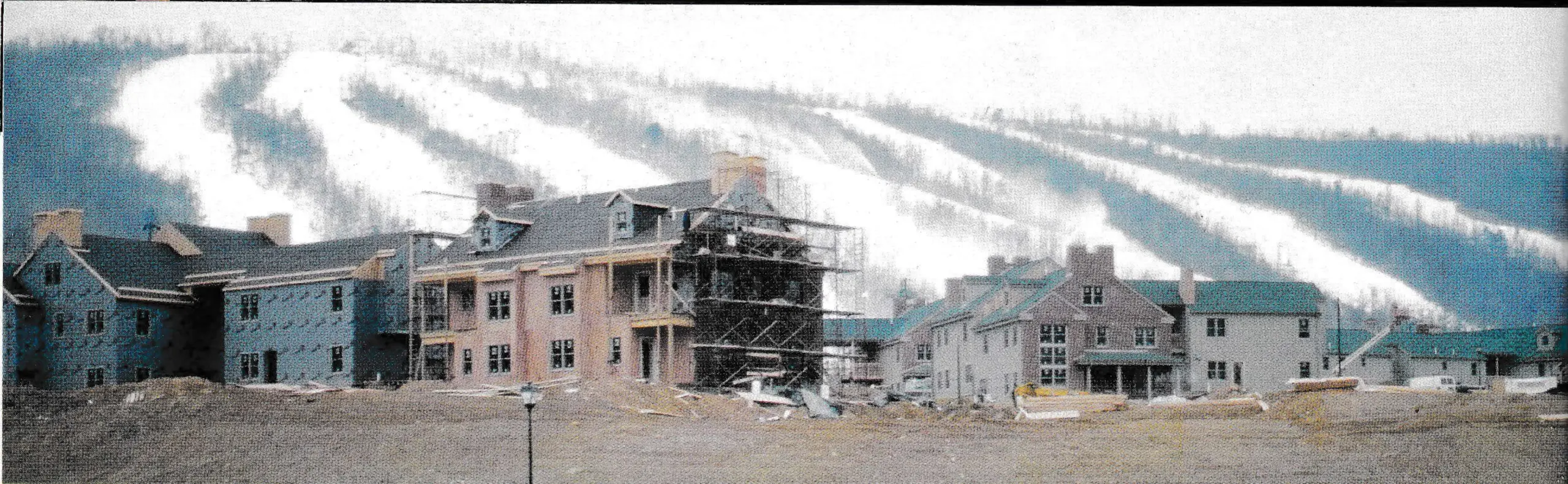
In the first phase of housing construction, which began in 1996, Whitetail is building a series of two- and three-level townhomes next to its Northern Lights beginner ski trail. Ranging in price from $178,000 to $260,000, the three- and four-bedroom units are being built in clusters of up to four; so far, 30 of 48 planned units have been completed. According to homeowner preference, the units see duty as vacation homes, rental condos and primary residences.
Whitetail faced a choice between using electricity or propane for heating and cooling. Ron Inkell, Whitetail’s vice president of operations and development, says natural gas was the resort’s first choice, but they couldn’t get a nearby line extended to the resort.
The possibility of using geothermal energy arose when Allegheny Power Company, the local electrical utility, approached the resort about using geothermal power for heating and cooling the new townhomes. Allegheny had worked with Whitetail since its startup on infrastructure to supply electricity for operations such as snowmaking and lifts. According to Joe Harry, Allegheny’s resident account manager for Whitetail, power companies encourage the use of geothermal because, when homeowners see how well it works, they’ll think of using electrical heat for other applications as well. Also, geothermal helps utilities smooth peaks in load curves because fewer electric-resistance back-up heating systems kick on in cold weather.
After weighing the options, geothermal became the choice for Whitetail. “We really liked the option because it does the cooling in the summer and it’s an inside unit,” says Inkell. “It’s quiet, and the efficiency of it seemed to fit with what we were trying to create here.”
With the decision made to go geothermal, Allegheny Power conducted a heat-loss analysis on Whitetail’s townhome design and advised resort management on how to proceed, supplying management with the names of other projects using geothermal. After specifications were developed for Whitetail’s geothermal systems, Allegheny helped the resort contact geothermal installers and helped with the bidding process.
In building the new townhomes, Whitetail used as many local and regional contractors as possible. Rockwell Construction of Mercersburg and Brechbill & Helman of Chambersburg formed a joint venture to serve as the general contractor. Whitetail solicited four companies to bid on installing the geothermal systems and eventually selected Eichelbergers Inc. of Mechanicsburg, Pa., a company that specializes in geothermal power and has nearly 25 years experience in the field.
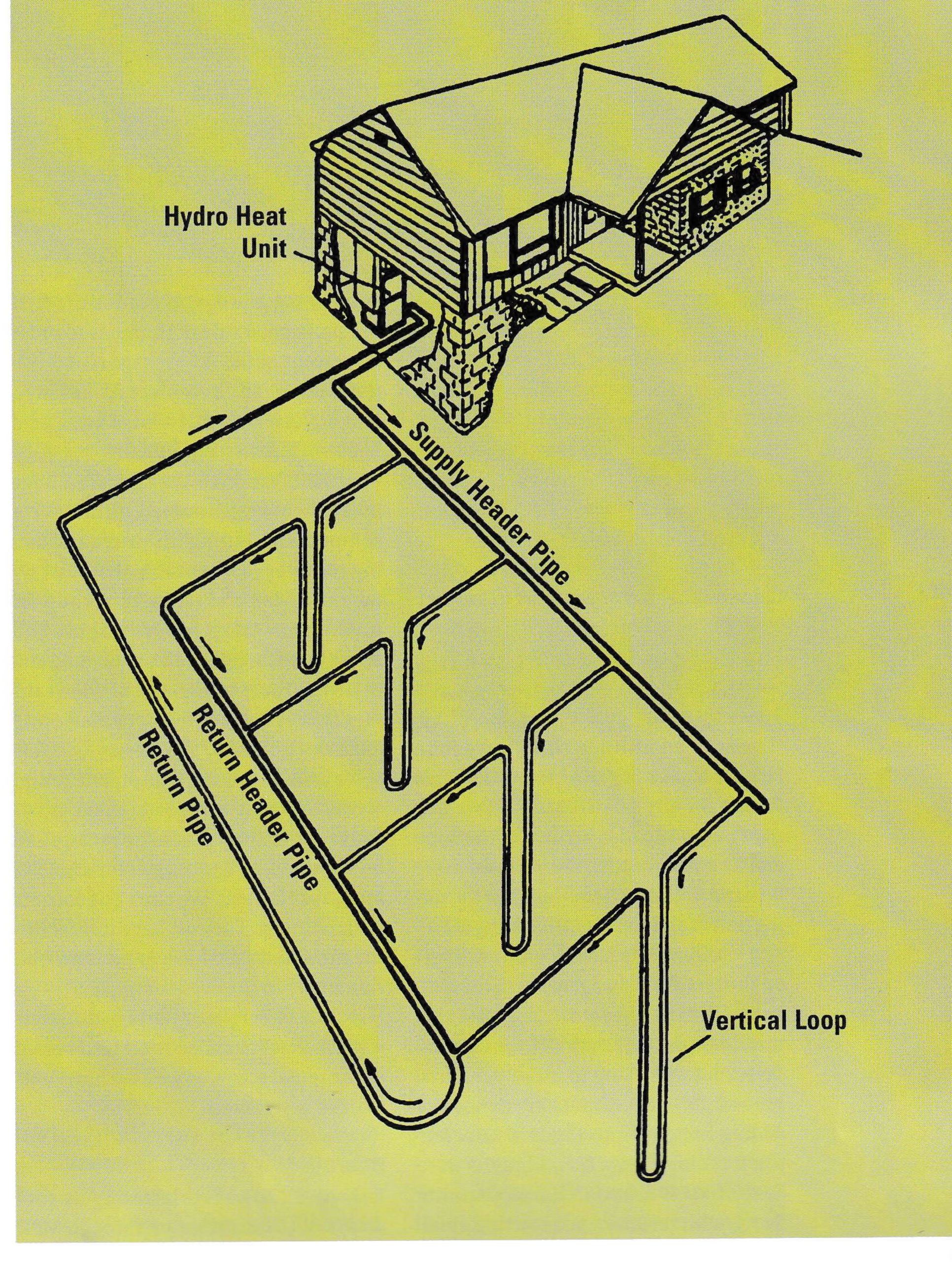
Whitetail’s geothermal system uses earth-coupled ground loops rather than ground water because no common well-water source exists and having individual wells for this would have proved too costly. Vertical loops, rather than horizontal, were chosen for the loop orientation because of space limitations imposed by clustering the townhomes together.
Eichelbergers sized the ground loops and heat pumps for the systems using design conditions of 0 degrees outdoor and 72 degrees indoor for winter and 90 and 74 for summer. They used a software package to size the loops, basing their size on 100 percent of the heating load. The loops enter the ground just outside the house and feature two U-shapes sunk to a depth of 300 feet and connected in parallel, using a reverse return. In this part of the country, the ground stays about 53 degrees year-round.
Eichelbergers drilled six-inch diameter holes for the loops in the ground using an air rotary drilling rig. Jody Hoffman, project manager for heating and air conditioning at Eichelbergers, explains that they couldn’t use a mud rotary process because of the hard sandstone found in the area. However, he says drilling through rock actually proves advantageous because it prevents cave-ins of the long and narrow holes. To stay below the frost line, trenches for horizontal piping runs to and from the loops were dug five to six feet deep.
The ground loops consist of black polyethylene pipe, with one-inch pipe used for the vertical loops and 1-1/4 inch for lateral runs. The pipe comes in rolls and technicians heat-fused sections of it together and used sockets for fittings. With the loop system welded together, Eichelbergers’ engineers ran two pressure tests for leaks: one on the loop sections in the ground and another on the entire system. To do this, they pressurized the lines to 100 psi with compressed air and held it in the system for 20 minutes.

To secure the ground loops in their holes, they were pressure-grouted in place by pumping bentonite clay to the bottom of the hole. The oatmeal-like substance dries to a rubbery consistency and allows for thermal expansion and contraction of the pipe. Hoffman says grouting with bentonite clay costs more than using other methods, such as filling with cracker dust, but results in a longer-lasting piping system.
For the circulating fluid in the ground loops, Eichelbergers engineers chose a solution of 20 percent propylene glycol, an anti-freeze that is non-toxic and safe for the environment. Hoffman says they had to oversize the loops slightly to use propylene glycol because it gels at a higher temperature than other more toxic anti-freezes such as ethylene glycol.
At the heart of Whitetail’s heating and cooling systems lie geothermal heat pumps housed in utility closets inside the townhouses—Hydro Heat Extended Range Plus Water-to-Air Reversing units made by Hydro Delta Corporation in Monroeville, Pa. Two sizes were selected: the Hydro Heat 036 size, rated at 32 thousand BTUs per hour (MBH) heat output and 37 MBH cooling, and the 046 size, rated at 38 MBH for heating and 42 MBH for cooling. The heat pumps have coefficient-of-performance ratings of 3.5 and energy efficiency (cooling) ratings of 15 and they use R-22 refrigerant, a hydrofluorocarbon that depletes the ozone layer less than CFCs.
The glycol solution circulates through the ground loops and then through a water-to-refrigerant heat exchanger in the heat pump. Two Grundfos model 2699 high-head cartridge-type pumps that are connected in series near the heat pump move the fluid through the system at 15 gallons per minute with a pressure of 25 psi. The pumps come as part of the heat pump package.
As with air-source heat pumps, the geothermal heat pumps have an electric-resistance heating coil as a supplement. These kick in when the temperature drops to 16 degrees, compared with a near-freezing setpoint for air-source heat pumps. The units can be set on two-stage operation, which works well for vacation homeowners who leave their house unattended for extended periods of time, because the backup heat stays on if the earth-coil system fails.
The blower in the heat pump has three speeds to facilitate humidity removal in summer. With the earth loops sized according to 100 percent of the heating load, the loops are oversized for cooling, meaning the unit won’t operate long enough in summer to maintain low humidity levels; changing fan speed helps compensate for this.
Whitetail offers geothermal heating and cooling as an option on its townhouses, with the cost about $4,500 higher than an equivalent system using an air-source heat pump and electric-resistance backup. Despite the higher initial cost, all 38 homeowners of the existing townhouses chose the geothermal option. Based on operation so far, resort officials say homeowners who take permanent residence can save up to 60 percent on their energy costs during winter and summer months, and they can expect a four-to-five-year payback on the investment.
Joe Harry at Allegheny Power adds, “With the conditions you have at a ski resort, geothermal makes a very efficient system for the homeowner.” Efficiency helps when homeowners rent condos to skiers, who usually pay little heed to energy conservation when they vacation in someone else’s home. Also, Harry points out that geothermal competes well with natural gas at ski resorts because gas prices rise in winter.
Looking to the future, Whitetail has plans on the drawing board for a 50-unit condo building for which they will offer geothermal power. This comes as part of the upstart resort’s ambitious master plan—to be carried out in slow-growth fashion with consideration for the environment.