

That conclusion became clear following a meeting in February when five major ski organizations adopted a comprehensive and coordinated safety awareness program—complete with logo and slogan. The program goes into effect next season with the objective of educating or re-educating all skiers about risk and safety.
“We want to make sure that people know what they are doing when they choose to ski,” said Chris Stoddard of the National Ski Areas Association who has played a major role in shaping the program. “Skiers should understand the risks of the sport and react accordingly.”
Even as the representatives of the five organizations were meeting in Denver, a number of ski areas had undertaken safety awareness programs. Some began with an intense commitment and many were instituted in conjunction with programs already established by the NSAA or one of the other organizations.
Their reports were encouraging. The areas that had launched full-scale efforts to discourage reckless skiing said they had received an overwhelmingly positive response from guests who for years, apparently, had quietly tolerated out-of-control or otherwise dangerous skiers. And one area, Hunter Mountain in New York, reported that the rate of collisions between skiers had gone down by 50 percent this past season, even though skier attendance was up 20 percent.
By now the background for safety awareness programs is familiar. In the late 1970’s, the NSAA commissioned Dr. Jasper Shealy of the Rochester (N.Y.) Institute of Technology to conduct a study of ski injuries. After gathering statistics over four seasons, from 1979-80 to 1982-83, Shealy found that while overall injuries from skiing had decreased from 7.6 per 1,000 during the 1960’s to 2.2 per thousand by 1980, the rate of serious injuries—paralysis or death—had increased.
During those four seasons, 92 skiers were killed and 63 permanently crippled. And in one season, the number of seriously injured skiers jumped 24.4 percent, from 0.82 skiers per million skier days in ’81-’82 to 1.02 skiers per million days in ’82-’83.
Further analysis revealed that the most likely victims of serious injuries were males under 25 who were accomplished skiers, roughly the same group who score tragically high in automobile fatalities and serious injuries.
The conclusion seemed clear. The combination of groomed trails and highly tuned equipment, interacting with masculine zest, had provided a false sense of security. Those involved in serious accidents were going too fast for their ability to react to the unexpected. The result was high-speed collisions with trees, fixed objects on the trails and sometimes other skiers.
Executives of the major ski organizations gave the Shealy statistics serious attention. They were concerned for humanitarian reasons, but they were also concerned because of the increasing costs of liability suits resulting from serious accidents.
Initially, they looked at the statistics from the framework of their previous skier safety efforts. The National Ski Areas Association took a new look at the Skiers’ Responsibility Code, and last year prepared and widely distributed, a Skier Education Action Kit. In the process, it hired Chris Stoddard and included safety awareness programs as a major part of his responsibilities.
Ski Industries America, representing manufacturers of ski wear and ski equipment, has traditionally encouraged the development of safety standards for such areas as release bindings, but SIA also began to take an interest in the NSAA programs as well. The National Ski Patrol, the Professional Ski Instructors of America, the U.S. Ski Coaches Association, had all been involved in safety programs on the mountain as routine parts of their responsibilities.
Yet, as last season began, the overall effort was still somewhat fragmented as each group followed its own star.
That approach to safety awareness, with each group sponsoring independent programs, ended abruptly at the February meeting in Denver. There, representatives of the five organizations, in short order, decided to combine their talents and prestige to promote a program that would use a common logo and slogan, increase the visibility for the Skiers’ Responsibility Code and train their members in methods of stressing safety awareness on the mountain and in dealing with reckless skiers.
Dave Hamilton, the executive director of the PSIA, reflected the enthusiasm of the others involved, calling the effort “the most exciting thing that’s happened in my 30 years in the ski industry.”
A veteran of committee systems, he exclaimed that “for the first time the organizations and the individuals took their egos off the table and united behind a program to promote a common concern.”
He referred to a process that started last May at the NSAA convention when representatives of the major groups informally agreed that because they were all concerned about safety awareness programs, then they should work together. They also agreed that a combined approach should be upbeat and positive. Their efforts should concentrate on education and reinforcement of good behavior, rather than punishment for bad behavior.
“No one wants to be a traffic cop,” said Stephen M. Over, executive director of the National Ski Patrol System. “People ski because it’s fun. . .we’d be the last people to take the fun out of skiing.”
The new effort relies on the strengths of all five organizations. The NSAA and SIA will provide support services, primarily by delivering the educational materials to their members and encouraging them to participate in the program.
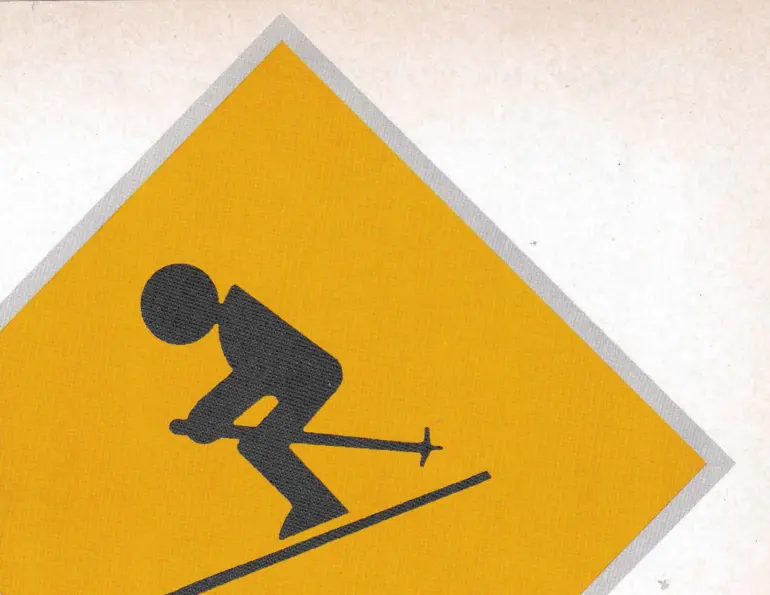
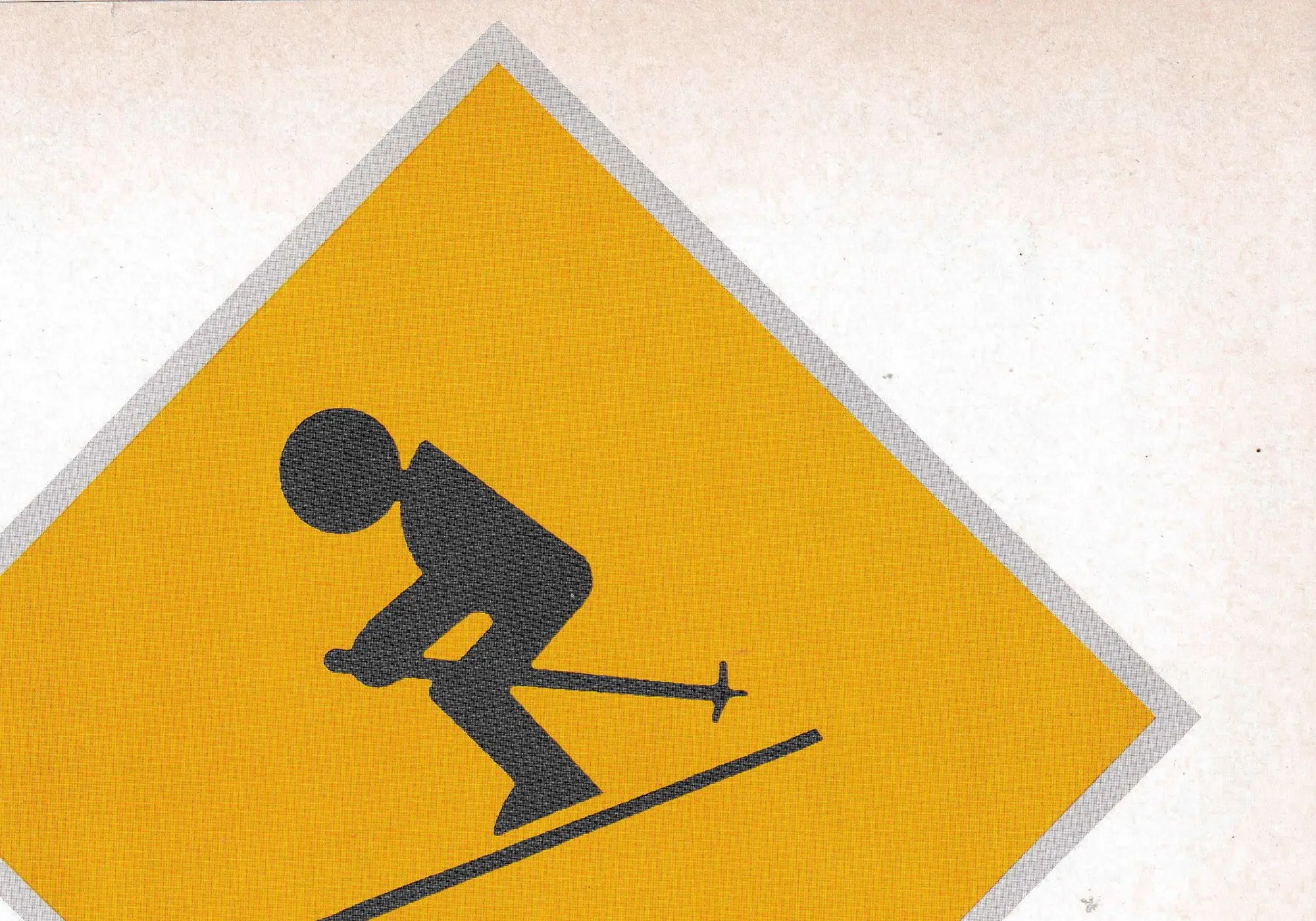
This means that the logo—a yellow diamond with a block figure of a skier in its center—will appear in hundreds of advertisements, along with the slogan, “Be Aware, Ski With Care.” The same symbol and slogan will also appear on ski posters, on napkins, plates, signs, lift towers. . .any place that it might be seen by skiers.
NSAA’s participation in the program falls under the jurisdiction of its new Ski Area Safety Committee with co-chairman Hans Geier, president of Steamboat in Colorado, and George Willett, general manager of Showdown Ski Area in Montana. The committee represents the merger of two former committees: Skier Education and Safety and Risk Management. Serving as the committee’s representative to other groups is Chris Stoddard, whose formal title is NSAA technical and educational program administrator.
The other three organizations, the National Ski Patrol System, the Professional Ski Instructors of America and the U.S. Ski Coaches Association, through their various memberships, will reach skiers on the mountain.
Next year, for the first time, ski patrollers will be formally trained in procedures for dealing with reckless skiers. Part of that training will consist of a videotape being produced jointly by the NSAA and the NSPS with financial support from the Massachusetts Mutual Life Insurance Co. The video will show how to identify reckless skiers and then how to handle them in positive ways that will result in more responsible skiing behavior.

“There’s a real need for such training,” said Over. “In the past, patrollers have been good skiers who could handle toboggans and knew First Aid, but we’ve never required them to be psychologists as well.
“Stopping reckless skiers is a difficult task. First, recognizing a reckless skier can be tough because skiing fast doesn’t necessarily mean skiing recklessly. Then if you do stop a reckless skier, the situation can be difficult to handle. Our training, with this videotape, will suggest positive ways to meet the problem.”
Hamilton observed that professional ski instructors have always practiced safety in class situations, but for the most part, have not taught safety.
“That’s going to change,” he said. “As of next season, every class at every level will include safety instruction.” The instruction, however, will be on a soft-sell basis.
“We are not going to drill skiers in the responsibility code,” he said, “but during the course of a class, all of its points will be covered.” For example, instructors will explain to their classes why they have stopped on the side of a trail uphill from a bump. Or instructors will stop a class before an intersection, then explain why entering skiers should yield to other skiers in the intersection. Both practices are among those specified in the Skier’s Responsibility Code.
In addition, to gain certification, all instructors will be required to demonstrate their proficiency in teaching safety awareness as well as skiing. Finally, the NSAA and the PSIA are preparing a safety guide for ski school directors, a project that has been assigned to Gwen Allard, the former director of PSIA’s eastern division.
The U.S. Ski Coaches Association, an organization composed of approximately 1,500 ski coaches at all levels, is developing responsibility codes for both racers and coaches, as well as a video training program, said John Armstrong, president.
The codes, he said, will particularly apply to the behavior of racers and be modeled somewhat on practices that already exist at Mammoth Mountain in California where he is based. The codes will emphasize the importance of warming up, leaving the finish area at the end of a race, wearing padded clothing and unbreakable goggles and informing coaches of problems. All racers and coaches will receive this training next year, Armstrong said.
These developments make it clear that within the next few years every skier will have been reached in one way or another with a safety message.
Dave Hamilton, the PSIA executive director, said that professional ski instructors, during any five-year period, have direct contact with 70 percent of all skiers. When that contact is reinforced by ski patrol efforts and safety messages on pins, ads, lift towers, napkins and in restrooms and cafeterias, a skier would have to be deaf, dumb and blind to miss the point.
Most states with ski areas have laws on the books that prevent reckless skiers who injure themselves or others from collecting damages.
David L. Cleary, special counsel for the National Ski Areas Association, said that 23 states have laws that pertain to skier responsibility.
The majority of them, he said, require skiing in control at all times, with control defined as “skiing in a way to avoid injuries to themselves or others.” Many of these laws also require skiers to observe all posted rules and regulations.
“This is interpreted to include the Skier’s Responsibility Code,” he said, since it is posted at most areas. Instead of providing for such penalties as fines, he said, the majority of the laws call for “civil sanctions.” This means if a skier is found in violation of the law, that skier cannot collect a damage award for any injuries. It also means if a second party is injured by a skier, who is found in violation of the Skier’s Responsibility Code, then that second party has a strong case for damages against the reckless skier.
North Carolina is among the states with a skier responsibility law. Attorney Cleary remarked that some areas in that state use their brochures and trail maps to call attention to the law with the following statement: “Ski in control…it’s the law.”
Will it all work? Will the various efforts taking place on all levels reduce ski injuries, especially the ones involving paralysis and death? The degree of effort being put into the campaigns, the coordination among the major ski organizations, certainly suggest that it will.
Yet, there are a lot of bad habits to overcome. As Randy Short, president of PSIA observes, “It’s as if you’ve had a bunch of motorists who have operated without speed limits for 25 years. Now we’re trying to institute rules of the road and it’s different. It takes getting used to. But we have to do it.”