

Wrong, at least in this case, because risk-taking there was—both for the resort and for the lift manufacturer. For the resort the risks included a critically short nine-month gestation from contract signing to completion—short for any major lift, but scarily so where so much had to be designed from scratch. Another risk was giving the contract to a domestic lift manufacturer whose reputation, good though it was, rested almost wholly on non-detachable chairlift technology.
From Lift Engineering’s point of view, the risks were enormous, and went beyond mere reputation to encompass even the viability of the $20 million/year company. But the challenge was too great for Jan Kunczynski to turn down. It was a chance for a domestic skilift manufacturer to break new ground, cross new frontiers in a technology currently dominated by the Europeans. (There is a certain irony that the Polish-born, European trained Kunczynski is by far the most ardent stars-and-stripes business nationalist among the domestic lift manufacturers.) He clutched the creative challenge, knowing the grasp could be fatal. He also knows he makes waves in whatever he does, and has become somewhat fatalistic about being the enfant terrible of the industry. And he well understands that he doesn’t lack for detractors who wouldn’t mind seeing his wings clipped a bit.
The bottom line? Kunczynski is proud of his accomplishment. Yes, he concedes, there are some systems to be de-bugged, but nothing major, nothing insurmountable and nothing you would not expect in any prototype. Certainly his customer, Keystone, is delighted with what they bought. John Rutter, VP of ski operations, summed up that “it was unbelievably popular with our customers—way beyond our expectations. People really skied the gondola. They got off at the top, skied right down and came back up the gondola. All day long.”
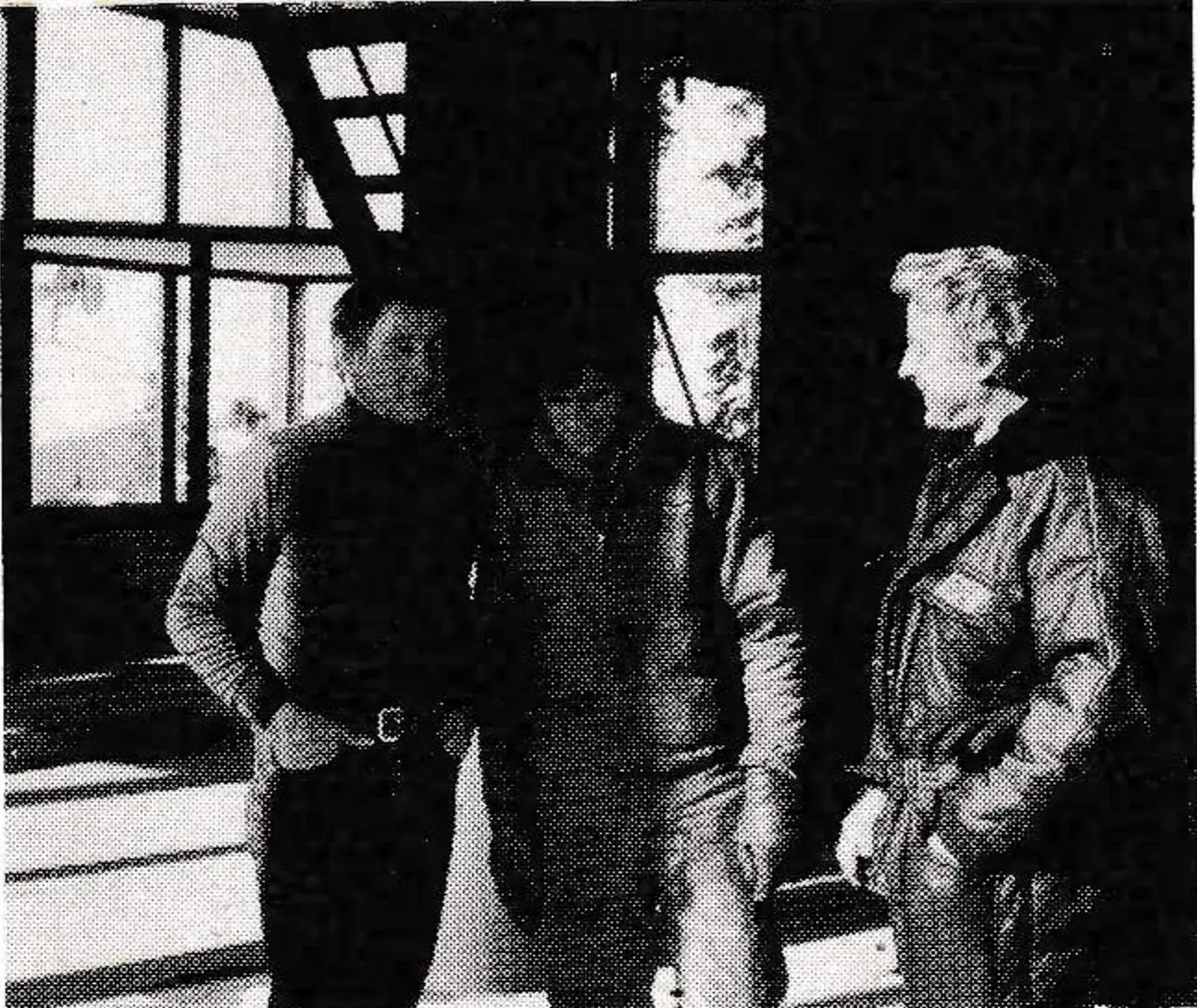
And any impartial observer would have to be impressed by any lift which delivered between 900,000 and a million skiers to the top between its late-December start-up and Easter. That has more of the earmarks of a work horse than of a finicky prototype.
From the industry, the reaction is mixed. A few say Kunczynski reached too high and went too fast for his own good, resulting in an ego-driven, magnificent failure; others, including most of his competitors, acknowledge its innovative technology as a laboratory of new ideas. Certainly nobody finds it dull. Jack deRyk, as Lift Manager, conducted countless tours for visiting firemen, domestic and foreign, and heard mostly awe and favorable comments. The smoothness of the ride, the spaciousness of the cabins and the clean, open design of the buildings were most frequently commented on, according to deRyk.
Some of the Yan Innovations
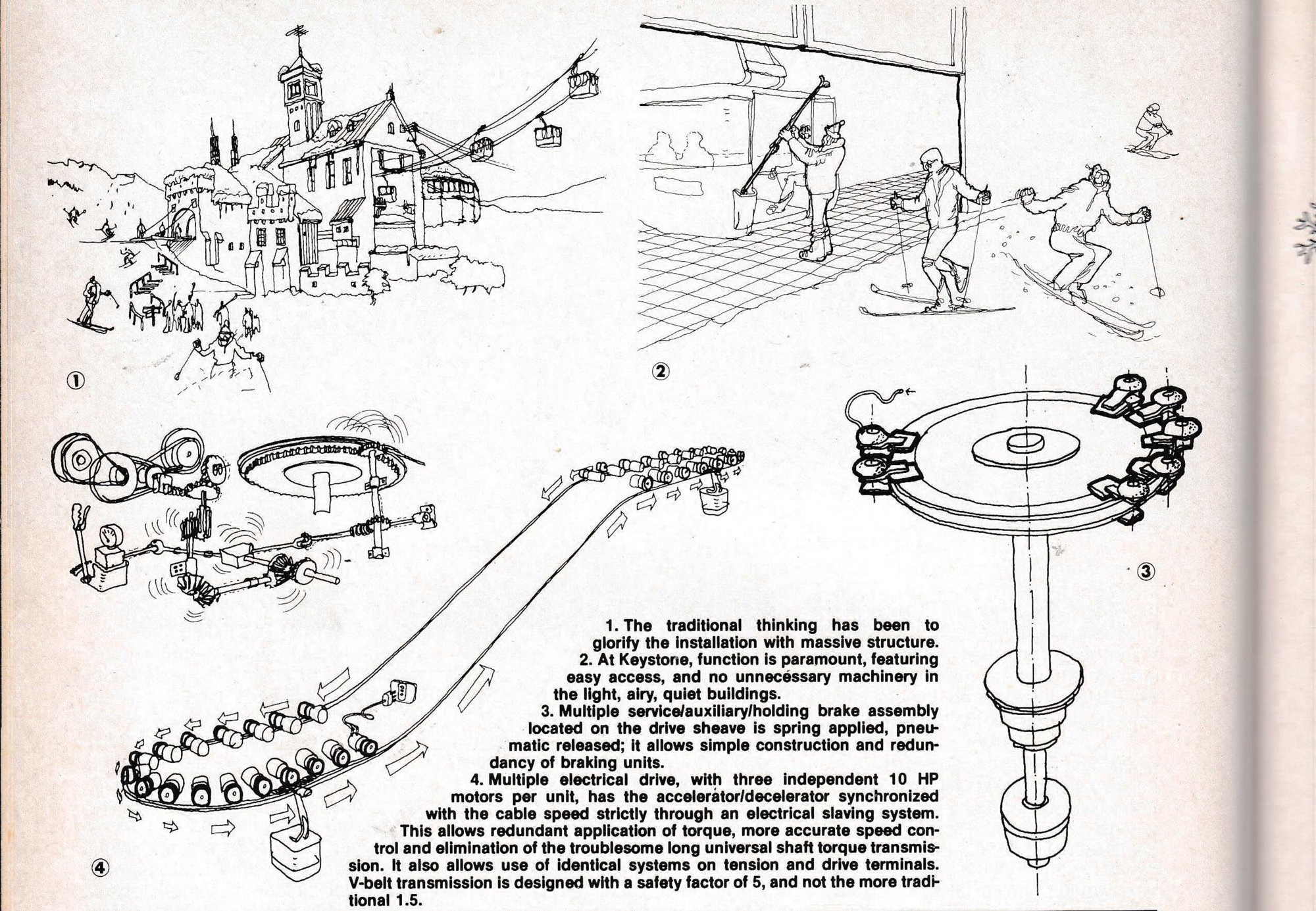
1. The traditional thinking has been to glorify the installation with massive structure.
2. At Keystone, function is paramount, featuring easy access, and no unnecessary machinery in the light, airy, quiet buildings.
3. Multiple service/auxiliary/holding brake assembly located on the drive sheave is spring applied, pneumatic released; it allows simple construction and redundancy of braking units.
4. Multiple electrical drive, with three independent 10 HP motors per unit, has the accelerator/decelerator synchronized with the cable speed strictly through an electrical slaving system. This allows redundant application of torque, more accurate speed control and elimination of the troublesome long universal shaft torque transmission. It also allows use of identical systems on tension and drive terminals. V-belt transmission is designed with a safety factor of 5, and not the more traditional 1.5.
Two design philosophies underpinned Kunczynski’s approach to the project: anti-building and using American hi-tech power concepts.
He believes that function should be paramount in designing a terminal building; that this function is in turn a function of what the skier wants; and that the impacts of the building—visual and auditory—must be minimized. This adds up to his “anti-building” philosophy.
Why make skiers go up and down stairs, clutching skis and poles and hobbling in hi-tech boots when access to the cabins both at the top and bottom terminals, can be at outside grade? Why assault the skier’s ears with the noise of coupling, decoupling and clutching in the terminal when these functions can be put outside the building? The usual clank of chains and metal-to-metal contact of cabin movement in the terminals are replaced here by the inaudible hum of small electric motors driving rubber-tired wheels. It is as though he was harking back to the old Rolls Royce ads about the noisiest thing in the car being the electric clock.
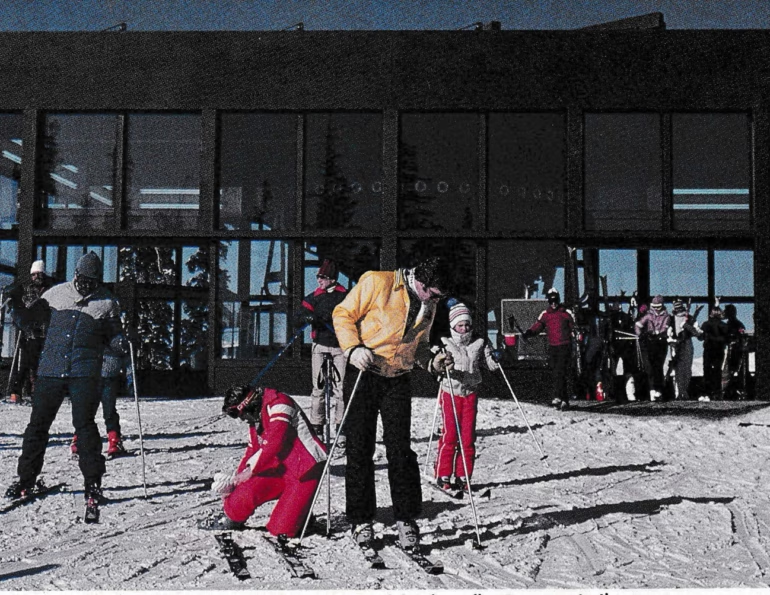
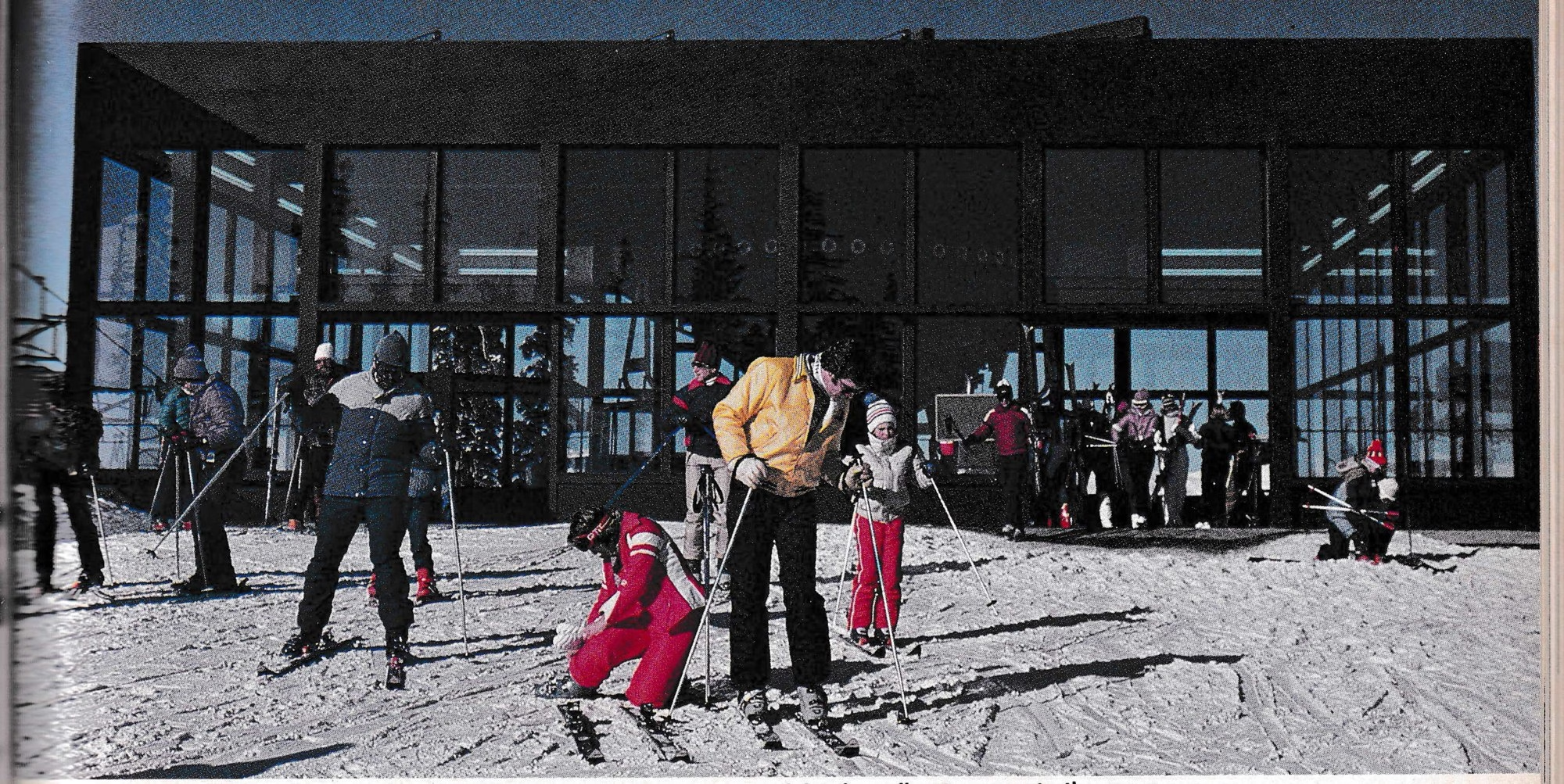
Basic to his anti-building credo is the minimization of the visual impact of the buildings. They are light, airy, un-monumental, and in no way reflect the massiveness of a system of 5,500 VTFH. The concept is carried to great lengths in the way the cabins are linearly garaged in a low shed, just 14 feet wide, that snakes through the lodgepole pines and under their concealing branches, following the contours of the land. Most skiers will never even notice its existence.

The American hi-tech concepts that Kunczynski utilizes prompted a European engineer to tease him about the “gigantisme” in his design. His response was that American industry routinely uses huge (by European standards) motors, so why not take advantage of the availability of these standard items and design accordingly? For instance, the 3,000 HP gearbox runs at low RPM using standard high-torque traction motors, also 3,000 HP.
The conventional is to have a multiple of smaller motors running at high RPMs.
There is also a certain “gigantisme” in his use of 55mm cable and a large single grip. In this case it is designed to maintain the ratio of the weight of the carrier to cable tensions (from 1 to 16).
Will Kunczynski build more such gondolas? “Of course I expect to, but don’t know when. The Europeans enjoy such a competitive advantage today. Skilifts are on the list of premium exports for Austria and France and get premium governmental subsidies. That, plus the cheap French francs and Austrian schillings…” and the unfinished sentence is eloquent. “There are some big developments out there that we don’t even bother to bid on,” he adds, “and it may be the same for the other domestic manufacturers. Our industry should understand this.”
“Janeck stop building lifts?” scoffed one prominent industry figure; “You haven’t seen the fish stop swimming or the birds stop flying, have you?”
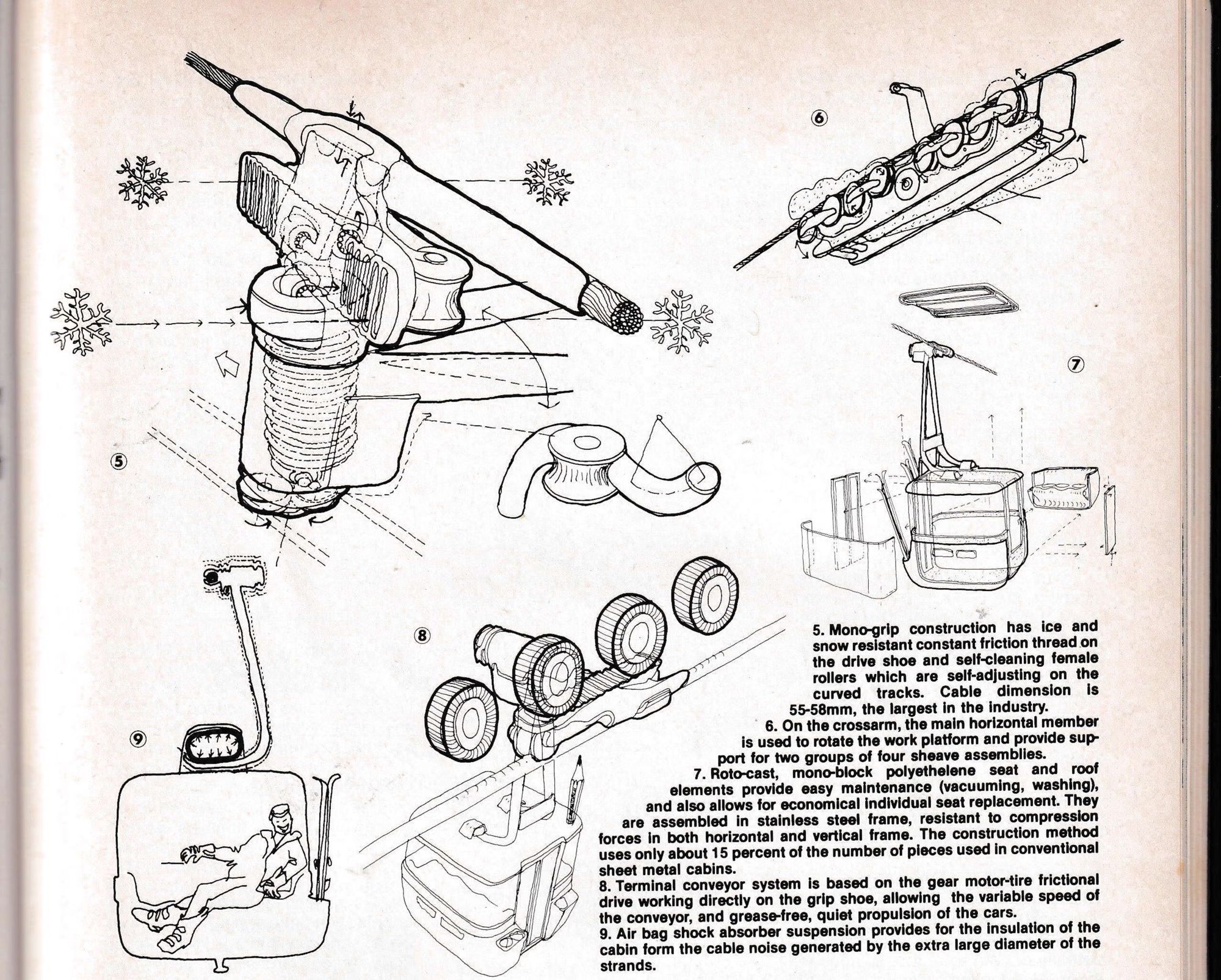
5. Mono-grip construction has ice and snow resistant constant friction thread on the drive shoe and self-cleaning female rollers which are self-adjusting on the curved tracks. Cable dimension is 55-58mm, the largest in the industry.
6. On the crossarm, the main horizontal member is used to rotate the work platform and provide support for two groups of four sheave assemblies.
7. Roto-cast, mono-block polyethelene seat and roof elements provide easy maintenance (vacuuming, washing), and also allows for economical individual seat replacement. They are assembled in stainless steel frame, resistant to compression forces in both horizontal and vertical frame. The construction method uses only about 15 percent of the number of pieces used in conventional sheet metal cabins.
8. Terminal conveyor system is based on the gear motor-tire frictional drive working directly on the grip shoe, allowing the variable speed of the conveyor, and grease-free, quiet propulsion of the cars.
9. Air bag shock absorber suspension provides for the insulation of the cabin from the cable noise generated by the extra large diameter of the strands.
| Item | Value |
|---|---|
| Slope Length (coupling to uncoupling) | 9295 ft. |
| Vertical Rise | 2302 ft. |
| Minimum Spacing | 150 ft. |
| Minimum Interval | 9 sec. |
| Maximum Speed | 1000 fpm |
| Capacity | 2400 pph |
| Number of Cabins | 136 |
| Cabin Capacity | 6 pass. |
| Cabin Empty Weight | 1200 lbs. |
| Drive Terminal Location | Top |
| Main Drive – 1000 HP DC SCR | Sabina |
| Main Gear Reducer | YAN 3000 |
| Electric Motor – 1200 HP | GULFCO |
| Auxiliary Drive | Hydrostat |
| Auxiliary Power – Cummins NTA 1150 P525 | 2 each |
| Hydraulic Pumps – Eaton | 4 each |
| Hydraulic Motor | Rex Roth A2F |
| Gear Reducer | YAN 1000 |
| Emergency Generator – Cummins NT 495 GS (drive) | 125 KVA |
| Tension Terminal Location | Bottom |
| Counterweight (direct pull) – Concrete | 63,000 lbs. |
| Counterweight Connection – Triple Width Chain | RC-240 |
| Emergency Generator – Cummins NT 495 GS (tension) | 125 KVA |
| Accelerators | Tires |
| Accelerators: Power – 10 HP AC Gear Motors | 3 each |
| Accelerators: Control – Inverter | Emerson |
| Decelerators | Tires |
| Decelerators: Power – 10 HP AC Gear Motors | 3 each |
| Decelerators: Control – Inverter | Emerson |
| Decelerators: Speed – Variable | 50 FPM Max. |
| Station Conveyor – Gearmotors w/Tires | 34 each |
| Station Conveyor: Control – Inverter | Emerson |
| Line Gage – Nominal | 15 ft. 9 in. |
| Cable (dia.) | 54.7 mm |
| Cable Lay | Rt. Lang |
| Cable Construction – Filler Wire | 6 x 25 |
| Cable Core | Fiber |
| Cable Lubrication | Castor Oil |
| Cable Breaking Strength | 445,000 lbs. |
| Cable Manufacturer | W.R.I. Ltd. |
| Drive Terminal Building | 2 story |
| Drive Terminal: Arrival Level Area | 3600 sq. ft. |
| Drive Terminal: Shop and Machinery Level Area | 3600 sq. ft. |
| Drive Terminal: Area Available to Public | 1700 sq. ft. |
| Tension Terminal Building | 1 story |
| Tension Terminal: Departure Area | 3600 sq. ft. |
| Tension Terminal: Area Available to Public | 1700 sq. ft. |