We heard every word the friendly-voice said, but we were most impressed with how it was said, because we’re in the business of teaching guest relations skills and this message was outstanding. The other areas we called gave us complete and detailed information, but the voices seemed flat, mechanical and monotone. They sounded bored; as exciting and stimulating as an oboe solo.
Because the skiing demographics were almost a toss-up, we opted to see what the friendly-voiced ski area had to offer. After several hours driving, we arrived to find a modest-sized ski area on top of a steep, but small mountain.
A bundled-up parking lot attendant with a trail-wide smile on his face and a friendly greeting made us feel that he was glad to see us. We couldn’t help but notice that his parking signals were more human and less robotlike than the variety you get from the cop-at-the-intersection in the big city. Not bad for openers. This reception, coupled with the outgoing manner of the unseen recorded voice, began to give us nice warm feelings about our choice of areas. But would it last?
Diane and I have been in the personnel training and development business for a combined 25 years. We’ve trained thousands of employees in hundreds of companies in such skills as guest relations, handling interpersonal conflict and supervisory skills. We’re ultra-sensitive about what we see at the delivery end of such training efforts and how well a company treats, not only its customers, but its employees as well.
As we waited in the ticket line, a personable young woman explained the no-no’s of buying a lift ticket to a fellow who wanted to pass it around to his friends. Mount Rushmore had never seen a better chiseler. But the lady in ticket sales was excellent. She kept the line moving, was patient with the would-be freeloader and finally won him over with logic, a smile and good guest relations skills. She got the argument to lose force without the customer losing face, and that’s a real skill.
After our imposed sabbatical in the Sun State, we needed to have our gear checked out, so we headed for the ski shop. The counter there was a crescendo of clatter and chatter but, here again, the people on the receiving end of all this were handling things in great fashion and were friendly, knowledgeable and efficient.
All this indicated good guest relations training, but the best demonstration was yet to come.
Most ski area managers know the physical and mental abrasions delivered to lift operators who load novices onto T-bars. Add to their inexperience cold feet, cold hands, an occasional ski pole in the ear, novice panic and a few unscheduled Mobius flips, and you have an acid test for any guest relations training.
However, the two smartly-attired lift attendants were having fun with the customers, and the customers were having fun with them. (And that’s the point of skiing, isn’t it?) The fun wasn’t the backslapping, wisecracking kind. Those attendants knew exactly what they were doing. They were combining their job skills with their people skills. The whole scene was enough to warm the heart of even the most hard-cash, bottom-line manager.
We watched ski instructors, food servers, ski patrol, groomers, snow makers—and almost everyone related to the guests in that same friendly manner. What’s more, we watched those paying guests, who had plunked down 21 bucks apiece to ski there. They were responding in kind.
There’s a truism in our business that says, “We teach each other how to behave,” and the personnel at that ski area were proving the point. By their behavior, they were “teaching” the guests to be friendly, responsive and caring, and they didn’t need signs, ropes, rules or a bullhorn to make that happen.
A further point is that the snow that day wasn’t the greatest, the area wasn’t the most glamorous, the vertical drop was about 700 feet, the weather was cloudy and crummy and… there were six other areas within an hour’s drive! Yet, here was this place with all the business it could handle. This was no accident.
Diane and I were curious enough to ask to see the area management. They told us they have guest relations meetings once a week (not in spite of the seasonal rush, but because of it!) The employees talk things over. They share experiences. They exchange ideas and they anticipate. Good guest relations they discovered, is a skill that can be identified, taught, learned and practiced.
Payroll Prisoners
Too many ski areas, businesses and even major theme parks get careless about keeping up guest relations skills. The pressures of day-to-day operations tend to crowd out the guest relations training schedules and the sense of urgency about it falters.
Some managements have told us that they are too big for this kind of training. It would, they say, cost too much because their personnel turnover is too high. One area owner said he hires only competent people who don’t need to be trained.
Other ski and resort managers claim they are too small. They can’t afford the price of training and they can’t spare their people for the time needed to attend such courses.
We’ve had people tell us that their area personnel are largely part-timers and guest relations training would be a waste. What they may not hear themselves saying is that it’s O.K. if the part-timers project poorly to the guests because they’re not around much anyhow.
Dr. Otis Maxfield, a noted humanist and consultant to several of the nation’s leading corporations, says of the attitudinal chasm between employer and employee: “If I work for you only because you pay me then, in effect, you use me and I become your prisoner. When that happens, I’ll look at where I spend most of my waking hours as a prison in which I labor and not a garden in which I can bloom and grow.”
Prisoners, are either planning their escape or have given in to the almost unbelievable frustration of confinement. This kind of attitude is seen in those employees who quit in December, but fail to let management know about it until they leave in April. If an area has many of those employees, it will show up in how the guests are treated, and it will surely waste scarce payroll dollars.
Employee Perceptions
The effectiveness of any guest relations program hinges largely on employee relations efforts. Good employee relations starts with accurate, unbiased appraisals of how employees see themselves, their jobs, the competence of their supervision, the future of the area and their future with the area.
The results of such appraisals are perceptions, but that is what managements must deal with. Whether they are perceptions on the part of employees or perceptions in the minds of the paying guests, these ideas, accurate or not, make the difference in both employee and skier loyalty to an area.
Employee assessment surveys are not used because of fear more than any other reason. Some senior executives are afraid that poor perceptions will reflect on their abilities and personal performance as leaders.
What they fail to realize is that perceptions are not necessarily facts. Playing ostrich with the feelings and opinions of the work force only makes management’s task more difficult, and it puts any guest relations program on shaky ground.
Surveying Attitude
There are hundreds of firms offering so-called employee attitudinal surveys. Unlike consumer surveys, employee surveys concentrate on the motivations, values and orientations of the people who are the working team. The consumer has little emotional involvement with the product he or she buys, despite what some would have us think. But the employee has both an economic and an emotional stake in the activity performed at a ski area.
Being able to get at these ideas, perceptions and feelings which, in many instances, are the employee’s “hidden agendas,’ is what separates the valid surveys from the also-rans. In fact, a poorly-designed and executed survey will do more harm than good and should be avoided.
How can management tell a good survey from a poor one? There are several ways. First, the best surveys are not self-administered. That is, they are not conducted, scored and analyzed by management, but rather by an impersonal source which can be more objective. People tend to tell management what they think management wants to hear as opposed to what management needs to hear.
Secondly, confidentiality is key to a successful survey effort. Most employees are suspicious that management will be able to identify their responses. The best survey instruments take this into consideration and are designed to safeguard the identity of the respondents.
Next, good survey techniques include looking for both the favorable as well as the unfavorable perceptions. Some we’ve seen are designed so as not to “bring bad news to the king.’ Don’t buy a survey that includes recommendations. This is a hard statement but one that can save a lot of unnecessary problems. The purpose of a survey is to report perceptions, not to run your business. If you need a consultant, hire one; but don’t ask for advice in a survey.
Finally, there is a matter of time and expense. Some survey companies call for elaborate meetings, conferences and travel. Rather look for a survey that is simple, confidential, externally administered and one you can afford. If you have to worry about the price of gas, don’t buy a limousine.
Get suspicious of the surveys that cost a dollar apiece, but shun the ones that cost $50,000. As a guide, you can get a valid, 200-employee survey that can develop a ton of information for about $10 each, and you have the right to expect the results back in no more than 30 days. (One outfit waited four months for the results, and it cost them another season of neglected misconceptions and a missed opportunity to reinforce some positive measures.)
Aside from the important information about pay, benefits, hours, communications, etc., an employee assessment survey will point out problems that can be addressed with training.

We always ask a client two questions: ‘What do you want to train them to do?” and “What do you think they want to be trained to do?” The answers generally divide themselves into three categories: job skills, attitudinal skills and interpersonal skills with fellow employees.
Knowing these factors, management can select specific types of training required to remedy the situation. We see a lot of money wasted on programs, courses and seminars that were selected because of the misconceptions of what was needed or bought because of over-zealous sales people. One size does not fit all in the selection of training programs, unless management is convinced that their area is exactly the same as someone else’s. Use an impartial survey to find out what kind of training is needed.
Training Sources
Like selecting the right supplier for an assessment survey, choosing the right source for training courses is important.
Some larger ski areas develop their own curriculum and cadre of instructors. They use professionals within the organization or hire educators or trainers who have an affinity for the ski business. Courses are designed and created to fill specific needs, and schedules are worked out for this kind of activity. Sometimes they utilize local colleges for material and personnel, and many have sophisticated audio-visual equipment for delivering the subject matter.
Most ski areas, however, do not have any guest relations or interpersonal skills training. What they might do is an occasional “give ’em hell, Harry” harangue by a supervisor or department manager. While ‘best is the enemy of better,” this method of educating area personnel is usually not fruitful.
Some areas hire local consultants who have a grounding in human relations. The problem with this approach is that, while most of these consultants have pretty fair credentials in psychology, humanistic studies or the like, they have very little practical knowledge of what it takes to run a ski or resort area profitably. Furthermore, they may lack experience in group dynamics and the technique of teaching adults.
If you’re inclined to favor a local, independent consultant, ask other area managers who they use, and don’t be bashful about asking what they liked and didn’t like about the guy.
Another approach is to hire a “training company.” The first-rate companies like Wilson Learning Corporation of Minneapolis, Minn., Xerox Learning Systems of Stamford, Conn. and others of their stature are solid. They are experienced and understand the process of learning, not just the content of a course or two. They have libraries of programs, professionally qualified instructors who will come to your area to conduct courses and/or train some of your area people to conduct their courses. This “train the trainer’ idea makes economic sense for larger ski areas.
The down-side of big professional training companies is cost. They require fairly large numbers of people to be trained in order to make the cost-per-person reasonable. They also require a substantial population potential of attendees in order to customize a given course for an area. Building “bridges” for your attendees so they can relate the generic examples in most of these programs to the specifics of the ski industry may pose problems.
A good tip for selecting an off-the-shelf training program is to ask, among other questions: “How will I know when my people have been trained?” If the answer you get is, “When the program’s over,” then skip it. It won’t work. Training must have measurements or you will never know what the return on your investment was when it comes to figuring out the true cost of the training. It suffices to say, minimize the risk by not going for the inexperienced, unproven or bargain deal.
It may come as a shock to those who are looking for the quick and easy to learn that it takes at least 8 to 16 hours of structured presentation, assimilation and demonstration to get the basics across. The instructor needs time to break down the barriers such as indifference, undue egotism and, in some cases, hostility in attendees who have been “ordered” into the learning experience. New concepts and ideas have to be advanced and old, but valid ones reinforced. Attendees must be made comfortable with new ways of looking at things and must be given time to try out these concepts in the safe environment of the group. This takes time. How much time depends on the size of the group, the degree of current skill levels and the facilitator’s ability to meet the agendas of the attendees.
Some courses have both follow-up and follow-on—these are the best kind. Conditions change and people’s attitudes change. As the cost of a lift ticket goes up, so do the skier’s expectations. What was acceptable last year may not be this year, so guest relations must keep pace. This kind of training is not something the employee puts on at eight in the morning and takes off when the area closes. Good guest relations skills go on. They become part of a person’s behavior pattern. They’re there 24 hours a day, everyday. Indeed, it is a way of relating to others, guests or not.
Training Objectives
Guest relations training is a lot more than an upper-numbered personality course. It embodies an understanding of human nature and human relations. It teaches something other than “fight or flight” in a contentious situation. It is a vibrant, practical method of dealing with human beings.
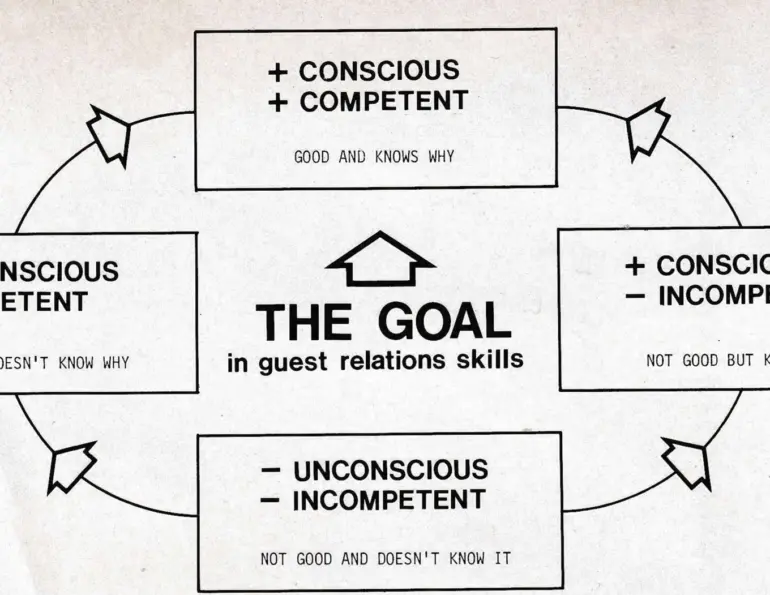
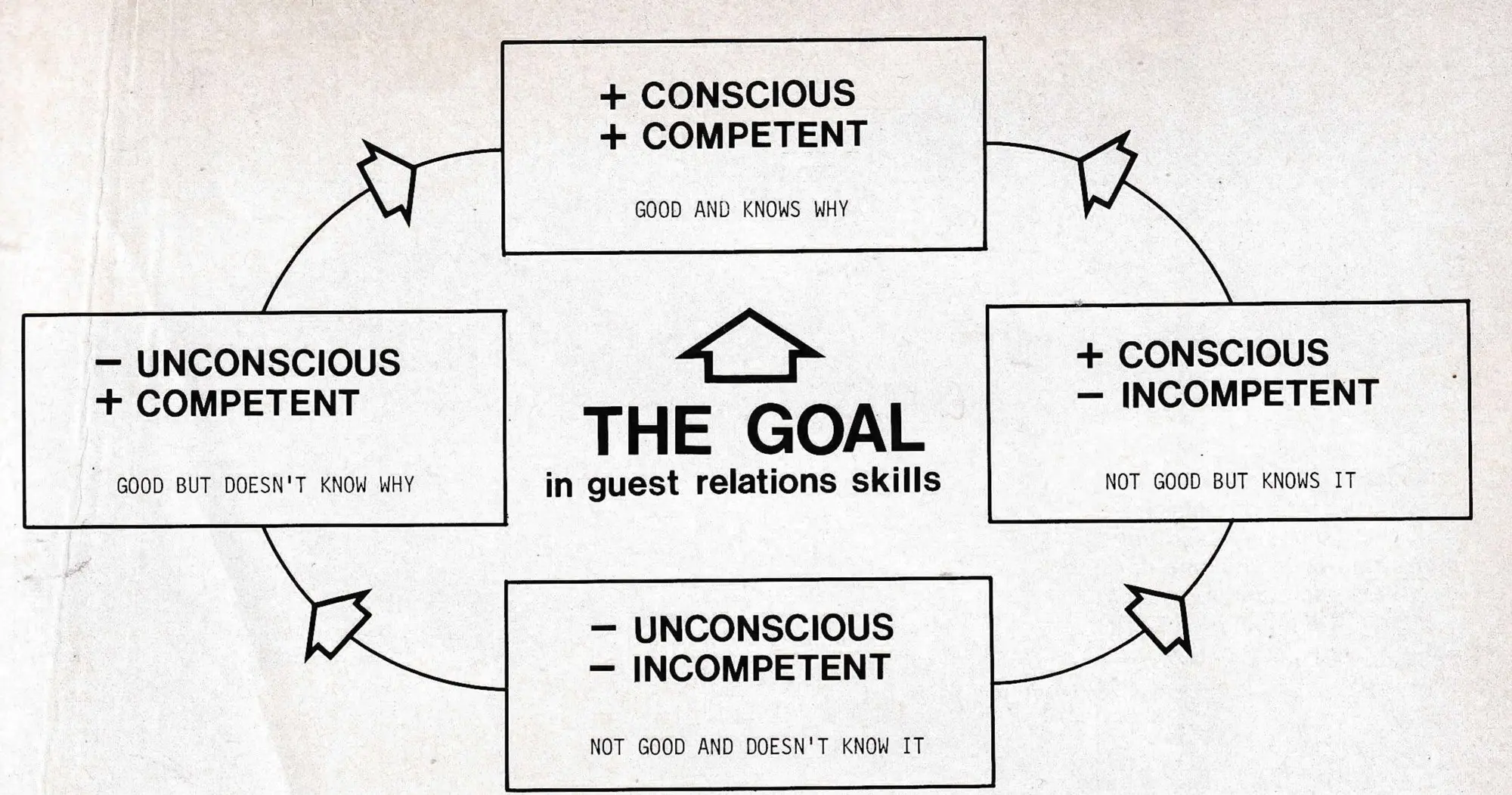
A universal objective of all skill training is expressed in the concept of conscious competency, and it goes like this: If conscious means aware and competent means capable, then the broad objective in learning guest relations skills is to be good at it and know why. This, in skill proficiency, identifies a person as a conscious competent, and should be the goal toward which all skill training is directed.
If a person has little or no guest relations skills, he or she might be referred to as an unconscious incompetent. That is to say, they are not good with the guests, but they don’t know it. Someone termed this “ignorance in action.” In any event, the word is out, “Keep ‘ole Charlie (or Martha) away from the customers.’
On the other hand, a person might be seen as being a conscious incompetent in dealing with people. While this type of person is not good at guest relations, at least they do know it. This comes to light after too many confrontations got out of hand and produced nothing but losers. Those kinds of situations don’t do too much for the area’s image.
Then there are those who are known as the unconscious competents. They’re good with the guests, excellent with people, but they don’t know why. They just are. It might be asked, “If an employee is good with the customers, what difference does it make if they don’t know why they’re good?” It makes a difference for two important reasons. First, they are not equipped to deal with the unexpected or a situation they have never faced before. It’s like a person who plays the piano by ear. They have limitations in what they can do. They can only play the tunes they know, and they can probably play only in the key of C. Secondly, if the unconscious competent is in a supervisory capacity, how are they going to pass along their abilities to a subordinate if they can’t explain how they do it?
Aim for the bull’s eye when it comes to guest relations training. If you miss, at least you’ll know where the target is.
Who to Train
There is no such thing in the entertainment business as only those on center stage. (Some of you may have tripped over the word “entertainment,” but think about it for a moment.)
The inside support forces are supporting the outside support forces in every successful ski area, resort or theme park. How the bookkeeper relates to the ski instructor, how the electrician relates to the lift operator, how the office manager relates to the ticket seller or how the food manager relates to the rental shop manager —all of this comes through to the guests. There’s a common denominator of attitude that permeates a ski area. It’s positive or it’s negative or it’s neutral, but it’s there for all to see and feel.
Attitude came through to Diane and to me when we heard the “friendly voice” on the recorded announcement and met the parking lot attendant. It came through when a payroll clerk helped push a guest’s car out of a snow bank at Crested Butte. It came through when an office manager made sure there were sandwiches and coffee for the training session break at Jiminy Peak.
The goal should be to train everyone; inside, outside, management, workers. If everyone were at least exposed to guest relations training, then it might seem as impossible as skiing uphill in July.
Snow is snow… .lifts are lifts. . .but how your people treat your paying guests will make the difference at the corporate cash register.
By the way, have you listened to your recorded area announcement lately?
*Jack Bogart is a consultant in the field of human asset development. He has trained customer contact personnel for various businesses and was a speaker at the NSAA trade show at Stratton Mountain, Vt. last January.*