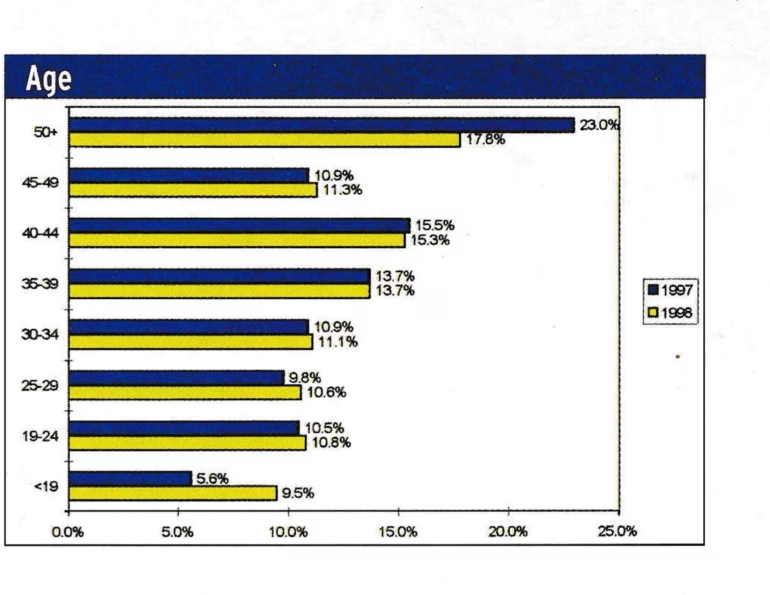
Age has been the engine pulling the ski train since the baby boomers first began buying lift tickets. For the first time in over a decade, the average age of a downhiller over the age of 16 declined from the previous year. In 1997 the average age of a skier/rider was 39.3 and in 1998 it is 37.5.
The 16 to 19-year-old market segment increased 70 percent, going from 5.6 to 9.5 percent of the adult downhill population. In this age group, those who ski exclusively are outnumbered by those who are boarders or who both ski and board. Many are students and 54 percent are male.
At the other end of the train, there was a 29 percent reduction in downhillers over the age of 50, with this segment declining from 23 to 17.8 percent in 1998. The bottom line for the industry of these demographic shifts is that a huge (70 percent) increase in the tiny (5.6 percent) piece of the market represented by the young does not offset the 30 percent decline among the older folk because, at 23 percent of the market, they are four times as numerous.
The shift in age did not influence average income, which remains steady at $87,000 per household. Over the years, there has been a steady increase in households with annual incomes greater than $100,000. In 1998, however, this increase was less than two percent.
Nevertheless, one-third of all skiing/riding households have incomes over $100,000, 18.2 percent over $150,000 and an impressive 10.7 percent over $200,000. All downhillers are not equal, however: Those who only ski have average incomes of $93,000, while those who board exclusively put downward pressures on the averages with annual incomes of $54,000.
Snowboard Growth Slowing
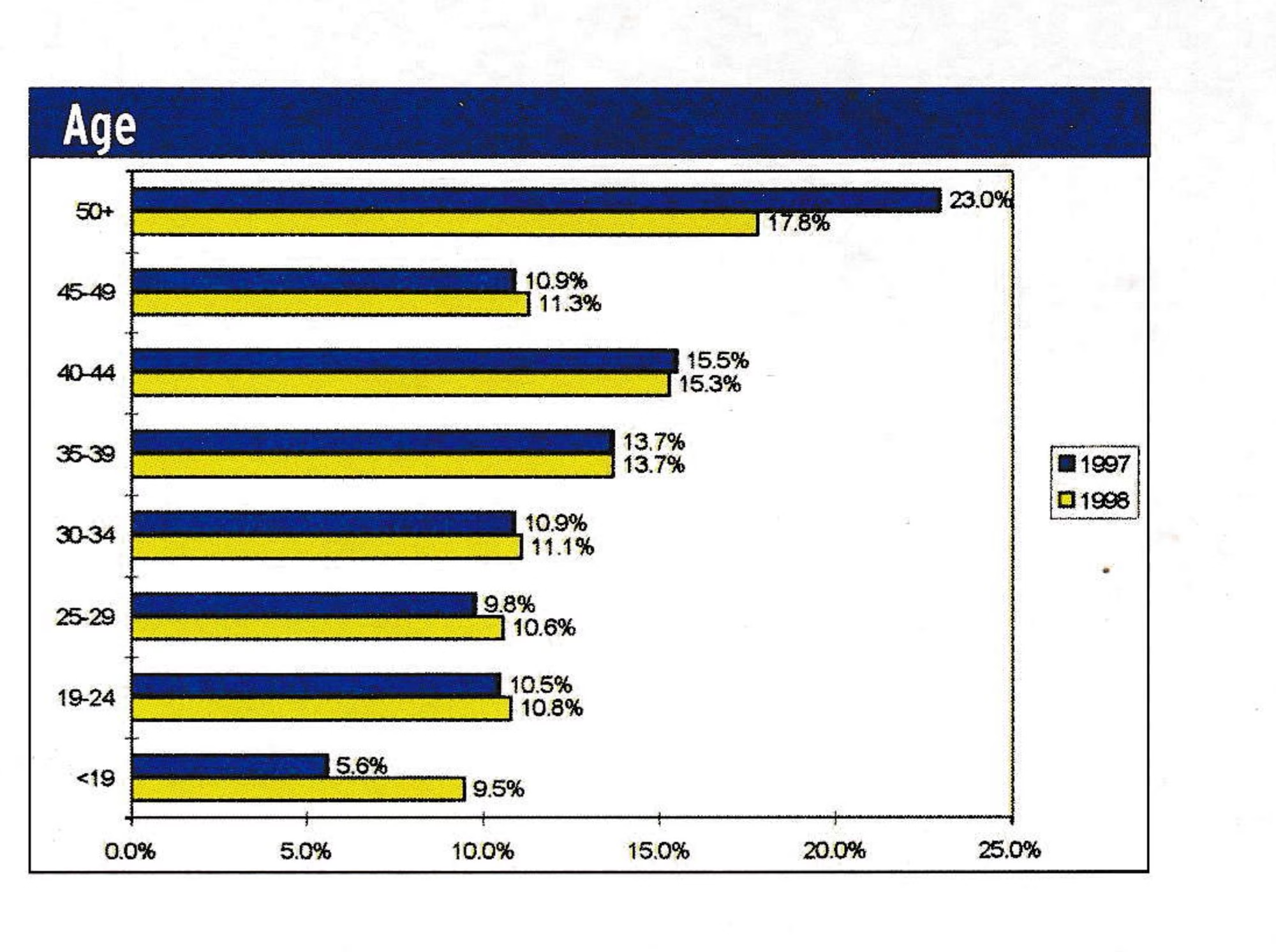
After three consecutive years of dramatic growth, snowboarding grew only seven percent. Twenty-nine percent of downhillers say they are boarders—24.8 percent saying they both ski and board and 4.3 percent boarding exclusively.
This season, the growth of snowboarders can be attributed to the increased percentage of under-24-year-olds in the market. In previous years, growth came from crossover skiers.
The crossover frenzy among adults has virtually stopped for all age groups. Thirteen percent of under-16-year-olds board only and 17 percent both ski and snowboard.
Snowshoeing participation remains the same as last season at five percent, while snow skating declined from 2.6 to 1.3 percent.
Ability Levels
Novice (skied five times or less) and beginner skiers increased 17 percent, with the biggest gains in the South and West. The increase in novice skiers tended to come from the under-24 single females, most of whom are students. The total 5.9 percent of novice skiers includes first-timers.
Among boarders, 45 percent consider themselves novice or beginner—down from 51 percent. Over half of these are male, most between the ages of 25 and 44. The percent of advanced and expert riders increased from 16 to 19.6 percent, leaving about one-third as intermediates. The increase in snowboarders is coming from the South and Midwest.
One fact that hasn’t changed is that better skiers and boarders do it more often. Advanced intermediate and better skiers averaged 14 days on the slopes and boarders who fit the same description averaged 11. But with the age factor there has been a change. Ten years ago, the young skied more days, while now it is the mature who rack up the numbers. Under-24-year-olds skied an average of 12 days while the 55 to 64-year-olds cranked out 15.6. The energized 65-plus skiers upped the ante to an impressive 17 days. Of course, income plays a role here, with higher-income skiers skiing more often.
Boarders follow the same pattern and those who board exclusively average a whopping 17 days on the slopes.
Regions
A few regional anomalies stand out in the 1998 numbers. For instance, downhillers living in the North Central region of the country, where it was long on warm weather, either stayed home or found something else to do this past season. The region, which represented 22.9 percent of all downhillers in 1997, fell to 15.4 percent. Stays of three or more nights were down 37 percent among Midwesterners.

This past season, nearly one-third of overnight guests lived in the Northeast compared to 21 percent in 1997. Overnight downhillers from the North Central region declined from 20 to 16 percent while those from the West declined from 21 to 18 percent.
The Internet
There is a definite profile of people who make their reservations via the Internet. They tend to be under 34, be from the South or Midwest, stay overnight, visit a new ski area more often, be of modest ability when it comes to downhilling and they snowboard or both board and ski. In other words, the Internet shows signs of being an attractive means to find new downhillers and gain trial.
Seventy-eight percent of all downhillers have access to the Internet. While 3.1 percent of downhillers made the reservation for the trip they were on via the Internet (up from 1.9 percent the previous year), when asked if they had ever used the Internet to book a ski trip, 5.6 percent of all skiers/riders and 7.4 percent with access have made reservations. One-third of all skiers and 43 percent of those with access looked at the home page of the resort they visited prior to arrival.
Costs
Is skiing really that expensive? Take a look at the following table which delineates how much skiers believe they spent for a ski trip that included transportation, lodging, lift tickets, rentals, lessons, food and miscellaneous store purchases.
| Trip Expenditures | All Skiers | One Day | 1 – 2 days | 3+ Days |
|---|---|---|---|---|
| Under $50 | 13.5% | 81.5% | 5.5% | 4.5% |
| $51 to $100 | 12.9% | 58.7% | 18.9% | 8.5% |
| $101 to $200 | 11.8% | 2.4% | 41.2% | 22.5% |
| $201 to $300 | 11.8% | 7.9% | 40.4% | 37.4% |
| $301 to $500 | 14.5% | 6.2% | 23.6% | 59.2% |
| $501 to $700 | 9.6% | – | 16.1% | 72.2% |
The fact is, for three-quarters of skiers, the cost of an all-inclusive ski trip for an average of 4.5 days costs under $700 per person. A single day of skiing costs less than $100 for most skiers/riders (under $50 for 81 percent of day skiers) and for a short 1 to 2-day vacation, 25 percent of skiers spend less than $300 per person.
To this observer, these prices are not unreasonable. A two-day weekend for a family of four costs $322 for lodging alone (two rooms) at a typical hotel in the United States. This does not include three meals a day plus the cost of any other activities such as shopping, attendance at a theme park, ball game or going to the movies.
What may be absent in the selling message for ski areas is what is called the quality cue—the implied or explicit message of what it is you get for what you spend. This message should concentrate on the benefits to the consumer. Only an aficionado cares about a high-speed lift. And the data show that aficionados ski anyway.
The benefits to most consumers have to do with fun, being outdoors, exercise, a different experience, snow, sport and all of the intangibles that skiing delivers in a superior way and cannot be found somewhere else. These qualities are worth more money, not less.
There is some evidence that the industry is getting sucked into the price game. For example, compared to 1997, the average cost of a trip in 1998, whether overnight or day, actually declined from $757 to $694 per person.
Is it possible that the industry has bought into the “too expensive” perception without thinking about why the perception exists? Evidence from other research suggests that “no time” is more important than “too expensive” as a reason not to ski or board. The truth is, though, that “no time,” in marketing parlance, translates to weak marketing.