


Utility companies, as suppliers of essential ingredients for life and business, may seem like greedy enemies. But, in fact, consumers are gaining authority and independence, particularly in the electric power supplier segment. In the near future, users of power will be able to select from a group of suppliers, just as consumers can select from a variety of automobile brands, models and distributors—even salespeople.
What makes this possible is a concept called retail wheeling, which promises to demand that suppliers/brokers be competitive and creative in meeting consumer needs and demands. As this competition grows, ski areas—as big users of electric power—will become sales targets and may be able to ask more of utilities than ever before. Looking at this glorious possibility, area managers would be well-advised to establish advantageous relationships with utilities right now.
The following story explains how Vail/Beaver Creek created a profitable arrangement with a local power company, with the expectation of mutual benefits from the relationship in the future. Although this is an example of a very large resort using available techniques, smaller areas can learn from this in anticipating future changes in power suppliers. —Ed.
Four years ago, I co-authored an article for SAM (May, 1994) on harmonic distortion caused by SCR drives and how it affected the utility’s power distribution.
At Vail/Beaver Creek, we were trying to correct the problems through a joint effort with the utility company, Holy Cross Electric Association. At that time, I wrote of my trepidations to commit half a million dollars to what I considered the “black magic” of harmonic filtering. That project proved to be not only successful, but also led to other cost-saving innovations undertaken jointly by Vail/Beaver Creek and Holy Cross.
First and foremost, the installation of the filters corrected the distortion problems experienced by customers in the area. The initial filters and subsequent ones installed in conjunction with new lift and snowmaking facilities have kept everyone happy. Holy Cross is now in compliance with the IEEE 519 code and the Vail/Beaver Creek cash registers and ticket sales computers operate trouble-free (relative to clean power requirements). The problems that had plagued our neighbors for years vanished: hotel telephone systems no longer failed daily at 3:15 p.m., heating systems kept heating and the sewer plants’ computers kept computing. Also, the savings were more than enough to pay back, on schedule, the interest-free note that Vail/Beaver Creek had received from Holy Cross to buy the filtering equipment.
The biggest windfall, however, came later. Due to the relationship that had been formed and nurtured through the distortion problems, Holy Cross and Vail Associates realized that they could expand their cooperative operating style to other aspects of operation.
The power distribution system at Vail/Beaver Creek had been structured so that Holy Cross owned and maintained the entire system to the points of delivery, which were transformers located at each facility on the mountain. A meter at each transformer recorded the power usage at each site. Using this system, the areas were able to conserve some power, but were not able to control power costs significantly.
Holy Cross and Vail/Beaver Creek began to discuss the possibility of metering the primary power supply to the mountains. That is, to have Holy Cross supply power to the base of the mountains and have Vail/Beaver Creek take control of the system at that point. This is already done at some ski areas, but normally these areas own the entire system. For Vail to purchase the existing system—including hiring high-voltage linemen and selling power to other users on the mountain—would be a very expensive proposition. For example, for the area to sell power to the valley radio communications system located at the top of Vail Mountain would require a PUC license—not easy, not cheap.
Then Holy Cross put a unique concept on the table. Kent Benham, general manager of Holy Cross, proposed to meter our mountains at two points on each mountain and then, through computer modeling, send two invoices for mountain operations: one for Vail and one for Beaver Creek. The modeling would also take into account random locations that directly involved mountain operations. An example of this would be a pump house located in the confluence of Gore Creek and the Eagle River that supplied water to a snowmaking reservoir located on Vail Mountain.
Now we had an opportunity to save power (ergo money). But there was still a lot of work to do. A rate structure had to be established that would allow Vail/Beaver Creek to achieve the greatest possible savings and yet at the same time allow Holy Cross to recoup their investment and remain strong. Also, since Holy Cross still owned all of the underground lines and transformers on the mountains, we had to agree on a maintenance fee for upkeep of the electrical system. Because both companies needed to remain healthy for our mutual benefit, this was not a difficult problem. Then the fun began.
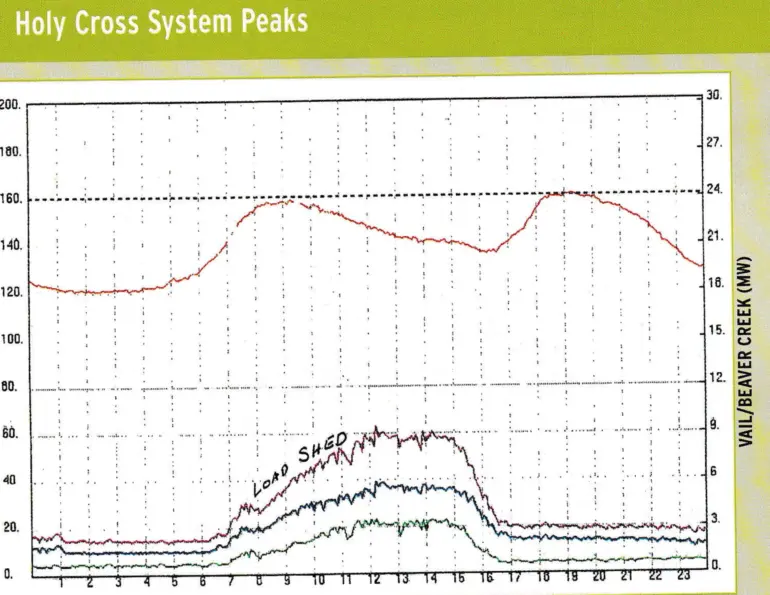
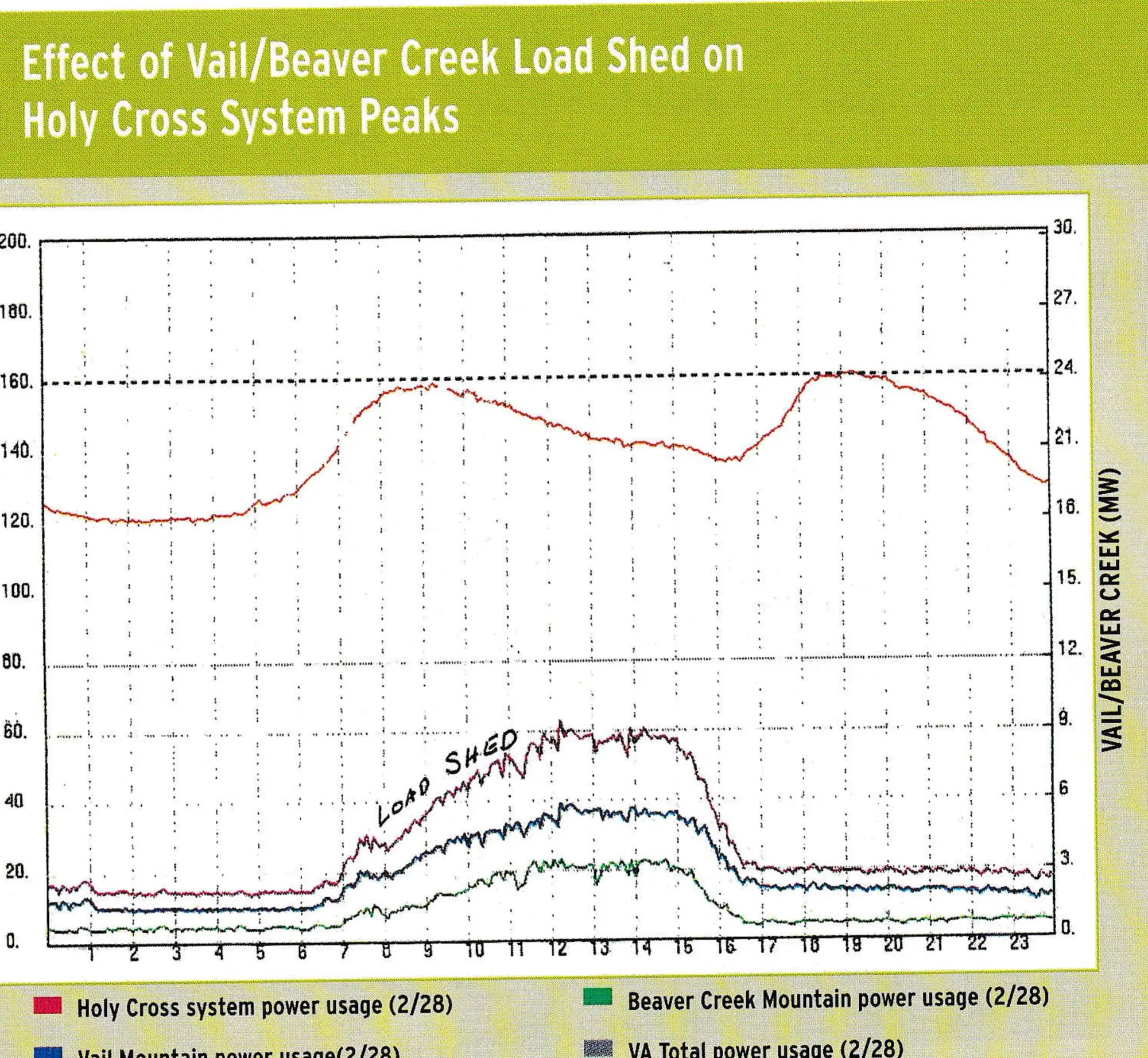
Holy Cross and Vail/Beaver Creek installed a real-time computer program to allow the areas to load-shed intelligently. The load on Vail and Beaver Creek can approach 15 megawatts (MW). If Vail/Beaver Creek were operating at 15 MW when Holy Cross reached its peak for the month, it would cost about $159,450, plus energy costs for the month. If Vail/Beaver Creek could, through the use of back-up diesel drives and generators, reduce usage to three MW, it would translate to a savings of $127,560 for the month.

Vail/Beaver Creek has done that and, as a result, has actually shifted Holy Cross’ peak from the daytime to the evening. This use of alternative power only needs to last for an hour to shift the Holy Cross system peaks.
This doesn’t mean the utility is shooting itself in the foot. By reducing the system peak, Holy Cross can purchase less power at higher rates, just as Vail/Beaver Creek can purchase power at off-peak rates. Once again, the partnership is a winner for both sides.
Because the first year of this system (1996-1997) was so successful, Holy Cross and Vail Associates decided to combine the two metering points into one, allowing even more flexibility to shed and save. Beaver Creek does not have the generating capacity of Vail, but it does have greater use of electricity due to its large snowmaking facility. Before, Beaver Creek was often unable to offset much of the electrical usage. Now, by going to one meter, the generating capacity of Vail can offset power usage from snowmaking at Beaver Creek.
Vail/Beaver Creek and Holy Cross are currently installing a second monitoring site at the Beaver Creek snowmaking central headquarters. In the evenings, when snowmaking is most prevalent and lifts are generally not running, offsetting snowmaking usage is more difficult. Vail’s Eagle Bahn gondola, which operates in the evening, can be brought off line by using the generators, but not much else can be done. However, when peaks appear imminent, the snowmaking system can be throttled back to reduce energy consumption and allow Vail/Beaver Creek to keep purchasing electric power at the lower rate.
Why would a utility want to do this? After all, what sense does it make to sell cheap electricity?
There lurks in the future a concept called retail wheeling that will allow an end user of power to pick a supplier out of virtually every power supplier/broker in the country. Aggressive pricing structures will be created, tailored to the users’ needs. Holy Cross and Vail/Beaver Creek are both aware of what could happen.
Therefore, Holy Cross—being a creative and prudent supplier—has proactively created a relationship with Vail Associates that will continue to be beneficial to both the customer and the producer.
In summary, area managements need to build good relationships with utilities and use readily available technology. When retail wheeling takes place, the wise consumer can be in a very good position. Remember the old saw, “It’s easier to catch flies with honey than with vinegar.”

