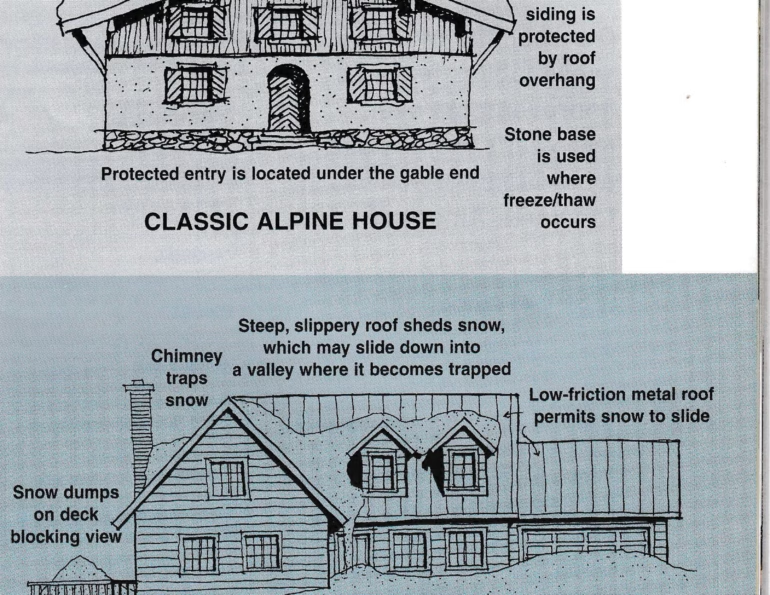

It is also still true that the vast majority of buildings in snow country have problems because the basic laws of physics have been ignored. For example, it is still common to see roofs that allow snow to dump or to drip water that forms ice in front of garages, entry doors or on decks. Such designs cause inconvenience at a minimum, but also can lead to injuries or even death. Signs proclaiming “Danger! Watch Out for Sliding Snow and Ice from Roof” are a staple in snow-country hardware stores.
Common-sense design can avoid such problems. Roof configuration that deals with snow management is an important starting point using the KISS principle: Keep It Simple, Stupid. Fundamental is the concept that all roofs should slope away from entries or anywhere there might be people—always.
Fortunately, over the past 25 years, better ways to fight leaks caused by ice-dam formation and even prevent the formation of ice dams have been developed. In addition, regulations to conserve energy and increased snow-load requirements have affected roof design.
One product now in general use in snow country is a rubberized self-sealing membrane that prevents leaks on all types of roofing. In fact, many local building codes now require this roofing material. These membrane products are expensive, but nowhere near as expensive as dealing with the consequences, inside and out, of major roof leaks.
The most widely used membrane is Ice and Water Shield, which is a somewhat less-expensive, easier-to-use and thinner version of Bituthene, but both products are sticky and self-adhering. At a minimum, these membranes should be applied at all eaves up to three feet beyond the wall, all valleys, ridges and three feet up all walls at roof-wall intersections. As inevitably happens, less expensive versions of these products have come on the market, but some of them are effectively worthless. If it isn’t gummy and tough to tear, watch out!
Can ice dams be prevented? In 1973, I wrote that there’s only one right way to prevent ice dams and that is to build a European cold roof, but since then, I have changed my mind. It is my observation that three quarters of the cold roofs built in the United States do not work and are not worth the added expense.
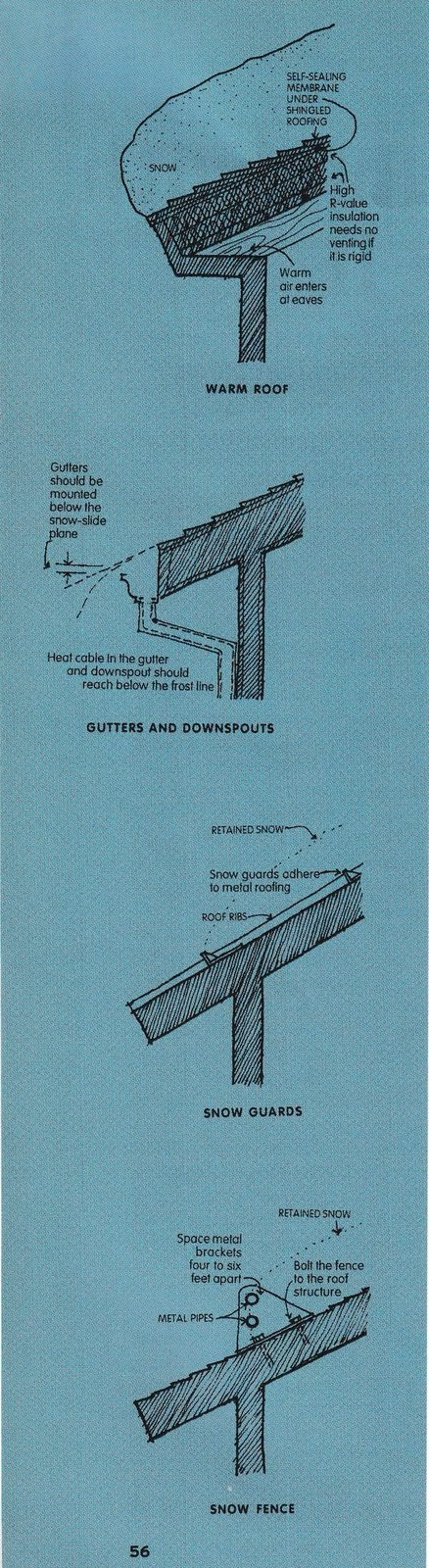
The problem is usually that there is not enough space to circulate cold air between the lower insulated roof and the upper weather-exposed roof. With larger, complicated roofs that have valleys, hips and gables, it is difficult, if not impossible, to design so that cold air flows freely from the inlet at the roof eave to the outlet at the ridge. Additionally, in deep-snow areas, the upper vents can get covered with snow and the roofs automatically revert to a warm-roof design.
If that is the case, why not build a good warm-roof design in the first place? Current energy conservation laws mandate insulation with U-values several times greater than was common 25 years ago. Insulation is a bargain and using more than is required by law not only saves money in fuel costs, but also cuts down or eliminates ice damming. It is my opinion that such a super-insulated warm roof is more cost effective than most cold-roof designs. Remember, too, that snow is an insulator, which keeps the roof surface at approximately the freezing point and protects it from below-zero cold.
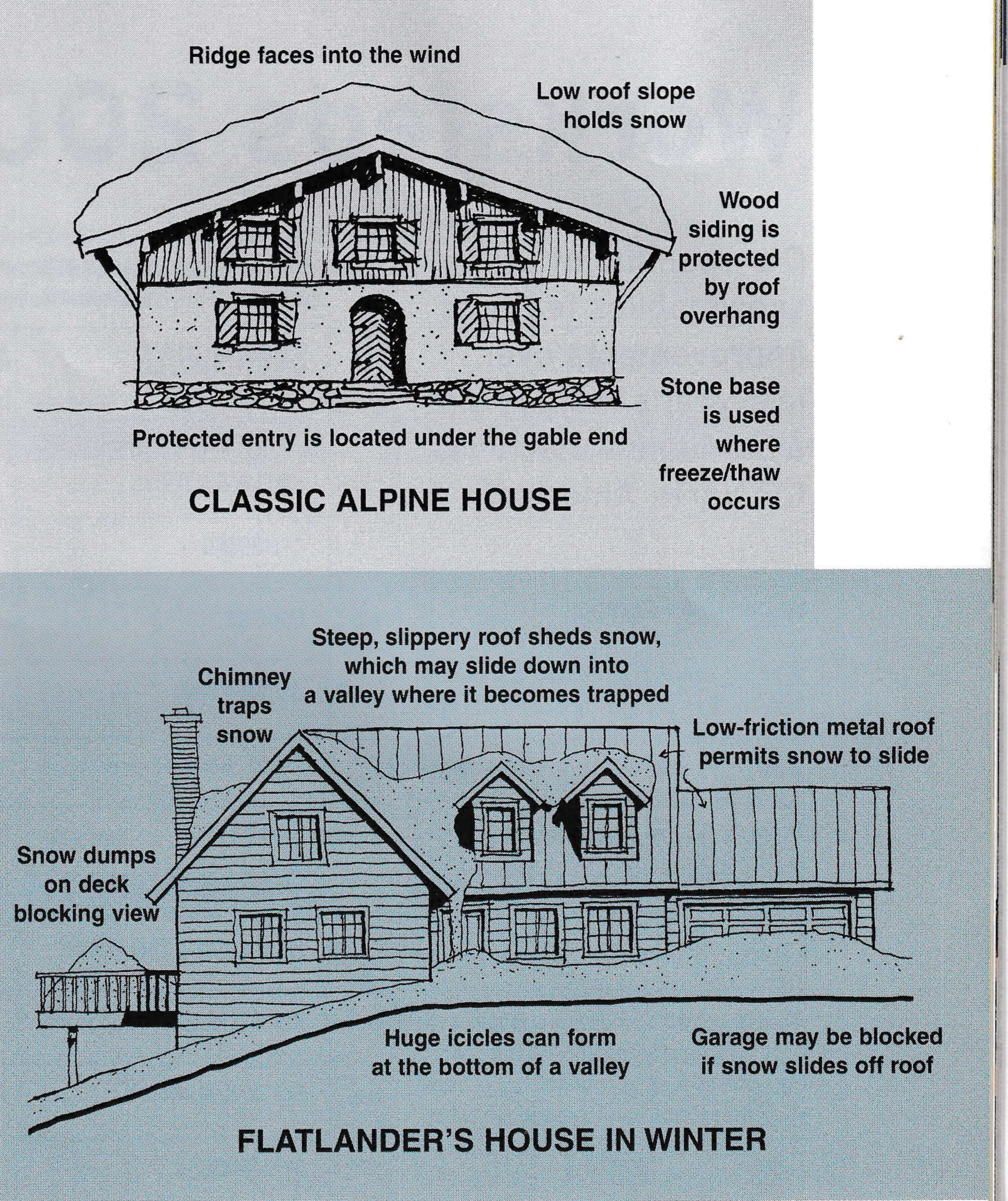
This brings up the question of whether to keep snow on the roof. After 40 years of practicing architecture in snow country, I have gained increasing respect for traditional architecture of the high mountains where hundreds of years of trial and error led to building forms that kept snow on the roof. The peasants of the Alps knew about the insulating qualities of snow and the destructive power of avalanches. Roof pitches were typically about four inches vertically to 12 inches horizontally or about 19 degrees, and logs were lashed crosswise at the slope to make sure the snow did not move.
But snow will creep downhill over time creating a mini glacier—and we know the power of glaciers to sculpt mountains. Moving snow can tear off chimneys and plumbing vents and rip flashings, which augments the incomes of sheet-metal contractors after a heavy snow year.
So don’t we want to get rid of the weight of all that snow? No. Building codes today are very conservative about snow loads and roofs have to be designed for specified snow loads regardless of pitch or roof material. This is as it should be. Roof materials can be changed and nature works unpredictably.
Metal roofs became popular because of their snow-shedding characteristics and because there was less tendency for ice to cling to the surface. In addition, without horizontal joints, there was less possibility of leaks if ice dams did form. But the slipperiness of metal roofs brings other problems. Sliding snow can cause damage and, as noted, can be dangerous. Every year dozens of cars are crushed by sliding snow in the heavy-snow areas of the West, view windows are blocked as snow builds up to roof eaves and snow becomes trapped at roof valleys when it slides down from both sides. This not only causes unusual loadings, but also creates mammoth ice dams and icicles at the bottom of the valleys. Over the years, manufacturers have marketed dozens of devices that can be screwed or glued to the roof surface or bolted between the ribs of the roofing to prevent or impede the sliding of snow on metal roofs. Such devices are often effective and are standard in Europe.
Snow fences can prevent snow from sliding on low-friction metal roofs or on steeper high-friction roofs such as asphalt shingles. Snow fences for these purposes should be sturdily designed and bolted into the building structure. If they are not designed to cope with the enormous gravity forces, they will be bent or ripped off the roof entirely.

It is also possible to combine the advantages of high-friction and low-friction roofs by using metal at the roof eaves. This has been done in the Northeast as retrofits to fight ice dams. Another method used to fight ice dams is heat tape in a running W-pattern along the eaves to melt channels and allow water to drip off the roof without forming ice dams. This solution seldom works in the long run, however, because snow movement tears the heat tape off the roof, often causing short circuits and sometimes fires.
In recent years, a sturdier heat-cable product has been developed that has the property of drawing more power as the temperature decreases and drawing no power if the temperature is above freezing. Called Ice Stop and manufactured by the Raychem Corporation, this product is far superior to heat tape, but it, too, should be protected with a snow fence mounted above the exposed heat cable to prevent snow sliding. Better yet, avoid any exposed cable. Better still, design a roof where the snow won’t slide.
Recently, a heat-transfer engineer designed a product that promises to end the ice-dam curse completely. The system combines the best characteristics of metal in the ice-dam area, high-friction roofing above the ice-dam area and heat to prevent the start of ice-dam formation. Called Bylin RIM (Roof Ice Melt), the system employs metal eaves with heat cables underneath. It can be installed as a retrofit or in new construction.
Gutters are a necessary evil in snow country, particularly if a building’s designer has not shed water away from entryways. Often gutters are destroyed by ice formation, either by the weight of the ice or its expansion. To prevent this from happening, heat cables can be installed in the gutter and down the downspouts to below the frost line. Gutters must be installed below the extended plane of the roof so that sliding snow will not tear them off the building.
In 1973, I cautioned against the construction of walking decks, particularly over occupied space. Since that time, a trowel-on elastic plastic product called Tufflex, which seems to solve the problem of leaking spaces below decks, has come on the market. It can be applied to new or old construction with a variety of substrates and has the additional advantage of being relatively slip-resistant, even with hard plastic ski boots.
The practicality of snow melting at pavement areas also has changed dramatically with the use of high-temperature-range polybutylene and polyethylene pipe. Installing such piping in a concrete walkway is not expensive. Typically the only joints in the piping are at the manifold that feeds various zones of snow melting, which avoids numerous joints; the Achilles heel of both copper or steel piping. This system should be operated only if it is snowing or if there has been buildup of ice. Operational cost is proportional to the price of fuel or electricity used to heat the water, but the cost may be justified by more satisfied visitors. One slip-and-fall lawsuit could be more expensive than a snow-melting system.
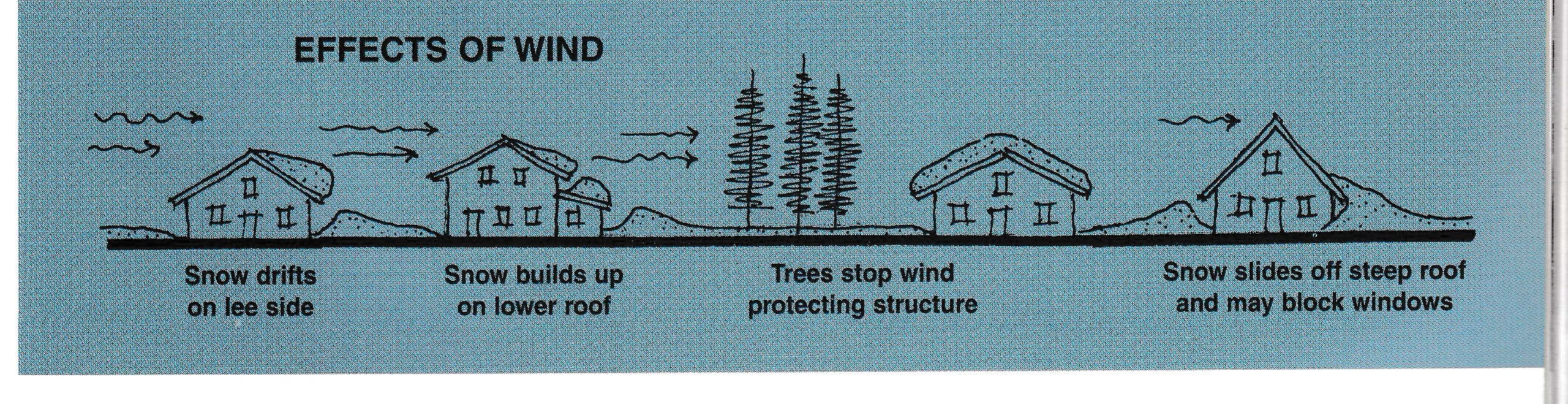
It is almost an article of faith among old timers that all flat roofs will leak. Keeping with the KISS principle, the simplest roof shape is, of course, flat, but a well-detailed and well-constructed flat roof can be the most trouble-free roof in snow country. It must, however, slope at least one-fourth inch to one foot toward internal drains located in heated space. Such a flat roof usually collects less snow because high winds scour the snow off the roof, so there will be no icicle buildup or moving snow to cause trouble.
Whether or not a flat-roof design is compatible to a mountain setting depends a lot on personal preferences and the skill of the architect. Several California resorts, including Mammoth Mountain, Sierra-at-Tahoe and Squaw Valley, have used flat roofs on day lodges and mountain restaurants as sun deck space. For such use, wood decks are typically placed over the roofing and serves the same purpose as gravel in keeping ultra-violet rays from deteriorating the roof material. The supports for the decking must be detailed to allow free flow of water to the drains.
Single-ply elastomeric plastic roofing can be warranted for low-slope roofs if joints are heat-welded to form a continuous seamless and waterproof surface. Color selection is limited with white being popular because of heat-reflecting properties. However, a dark neutral color is probably more appropriate if the roof will be looked down upon in the no-snow seasons.
Although some of the new products answer some of the perennial problems of snow-country building, they should not be a substitute for fundamentally sensible design. I believe in a “belt and suspenders” approach to design in which the basic design keeps the pants up and the suspenders come into play when there are unusual conditions. Even if the ice dam was not supposed to form because of a simple cold-roof design, the self-sealing membrane is there when the ornery ice dam appears anyway.