


Our investigations during the past year covered tests, consultations with rope and grip manufacturers and study of pertaining reports.
The fact that wire break occurred only in a small percentage of ropes indicated that special conditions are existing where breaks occurred. They were typical fatigue breaks found on short lifts. We immediately suspected a connection between the number of turns of grips around the bullwheel, which increase with decreasing lift length. But again, some short ropes were retired after 14 years due to decrease in diameter only and had no breaks despite many more cycles.
This indicated that other parameters are involved. Since each type of grip has its own shape, the following conclusions may not apply to all types. Here are the ones we consider to be contributory.
Length of Lift Line—The number of cycles around the bullwheel is inversely proportional to lift length. With the grip held stationary (ie. nut allowed to slide) on a 1″ dia. rope, with a 10’6″ dia. bullwheel, breaks appear in 12,000 plus cycles.
Liner Wear—With the liner wear increased to 3/8″ the breaks occurred at 7,000 plus cycles. This again with the grip stationary on the rope.
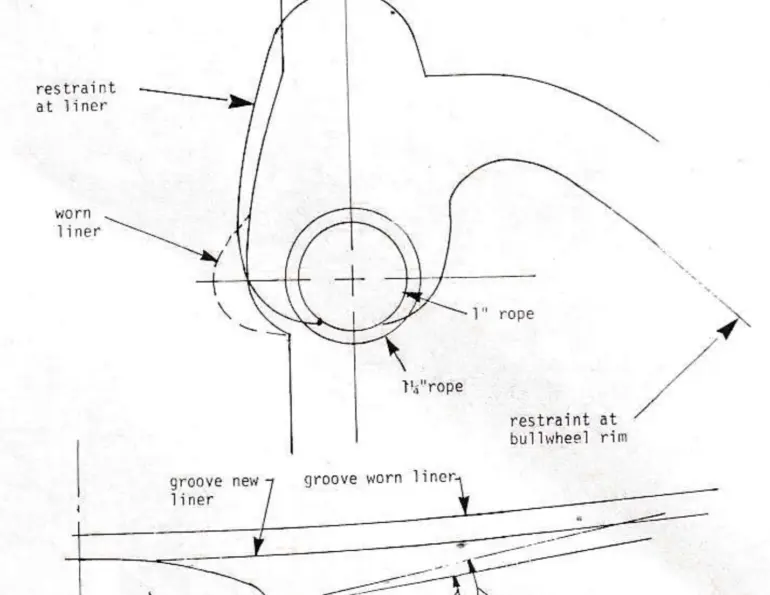
Rope Diameter—Larger diameter rope decreases liner wear. The grip is forged for several sizes of rope, and subsequently machined for the proper size. The decrease in rope diameter increases the tangential angle between rope and bullwheel. This angle is the main contributory factor to the fatigue stress.
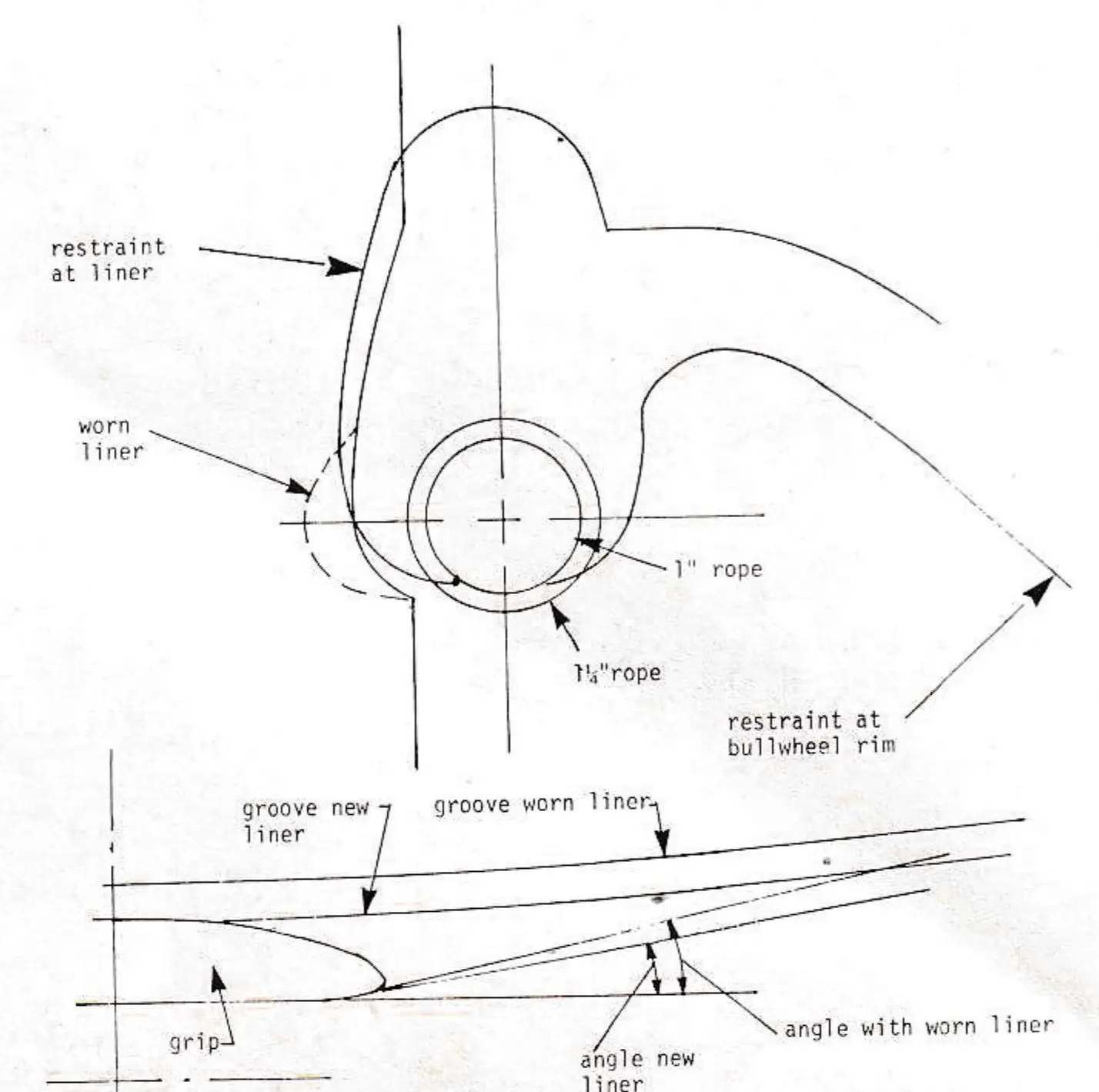
Grip to Liner Geometry—The chair is restrained at the bullwheel by a ring on the lower flange and the upper part of the grip against the liner (see sketch). This, too, increases the tangential angle with increasing liner wear and smaller rope diameter.
Durometer of Liner—The higher the durometer (a measurement of hardness), the larger the tangential angle. This applies to grips with large rubber contact area. Relative durometers investigated are between 80 and 90.
Strength of Rope—The fatigue resistance of a rope 10% stronger decreases 20%. The improved plow steel rope that we are using is on the average 20% stronger then the catalog value.

Compression Due to Grip Spring Action—We could not determine what effect, if any, the stress produced by this action has on fatigue properties. In the mean time we are instructing the areas concerned to release the spring compression to the point of compliance with the ANSI code requirement against slippage.
Rope Safety Factor— Ropes with a safety factor approaching 10 are increasingly subject to stress reversals, whereas lower factors are within fluctuating tensile stresses.
We divided the incidents into four groups: (A) This group has the majority of cases (10). The lifts are short, cable dia. 1″, liners severely worn, built in the years 69 – 72. In these years we had a different bullwheel liner supplier with a higher durometer rubber, and laminated.
(B) One case. It is a lift from Group A which had the rope replaced but not the bullwheel liner. (C) One case. This lift is longer and has a 1¼” dia. rope. The liner was completely deteriorated after 9 years of use. A similar size lift installed earlier with liner wear monitored has no breaks. (D) One case. This lift was one year in operation, very short, low gradient (7%). We used here our larger size grip for rope up to 1.42″ dia., which on a 1″ rope aggravated the tangential angle. Significantly, two lifts of same size but higher gradient (26% – 29%), show no breaks after twice the amount of cycles.
The following is my opinion of the above incidents after analyzing the results of the investigation:
- The cardinal cause of the breaks is the excessive number of grip turns around the bullwheel. The other factors contributed to varying degrees.
- Indicative of the importance of the second factor—liner wear—Case B lift operated for five years before the rope was replaced due to breaks. The rope was replaced but the liner was not exchanged. Breaks appeared within the first year of service.
- The reason that some ropes with approximately 300,000 cycles did not show any breaks can be attributed to the grip creep along the rope. We observed this to occur at the entrance of the bullwheel, and on heavily loaded breakover sheaves. As the chair swings the rope is restrained and the grip rotates on it. The rope lay causes an axial grip motion. Similar to this condition is the turning of the rope caused by misalignment and uneven sheave wear within the sheave assembly.
- This grip has been used extensively overseas for many years without any reported breaks. The reason for this is compatible with our findings. The grip was used on chairs and fixed gondolas, which, overseas, are always long and steep, requiring large diameter rope. The regulations require either monthly or hourly (100 – 500 hrs) relocation interval, and close monitoring of the liner.
I do not feel that each of the above causes applies to grips used in the industry; however, the frequency of grip relocation and liner wear should be considered in new regulations.

