Nothing about it was going to be easy. The men came aboard when the snow already was flying and the resort had to be ready to open—soon.
Then, they’d be competing with a half dozen other ski areas within a two-hour drive of Seattle, including well entrenched Snoqualmie Summit, Ski Acres and Stevens Pass. In addition, they were burdened with a $400,000 loss carry forward. By the end of that first year, they’d lost $65,000—a smaller loss than some earlier years, but still substantial. Then, the comptroller quit, giving as his parting shot: “You guys are never going to make it.”
The men knew what the problems were, however: they had to improve Crystal’s image and reputation, expand and redesign to include plenty of terrain for beginners and intermediates, beef up midweek skiing, hold the line on expenses and manpower and institute strict fiscal management.
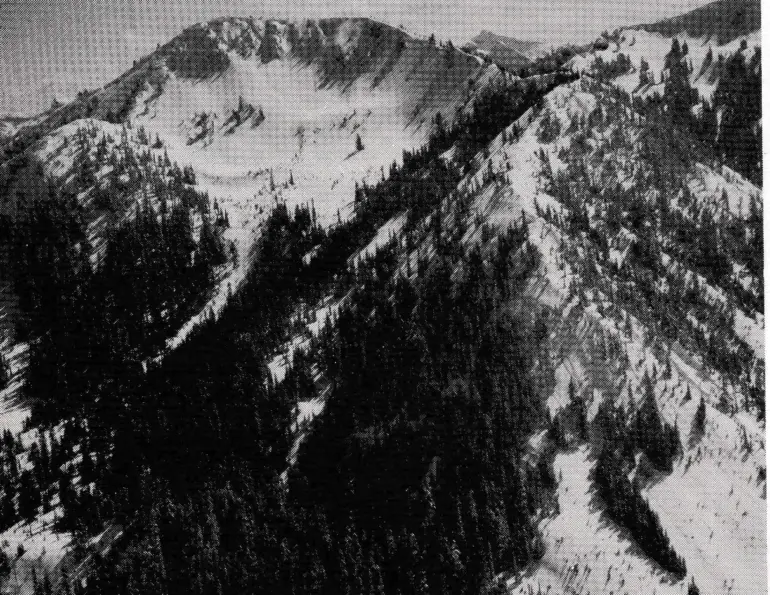
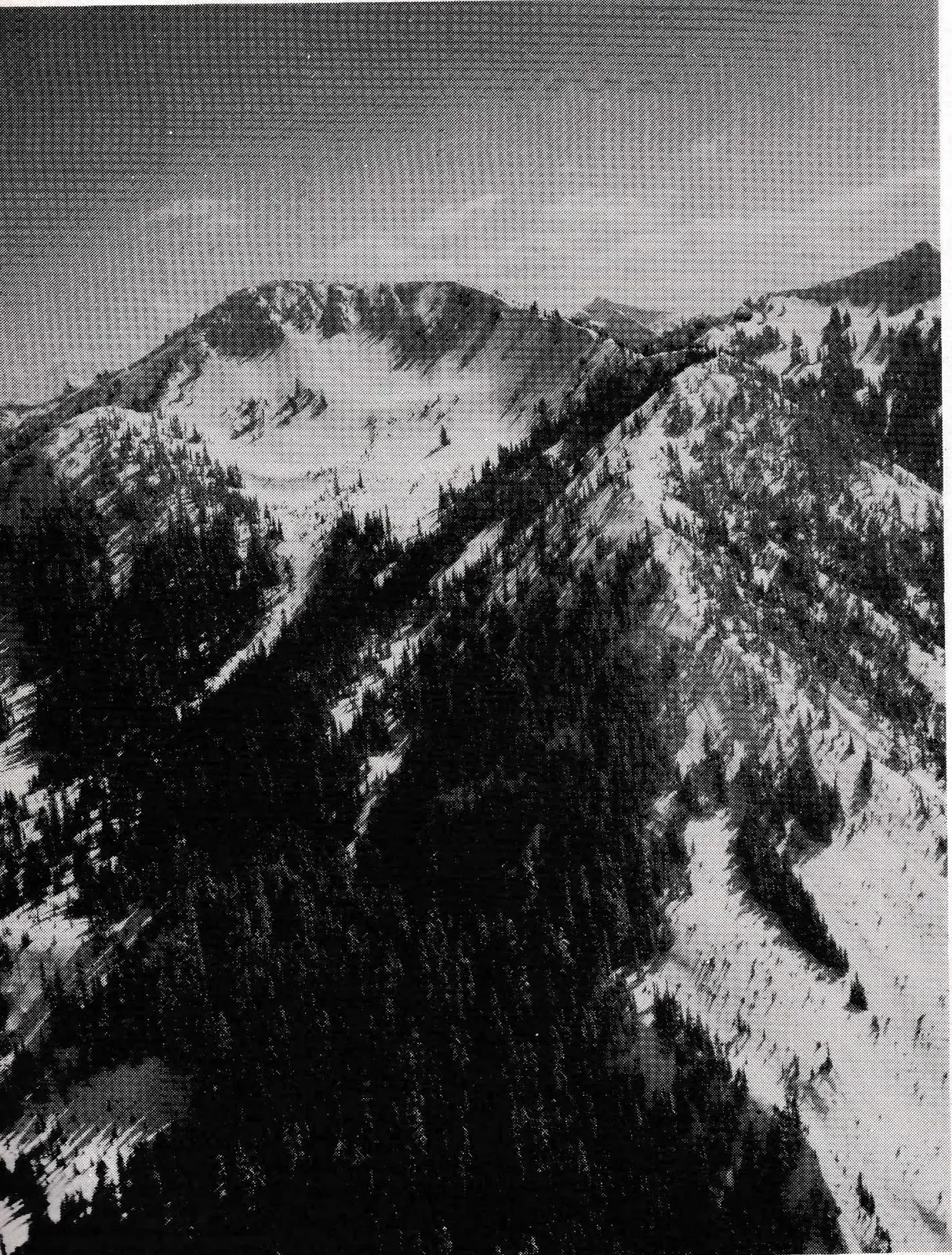
They also knew Crystal had a lot to offer, nearly 4,000 skiable acres and 2,500 feet of vertical as well as a long ski season. The ski village began at 4,400 feet, the elevation where many competiting areas topped off. Although built almost entirely on public lands, Crystal was the only Seattle ski area with plenty of lodging, over 800 beds.
Link, president, hired Christianson, now vice president, because, “He was the best mountain manager around.” He’d had experience at Washington ski areas such as Pilchuck, Paradise and lastly, Stevens Pass. Link dealt with administrative | concerns and Christianson operational matters, although the two often overlapped. But the men complimented each other to the point that Link now says in retrospect, “We’ve never had a serious disagreement.”
As a climber, former member of the Tenth Mountain Division, retired army colonel, ex-commander of several military posts and civil defense chief for Washington state, Link was used to a well-run organization. At Crystal he delegated responsibility, but set up a “proper chain of command;” until then, he says, the ski resort had been “a pretty loose-knit organization.” He revamped the staff, too, replacing prima donnas who only wanted to ski with a well-trained, friendly crew that was soon oriented to the enjoyment and well being of Crystal’s customers. Crystal is now considered as “the” training ground for ski area personnel in the Northwest.
Some board members initially complained that, “Link is running Crystal like it was the God damn army,” but the methods the new managers used started to pay off. In their second year, Crystal made money. Except for the drought winter of 1976, Crystal has made a profit every year since. The $400,000 loss carry forward was wiped out the winter of 1975. Crystal is now one of the biggest and most popular in the Northwest, with 276,000 skier days last year.
The managers soon did a better job of grooming trails, which attracted more skiers and they began expanding. Although some stockholders initially objected to expansion, the managers argued that to survive in the face of increasing competition, that Crystal had to grow. More beginners’ and intermediates flocked to Crystal when a fifth chair with 1,773 feet of vertical and numerous runs (one three miles long) was installed, in 1970. It was followed in 1974 with a sixth, intermediate chair. This season Crystal opened with a seventh lift which empties into tough, expert bowls and raises total vertical to 2,602 feet.
The managers also started an open-door policy for skiers and employees alike so they’d be the first to hear of problems, not the last. Link works the ticket window when Crystal is short-handed, or when he wants to gauge skier reaction to such things as lift ticket price increases.
To improve Crystal’s image, they opened booths at ski fairs. “Before,” says Link, “we were conspicuous by our absence.” He and Christianson also personally began visiting ski shops to distribute trail maps and brochures, and gave talks to ski clubs and other groups. They really began to polish Crystal’s image when they became active in the Pacific Northwest Ski Assn., and hosted races such as the 1972 World Cup and a national championship.
Link has developed close ties with Crystal’s bankers at Seattle Trust and Savings Bank, a role he fell into by accident. Six years ago, he had such a good weekend, on impulse he called his banker and relayed the good news. The banker was so appreciative that Link decided to call him every week, to update him on lift revenues, financing matters, improvements and to discuss any problems. “Now, if we wanted to increase our short term debt, I wouldn’t have to go to my banker and take half the board with me because the bank is on top of every facet of our operation,” says Link.
“They say we’re one of their best customers because we keep debts current,” says Link. Crystal pays its debts early whenever possible, although not in advance, at a 1% savings in interest. “We like to stay in close touch as our bankers can advise us on how to invest in CDs, profit sharing, whether we should recast our long term notes and so on,” says Link. Long term debt is under a half million dollars.
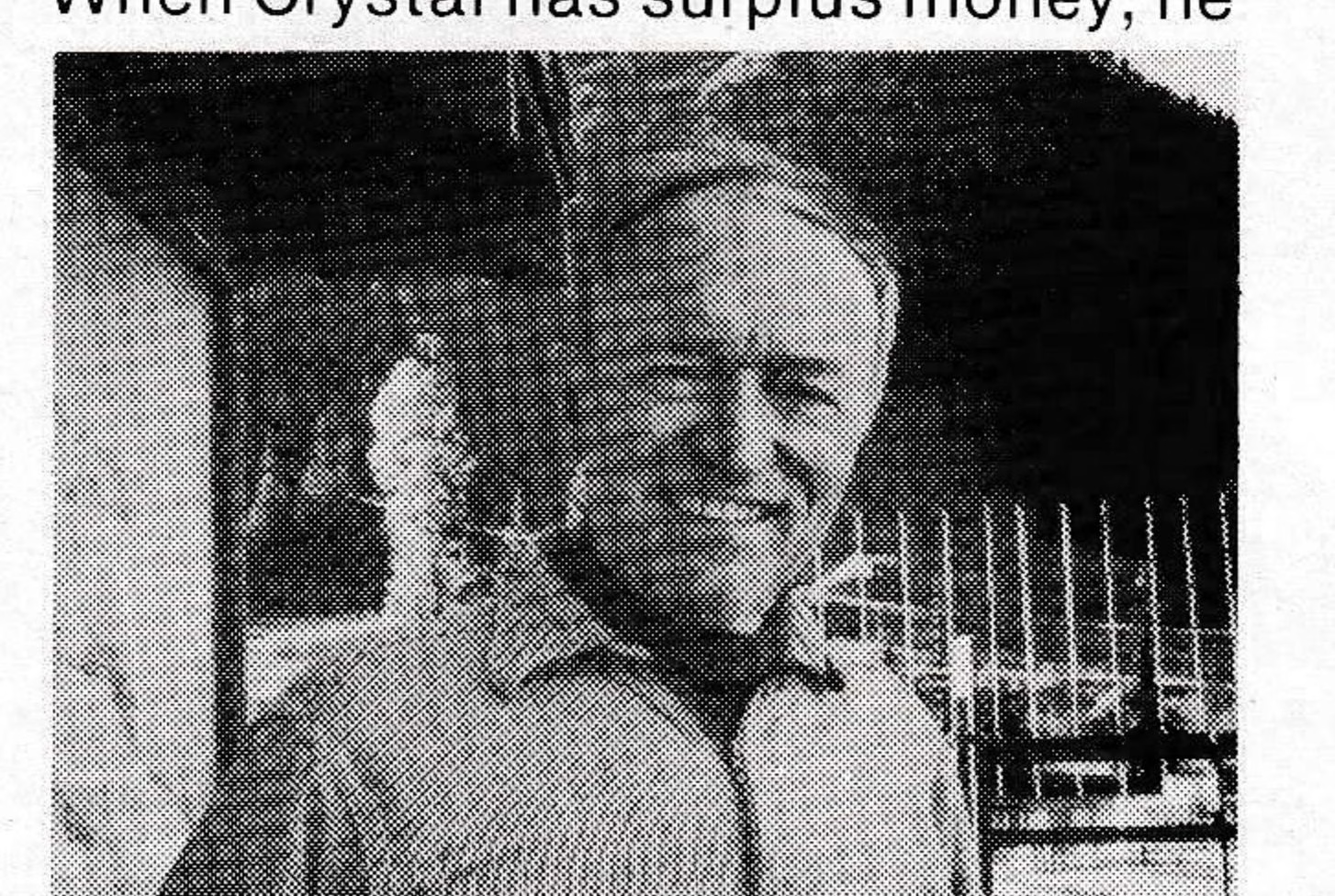
Several years ago, too, he hired G. Stuart Douglas, a tough, highly respected Seattle financial consultant. Douglas’ first task was to make a 10-year financial projection. He now works on a monthly basis. He goes over Crystal’s statements, works closely with auditors, attends board meetings and presents the management’s position on financial matters. When Crystal has surplus money, he suggests what can be done with it. He also strictly adheres to the rule that when a financial reporting period has ended, a statement must be ready within 10 days.
Although some board members have contended that the resort should borrow money and implement fully its master plan immediately (including numerous other chairs, a gondola, enlarged base facilities and new up-the-mountain facilities), Link and Christianson have insisted that they not borrow additional funds. They’ve argued successfully that improvements should come from each previous year’s revenues.

Currently, Crystal has no outstanding bonds. When the managers came aboard in 1968, the board had authorized a $500,000 bond issue and sold $180,000 worth. “I cut that out quick,” says Link. “We didn’t need it. Some $300,000 had been slated for capital improvements, and $200,000 for operating costs. Later, it was Stu Douglas’ idea to go ahead and buy the bonds back at a 10% discount, which we did.” Crystal originally obtained financing by turning to skiers. For a minimum $1,000 investment, they’d get a vote, elect the board which is comprised of stockholders and local businessmen, and ski free for perpetuity.
Link also hired a purchasing agent who goes out and “gets the best buys, keeps track of purchases and in general, keeps things under control.” The agent’s salary is more than paid for out of the savings achieved, Link believes.
The men also went after ski schools. The Northwest is reputed to have more skiers per capita than anywhere else in the country, partly because six major areas lie within a two hour drive from Seattle. Consequenty, a plethora of ski schools are operated by ski shops, community groups and public school districts, adding to the swell in ranks of area skiers.
“To a resort, ski schools can mean the difference between profit and REAL profit or in a poor snow year, profit and no profit,” says Link. Initially, Crystal operated only a mountain-owned school, but in the early 1970s, invited other ski schools to base at Crystal. Consequently, in the 1978-1979 season, nearly 20,000 persons attended ski schools at Crystal. Of these, some 5,000 enrolled with the mountain’s school.
“The ski schoolers are all buying lift tickets and learning to ski. They’re a new generation of skiers,” says Link. “The schools provide transportation; without this, many persons would not have been able to get up here.” About 45 students come up on each bus, the equivalent of about 15 cars, conserving fuel, litter and traffic density. “This represents a big safety factor, plus, the kids are supervised all the time they’re here by an adult,” says Link.
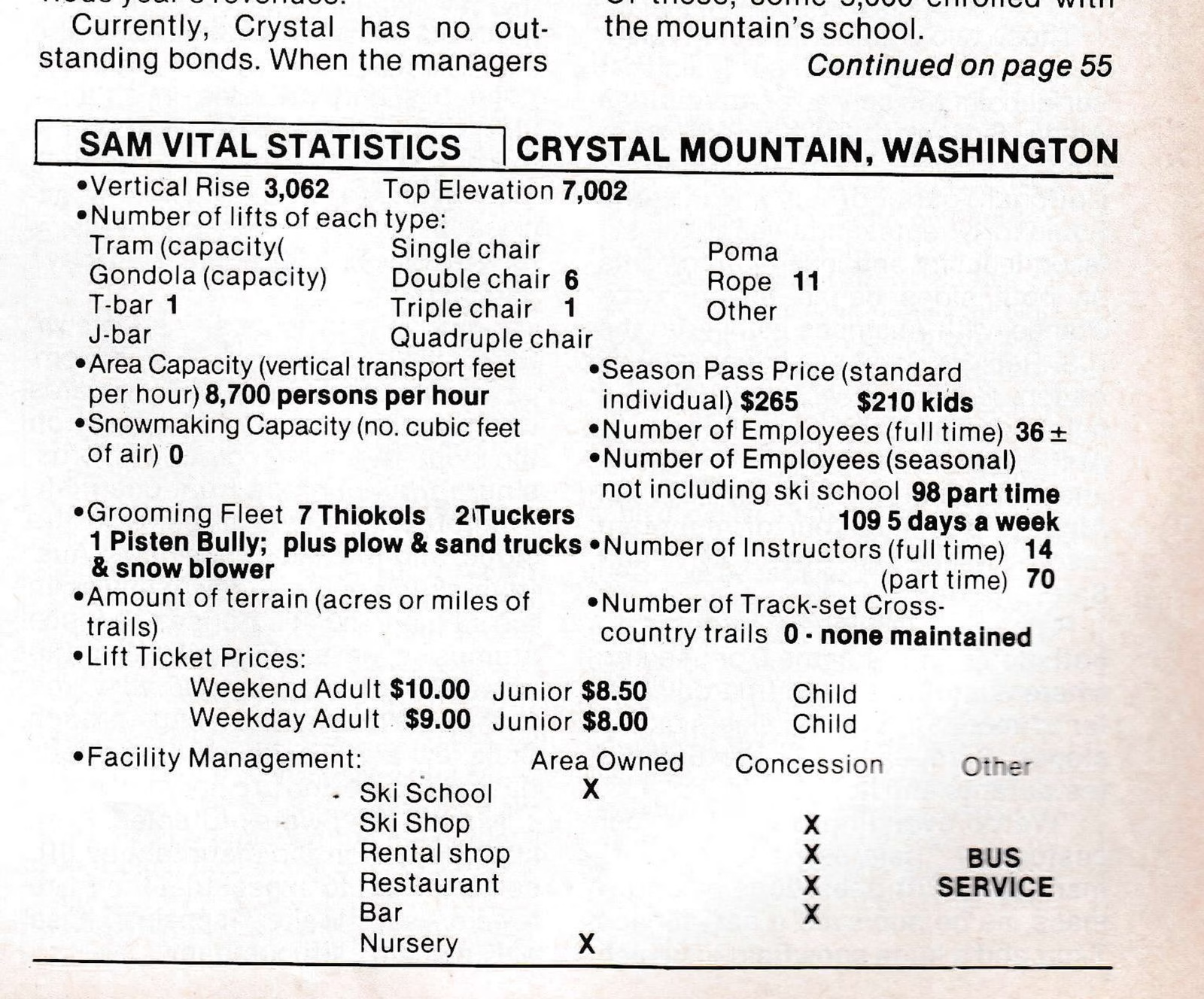
Typically, Crystal is the first of the state’s ski areas to open, even if the only skiable terrain is on “top” where the Green Valley chairlift offers a thousand vertical feet over vast and varied terrain. “This can be very profitable. If a flake of snow falls, Chris is out there packing it,” says Link. In only three or four years in Crystal’s history have both the top and bottom of the mountain opened at the same time; in early snow years, the resort opens around November 1.
Night skiing, too, on the lighted intermediate Chair 4 gets more profitable and draws a larger number of skiers every year, according to Link, who notes that lighted terrain will more than double with USFS approval, expected soon.
Midweek skiing gets a big boost from the bus load of women who swarm to the resort Wednesdays and Thursdays. On a typical Wednesday, more than 600 women ski at Crystal, paying full rates. “It started when a gal came to me and said she wanted to bring a bus load of women from Bremerton throughout the season and what kind of arrangements could we make? I told her how we’d handle them and that I’d give her a season’s ticket if she got them up here for eight weeks,” says Link. “From there, it really opened up.”
Link, who is chief of course for women’s giant slalom and chief of finish on all events for the 1980 Olympics and a two National Veteran Racers senior class champ, plays down his competitive achievements. “Ed gets his kicks cultivating leadership in others,” says Christianson. “I’ve never known anybody who can make you feel better and teach you more when you’ve screwed up.”
Another associate notes: “He’s hard, not easy, but the fairest person I’ve ever worked for and impeccably honest. He does everything with gusto and spirit and motivates everyone else.
“The key to the success of our whole program at Crystal is our good managers. It doesn’t have a thing to do with luck because after that terrible drought winter of 1976, we rebounded the next and made a profit.”