


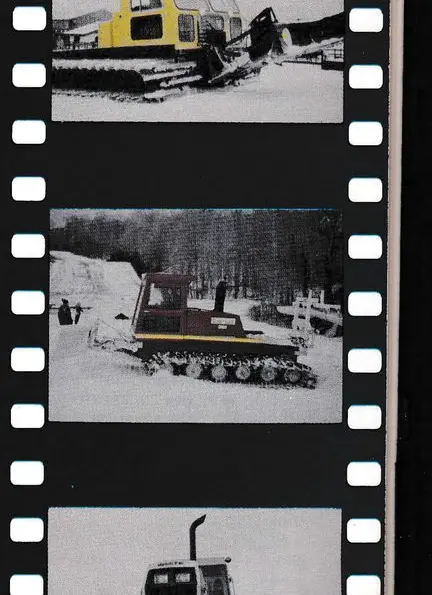
Every year sees the industry crossing new thresholds in over-snow vehicles—thresholds of engineering sophistication and design, to say nothing of price. We’re now into the $70,000-plus-accessories market, and unfortunately there’s not much left in the 20K price range any more. However, there’s always a brighter side to the story, and this year it lies in what’s new.

Photographs by Nils Ericksen
What’s New?
New in the North American market this season are the DMC (formerly Thiokol) 3300 and Kassbohrer’s Pisten-Bully 25.060. Let’s take a look at the little guy first, the PB 25. For starters, it’s a hydrostatic drive machine and is propelled by an amidships Mercedes 55 HP diesel. At 4300 lbs. it is considerably heavier than Bombardier’s “Bombi” but shorter than the DMC 1450 Imp. The high revs (3800) of the 4 cycle diesel are somewhat hard to control, yet the machine is easily manuevered with the twin hydrosticks. Offered three years ago in Europe, there are hundreds in use overseas already.
If you haven’t driven the new DMC 3300 (cousin of the retired Packmaster 2100) it’s time. The new and old may look alike but the similarity stops there. Handling and maneuverability have vastly improved thanks to a totally new differential sporting external steering brakes. A “blown” AC 649 diesel does a slick job through an Allison 4 speed automatic. New grouser profiles, sealed track belt edges, totally new steering and use of standard 80-90 gear oil in the rear should decrease maintenance costs and improve on-slope production dramatically.
For next season, the Kool Kat Mark II will be uncovered which is the only midsized *hydrostat* announced so far. Reportedly, in the $35,000 range, it’s diesel power will be by John Deere. An overall width of 8′ and weight to hp ratio of 48.9 should make it a good all-around vehicle.
Another totally new entrant into the snow farming market is the Sasquatch Mk-II, manufactured by Ontario Drive and Gear Ltd., Canada. Advance information indicates it will be a “compact” hydrostatic vehicle powered by a 4-cylinder gas or diesel and will weigh in at under 3000 lbs.
Other Highlights
**White** tractor has switched totally to the heavier and more powerful ‘210’ with front and rear axle lockup and is offering a 2-ton dozer (D-6 size) blade for the front . . . **Tucker** continues to methodically improve their popular mid-engine ME series with a 4″ wider cab, full-size buddy seat, stronger sliding windows and side window defrost. The 1742 ME is slowly replacing the giant 2700 ME and offers a “fuel squeezer” 453 Detroit as a power option . . . **Kassbohrer’s** luxurious Pisten-Bully has Mercedes-type electrically defrosted front and rear windows (you can’t see the wires) and an additional 3-speed electric shift selector for 6 forward speeds. Also, the parking brake sets automatically when the ignition is shut off . . . **Kool Kat** has produced a “library quiet” cab interior by fully isolating their cab on rubber. Tracks now adjust automatically “on-the-run” and detension upon shutdown. Instrumentation has been moved to overhead, and different sheetmetal provides easier engine access . . . For the Hydromaster 3700 **DMC** has provided a new, extra-heavy alternator, molded track belt edges and stronger grousers, all of which should add to that vehicle’s reliability . . . **Bombardier** is officially in the hydraulic power race by entering their 302HD with horses by John Deere. The fuel tank is a bit modest so don’t stand on the throttle. Speed control is through twin sticks and an electric 2-speed transmission. Front glass is insulated type. The 302 gasser was dropped in favor of this new comer. A Perkins 4 lunger that should really save on fuel, has been built into the improved 2520.
The table below, somewhat reorganized from last year’s, summarizes some of the specifications of over-snow vechicles currently available—new. It is difficult in some cases to present comparable data in a meaningful, objective, accurate way and still be fair. We have done our best. More standardization in making some measurements would help greatly.
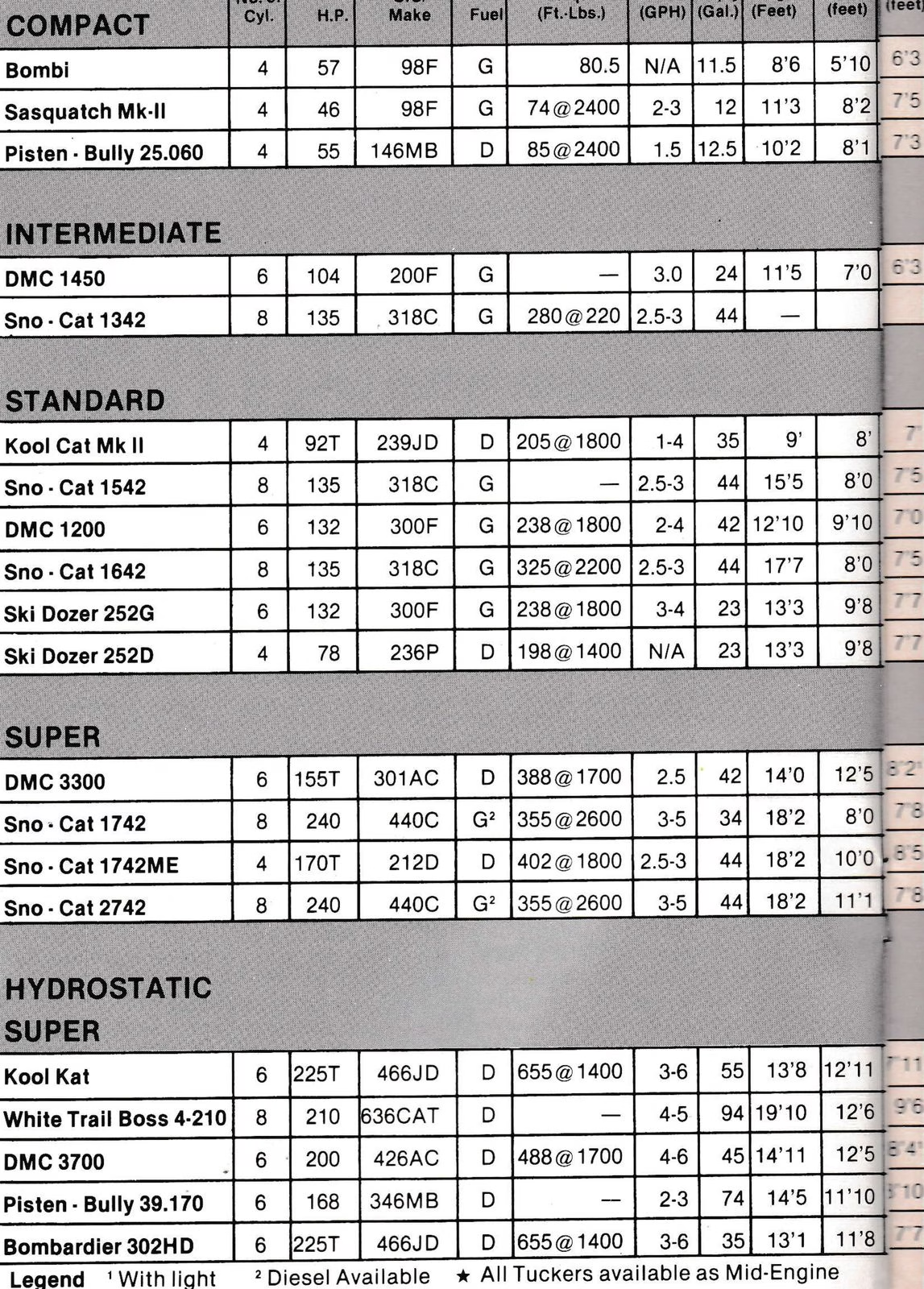
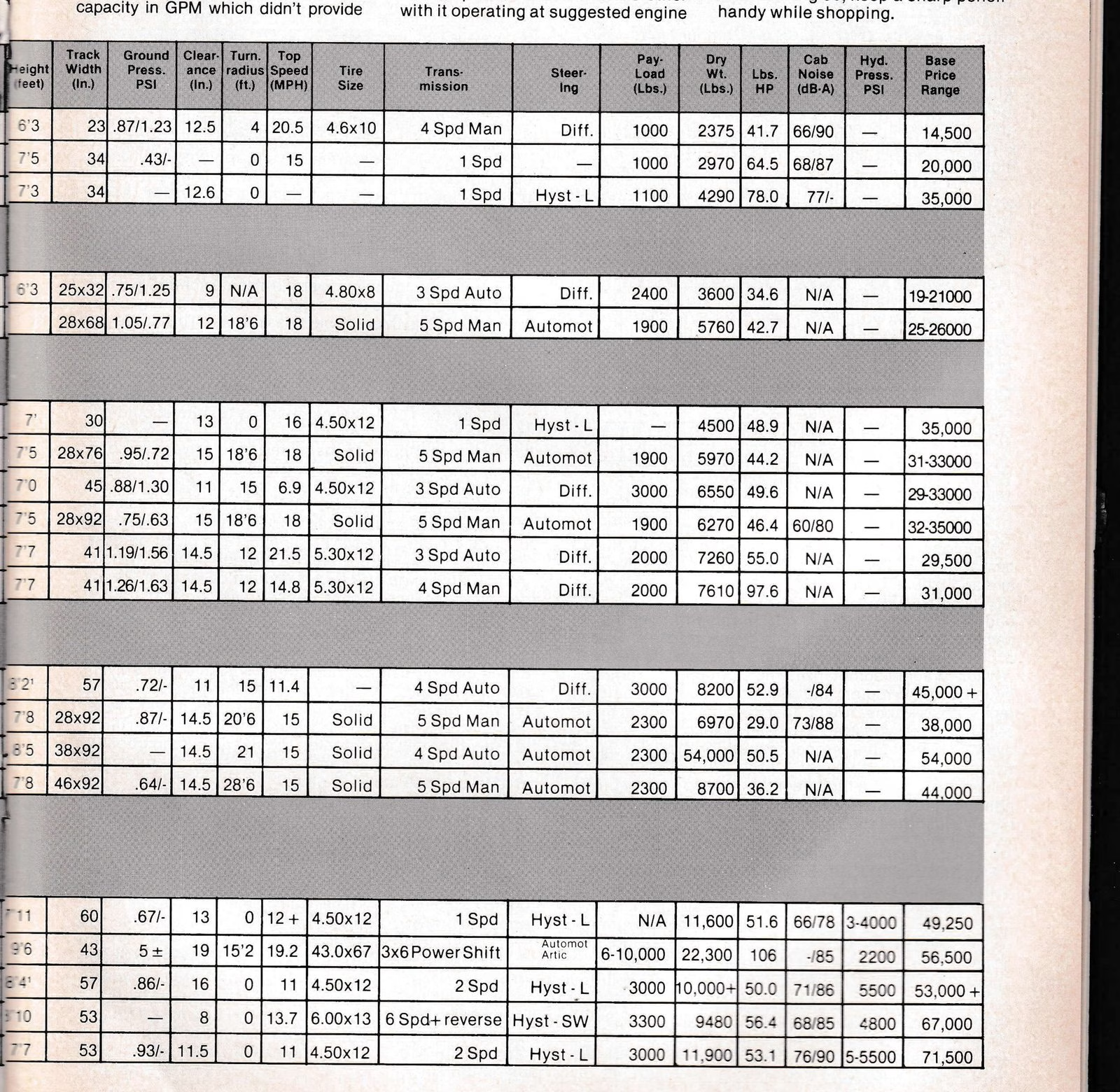
We present here some comments and fuller explanations of some of the categories.
**Engines:** Powerplants this season show few increases in cubes or horsepower. White’s Trail Boss benefits from a new-sized Cat 210 HP which is needed to carry the much heavier series vehicle. Bombardier now offers a Perkins four-cylinder to complement their Ford 300. Some of the engines (indicated by a T after the horsepower) have blowers or turbo-chargers for cramming more air into the intake for extra power, especially at higher elevations. Remember to read the torque for each engine, which will give you a direct measure of usable horses regardless of cubes displacement. Engine manufacturer is indicated by the letter in the Cubic Inch Displacement (CID) column: C – Chrysler; F – Ford; P – Perkins; JD – John Deere; MB – Mercedes Benz; AC – Allis Chalmers; CAT – Caterpillar.
**Fuel Consumption:** As with the stock market, nothing beats inside information. Ask the guy who owns one.
**Dimensions:** A box built to the given measurements should contain the whole vehicle, tracks included.

**Track Width:** Due to the numerous variations available, the list has been limited to the most commonly used *winter* tracks.
**Ground Pressure:** Although the figures vary considerably, and thus seem to be indicative of something, they should be reviewed with a cautious eye. Standardization of measurements in this area would be of great assistance. In the meantime, the numbers are unladen weight and gross weight at “O” penetration of the *belts*.
**Tires:** Mostly 6-ply on the smaller machines and 8-ply on others, the tires vary more in construction than diameter. The leading tire on each side is usually solid or urethane filled, and thus differs from the rest. Tucker tires are all solid.
**Steering:** Automotive type steering is provided on all Tuckers and a variation on the White (articulated) and Pisten-Bully (hydrostat). Differential steering with brakes at the rear is actually planetary in construction as opposed to the “brake and skid” type found on earthmoving dozers. Hydrostatics is of coarse the utilization of hydraulic motors (2) to drive each track independently. Control is with levers or a steering wheel and electronics.
**Dry Weight:** Tare or dry weight is the naked vehicle with no attachments, humans or liquids on board.
**Weight-to-Power Ratio:** Although usually expressed as “power-to-weight” ratio, I’ve found it’s much easier to read whole numbers than decimals. These figures are presented at the expense of last year’s hydraulic capacity in GPM which didn’t provide very interesting reading.
**Cab Noise Level:** Excessive noise level and duration have undeniably been accepted as definite contributors to human discomfort in all types of environments. The cab of a snow groomer is no different. Therefore, this year SAM used a Realistic Model 42-3019 to measure sound levels in the cabs of all available vehicles at the Eastern Regional Trade Show, Stratton, Vermont. Two measurements were taken, one with the vehicle parked at idle and the other with it operating at suggested engine RPM. All vehicles measured met Department of Labor guidelines or 90 dB-A maximum for 8 hours exposure per day per operator. (Normal conversation is about 65 dB, average factory noise, 75 dB.)
**Base Price:** All prices shown do not include grooming attachments. However, you do get a running machine that must be shipped from the dealers dooryard. Some of the units offer a formidable list of standard accessories from ski racks to air conditioning so keep a sharp pencil handy while shopping.

