

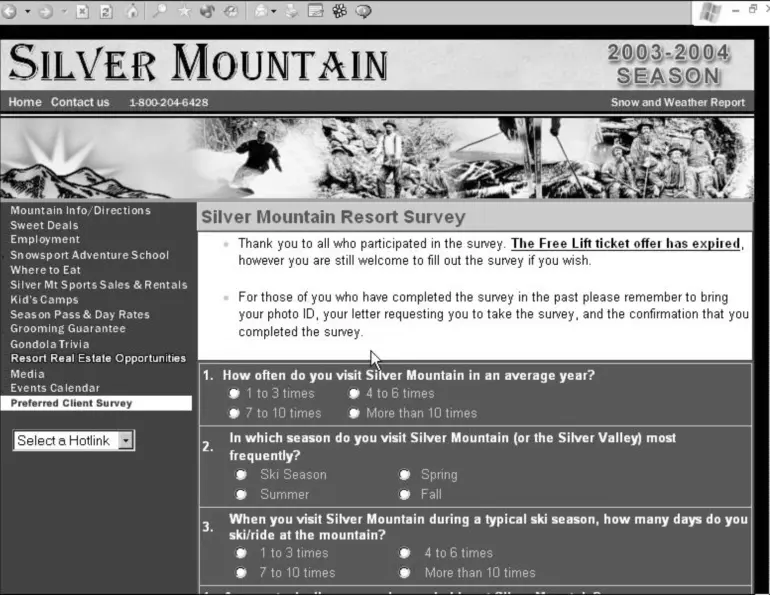
According to Joanna Belbey, president of Direct Response Marketing, based in Brooklyn, New York, a typical e-mail survey costs about half that of a conventional mailed survey. Moreover, she says electronic surveys enable response times to be cut to about a week, and return rates can be as high as 50 percent.
Not surprisingly, those metrics have turned more than a few heads in the business world. This interest has made two electronic survey solution providers among the fastest-growing companies in the U.S. Web Surveyor (www.websurveyor.com) made the Rising Start Fast 500 for 2003, a list compiled by Deloitte Technology. And Perseus (www.perseus.com) made the Inc. 500 List of America’s Fastest Growing Private companies for 2003.
What Do You Want to Know?
One of the major factors for the success of web surveys is its versatility. Ski resorts and other firms across the country are using e-mail surveys to assess the efficacy of advertising campaigns, test new ads, distill customer awareness and attitudes, and float trial balloons for new products and services. Plus, the electronic missives are also perfect for product evaluations, feedback on website design and functionality—as well as any number of employee feedback applications.
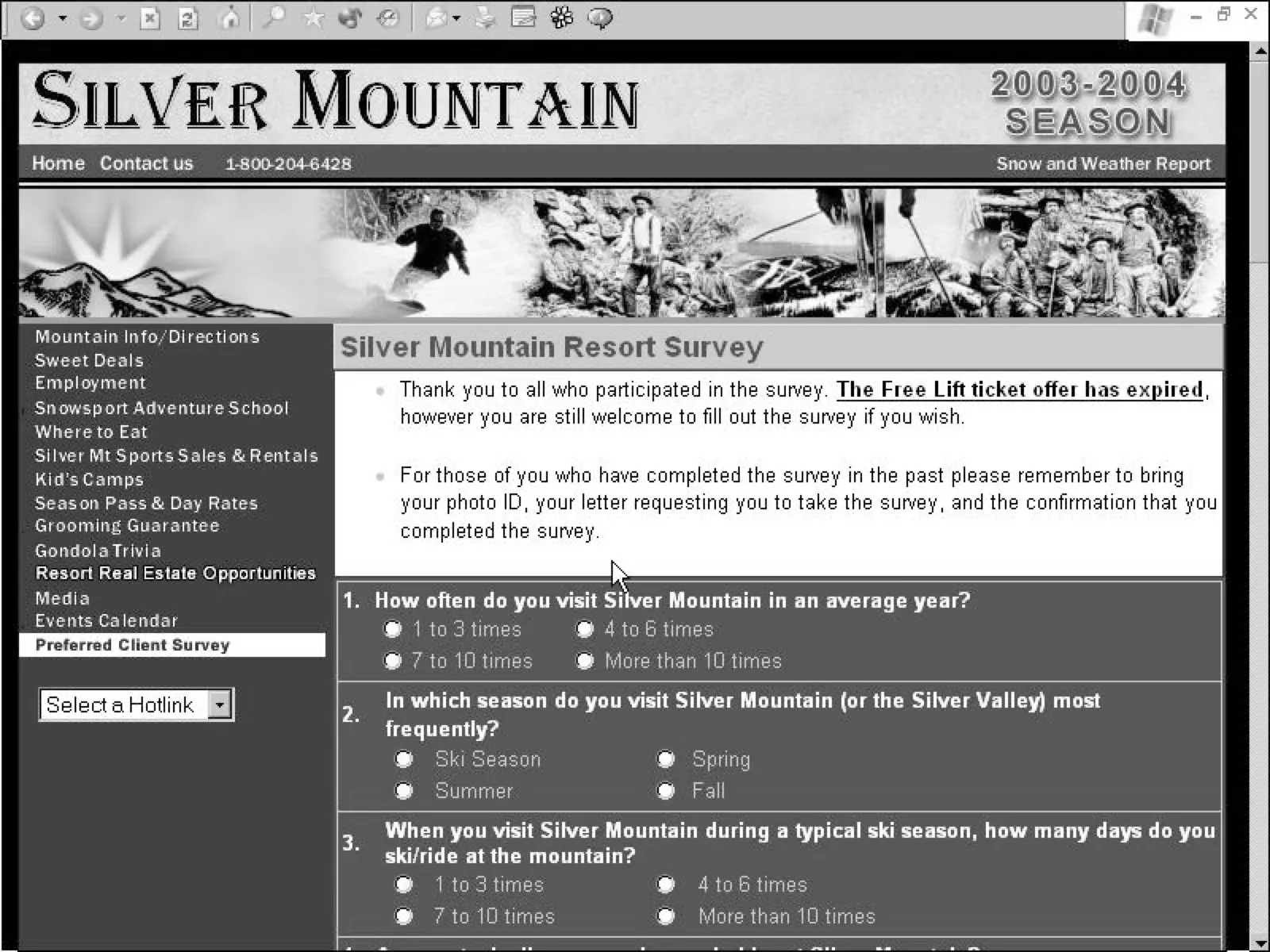
E-mail surveys have grown increasingly sophisticated during the past few years, offering ever-more-powerful tools for soliciting responses and analyzing results. Some of the more advanced e-mail survey solutions, for example, enable companies to personalize each survey with up to 20 fields defined by the resort. In practice, that translates into being able to address each potential respondent by his or her own name and to include up to 19 other personalized facts about them in your survey (assuming you have this information in the first place). This may well make the recipient feel a greater connection with the resort and less like an anonymous drone in a spam-fest.
The more advanced survey software packages can compile a raft of additional useful information: who actually received your survey, who clicked on links embedded in the survey, who forwarded the survey onto a colleague or friend and who responded to the survey. Such packages can also enable you to embed a survey within your company newsletter. You can even add automatic triggers to your existing customer and sales support systems and send out surveys to measure the impact of specific events immediately after they occur.
Many survey packages also analyze the data. They will automatically graph your survey responses, create multiple sub-reports based on how one or more questions are answered, and offer simple and multi-level data filtering based on all question, data or system data points. If you know how you want to slice and dice your data, chances are one or more of the solutions providers already have a tool do so—or can offer you tools you can use to do your own customization.
Make Yourself a News Item
Of course, once you’ve analyzed your data, you can get some extra mileage from your efforts by releasing select results and insights from your survey to the media. In doing so, your company will become an industry authority—and in the process, win you instant friends in the press corps.
“Surveys and studies are valuable publicity tools because they tip off reporters to emerging trends,” says Joan Stewart, a publicity consultant and founder of The Publicity Hound (www.publicityhound.com). “Often, they provide nuggets of information that don’t take up a lot of space. Or they can result in longer news or feature stories.”
Stewart says companies looking to get publicity from their surveys should make sure those surveys have authentic news value. If your website already generates a great deal of traffic, for example, you may want to ask visitors their opinions on emerging industry trends or their favorite products within the industry. That gives your data broader appeal.
Even more valuable—to both survey participants and the news media—are surveys that include some follow-up phone call interviews with participants, which are used as the basis of quotes and further insights that can be sprinkled liberally throughout the final document. “Many people will be pleased that you asked them to participate,” Stewart says. “They will also want to read the report once it’s done, which gives you a second chance to contact them.”

Software Tools
The widespread popularity of web-based surveying has spawned an entire cottage industry of web service providers eager to help companies conduct surveys online. Many provide these services for free, often in exchange for free advertising space within the survey form. (To find these providers, simply type “free surveys” into any major search engine.) Others sell in-house packages, with prices starting under $100. Most will host your online survey on their own computers for a nominal fee.
Many providers also offer free advice on how to design and implement an online survey. For example, Perseus Development (www.perseusdevelopment.com) serves up “Survey 101—A Complete Guide to a Successful Survey,” “Seven Steps to a Successful Web Survey” and “Web Surveys—For Knowledge, Lead Management and Increased Traffic,” among others.
Take a look at the full spectrum of survey software packages and service providers before you decide what will work best for you. Then let your marketing and IT departments find out what your customers think about you.
Joe Dysart is an Internet speaker and business consultant. E-mail: [email protected].
Survey Solution Providers
Here’s a sampling:
- EForm ($59), by Beachtech (www.beachtech.com). This is a handy service that will collect data both on the web as well as via forms that are e-mailed to each individual participant. An “open system” package, Beachtech says the results of its surveys can be deposited into any company database.
Surveys conducted via EForm are actually hosted on Beachtech’s own servers, so your IT department will not have to create any special scripts or programming to run the survey. Instead, Beachtech’s server encodes the survey responses and e-mails the results to your company’s database.
- EZSurvey ($399), by Raosoft (www.raosoft.com). EZSurvey offers 12 generic question templates (write-in, multiple choice, etc.) to help ease first-timers into the world of online surveying. Plus, it includes its own database module which helps users analyze and manipulate results.
The program also auto-generates the necessary CGI-scripts needed to host a survey or survey on your company’s server. The program is designed to automatically read responses and send the results along to your company database.
- SurveySolutions XP ($995), by Perseus Development (www.perseusdevelopment.com). This package is designed to work like a word processor for developing surveys, and will render a questionnaire for use on the web, via e-mail, fax, telephone and similar data collection formats.
Like many service providers, Perseus collects data on its own servers and forwards the data for integration into a company’s database software using its SurveySolutions interface. Most recently, the company has added an advanced statistics capability for users looking to vigorously manipulate data from survey participants.
- WebSurveyor ($449 to $3,000) by WebSurveyor (www.websurveyor.com). This company offers an extremely sophisticated web surveying solution, featuring all the bells and whistles, and then some.