



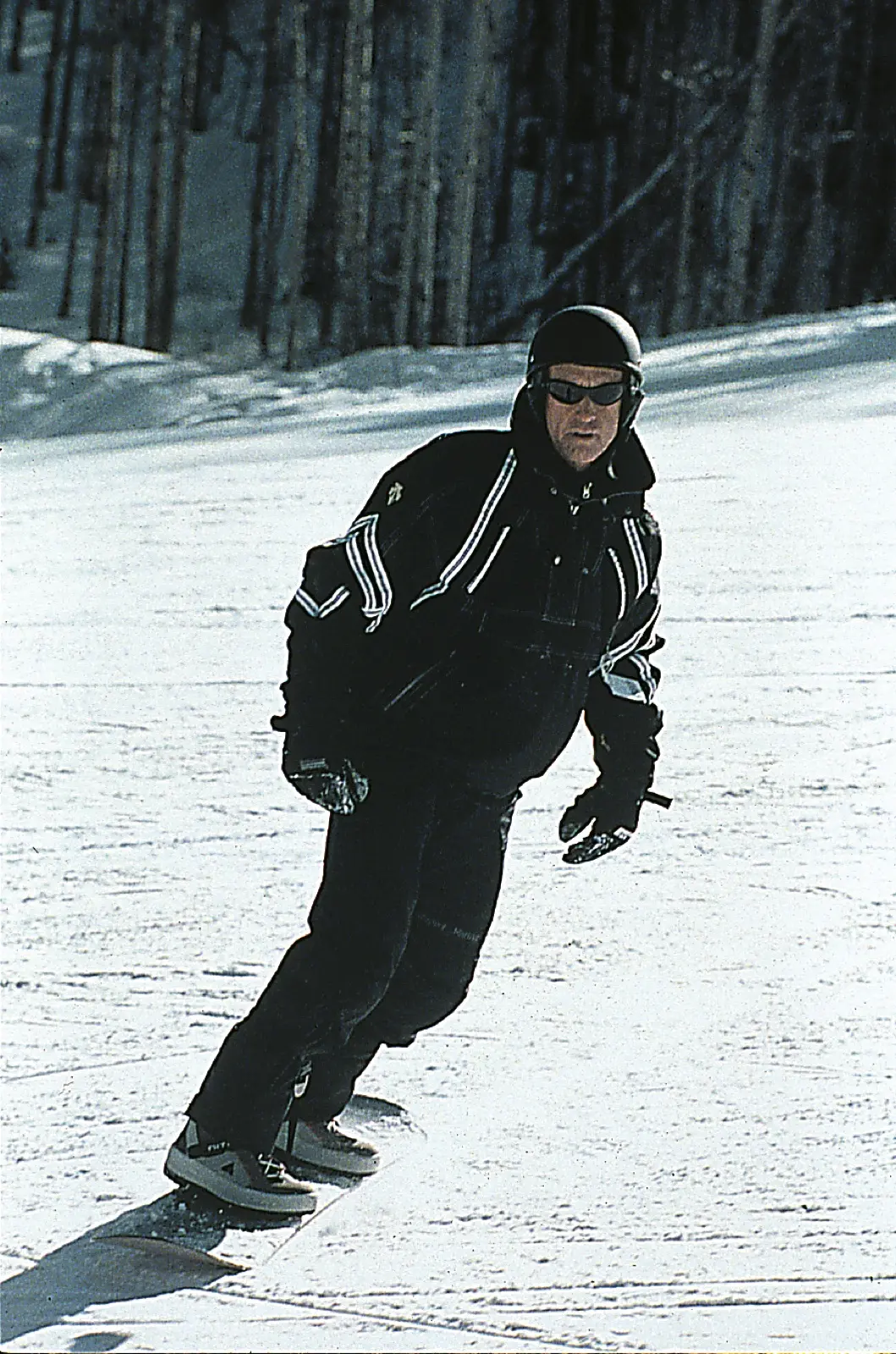
Ever since Pat O’Donnell took over as CEO of Aspen Skiing Company (ASC) in 1996, the resort has been at the forefront of environmentally-oriented management and development. It’s part of the company’s mission statement. The area has won the Mountain Sports Media Golden Eagle Award four times in the 12 years of the program’s existence. Aspen was the sole resort company to support the Forest Service’s preferred plan for White River Forest management, which favored wildlife protection over development.
O’Donnell gained his environmental awareness during the 1960s while rock climbing and living in Yosemite, where he was GM of the ski area for four years. He then helped found both Kirkwood and Keystone before leaving the ski industry to run the non-profit Yosemite National Institute, a non-advocacy environmental education foundation, which led to a position as CEO of Patagonia, where his mandate was to run a for-profit company as a tool for social and environmental change.
After a dozen years out of the ski industry, he returned as CEO of Whistler, B.C., then moved to Aspen a decade ago, first as COO and, for the past eight years, as CEO. This has given him, as he says, “a chance to exercise my own environmental agenda.”
SAM recently talked to O’Donnell about ASC’s environmental goals and policies and how they impact guests and employees.
SAM: Why is the environment such a top concern for Aspen?
O’Donnell: I want to protect something I was able to enjoy for future generations. For me, growing up in San Francisco, I drove to Yosemite every weekend. I loved it so much I just had to get a job there. I remember looking out over the national park, you were so steeped in it. You’re in the crucible. When you come out, your appreciation is there.
Some of my drive comes from spending time outside the ski industry. When I was at Patagonia and the Yosemite National Institute, I saw what can be done when there’s a lot of passion behind environmental issues. It was great fun for me. That’s why I went to Patagonia, and that developed my keen interest to harness the power of 3,400 employees behind environmental causes. Some of that has been manifested in the Aspen employees’ Environmental Foundation.
SAM: How did the Employee Environmental Foundation come about?
O’Donnell: I encouraged our environmental coordinator at the time, Chris Lane, to set it up. But it had to be their program. It’s eight years old now, a 501/C non-profit foundation, with 1,000 to 2,000 members. Employees contribute from their paychecks, the company matches them dollar for dollar, and so does the Aspen Valley Community Foundation, so every $1 of employee donations brings in $3. To date, it has raised $700,000.
My hope was to be able to teach philanthropy to patrollers and snowcat drivers. My dream has always been that, driving home with the wife and kids, employees can point out their good work—whether it’s open space or a restored stream. Every time I read a list of projects they give money to, it’s heartwarming.
It’s been a great success. We’ve established a culture that’s become so sacred that whoever we hand the baton off to won’t be able to scotch it. It’s a great legacy for our tenure, and hopefully they will build on it.
I’ve tried to encourage other areas to support similar programs, but they say, “We don’t have that kind of money.” I say, “Yes you do. Take $10,000 out of your budget and match 25 cents for every dollar.” Then you can go to naysayers and say, “We don’t just take from the community, we also give back via our employee environmental foundation.” It’s my dream that one of these years the industry can say it’s got 20 employee foundations across the country and they’ve given away $7 million. There’s no better way to defuse environmental opposition than to do these things.
SAM: How much of a difference can you, as the CEO, make?
O’Donnell: If it’s important to the CEO, it’s important to the employees, who become creative in their thinking. For example, take our latest Golden Eagle: Our managers asked, how about if we put a turbine in the return line on the snowmaking system? Holy Cross Power buys the power back. We spent $150,000 on a micro-hydro plant, and it generates enough electricity to power 40 Aspen homes on a year-round basis.
We hope other people will copy these things, as we have copied what others have done in the Mountain Sports Media Eagle Awards program. We’re a big supporter of that. We’d love to identify another 28 areas that are co-generating power. Nothing makes me happier than to see someone else win the Golden Eagle. I say we’re making progress and it’s great.
SAM: How do you institutionalize this type of thinking?
O’Donnell: My strategic mission is to create a culture where every capital request, from a toaster to a new lift, requires you to fill out a small EIS. Will it impact the environment? If so, how? If so, how much can you mitigate it? If they don’t have the answers, they have to get other staff involved.
We tell our people on any of these projects that if it has ROI it has the greatest chance of being done. We’ve been able to do a lot of partial mitigations, because we can’t always afford to mitigate every impact.
The greatest example is the new clubhouse built at Snowmass. We’ve created these checks and balances—we have a green building policy, any construction has to meet that. We brought the guidelines to architects. It ended up being definitely six figures plus-plus, about three percent of the total cost, to meet the guidelines: Super efficient dust-free ducts, the whole building is heated and cooled out of source pumps in the lake on the 18th hole. The golf clubhouse exceeds energy codes by 60 percent.
We’re going to do more of that in the new Snowmass village. But it will depend on what the town managers want. Will it be perfect? No. But it will be the best that we can afford.

SAM: Aspen appears to have a good relationship with local environmental agencies.
O’Donnell: Strategically, years ago, we put together a community environmental advisory committee. It’s made up of all the adversaries, about 16 people, an eclectic mix, from county and city government to wilderness advocates. We try to get them to understand that we are a for-profit company, and that there has to be a balance between environmental sustainability and profitability. This develops a trust between us and the entitling agencies. It has taken a decade to develop that trust.
SAM: How do Aspen’s environmental goals play out in the plans for the new Snowmass base village?
O’Donnell: Our owners, the Crown family, interviewed several builder-developers and told them, “Within financial reason, we’re going to make this as environmentally sound as possible, so there’s going to be an extra cost to it. That’s probably not the way you’ve done things in the past.” We even have an outside auditor come in and look at the project from environmental standpoint.
Bill Kane [Intrawest project manager] and Auden [Schendler, ASC’s environmental coordinator] have worked on the environmental aspects. We’ve got four different architects working on it. We’re going to make every piece of the project as energy efficient as possible—we’ll exceed the building codes by 30 percent. We think that it will pay off and then some in the long run.
SAM: Has Aspen’s environmental record helped ease the path for the village?
O’Donnell: We don’t expect much environmental opposition to the Snowmass village, although whatever you do, it’s never enough to satisfy everyone. Everything you do as a resort has an impact. From the beginning, we sat down with the environmental committee, which covers just about everything, from wildlife to water. Plus, it’s not like the village site is an undisturbed area, it was a parking lot.
In fact, the committee gave the builders lots of good ideas, things we would never have thought of.
What the conservation groups are saying is, if it’s inevitable that you’re going to develop your land, let’s make it the best possible development. That’s the payoff for the time we have invested in other, smaller issues in the past.
SAM: Does environmental virtue draw skiers and riders to Aspen?
O’Donnell: We surveyed customers and asked, would you choose a ski area based on its environmental record? The answer was, “No we wouldn’t.” But people will support environmental products if it doesn’t cost them to do it. In focus groups, we learned that if you had three bottles of ketchup and all were the same price, people would go for the organic one. Otherwise, they wouldn’t. I am not frustrated by that. It’s part of the process and evolution of things.
So our environmental record hasn’t given us any business advantage. But we have been almost deluged with applications for employment based on our core values, not just from front-line people but especially from people who want to work in management or in environmental affairs.
SAM: Where is the public headed on environmental issues?
O’Donnell: I’m encouraged that the public is headed in the right direction, but the movement is very slow.
Nonetheless we will stay the course. We don’t want the valley to become one big strip mall. So when people are looking for as pristine a setting as possible in 20 years, we’ll look the same—or even better. As others continue to develop or overdevelop, we’ll have a strategic edge.
The Snowmass Hydro Powerplant
The new 115 kW micro-hydroelectric power plant at Snowmass uses the existing snowmaking system’s underground pipes to channel spring runoff from West Brush Creek through a turbine, generating electricity. The expelled water is returned to the stream. This system will run from May through August, when runoff is at its highest.
The plant should generate 250,000 kilowatt hours of energy annually, which prevents a half-million pounds of carbon dioxide from being emitted. ASC sells the power to Holy Cross Energy, earning around $15,000 each year. If this micro-hydro plant proves successful, ASC would replicate it at its other four mountains, providing the potential to power 400 homes.
“This project . . . is a successful, transferable and eventually profitable example of on-slope renewables for the ski industry,” says Aspen environmental coordinator Auden Schendler.

