

Recent inspections by people professing expertise in the inspection of gear boxes (gear teeth) have caused both concern and conflict. One expert says the entire gear unit should be scrapped, thereby opening the door for total terminal replacement. This may involve a total cost of three to five hundred thousand dollars per lift.
Other “experts” have suggested that individual gears be replaced or re-cut, where costs may run from three to thirty thousand dollars.
These conflicts in opinion and their subsequent economic impact on the industry prompted an industry-wide search on the part of the writer with the results as shown below.
First, let’s establish some basics so that we may perhaps be able to wade through the situation in a more enlightened way.
The gearing units used on aerial passenger tramways vary greatly in size, shape and manufacture. Open gearing has been used — and is still in use — on many lifts, both new and old. Enclosed gear units have gained in popularity in recent years as higher speed lifts and stronger materials have become available.
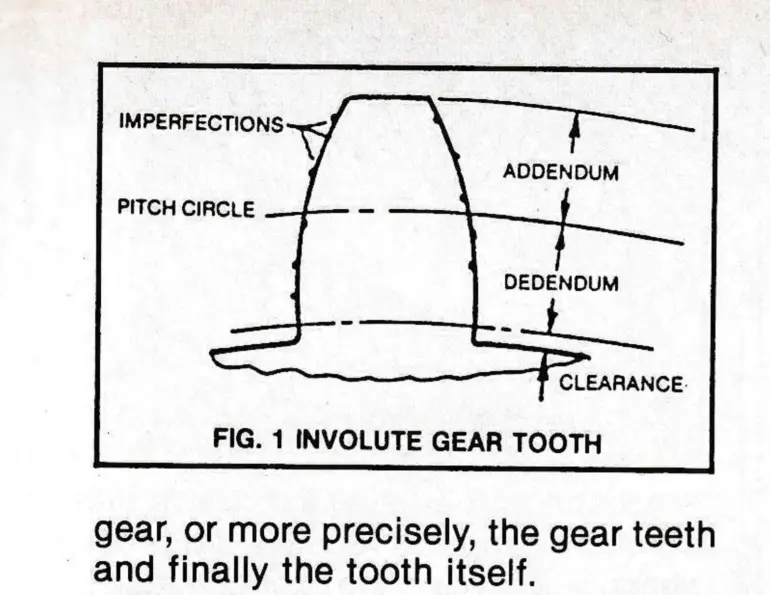
The primary elements of the gearbox are the housing shafts, bearings and gears. There are other secondary, although necessary, elements such as pumps, bolts, hoses, gaskets, and shims. The focus here is to be on that element of the gearbox or gear set which exhibits wear in its life: the gear, or more precisely, the gear teeth and finally the tooth itself.
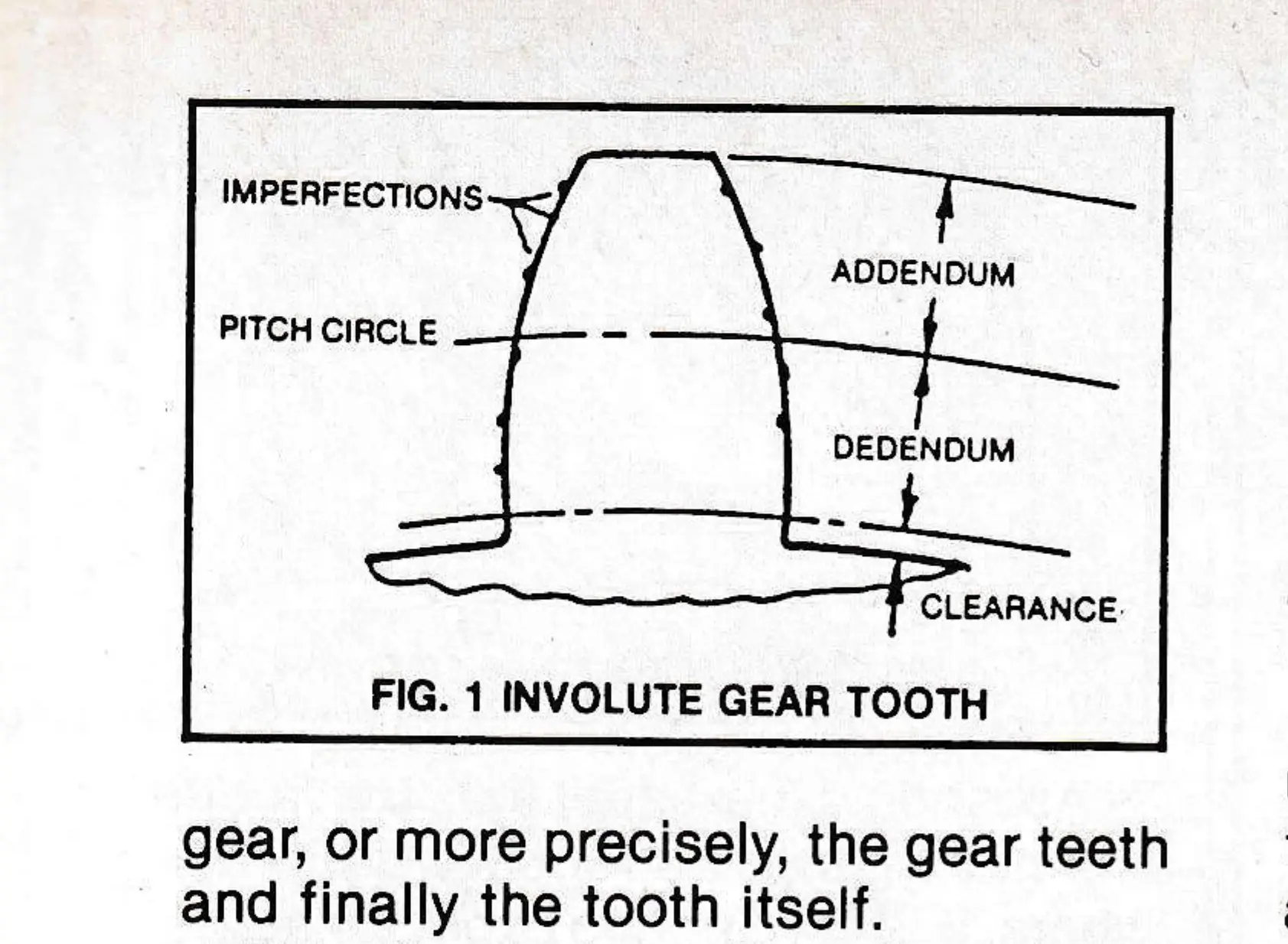
This discussion will be focused on “soft” gear teeth which are most common in older gear units and are still in production today. The term “soft” is obviously not very explicit; however, a bit of further definition may tie this down. Soft gear teeth are usually cut from suitably strong material — usually alloy steel — by a milling machine or “hob.” As the teeth are cut in a gear blank, it is common to have a final product as shown in Figure 1 which has minor imperfections to what we know as the involute shape.
These minor imperfections are polished out during the initial wear-in period of the gear teeth and there is some polishing and wear that takes place during the operating life of the gears.
Since our “soft” gear teeth are expected to wear during their life, the obvious question is how much is normal and when does the wear reach the point where the gear should be replaced?
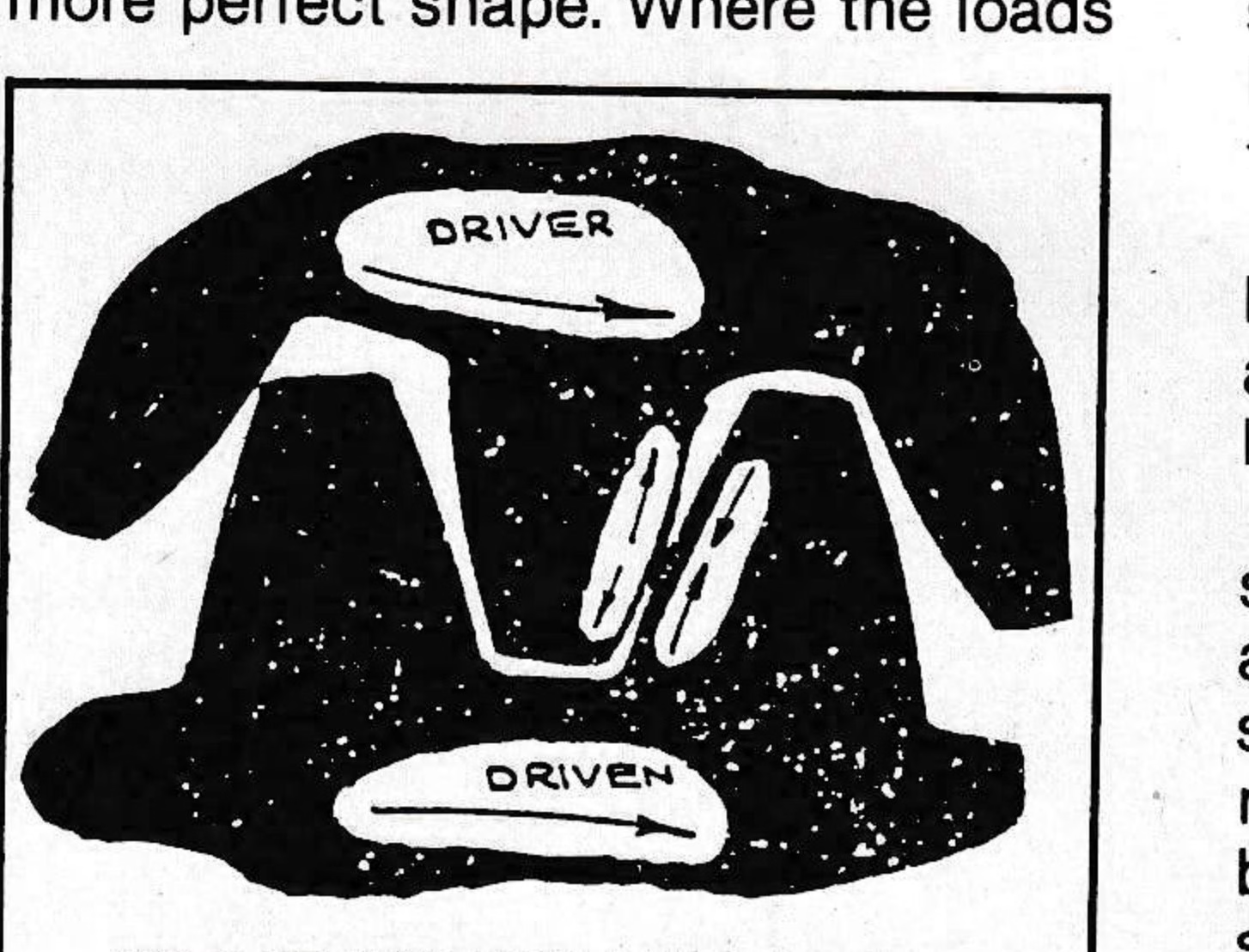
Although in theory, the gear teeth are supposed to have true rolling contact, reality shows us that the relative movement of the teeth is varied from pinion (driver) to gear (driven) — see Figure 2.
The nomenclature used in the figures and discussed below is that defined by ANSI/AGMA 110.04. Wear and surface fatigue are the general areas of concern to this discussion. Although foreign material or lubricant failure may cause scoring, this mode of wear is not the subject here.

The new gear tooth starts its life as an imperfect entity, with the imperfections noted above. As it goes through its early life, it is polished to form a more perfect shape. Where the loads on a given area are large enough, a process of minor pitting occurs, which is the second stage of polishing. As pressures on the material get higher, further deterioration occurs to a point called destructive pitting which, if conditions are severe enough, leads to spalling.
In general, four levels of wear mean four predictable levels of future service life:
- Polishing — Normal or extended service life.
- Initial Pitting — Normal service life.
- Destructive Pitting — Shortened service life except in special situations.
- Spalling — Severely shortened service life.
These four terms basically describe the pitting or holes we see as wear in gear teeth. The small holes we can’t see are polishing. When the pits get large enough to join together and form canyons, we call it spalling.
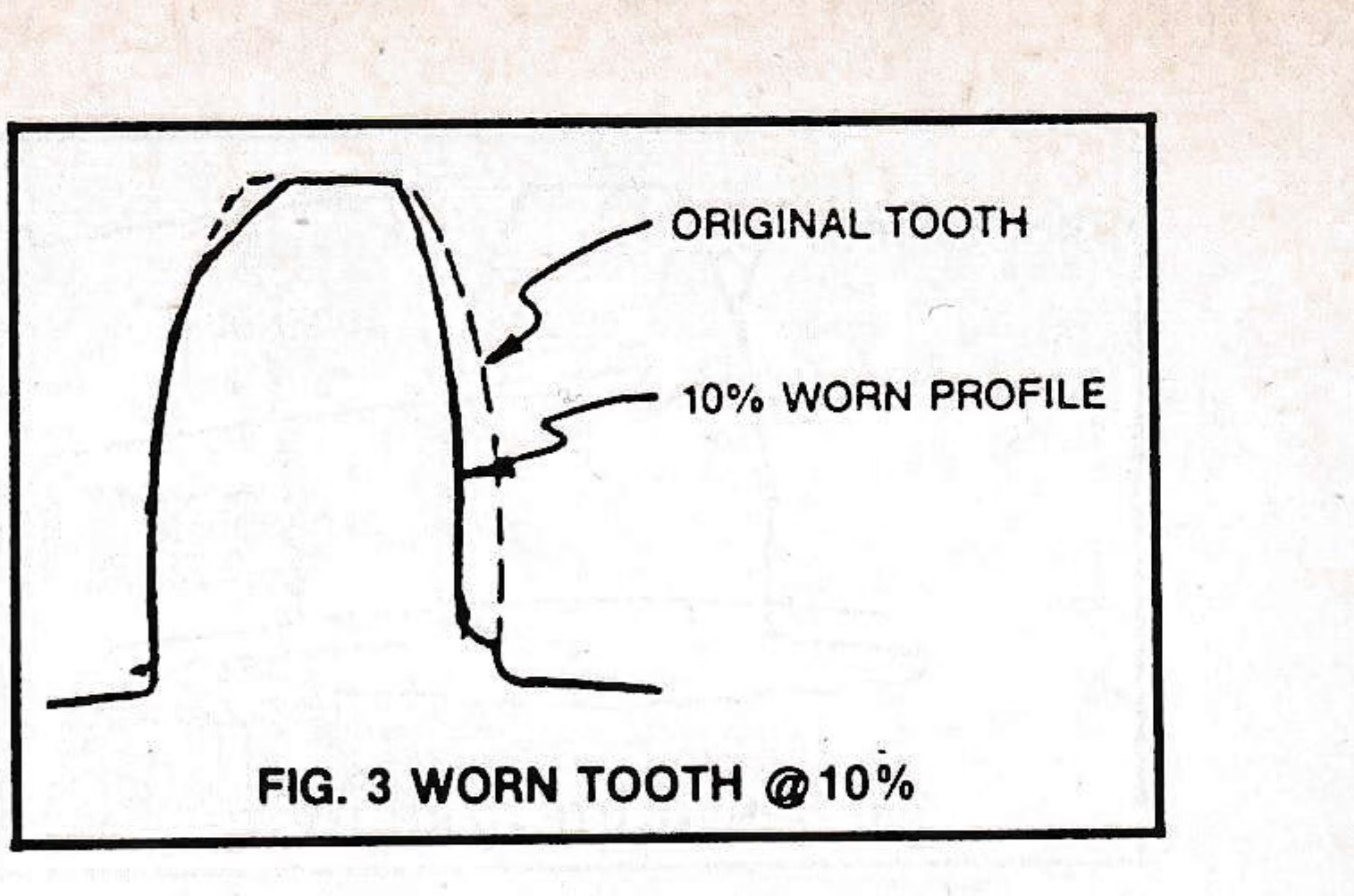
Enough for the verbiage; let’s get back to the teeth which are inspected and see if some light can be shed on how bad is bad. Heinz Kissling was kind enough to share his knowledge on this subject and his basic recommendation for soft gearing is to consider replacement when the tooth thickness has been decreased by 10%. Figure 3 shows a typical tooth and an anticipated 10% wear profile.
As should be expected, the tooth will not wear to its root. As the tooth wears, it is common to expect that the tip of the tooth will show signs of “wire edging,” which is plastic flow of the tooth surface at the tip of either a pinion or gear. Removal of this wire edge will help in several ways: 1) It reduces the high stress produced by the contact so far from the root; 2) it slows the root wear on the opposing tooth; and 3) it removes metal before it is worn off to become part of the lubricant.
In conclusion, those people inspecting gear teeth should understand the normal tooth wearing process and be capable of objectively analyzing the condition and giving meaningful, justifiable advice to the owner.
Under the guise of “excessive wear,” “worn out,” or “badly worn,” salesmen have generated work for gear box manufacturers, gear cutters, and lift manufacturers. Yes, in some cases, entire drive terminals have been replaced because of an adept salesman with a little gearbox knowledge.
Beware of the “expert” who has a vested interest in replacing your components, be it wire rope, chair guards, gears, gearboxes, terminals, or entire lifts. On the other hand, most reputable manufacturers have qualified technical people who can perform objective field inspection services. This is what you want as well as want to pay for.