The first clue that Olympics organizers aimed to err on the side of operational overkill was a complaint from a cab driver. “Do you know the average wait for taxis to pick up a fare at the airport?” the cabbie asked in a thick Croatian accent. “Two-and-a-half hours. There are too many free shuttles and too many cabs.”
Better the cab drivers should complain than visitors gathering in Salt Lake City for the 19th Winter Olympics. Determined to avoid the infamous snafus of Lake Placid, Atlanta and Nagano, the Salt Lake Organizing Committee (SLOC) met early and often with ski areas hosting events to hammer out logistics.
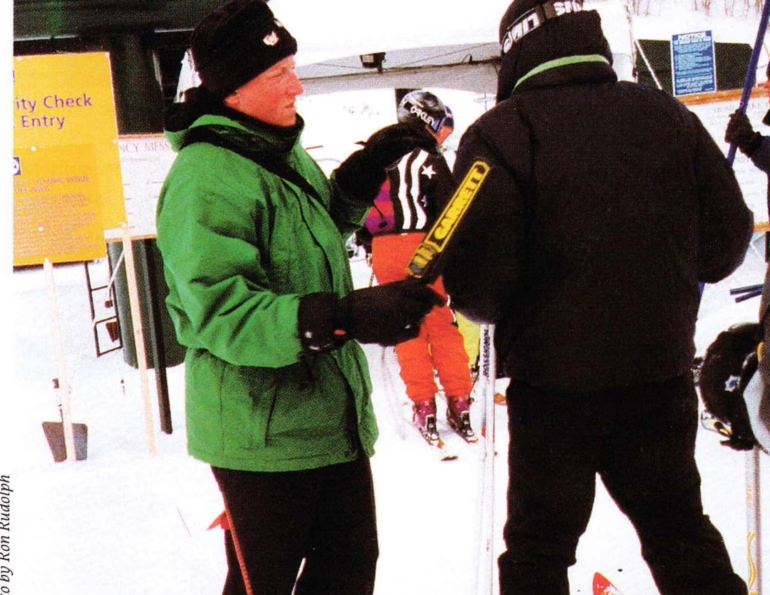
At most skiing venues, spectators marveled at the efficiency of crowd management, despite the post-9/11 need for airport-like security checks. SLOC’s “Know Before You Go” campaign beseeched the public to set out for venues early and expect thorough searches at metal-detecting stations known as “mag ’n’ bags.”
“SLOC put the fear of God in everyone,” said Deer Valley marketing director Colleen Reardon.
Still, not every situation could be anticipated. In spite of all the planning, the biggest challenge for resorts—herding large numbers of spectators under tight security while minimizing inconvenience to skiers—was met with differing degrees of success. Performance largely reflected two factors: the resort’s experience with holding major events and the resort’s culture.
Photo by Ron Rudolph
Deer Valley: Rising to the Challenge
Most events at Deer Valley ran smoothly, as one might expect. But the exceptions showed the resort’s character. For example, skiers watching the women’s mogul competition (the first event held at the resort) from a run above the venue had to stand in line for 40 minutes to get to the bottom of the mountain.
With its typical attention to customer service, Deer Valley management quickly figured out how to efficiently move people to and from its moguls, slalom and aerial events. The key to getting people to events in timely fashion was increasing the number of mag ’n’ bags, said Reardon.
Managers also responded to a huge glitch in food service, which was SLOC’s responsibility. “People were angry because of long lines for hot dogs,” said Reardon. Deer Valley, as is its custom, wanted to serve up a greater variety of higher quality food, but SLOC was protective of its gastro-monopoly.
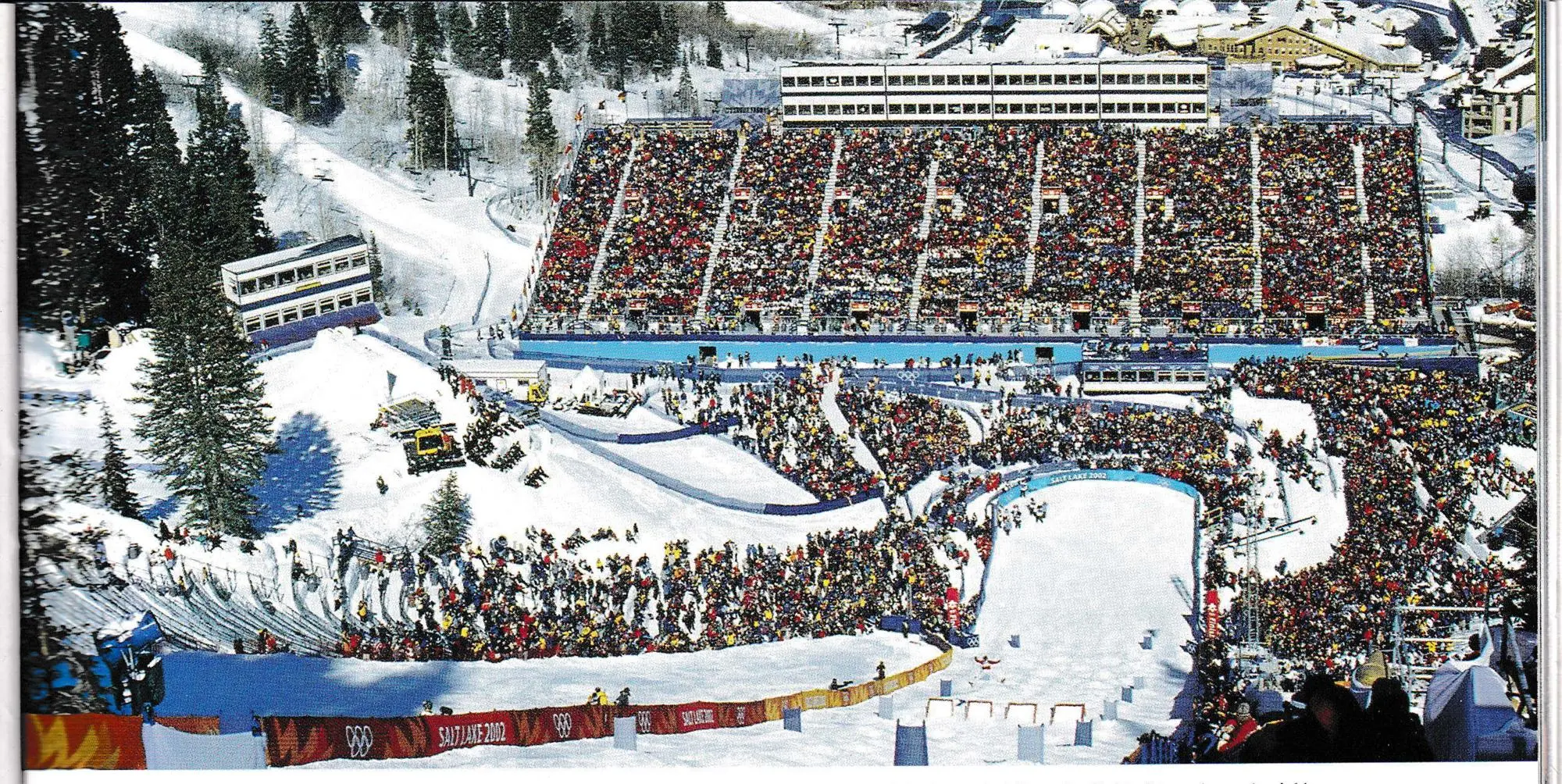
Photo by Lori Adamski-Peek
“Bob Wheaton [Deer Valley president and general manager] went to SLOC and said, ‘We’re going to sell food. We’re Deer Valley, and people expect more from us.’ It wasn’t easy, but SLOC caved,” Reardon said.
After the first day of competition, Deer Valley set up a string of banquet tables outside the Snow Park Lodge and began serving some of the delicacies for which the resort is famous: Caesar salad, turkey chili, the area’s supersized cookies, bagels and muffins. The resort charged its usual prices, and sent hundreds of spectators away happy. “We received tons of comments about it,” said communications manager Christa Graff. Guests were even more gratified after SLOC famously ran out of hot dogs.
Another example: Even on non-event days, U.S. border guards and uniformed National Guardsmen with M-4 automatic weapons oversaw the mag ’n’ bag stations that controlled access to any run that approached the competition courses. To counteract the inconvenience, Deer Valley rolled out the customer service. At the top of Bald Mountain, a uniformed soldier held one of the Olympic torches and allowed skiers to pose for pictures with it. On Valentine’s Day, one of the security volunteers handed out Hershey’s Kisses.
On-mountain personnel had time for the extra TLC because so few people were feasting on Deer Valley’s sumptuous corduroy snow. Attendance dropped below 300 skiers one day early in the Games. Lodges, usually bustling, were like ghost towns.
And there wasn’t much management could do to reduce expenses. “Our payroll didn’t drop much,” said Reardon. “We cut back on ski school, but we needed to beef up a little on food and beverage.”
Park City: The Value of Experience
Park City Mountain Resort (PCMR) experienced similar challenges while hosting the GS and snowboarding events. Perhaps a sign that snowboarding and snowboarders are coming of age, PCMR survived without a major brouhaha.
Michelle Palmer, PCMR spokeswoman, said the working relationship with SLOC was key. “We feel the day-to-day co-existence was relatively flawless,” she said. Skier visits during the Games “exceeded all projections,” she said, but the privately held company doesn’t release numbers.
Palmer also attributed the success to the number of volunteers who were either current or previous employees of the resort. “Lots of people who worked for us during America’s Opening World Cups came out of the woodwork,” she said. Their experience at handling big events certainly helped keep order. On the last Olympic day at PCMR, most of the crew who worked on the original America’s Opening race 15 years ago took a curtain call in front of the 18,000-head crowd.
Snowbasin: The Price of Inexperience
Events at Snowbasin didn’t transpire quite as smoothly. The burgeoning Sun Valley Company resort, site of the downhill and super G courses, had the most formidable challenges of the three alpine venues. Many of the facilities and service operations were brand new, and staff had little time to work together. Moreover, hosting the long courses of the speed events required the resort to secure much more real estate than was the case at the other mountains. The result was difficulty moving spectators and day skiers.

Snowbasin and SLOC clearly communicated that the public had two options on event days: either buy admission to watch from the finish area, or purchase a lift ticket to ski for the day and try to glimpse racers as they flashed down the course. Security concerns and physical barriers prevented the two groups from mixing.
That was a bitter pill for Snowbasin. The area’s opulent new base area was only a few hundred feet from the grandstand, but separated by a security fence.
Even if a spectator had a masochistic notion to wait in enormous security lines twice, there weren’t enough daylight hours to attend an event in the morning, leave the race arena, clear two security checkpoints and return to ski the same day. Ironically, the opulent lodges that were rushed to completion just in time for the Olympics were off limits to Olympic spectators.
Thanks to the Byzantine security setup, approximately 2,300 spectators missed the start of the men’s downhill because of a traffic snarl. Among the masses was Mitt Romney, president and CEO of SLOC, who jumped out of his car and attempted to direct traffic.
Perhaps more damaging to Snowbasin’s reputation was the plight of skiers lured to the mountain on race days by an aggressive marketing campaign. Some skiers complained that Snowbasin’s advertising exaggerated the amount of the downhill race that skiers could view. (For the record, the women’s downhill course offered excellent trailside locations, but the men’s course was more difficult to see.)
Skiers weren’t the only unhappy campers. SLOC officials reportedly were miffed that Snowbasin owner Earl Holding would promote his resort so heavily on event days, which surely exacerbated traffic congestion.
To make matters worse, skiers were parked in a remote, icy gravel pit, then bused to a security station where many waited more than an hour-and-a-half to pass mag ’n’ bag inspection. Entrepreneurs sold lukewarm cups of coffee to the captive throng for $2. To help ease tension, Holding and his wife, Carol, walked along the line doling out free hot chocolate. That was a welcome touch, because this wasn’t the end of the ordeal: From the security checkpoint, skiers boarded another shuttle to get to the slopes.
At the end of the day, the return trip wasn’t much easier; it took two shuttles to reach the gravel pit, which had turned muddy in the afternoon sun.
When asked why there were only two queues for the mag ’n’ bags, a contrite security manager said, “We weren’t expecting so many people.” And Custer didn’t expect so many Indians.
Snowbasin’s line: “SLOC organized the security,” said spokeswoman Karen Vardeny. “Unfortunately, it wasn’t under our control.”
“We wish we could have hosted some spectators as skiers,” Vardeny said. “We obviously hoped those 25,000 people who attended events would come over to see our new facilities. We hope they’ll return next year.”
But Vardeny said the experience wasn’t all bad: “Sales skyrocketed in our retail shops.”
And the mountain sure looked great on television.