


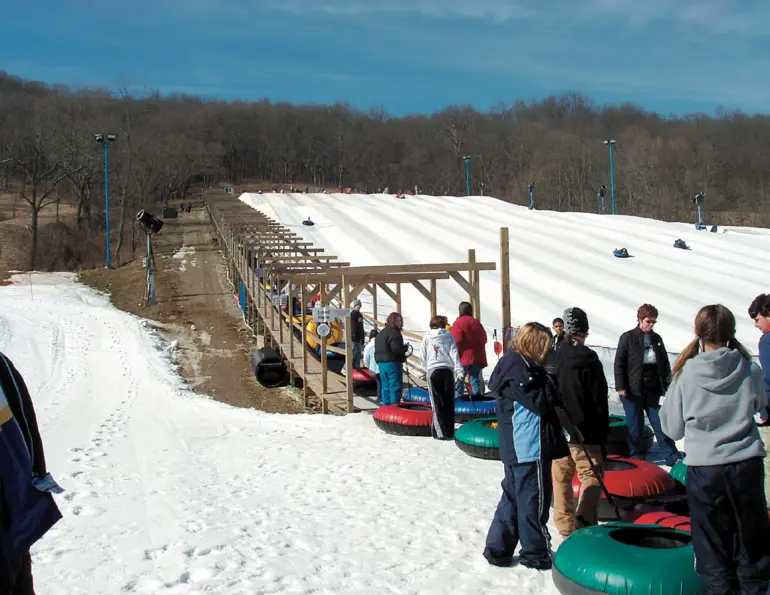
At Perfect North Slopes, some of our best innovations have come from remolding a good idea we have seen elsewhere. Our two-season-old tubing hill is a good example. It’s been a huge success, largely as a result of learning from other operations and coming up with a few wrinkles of our own.
We started looking at successful tubing operations a number of years ago. But we were more concerned about not being on the bleeding edge than about being on the leading edge, so we waited and watched. Our patience paid off, as we had the opportunity to learn a lot about tubing before we ever got started.
During our visits, many operators shared as much about what not to do as they did about what to do. Setting up the tubing hill to accommodate huge swings in crowd size was a good example. Several areas also indicated the need for more and better staff than one would anticipate to keep the facility operating effectively. That reoccurring theme pointed out the need to design the tubing hill so we could expand and contract the staff according to the size of the crowd.
Controlling the flow, which at first seems very simple, is actually advanced physics. The coefficient of friction is changing constantly. Combine that with a wide range in the “mass” department, and you have tubers stretched out all over the hill. We also saw several theories about how to stop tubers, which is diametrically opposed to what the laws of physics want them to do.
Finding the Right Location
We quickly realized that “Location, Location, Location” was not the only important factor—so is “Runout, Runout, Runout.” We are an urban day ski area with around 6 million people within a two-hour drive, so we knew we had a good market location. We also had a very good tubing hill location with optimal runout. It wasn’t just a spot that was convenient to the rest of the ski area.
This site is at one end of our property, only a couple hundred feet from our boundary ski trail, but it is downhill and too far from our existing day lodge facilities for tubers to use them. It is, however, well suited for a tubing operation. By developing this site we put faith in those who said that tubers were largely a separate group, a new market, distinct from skiers and riders. And choosing the more remote site that had the most potential as a tubing slope has created many more pluses than minuses.
Designing the Ride Down
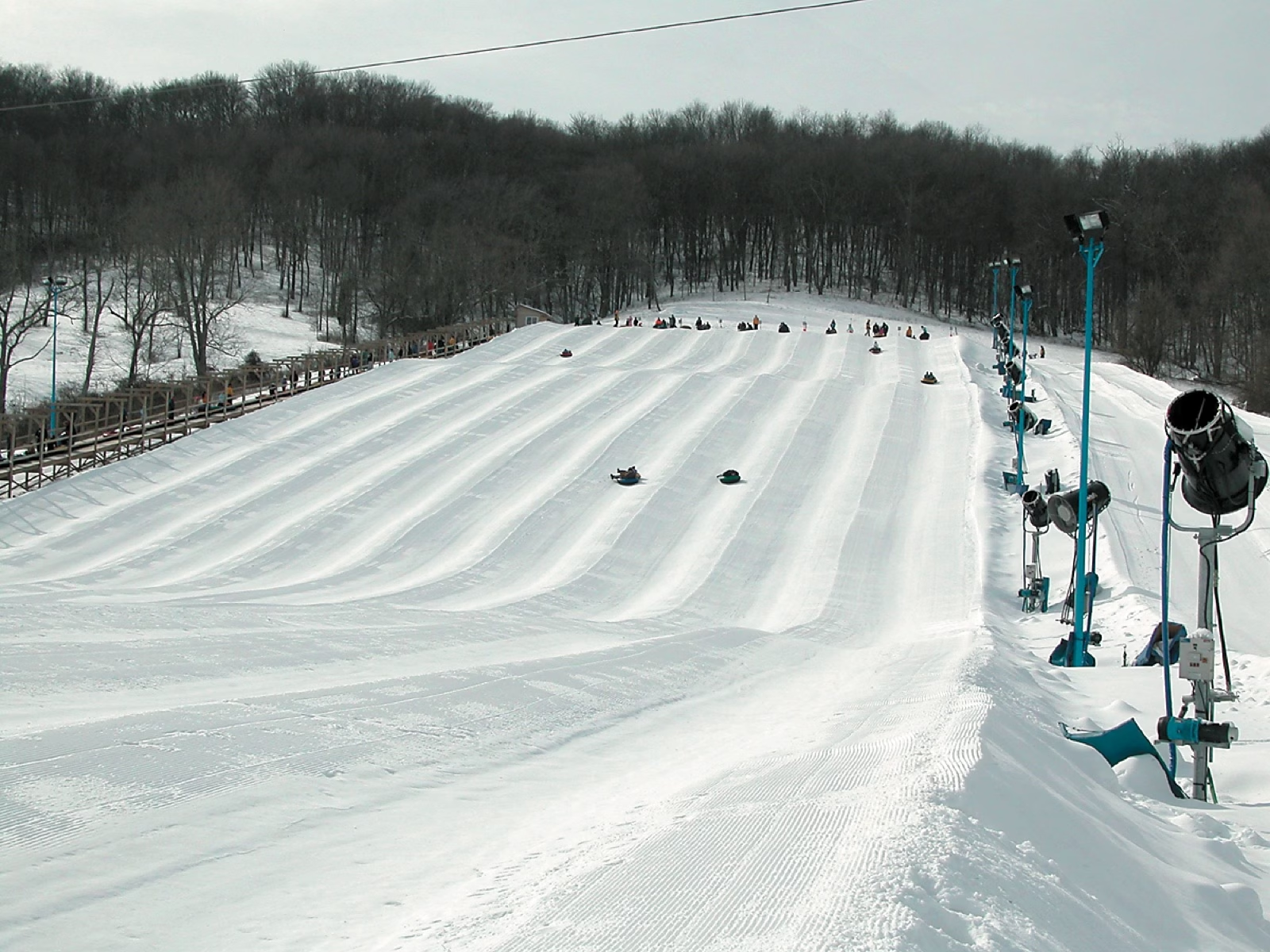
Decision number two was the size and shape of the tubing hill. I was pushing for minimal excavation, but relented to the majority on our staff who felt we should “shape it right.” They were right!
Our tubing hill has about 400 feet of slope with an average grade of 17 percent. We built a large shelf in the middle to make the run more interesting and to slow people down. We excavated 350 feet of runout with a 5-foot upward grade from the toe of the hill, with 250 feet of flat “bonus runout” beyond that for those speedy cold nights.
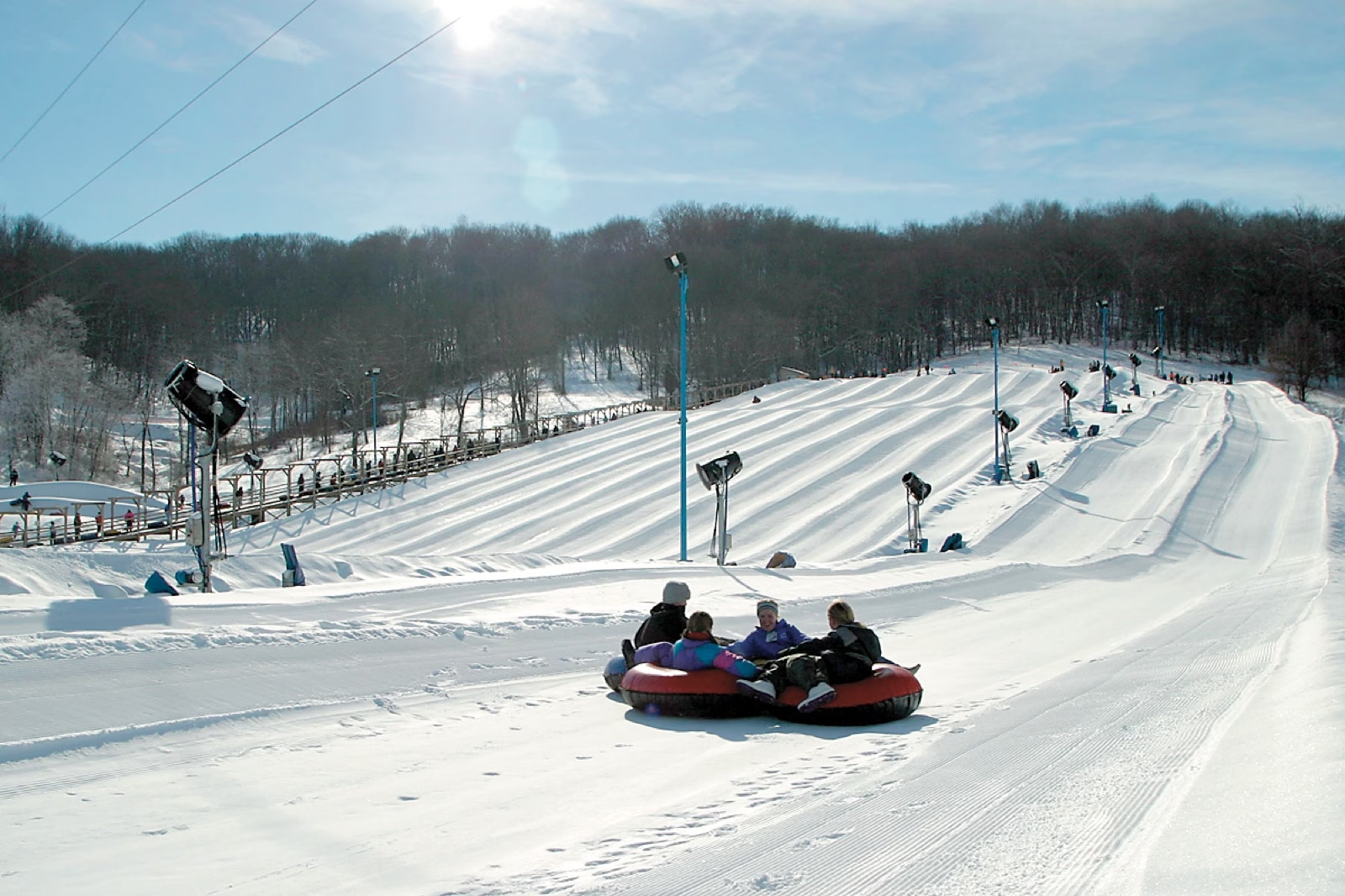
Our primary tubing slope is about 150 feet wide, providing room for 9 or 10 lanes. We have 9 SMI Polecats with compressors about 170 feet from the carpet lift, more than necessary but enough to hammer it when we have a window of weather.
We also are able to swing the snow guns 180 degrees and make snow beyond the primary tubing hill. We did so this season to create a couple of Super Lanes on the back side of the guns. These Super Lanes are much wider and less steep than the regular lanes; we cut them with a full-size cat. They are strictly linking lanes and typically, 10-plus tubers link and go at one time. (The record on a slow-snow day was 50 people in a link.)
Our regular lanes are roughed in with a PB 300 and finished with a PB 100. We purchased the PB 100 primarily for grooming the tubing hill lanes, and though it is much more time consuming than grooming the lanes with a full-size cat, the lanes are more V shaped, look very finished, and are smooth. We don’t have jagged trough edges or steep lane walls, which has eliminated the leg injuries that can occur as tubers bang the sides of the troughs.
Our hill is not perfect (pardon the pun), but it’s close. We will probably cut the shelf back a little some day. It doesn’t slow people much on fast days, and it is a big problem on slow-snow days. We will add an additional snow gun to the bonus runout area; that additional area is used often and needs consistent maintenance. We continue to seek faster grooming options that will still give us the function and finish we want.
We also plan to cover the last 100 feet of the deceleration area with a few inches of washed pea gravel. We tried a number of materials—carpets, Astroturf, rubber mulch—but plain old pea gravel seems to work best, even on the fastest days. A pop-up fence just past that will create a secure exit lane for all tubers.
Easing the Ride Up
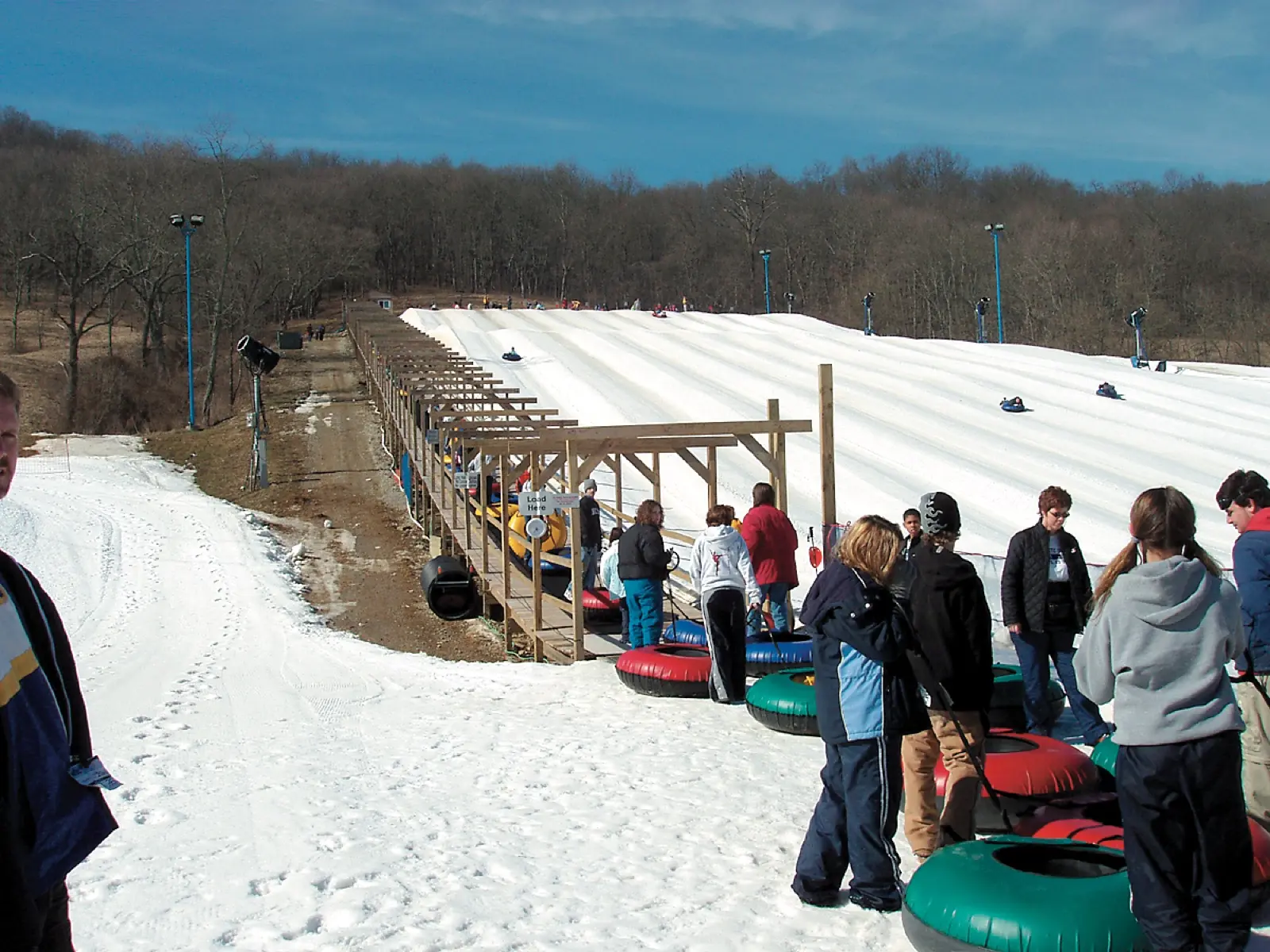
While cable lifts are cost-effective, we were more concerned about ongoing labor and maintaining the uphill track. We believed that a conveyor lift would answer those concerns.
We took another leap of faith on this concept, and it was a slam dunk. We put in a 400-foot Magic Carpet for the first winter, and lengthened it to 480 feet for our second year. Our customers love it.
We do, too. It is operationally simple, takes minimal staff, and the capacity is huge. We can oversupply tubers to 12 lanes and achieve in excess of 1,500 tubers per hour if we choose. We added some simple affordable cameras to the lift line along with a PA system so that one operator can monitor the lift on moderate or light-use days, and two can handle a huge crowd. The carpet lift takes up a lot less space than the several cable lifts it would take to match the carpet’s capacity. We have virtually eliminated the concern about tubers detaching on the way up. People just walk on pulling their tube behind them.

Chuck Heist, our tubing hill manager, came up with the idea to use pre-cast concrete pits under the drive and return sections of the lift to remove excess snow. Collectively our crew improved upon this idea by putting drains in the pits, so that any snow buildup can be simply melted and flushed away with a snowmaking hose and a nearby hydrant.
Since our tubing area is separate from our ski/ride hill, we put up a high-end 40- by 60-foot base lodge “tent” to provide ticketing, concessions, an observation area, some tables, and some heat. We also rented a concession trailer, as well as a nice self-contained restroom trailer. It’s basic but meets our guests’ needs.
Proof in the Numbers
All in all, our tubing installation came together very well. Though our initial investment of around $500,000 was significantly more than most areas put into their tubing hills, it was definitely well worth the investment.
Our tubing area is open from 4:00-9:00 p.m. weekdays and opens at 9:00 am on Saturday and Sunday. We are open on Friday and Saturday nights until 1:00 am (the ski area is open until 3:00 a.m.). We only offer pre-booked group discounts after 4:00 p.m.
Since we have a very nice facility and a good market we charge a higher price than other operations: $18 for two hours. We had more than 30,000 tubers in our first year, and more than 50,000 this season, which represents about 20 percent of our total visits. The tubing ticket expires two hours from the time of purchase and the expiration time is printed on the ticket.
We had 10 lanes and 450 tubes in year one, 9 lanes and 2 Super Lanes and 650 tubes in year two. We had several days this season with more than 3,000 tubers, but we generally were able to accommodate everyone with this setup.
When it comes to safety, we heard some stories that gave us pause. So we knew we must be very safety-conscious with our design and operation. Again, we learned from the experience of other areas. We literally have had just a few bumps and bruises, and only one injury of significance, where the “who” that was injured was a much bigger factor than the nature of the injury (and you know what I mean!). Our tubing incident rate is about .00025, or 1 incident per 4,000 tubers.
We do throw a lot of high-quality labor at the tubing operation. On busy days we are staffed with about 20 people, and we can cut that in half on slow days. But we always have one to four supervisors on duty. As for dispatching: On slow days it is typically “all lanes go at once,” but on the busy days, pitcher and catcher teams run three lanes each.
We learned from other operations to have an “exit out the end” policy. We do, however, have a floating end, determined by the furthest point that people are typically reaching at that particular time. We mark it with movable marking cones. Patrons are instructed not to cross to the lift until they pass that end point.
We love linking. We allow limited linking (2-4 people, depending on size) in the normal lanes, and nearly unlimited linking in the Super Lanes. These are very popular, high capacity, and we experienced virtually no incidents there. We found that generally, speeds in the Super Lanes don’t increase once the link exceeds 4 or 5 people—sometimes they even decrease. The physics are a bit past me, but we understand the economics perfectly!
We are working on a couple of innovations for next year—an additional carpet lift, and nearly doubling our tubing area. In addition to our deceleration plan, we are working on some start gate technology. We are probably going to add another smaller group tent as well, but a permanent tubing lodge is down the road.
At Perfect North Slopes, our tubing hill has fundamentally changed our operation. Though our skier/rider visits were down a bit from 2002-03’s record level, our total snow sports visits and, most importantly, our total revenue set new marks this season. We have discovered that this tubing thing is not a bad idea after all.

