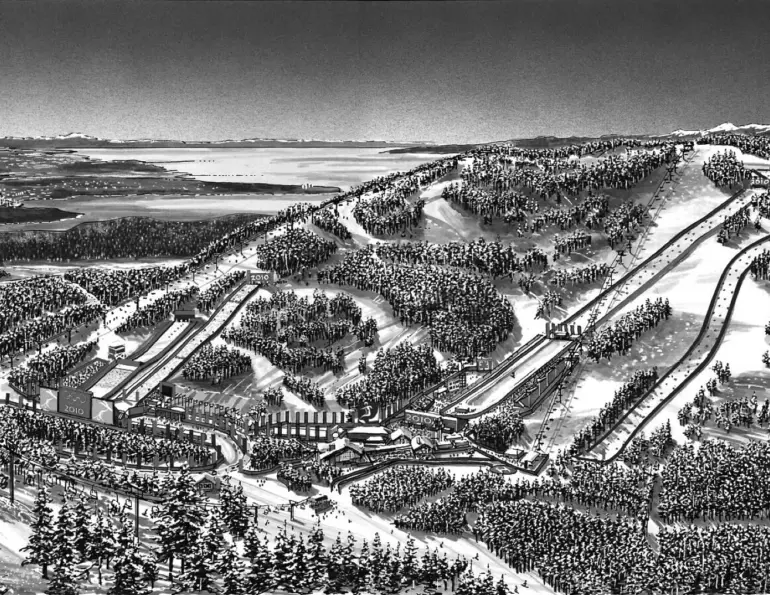
Whistler/Blackcomb will get the lion’s share of media play for on-slope events at the 2010 Winter Olympics. But Cypress Mountain, the largest of Vancouver’s three “local” ski areas, will be the site for snowboarding halfpipe and parallel giant slalom events as well as freestyle moguls and aerials. It could be chosen as the site for snowcross events as well. These events and the Olympic corporation’s investments in them may well make Cypress the Games’ biggest winner.
Cypress is a day area in the North Shore Mountains only 25 minutes northwest of downtown Vancouver along a well-maintained three-lane highway. It has 1,700 feet of vertical drop, and that, combined with reliable snow (an average of 208 inches a year) and aggressive regional marketing has made the area a larger player than neighboring Mt. Seymour and Grouse Mountain. Last winter, Cypress saw roughly 500,000 visits (about 50 percent of them snowboarders), including visits to the physically small but extremely successful nordic (cross-country skiing and snowshoeing) and tubing/tobogganing operations.
Cypress’s two mountains currently have 34 runs served by one detachable quad, two fixed-grip quads, and two double chairs, serving about 1,500 skiable acres. There’s night skiing on the main runs, but no snowmaking. Comfortable carrying capacity is around 4,200 skiers with a peak day of 7,200. Support services are limited and have resided in temporary structures for more than a decade; replacement buildings have been waiting on government approval of a Master Plan.
The highest point at the area is only 4,785 feet above sea level, so the snow has a high moisture content. But views are spectacular—as much as 50 miles on a clear day, looking south over Vancouver to Olympic National Park in Washington or west to Vancouver Island.
The Cypress Story
Proximity to the city has been the most important element in Cypress’ growth, though its location within a Provincial Park runs a close second. From 1972-1975, the Parks branch of the British Columbia government worked on trails, installing lifts and a potable water system, as well as parking lots and access roads. B.C. created Cypress Provincial Park in 1975 both to develop recreation and to preserve remaining old growth forest. B.C. Parks operated the area from 1976 to 1984, at which time operations were privatized under a park use permit.
Cypress Bowl Recreations Limited Partnership (CBRLP) owned and operated the area from 1984 though 2001. A Master Plan submitted to the Province in 1988 generated nothing but controversy. In 1995, a Special Planning Commission was appointed by the government to resolve issues within the Park. CBRLP, which went through various partnership changes, accepted the Commission’s recommendations and began work on a new master plan. This included a high speed gondola and mountaintop restaurant as well as more fixed grip lifts.
In 1997, the Minister of Environment, Lands and Parks gave the necessary approvals despite controversy over the master plan’s impact on old growth forest, and CBRLP started work on trails and lifts, snow tubing, and support facilities including temporary buildings that are still in use. Financing remained a stumbling block.
Enter Boyne
In February, 2001, family-owned Boyne USA bought the area and immediately stepped up the pace. A fixed-grip double chair on Black Mountain (site for the 2010 events) was replaced by a detachable quad, and a rope tow on Mount Strachan gave way to a fixed-grip quad.
Cypress is the only Canadian area among the Kircher family’s holdings. It’s also their newest acquisition, and according to John Kircher, president of Boyne’s western operations, it’s one of the most profitable operations, even without a real estate or lodging component. “In a gray year, that is our most profitable ski area percentage wise and per capita. It does absolutely fantastic, it’s great business,” he said.
Kircher explains that “We were looking at some other opportunities at the time. . .I’d never heard of it and figured they must not have any snow.” Boyne got a call from investment bankers that it was for sale and he said: “Forget it, the place can’t have any snow, it’s too low or something. Then I see these huge numbers and did an about face, and I thought, ‘This is not only good, this is fantastic!’”
The area followed the family’s strategic plan for buying solid ski areas in major metropolitan markets (Brighton, Utah and Crystal Mountain, Washington) that need some fixing up, then putting in improvements. And it’s been a wise choice.
Joining the Olympic Movement
Being chosen to host the snowboard and freestyle events was pure serendipity. According to Vancouver 2010 spokesman Sam Corea, the bid committee evaluated every potential venue from Pemberton, north of Whistler, down to Hope, east of Vancouver. There were several criteria. For example, each sport federation has specific needs for terrain and spectator capacity. Then the site had to meet Olympic standards, including travel time from where athletes live and train.
Corea says, “Originally in the domestic plan, snowboarding and freestyle were proposed for Whistler Mountain and Blackcomb Mountain, along with the other alpine events. As we continued through that [evaluation process], we discovered that Cypress Mountain has similar snow quality and temperature as Whistler does at that time of year.

“Plus, we had the issue of transportation, in that the more sport that you had at Whistler, the more you had to transport people to and from Whistler along the Sea to Sky Corridor. So partly because of an operational thing, we discovered that you could run those events on Cypress Mountain which would bring them closer to the people in Vancouver as well.” There was discussion about locating nordic events there, too, but the committee decided that temperatures would make waxing extremely difficult and there would be too many events in a limited area.
While the Olympics were a possibility at the time Boyne bought the area, “I thought at the time [they were] a quite remote possibility,” Kircher said. “The previous ownership had not embraced the Games. In fact, the bid corp had been doing some studies on Cypress as a venue behind the owners’ backs, really. Of course we jumped on the bandwagon as quickly as we could.”
Kircher added, “We were kind of a cheap date as well. We’ve got tremendous access there, we’ve got the location, and for freestyle events there’s not an inordinate amount of capital expenditures needed to make those events happen. Everything is pretty much in place.”
Games Planning
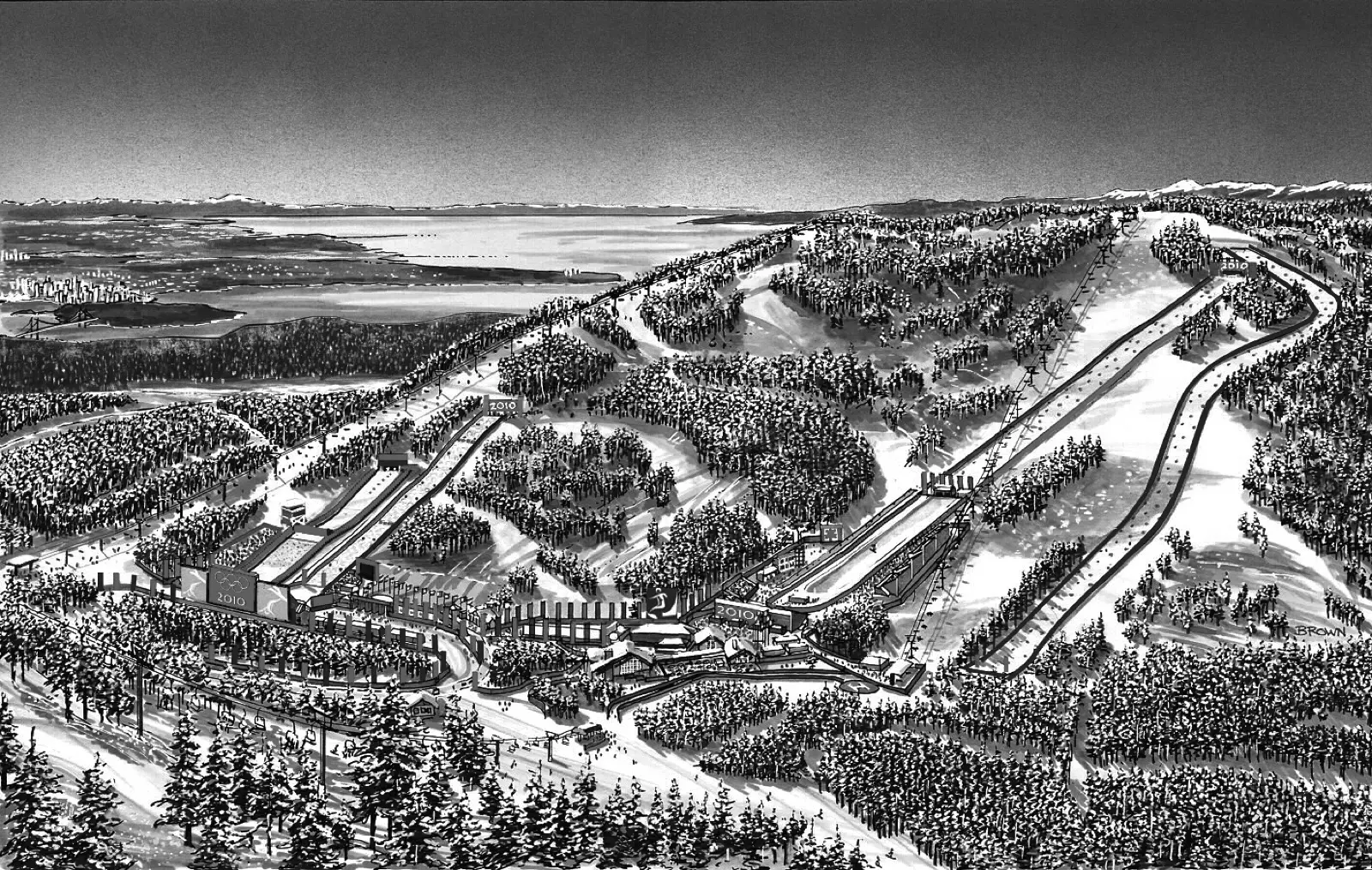
Relatively cheap, perhaps, but Cypress is also receiving $7.5 million (U.S.) out of a total $844 million (U.S.) of the Games’ capital-improvements budget. The bid committee will install a state-of-the-art snowmaking system (with invaluable water rights); a fixed-grip quad that Boyne expects to upgrade to a detachable; 100 acres of new terrain with eight new runs and lighting; parking expansion for up to 15,000 spectators, sponsors, volunteers, and media; viewing stands, and a temporary stadium. Construction will start next summer.
The area has also ended the long and bitter environmental battle the previous owners created. It has abandoned the controversial plans for the gondola and mountaintop restaurant, thus safeguarding old growth forest and water quality within the ski area and surrounding Park. “We de-commissioned the part of the [former] plan that called for a top-to-bottom gondola and a mountaintop restaurant as well as three trails down off that gondola,” Kircher said. “We essentially traded that development for this new detachable quad, which goes in second cutting, and everyone was happy.”
Still, Boyne faces some increased costs in preparing for and hosting the Olympics, including World Cup pre-events. There will be business interruption during pre-events. And Kircher said the area feels the pressure of renovating the base area. “We have to produce new base facilities for the area by 2010. You can’t bring the world to Cypress with [temporary buildings]. Virtually every building that you see there now is going to be removed and replaced with a brand new facility, the alpine as well as the nordic side.”
For the most part, these investments would be made with or without the Games. With one possible exception: All new structures will meet the Games’ LEED (Leadership in Energy and Environmental Design) standards.
But based on Kircher’s premise that “every new lift has brought an increase in business,” Cypress will benefit handsomely from its role in the Games. “We’ve proceeded on a policy of ‘coming out whole,’” Kircher said, so the area becomes a more balanced and up-to-date operation.
The area is even insulated against losing revenues during the Olympic year. The organizing committee has guaranteed Cypress an EBITDA (Earnings Before Interest, Taxes, Depreciation, and Amortization) during the Games equal to the average of the prior three years’ cash flow. Plus, Olympic funding up to $6 million (U.S.) is available for operations. That means Cypress will fare better than Utah resorts did in 2002, where Olympic venues saw a 30 to 40 percent revenue drop.
The bottom line: Selection as an Olympic venue means Cypress Mountain will be about as close to buildout as it can get, with a significant portion of infrastructure and permits underwritten by the Canadian and British Columbia governments. It doesn’t get much better than that.