


That was the scenario last December at Solitude Ski Resort in Utah.
“I know any year we have that type of snow conditions, we’ll be well off our normal level of business,” said Mike Goar, vice president of operations for Solitude. “But going into the Christmas holidays without snow would have a lot more impact on us.”
With that in mind, Goar went to owner Gary DeSeelhorst with an unusual suggestion for December: immediate installation of a snowmaking system.
“To put in a system that would have the impact we’d need would be quite a project — but possible,” he told DeSeelhorst. “But if we’re going to do it, we have to make the decision today.”
There were some positive and some negative aspects to this proposal. The weather, though snowless, had often seen temperatures below freezing over the past few weeks. Solitude had previously made a public bond offering to raise money for a future snowmaking system and had contracted with the city for water, but the Forest Service had not given clearance for snowmaking and engineering for a system had not begun.
DeSeelhorst said, “Let’s do it!”
It was less than three weeks before Christmas and if snowmaking could not be in operation before the holidays, you might as well not do it. DeSeelhorst set a timetable: everything from start to finish would have to be completed within two weeks. It was December 6th.
Goar met with Assistant Mountain Manager Dave Roberts and in five minutes they were on the phone with Wayne Ragland of Snomax Technologies in Salt Lake City. An hour later, the three men were at a table drawing up plans for the system.
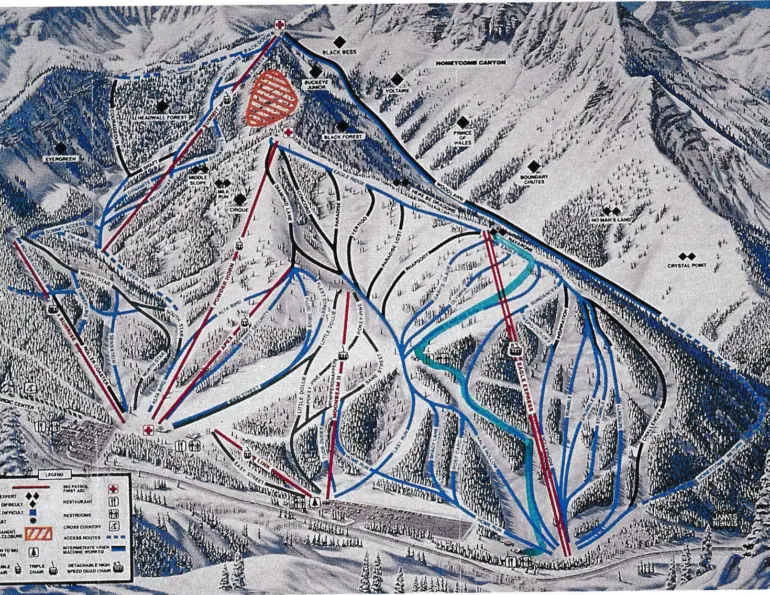
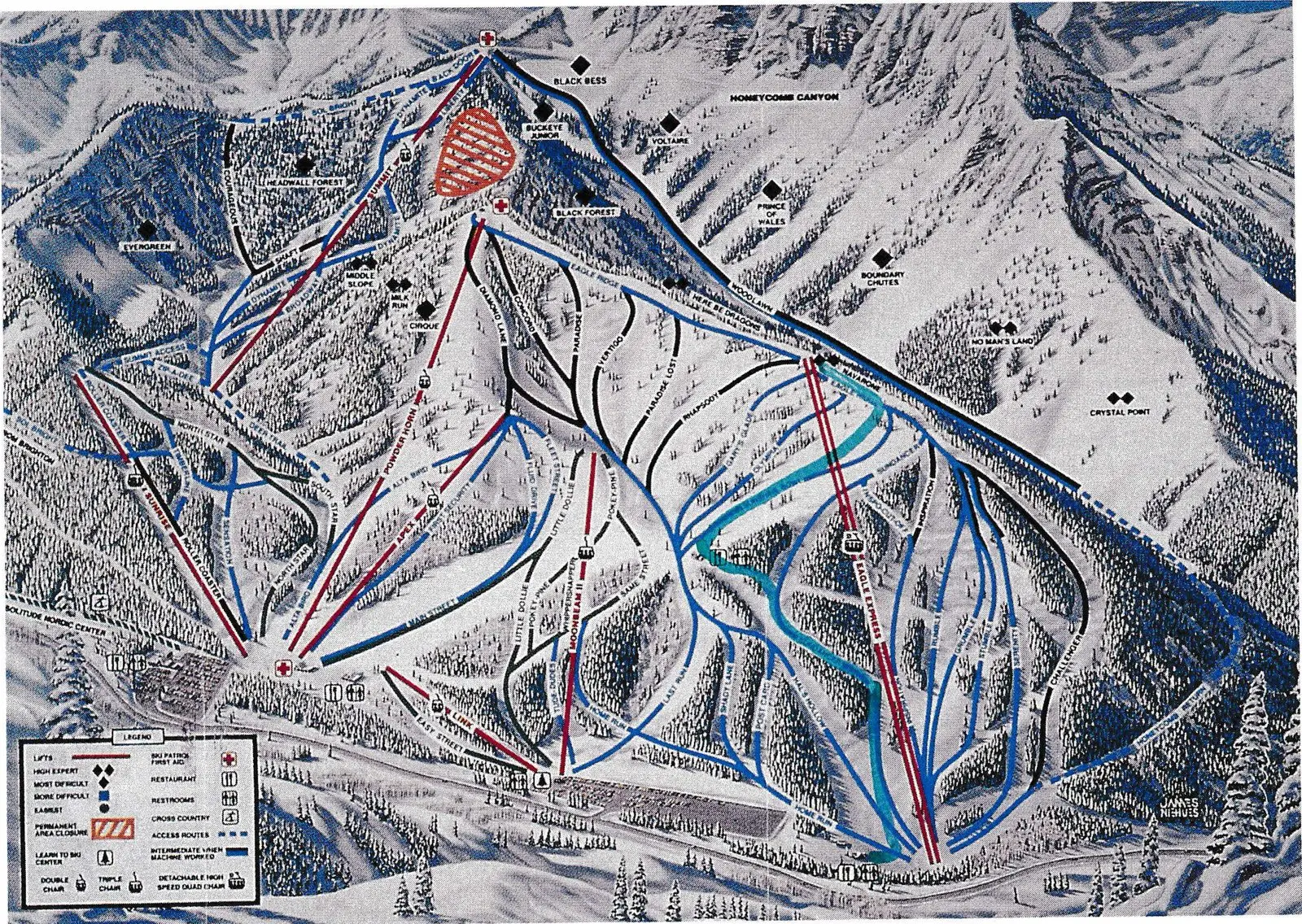
By mid-afternoon, they had a design penciled on a trail map for a line that ran from the bottom of the Eagle Express high-speed quad to the top. They showed it to DeSeelhorst who gave the go-ahead. The project began in earnest from that moment.
Ragland commandeered a phone and began calling contacts all over the country to locate equipment. Joe VanderKelen of Snow Machines Inc. in Midland, Mich., assured Ragland that he would have the snow guns delivered on time. Goar ordered the 5,600 feet of pipe. Meanwhile, DeSeelhorst began drafting a letter to the Forest Service.
There wasn’t time to mail the letter, so Goar hand-delivered it the next day. In 24 hours, approval was received from the Forest Service.
At the same time, Roberts began organizing people. Because the operation was a last-minute decision, there might have been additional problems if it weren’t for the way Solitude is run. “We don’t have an ego company,” DeSeelhorst explained. “Everyone does everything. If we need parking attendants, Mike and I or anyone else in the office goes and does it. If ticket lines get too long, everybody in the office goes and becomes a ticket clerk. Everybody picks up trash. Nobody is treated differently because of a title.”
That meant groomers could become pipe haulers and other employees could pinch-hit where necessary, which saved a lot of time and expense searching for extra labor.
The most important part of the system was, of course, the pump station. This was where Ragland’s experience became essential.
“I called Joe Cousins of Flowtronex International in Tyler, Tex., to design the pump station,” Ragland said. “Not only did we need to pump up 1,400 feet of vertical, but it had to be designed so we could move the equipment and apply it to a permanent larger system to be installed in the future in a different location. Joe said he would have it to me the next day. He faxed me the design on the 8th.”
The next step was to find a pump that would deliver 1,450 T.D.H. along with 462 feet of positive suction pressure that was needed to push up the 1,400 feet vertical. They were restricted by the water source to 300 G.P.M.

Normal lead time for this type of pump is 14 weeks, but after numerous phone calls, Dick Nickerson of Nickerson Co. in Salt Lake City called back to say he had located a pump in California. The parts were on the shelf and it could be built in a week. Nickerson said he would go to the factory to make sure that the pump would be ready and that they would have the “pump can” by Friday the 10th. The pump would be available on the 15th of December.
On Thursday the 9th of December, the 5,600 feet of pipe arrived and was placed in the parking lot for welding by the contractor who was to arrive over the weekend. Then the first setback occurred. The welding contractor telephoned on Monday to say he couldn’t make it until the 19th. That was too late. “I couldn’t wait,” said Ragland. “On Tuesday I called Dick Smith of Park Acres, a contractor in Salt Lake that I had worked with on the Brian Head snowmaking system the previous summer, and told them I had a little problem and could they possibly help us out. With snow in the forecast for the next day, getting equipment up Big Cottonwood Canyon could be a problem. That afternoon Smith had his equipment in the parking lot and a crew was on their way from Wyoming.”
On Saturday the 11th, Mark West from Snow Mountain Engineering of Whitefish, Mont., arrived to start fabricating the pump station along with Jan Campa of the Solitude staff. Because the pump was to be removed at the end of the season, it took some ingenuity to put in place. The pump can would fit neatly inside a 24-inch piece of lift tower, so a five-foot-long section of tower was buried in the concrete floor of the basement of the restaurant.
On Wednesday, the welding crew arrived and began joining the pipe into 500-foot lengths. As each section was completed, it was hauled up the mountain by snowcats and welded into place.
It was during this time that Goar’s biggest moment of doubt hit. An extra-long 1,000-foot section of pipe was being winched up the steepest section of the run. “We had ski patrolmen, ski instructors, restaurant personnel and even a journalist covering the story, all out there trying to help with skier traffic with a portion of the trail closed,” he said. “It was involving so many people, I was sensing that Gary [DeSeelhorst] was about to say ‘stop’ for the day. But I knew we were through the worst of it.”
Meantime, Ragland was searching for the last piece of the puzzle —a 600-class high-pressure gear-operated wafer butterfly valve—with no luck. Finally, Cousins called to say he found one at Valve Systems in Colorado, but one piece was in California and another was in Ohio. Both pieces were flown in the next day.
On Tuesday, the 14th, DeSeelhorst dispatched two employees in a company truck to California to pick up the pump. “It wasn’t finished yet, but we trusted that they’d keep their schedule,” he said. “With two guys, one could drive while the other slept.”
By now the groomers had become expert pipe haulers with their skills honed to precision work. A 500-foot length of pipe would be tied to the cat, hauled up past the section previously installed and then directed backwards to butt with the piece already in place. It was welded together and then tied off to trees with cables.
Early Thursday, December 16th, the men returned from California with the pump and things seemed to be in place to meet the completion date. Just when it looked like everything was going to be as good as gold, however, another problem arose. Concrete was needed for a thrust-block to hold the pipe where it made a 90-degree angle coming out of the pump house, but no concrete was available on Saturday the 18th.
On Monday the 20th, with the concrete thrust-block still drying, the system was finished. The SMI fan guns were on the hill with portable 50 K.W. generators and ready to go.
“On Tuesday the 21st, we fired it up,” said Ragland. “We had people on the mountain to see that the pipe didn’t move. We turned the system on and you didn’t even know there was water in the line, it was so smooth. We ended up with a little over 860 psi and it all worked great.”
Goar estimates that the system increased skier visits by at least 25 percent during the season and, of course, that included Christmas. Despite the hectic schedule, he said if he had to do it over, he would. He paused and added this advice to other ski area operators: “Do it in the summer.”
Solitude Snowmaking System
- Snow Guns: 4SMI Highland Super Sport 25, H.P. fan with 10 H.P. compressor
- Pump: Floway Model 10XKLL 8-stage vertical turbine
- Motor: U.S. Electric Motor 125 H.P. 3600 RPM Snowmaster
- Hydrants: Ratnik Model 1500 – 2-inch 1000 PSI O.W.G.
- Electrical: 50 K.W. generators
- Pipe: 5600 feet of 6-inch 188 wall
- Terrain Covered: 50 Acres.
- Total Cost: $79,000

