
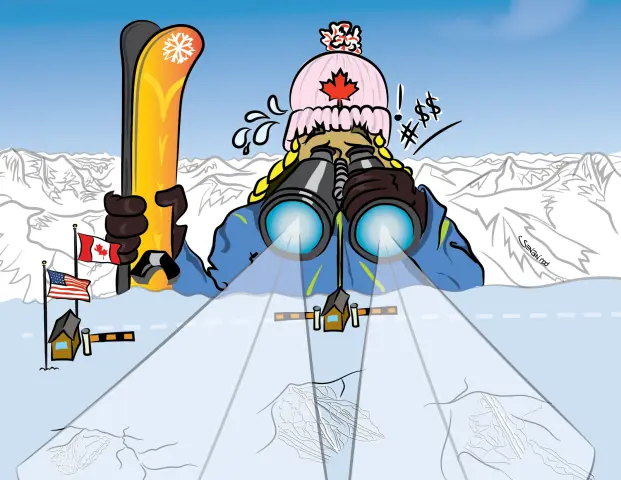

Memo to Management
We don’t really think that reason No. 1 can apply to any of our readers, so let’s dismiss it. If reason No. 3 applies, we feel sorry. You’ve got real problems.
Now, as to reason No. 2, we sympathize. It’s a pain in the butt to fill out any questionnaire, especially one that sends you poring back over long columns of figures on a bright July day better suited to relaxation.
But, come on, now. First of all, re-reading the 1977-78 figures should be a great joy for most of you. And this really is a very important study. It results in a marvelous yardstick for you—a way to measure your operation against industry norms. But norms won’t be norms without the brodest possible participation by Ski areas right across the country, large and small.
This past year is going to be seen as a benchmark year against which we will be measuring ourselves for years to come, which makes participation especially important.
Let’s show that our industry is maturing. Let’s make 1977-78 a benchmark year in survey participation as well as in profits!
A SAM Editorial
Some Thoughts on Growth
Item: A Skiing Magazine sponsored research project(see article on page 32, conducted by the prestigious Opinion Research Corporation, says there were 13.9 million individuals aged 12 and over who skied in the 1976-77 season (the bummer in the West, in case you’ve forgotten), plus an undetermined number of youngsters under 12.
Item: The same study determined that one out of six teenagers is a skier—that is 16.7 percent of all teenagers in the whole country, black, white, urban, rural, southern . . . you name it.
Item: Research just released by Colorado Ski Country USA shows that 46 percent of adult Coloradans have skied. (It also showed that about a half of these have dropped out.)
Item: The Skiing study indicates that 73 percent of the total adult skier days were accounted for by 43 percent of the adult skiers.
Item: The American Ski Federation (NSAA, SIA, USSA, NSPS at als—essentially the organized ski world, trade and consumer) launches a massive effort to prevent potential ski terrain from being locked up as wilderness because, at the present rate of increase in skier population, there will not be enough ski areas to satisfy the demand.
Item: SIA launches a massive, well-funded, skillfully conceived program to broaden the base of the skier market and stimulate participation in the sport.
I don’t know how you feel about the picture that unfolds, but this writer finds it confusing.
If the statistics are correct and projectable, then we have one hell of a strange picture. First of all, we must come to grips with a figure of well in excess of 150,000,000 alpine skier-days for the 1976-77 season. (The adult market, 18 years and older, of 8.3 million skied an average of 11.1 days, giving us 92,130,000 skier-days. Then there were four million teenagers, aged 12-17, who, if they skied the same amount, would account for another 44,400,000, making a total of over 136 million skier-days—and that’s before allowing for the swarms of under-twelves.)
Now, if those 150 million alpine skier days are divvied up among a thousand North American areas (and with that figure you include even the smallest operations) you average 150,000 skier days, which is an average of 1,500 skiers seven
North America.
days a week of a 100-day season at every single ski area in North America.
Sorry, but I can’t buy it. Something went “Tilt!” in the methodology. Well, if not the methodology, then in the ability of skiers to remember how many times they skied during the previous season.
Which reminds me of the history of ski statistics. It is said it all began with two Vermont farmers back in 1936 who saw a ski train arrive in Waterbury. One said to t’other, “Christamighty, there must be a million of the damn fools”—and that was the first census of skiers.
And let’s face it, the figures haven’t exactly been models of precision since that time. People believe what they want to believe. In 1939, the accepted estimate of skiers in the East was a wildly optimistic 1.5 million. But in 1956, when Ski Magazine did some pretty sophisticated research through the Amos Tuck School of Business Administration, we found that the number of skiers in the whole country, adults and children, was half a million. Tops. Of course, nobody wanted to believe that in those super growth days, when new areas were sprouting like weeds in a manure pile, and when the magic words, newly-arrived on the lips of every economist, were “leisure market” and “disposable dollars.”
And, what the hell, the market did grow in the 50’s and 60’s, and it grew fast, so what did it matter that we were all a little cavalier with our statistics. But in the 70’s, fast approaching the 80’s, we’ve got a different ballgame. The stakes are bigger, and that means both the pitfalls and the rewards. Marketing plans that are based on false premises can be costly indeed.

But I want to get off history and return to the present, bringing along only the lessons of history.
In the past few years our industry has been obsessed by growth—or rather by an imagined lack of growth. Dire warnings were issued that our market was drying up, that we should do something to stimulate it. Major studies were undertaken, a massive marketing project was launched through Glendinning Associates and then dropped.
And today, we continue this frantic search for market growth at an even greater pitch. But I would urge all of us to pause and think a little about it. For a brief moment be a skeptic. Question a little.
I suggest, for instance, that a lot of things we keep congratulating ourselves about would not stand the test of close scrutiny. For instance, the Public Service Announcements-which we have had the past couple of years (Buddy Hackett and latterly Wally Schirra) are very nice, and their cost is probably reasonable. But do they do anything for anybody other than for the film companies which shoot them? Every year we get those juicy estimates of umpteen million viewings of them by the public, and I guess I don’t believe the figures. I known that I’ve never seen one, and a recently-pleted scientific survey of the other five members of my immediate family—God knows, heavy TV viewers all—shows similar results.
That, of course, doesn’t prove anything. But it may suggest the thought that stations run their required PSA’s at times of the day and night that no commercial sponsor wants, and that the few people likely to be watching—insomniacs;’ nightwatchmen and truck drivers on a 3 a.m. coffee break on I-80—are not great potential for the ski market.
SIA is pouring vast amounts of money into market growth. Their very able marketing director, former ski area publicist Dave Ingemie, has come up with an imaginative, well-conceived, highly-leveraged and effective use of the considerable funds available to him. Among the best of his many programs is a High School Assembly package—a professionally-staffed presentation about skiing which will travel the country. Another Ingemie program will specifically help our end of the industry by making an advertising service available to areas. Great!
But, I suppose that what I am afraid of is that Dave’s program might succeed in creating new skiers to the extent that his efforts deserve to be crowned with success. What gives me some reassurance is a conviction that it won’t happen. What makes me happy is that the ski industry will continue anyway to grow and prosper, especially with good snow years, and that everyone will be pleased and Dave will get credit for the growth.
It is not that I am against promoting the sport, but I am uneasy about tinkering with success. The sport has grown naturally and healthily over the past 25 years. There have been many factors which have contributed to that growth. To evoke a few: introduction of stretch pants. . .the glamour of Stein. . .the pride in Buddy Werner. . .the ski moviemakers like John Jay and Warren Miller. . .the introduction of GLM. . .the Head “cheater”. . .snowmaking. . .the de-tyrannization of ski schools. . .“Downhill Racer”. . .freestyle. . .I am sure any reader can come up with a similar list.
But notice, please, that these are factors that spring from the very nature of the sport. They are not created or contrived. The common thread is glamour, excitement, enjoyment—and that is what our sport and our business is built on. It sells itself. It is self-generating. Word-of-mouth, peer and family persuasion—those are the promotional forces that have always been at work on our behalf.
The marketplace consists of a thousand ski areas, each reaching out to its market area, each promoting the fun and excitement of skiing, many with outstanding first-time-skier programs. This is the interfacing with the public which builds business. And, of course, the efforts of marketing groups such as Colorado Ski Country USA and Ski 93.
What, then, is wrong with the national marketing programs of NSAA and SIA? Nothing, except I think we should really understand what we are doing—and why. Not so very many years ago the greed of two giants, AMF and Brunswick, threw the bowling industry all out of kilter. The very healthy natural growth of that sport—based on genuine public enthusiasm—was massively hyped to expand the market with an eye to selling more pin-setting machinery and bowling balls. The result was—albeit temporarily—disastrous.
I don’t want to see the ski sport and industry screwed up because SIA members want to sell a whole lot more skis and boots. I don’t know that this will happen, but I don’t think enough thought is being given to its possibility. If ever we lose the quality of the ski experience we will have lost the natural growth which has brought us to where we are.
And that brings me back to the point of departure: the Skiing study. That figure of 14 million is extraordinary, as is the figure of 16.7 percent of all teenagers being skiers. I have no reason to doubt those figures—even though they surprise me greatly— because ORC is highly reliable. (In the obviously wacky skier-day figures I can only guess that they were victimized by the wishful thinking of their skier respondents.) In these totals are skiers aplenty for every ski area, and a fantastic multiplier inherent in the teenage statistic.
Our problem as an industry is not so much how to create new skiers as it is to make sure the product remains attractive. An analogy: A recently-completed national survey of travelers showed that the principal reason for returning to a hotel/motel were cleanliness/appearance and good service. The survey concluded that, “More and more good customers are seeking out places that will give them what they want, and avoid the many alternatives that fail to meet their standards.” Today’s consumer faces many recreational temptations, many of which are as glamourous as skiing while costing considerably less. We must make sure that skiing continues to “give them what they want and. . .meets their standards.
David Rowan