


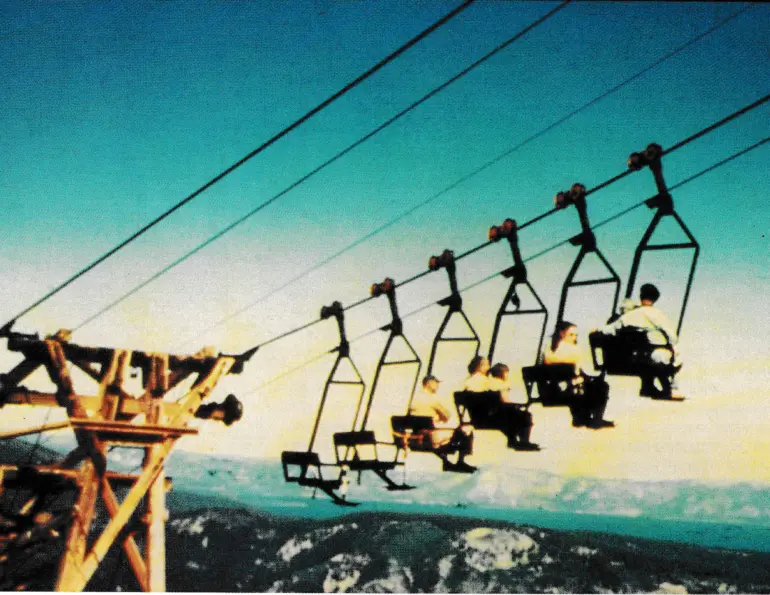
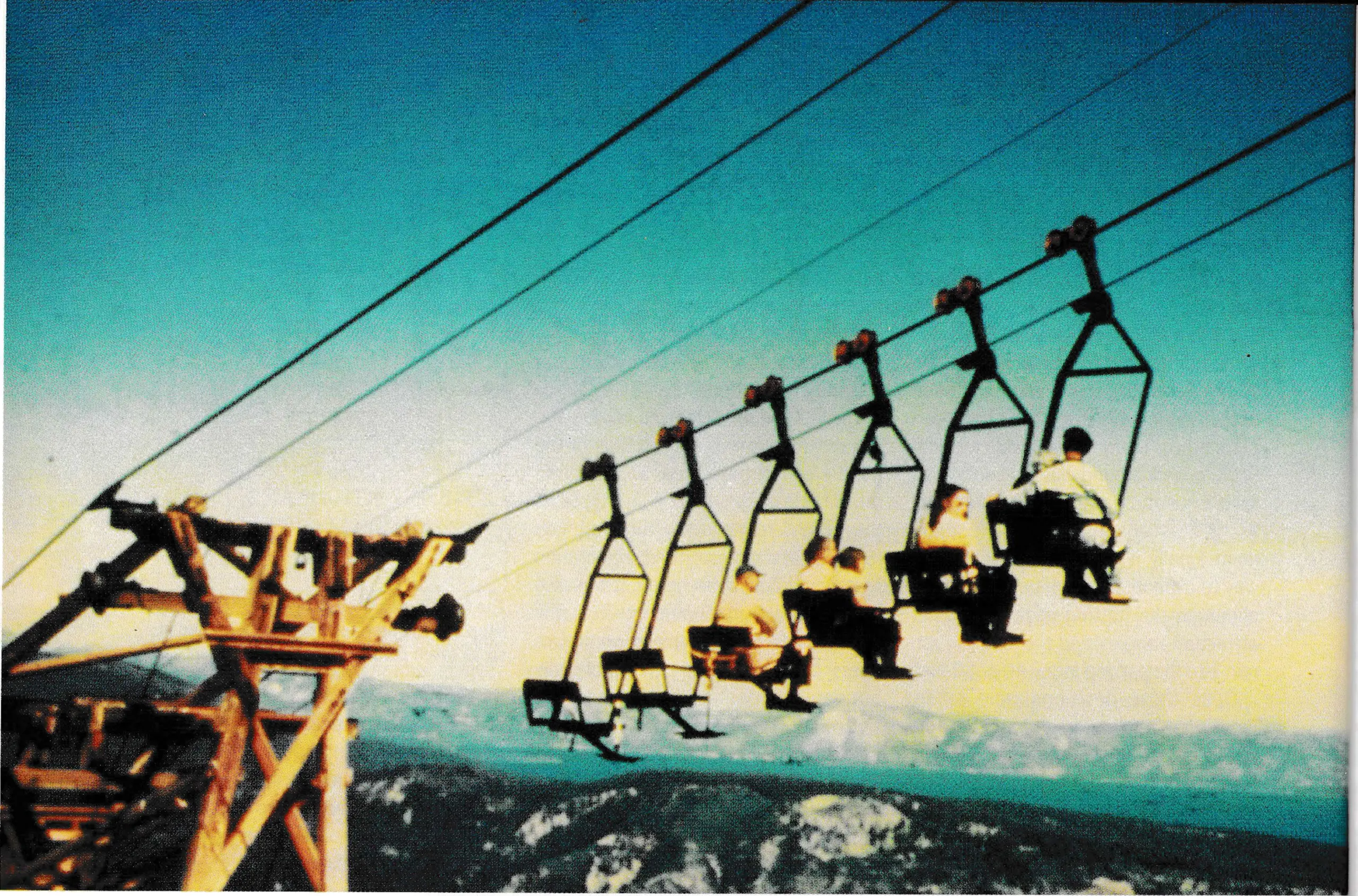
The Squaw Peak Tram at Squaw Valley, Calif., was born of necessity, constructed under duress, operated in peril and retired a legend. Built under restrictions imposed during the Korean War, the odd-looking wooden lift with the sideways chairs was meant to be temporary. Twenty-five years later, it retired with a record of dogged reliability for carrying skiers to some of Squaw’s most challenging terrain in even the worst of weather conditions.
Squaw Peak terminates at the top of the Headwall, 8,900 feet above a maze of rugged ridges, deep cornices and steep contours. Sheets of snow billow sideways from the rocky outcroppings, signaling extreme weather patterns above the treeless, windswept bowl. Though the spectacular Headwall terrain tantalized customers and challenged avalanche control crews—who had rebuilt the Squaw #1 chairlift at its base three times in as many years—it also presented enormous difficulties for installing a lift.
Vertical terrain and extreme weather patterns were not the only challenges to building this lift: in 1950 the Korean War was raging and no new steel was allowed to be used for recreational purposes. Squaw Valley owners Alex Cushing and Wayne Poulsen were not about to accept no for an answer, however. “We needed a lift to the top of the Headwall,” Cushing said. “We couldn’t build a ‘recreational’ lift,” he declared, tongue firmly in cheek, “but this was for avalanche control.”
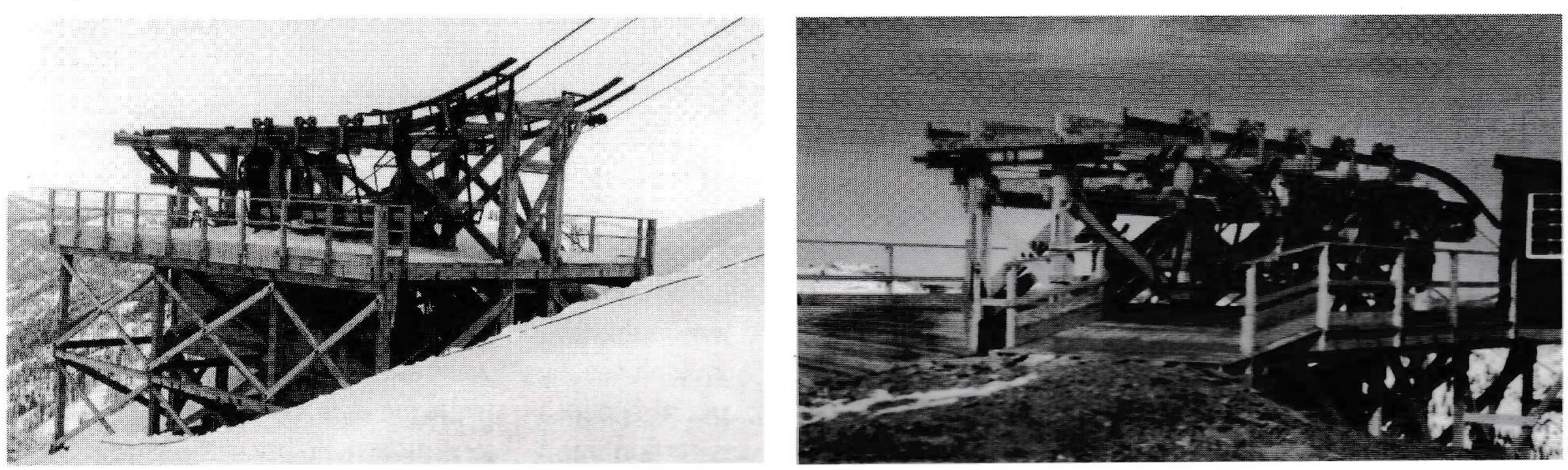
Photos courtesy of Charles F. Dwyer
Cushing and Poulsen selected Bob Heron, of Denver-based Heron Engineering Company, to design and build a lift up the Headwall. They had received government permission for a limited-capacity, low-budget installation with a projected operating life of five years. By then, it was hoped, the war would be over and a higher-capacity steel lift would take its place. “I surveyed the profile for the Squaw Peak Tram in the fall of 1950,” said Heron. “I designed it that winter and from May to September, 1951, we constructed it up the Headwall face.”
Both terrain and materials difficulties faced the engineering team. “There was a severe avalanche problem, so we couldn’t place towers in the slide path,” Heron said. “As a result, we designed a single, 1,000-foot-long cable span from the bottom terminal to one breakover tower. Since we couldn’t get steel, we used huge wooden timbers from Auburn, Calif., to construct the tower and terminals.”
The motor room components and wire rope were recycled from mining trams, as were the line sheaves—purchased at the bargain-basement price of $27 for three sheaves. The rest was a collection of used parts from Squaw Valley, Heron Engineering and E.G. Constam.
The final design was a double-reversible, bicable, grouped-carrier lift. Six double chairs were grouped together and mounted sideways on the lift, carrying 12 passengers at a time up to the top of the Headwall. The unique chair configuration, easy to load and unload, also accommodated the high winds blowing off the face of the mountain in which a conventional chairlift would have to run very slowly. The grouped-chair arrangement allowed the lift to run quickly up to the breakover tower, where it entered an extreme wind zone unshielded by the mountain and had to slow down significantly to avoid derailing.
| Item | Specification |
|---|---|
| Slope Length | 1,150 feet |
| Vertical Rise | 526 feet |
| Capacity | 300 pph |
| Lift Speed | 800 fpm |
| Carriers | 12 double chairs, side load (6 grouped chairs spaced 4 feet apart) |
| Towers | One wooden intermediate tower, 110 feet from top terminal |
| Main Span Length | 1,010 feet |
| Main Span Grade | 29 degrees (56%) |
| Installed HP | 60 HP Continental gas engine with Mack manual transmission |
| Years of Operation | 1951-1969 (for public) |
The strange-looking setup inspired the nickname the “Clothesline Lift,” because the chairs hung sideways off the cable like so much laundry. Cushing said he couldn’t recall an official name for the lift, explaining, “We kept it sort of quiet because it was illegal to use beyond avalanche work.” He said, however, that most knew the lift as the “Jigback,” a common name for to-and-fro reversible tramways.
There was no electrical power up the mountain, so a 60-horsepower Continental gasoline engine was used to run the Jigback with no provisions for standby power. It was controlled by a Mack T transmission clutch and with forward and reverse gears. When the chairs pulled into the terminal, the lift came to a complete stop to load and unload.
Designing the Jigback may have been difficult, but Squaw Valley’s first mountain manager, the late John Mortizia, recalled equally thorny construction problems. “We had no machinery, no helicopter, no cranes, not even a road going up to the top of the Headwall,” said Mortizia. “Instead, we had an army surplus jeep and an old ambulance converted to a flatbed. We’d drive materials up to the base on the only road and walk everything up on a footpath.” There wasn’t even a cement mixer for the foundation work—all of the concrete was hand-mixed in a hopper and carried up in buckets.
Although Mortizia had only 10 workers on the project, construction stayed right on schedule. “We built that lift the way the Egyptians built their pyramids,” he declared. The men used a ginpole and a block and tackle to hoist up the huge wooden timbers that formed the bottom drive terminal, top tension terminal and the breakover tower. Incredibly, the Jigback—constructed completely by hand—was completed in five months and was operational in time for a record Sierra snowfall in 1952.
“It sure was an odd-looking lift,” recalled Mortizia, “but the safety factor was great. The haul rope was five-eighths of an inch thick, while the track cable was an inch and three-eighths. That stuff could hold up a bridge. We made steel flanges to prevent the cable from falling inside the steel sheaves. The damn thing never really did have any major problem, but, with all the steel components, it made a hell of a racket.”
According to Mortizia, the lift’s worst potential problem was the engine stalling or running out of gas. He recalled an episode during its first winter of use when Emile Allais, Squaw’s ski school director, invited some French national team racers training at Squaw to go up the Jigback. “I was riding lead chair with Emile,” remembered Mortizia. “We went halfway up, through the trees, when the lift stalled and started rolling back, so we all bailed out. Luckily, there was so much snow underneath no one was hurt. Sure shook up those French boys a bit.”
Dick Reuter, retired mountain manager at Kirkwood, was a patrol and lift maintenance man for Squaw Valley who often worked on the Jigback. Situated as it was in wind-exposed icing conditions, Reuter remembers having to climb up and remove ice from the steel sheaves with a hammer on a regular basis. The steep terrain caused severe snow creep at the breakover tower, requiring an annual summer realignment.
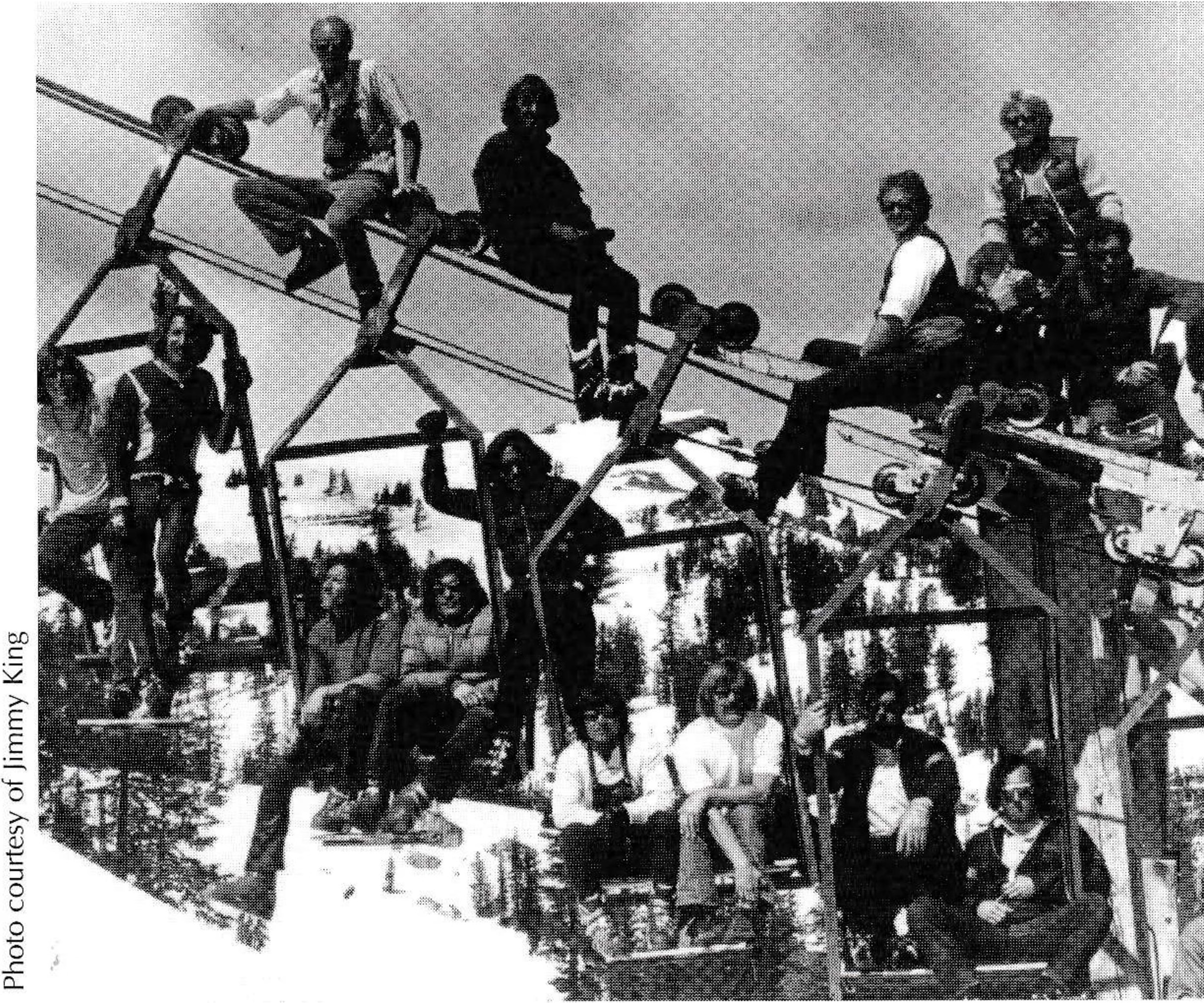
Photo courtesy of Jimmy King
Once, removing the sheaves for summer maintenance, Reuter experienced firsthand the trademark soundness of Heron parts. “Heron’s equipment always had the reputation of being solid,” he said, “but I simply dropped a top terminal sheave a short distance onto the wooden unload ramp and the damn thing went right through the deck!”
Reuter said that, when operated properly, the Jigback was built to outperform normal lifts in high winds, particularly the extremes found at Squaw Valley. “You’d have to shake a whole lot of barrels to find a lift like that ever again,” he said. “Even though there was a lot of tension in the thing, the worst danger was of it derailing. You had to run it slow during snowstorms and high wind, especially near the breakover tower.
“You had to have experienced operators who knew when to slow it down, because back then we had no radios to talk to each other,” he said. In fact, lift maintenance had painted the cable red at a certain point to signal the imminent arrival of chairs at the breakover tower, so the operator would know when to slow the lift down on windy days.
Even with these precautions, inexperienced operators could make dangerous mistakes. Reuter recalled an accident during a blinding snowstorm in 1962, when three patrolmen—Dick Reuter, Norm Wilson and Peter Beckett—went up the Jigback to do avalanche-control work. The operator at the bottom station didn’t slow the lift down and the patrolmen approached the tower at full speed in high winds.

“The first three chairs with Norm and me on them made it through okay,” Reuter recalled, “but the wind knocked the carriage rollers on the next three chairs off the track cable. Peter’s chair swung backwards and dumped him out onto hardpacked, windblown crud.”
Reuter and Wilson hiked down to help Beckett—who had dislocated his shoulder—climb back to the top. They replaced the chairs and rollers that had derailed from the track cable, which, as luck would have it, were still connected to the haul rope. Beckett and Wilson rode back down, while Reuter remained on the phone with the bottom operator to make sure he ran the lift slowly until the patrolmen reached the base terminal.
Now on his own, Reuter skied a short distance from the top terminal to begin the control work. “It was a helluva storm,” he described. “I couldn’t see my hand in front of my face and had no idea what kind of a mess I was getting into.” He threw a double shot down the Headwall, skied a few more yards and fell off a nine-foot-high fracture line. After picking himself up and climbing out, he stood and surveyed the results of the Class V avalanche that he had just caused.
“That morning the whole mountainside went down all the way to Mambo Meadows on the first throw,” Reuter said. As the Headwall slid, it severely damaged the lift shack at the top of Squaw #1, swept away the toboggan stationed there and deposited it 100 feet lower, right on the bottom ramp of the Jigback next to the operator house.
“Some sort of weird fate left that toboggan right where Norm needed it to haul Peter down,” laughed Reuter. “After you’ve worked 17 years at Squaw Valley, not much is going to surprise you.”
Though only designed for a temporary use of five years, the Jigback proved so reliable it was in operation for the public until 1960 and for snow safety until 1969. It was the only lift on the mountain that could operate in the kind of winds for which Squaw Valley is famous. A higher-capacity double chairlift was installed nearby in 1966 and from then on the Jigback was only used by the ski patrol on snow safety days. Finally declared an eyesore, it was removed in 1976.
“Taking down the Jigback was no easy task,” said Bro Shontz, head of upper lift maintenance during the 1970s. “We came in, bulldozed and burned the top terminal and platform.” The mountain manager, Dennis Hurt, took on the daunting task of cutting the high-tension cables with a torch. “Nobody really wanted that job,” recalled Shontz. “After all, with only one tower near the top, the cable was really tight. Dennis got out there with his knees shaking and cut through it—you should have seen him jump when the thing came down.”
The bottom terminal, built into the mountain with over 20 supports, posed another problem. “We tied boulder busters—shaped heavy charges we called ‘Pregnant Frisbees’—on every support with primer cords, directing the explosive force to the inside,” Shontz said. “The thing just laid down with one big boom.”
“It was kinda sad,” Shontz recalled. “I had first ridden the lift when I was eight years old, scared to death going over that steep terrain sitting sideways.”
Unique as it was in its conception and construction, however, the Jigback’s real magic lay in the opportunities it opened up to skiers. Leroy Hill, vice-president of marketing at Squaw Valley, who was a patrolman in the late sixties and was one of the last people to ride the Jigback, remembered a special feeling that he says is elusive in today’s ski industry.
“In this day and age, it’s hard to believe the limited loading of that chair,” Hill said. “You have to remember, the lift only carried 12 people, maximum, at one time. It took quite a while for the next group to come up. That gave us the whole Headwall: the Slot, the Face, the Nose, the Sun Bowl, the North Bowl—everything, for the pleasure of only 12 people.”
It was all yours, with no rush to pick and choose. You felt on top of the world—as if you owned the place.”
Acknowledgments
We would like to thank and acknowledge: Chuck Dwyer for his historical notes and photos; as well as Alex Cushing, Dick Reuter, Bro Shontz, Tom Anderson, Jimmy King and Jan Kunczynski for their patience and assistance.
