
Journalist C. Michael Stockstill, while serving as an intern with the California State Assembly, was assigned by the Assembly Rules Committee to investigate the matter of ski safety in the state of California. His findings subsequently formed the basis of Resolution HR 5, introduced in the California legislature earlier this year. Following is Stockstill’s exclusive SAM report.
Before the 1972 ski season, the relationship between California ski areas and the state legislature was limited to recreational visits by an occasional assemblyman or senator who enjoyed squeezing in a day on the hill between hearings and political speeches. But after a ski lift accident in January claimed the life of a young man, and a number of magazine and newspaper articles began raising questions about lift reliability, the relationship quickly became state business.
Even before the accident, a resolution had been introduced in early January in the State Assembly calling for a study of skiing safety. The resolution (HR 5) by Los Angeles Assemblyman Charles Warren, an avid skier for 20 years, led to an investigation and hearing that produced a “ski safety package” of six bills which are now awaiting passage in the State Senate.
Warren’s interest in ski lift and slope safety is easily explained by his personal passion for the sport. But it was an article in the California Journal, a magazine devoted to California politics, that prompted his action.
In its November 1971 issue, the Journal printed an article entitled “State Continues to Play Small Role in Ski Area Safety Despite Growing Public Concern.” The story, more concise than its headline, gave a brief history of state actions relating to skiing and raised issues about lift standards, inspections and area owner concern for public safety.
There was little reaction to the Journal article, but one sentence proved to be grimly prophetic. “Another major accident this winter,” the Journal reported, mentioning the 1971 Emigrant Peak lift disaster at Squaw Valley in which several skiers had been injured in a fallen gondola, “will surely touch off an outcry among skiers which will shake the ski industry right down to its ticket windows.”
The accident did happen—at Squaw Valley, ironically enough—in January. The KT-22 lift stopped in mid-run and, according to reports, the chairs began to drift back slightly. Two young men in one of the chairs panicked and attempted to leap onto an unused loading ramp the chair had stopped above. Both missed the ramp. One fell into the snow and was bruised badly. The other reportedly fell onto rocks and died of head injuries.
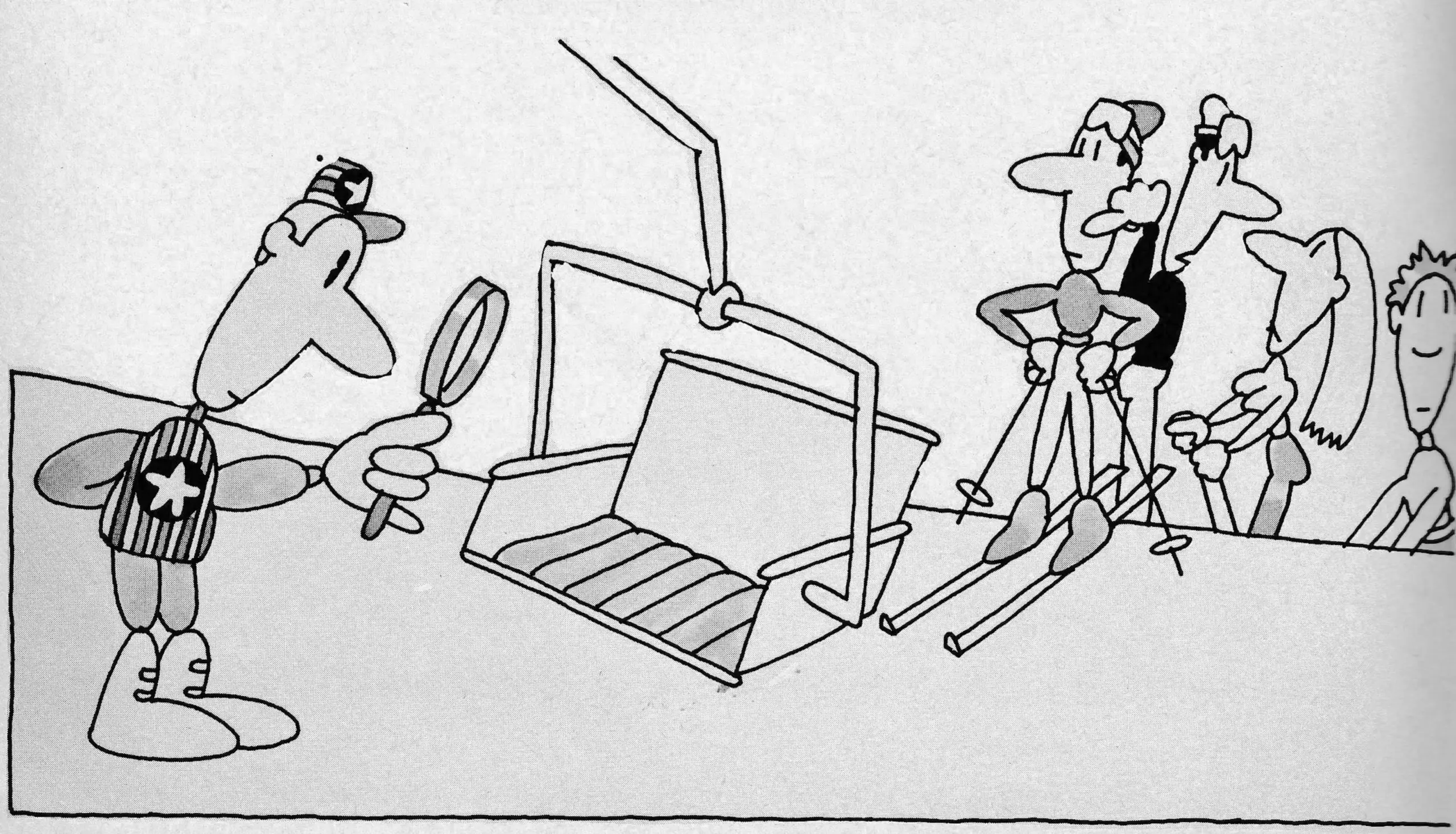
Warren had already introduced his resolution, but the accident and ensuing news coverage resulted in letters to the Assembly Rules Committee, which was to conduct the hearing. Sensing a genuine statewide concern for the issue, the committee chairman assigned a staff member to join Warren and investigate the situation.
Warren decided to limit his investigation to lift safety, fearing that the question of slope safety and all its related problems—grooming, ski patrols, medical facilities, ski bindings—would be too broad for a single hearing. With his target defined, Warren first turned to the state agency charged with inspecting ski lifts.
The Division of Industrial Safety (DIS) was given responsibility for the safety of California’s ski lifts in 1956. Beginning that year, inspectors from the elevator section began to make yearly inspections of chair and gondola lifts, pomas, J-bars, T-bars and rope tows. Since there were few ski areas operating at that time, the elevator inspectors were assigned to lift inspection duty on a part-time basis.
Two areas of California law cover lift devices. The rules on all ski lifts fall under Title 8 of the DIS Aerial Passenger Tramway Safety Orders. The safety orders regulate mechanical and structural aspects of the lift operations. Specifications on brakes, bullwheels, sheaves, cables and maintenance records are spelled out in detail. The orders also require that warning signs be placed in proper areas and that communication systems between terminals meet proper standards. To supplement the safety orders, the Legislature, in 1965, added a section to the labor code mandating yearly inspections and operating permits for lifts. Running a lift without such a permit is now a misdemeanor.
Despite the seeming completeness of the law, Warren and his staff found that loopholes existed. The tramway orders and sections of the labor code affected only employees—nothing was said about public safety—and because of that, DIS inspectors could lawfully inspect for only employee safety violations.
When the DIS began lift inspections in 1956 there were probably less than 100 lifts throughout the state. In 1972 there were over 300 in operation and dozens more planned. At no time during those 16 years did the DIS ever have anyone inspecting lifts full time. It was always an elevator inspector who spent most of his days looking at elevator shafts and the remaining time at ski lifts.
Thus, the DIS found it almost impossible to even make the yearly inspections required by law. It had assigned two men to cover the entire state, one out of Los Angeles for southern California, and another from San Francisco to handle the Sierra resorts and everything north to the Oregon border. The pair struggled along as best they could but never had adequate time to do the job properly. In fact, during a year when one inspector quit and the other had a long illness, no lift inspections were made at all.
Other factors added to the picture. Elevator inspectors at the top of their salary scale, for instance, receive just slightly more per hour than elevator maintenance helpers. A journeyman elevator repairman gets about $3 an hour more than the state inspector.
In early March the Rules Committee convened to hear testimony on the ski lift resolution. Representatives of ski area owners, skiing associations and state and federal officials came to Sacramento to offer their opinions.
“Speaking as a skier,” Assemblyman Warren began the hearing, “I do not welcome regulatory contamination, safety order emasculation or the interference typical of ill-founded legislation. Blanket or unreasonable safety orders will be identified as intrusions on the individuality of the sport. I trust that all skiers will vigorously oppose and defeat such intermeddling.
“I hope with this legislation to eliminate certain unnecessary hazards of the sport while preserving the thrill of skiing.”
“HR 5,” Warren continued, “was not introduced to harass or surcharge the ski resort operator. The resolution is not designed to tax the skier’s already burdened pocketbook . . . I will not truck with any proposal which limits the skier’s sport or his enthusiasm.
“Nor is it within the resolution’s scope to embrassass or expose entrepreneurs engaged in the ski resort business. I think we are of one mind,” Warren added.
The first witness was John Watson, president of the Far West Ski Association.
Noting that legislative interest in ski safety was long overdue because of the sport’s growth and popularity, Watson called for frequent lift inspections under the direction of a state public safety agency and a central clearinghouse for accident statistics.
Watson asserted that skiing was not inherently risky, but was much like aviation—“frequently unforgiving of human error.” A sound program of inspections, certified operators, accident reporting, educated skiers on the slopes, lessons and rigorous attention to safety would help skiing’s safety record, he said.
Watson claimed, however, that most accidents were not caused on or by ski lifts. Injuries on skis accounted for most accidents, he said.
Watson closed by offering FWSA’s safety recommendations: Reporting of all ski injuries to a central clearinghouse, lift inspections twice yearly by a public safety agency, a study on certification for lift operators, updating of construction and operating codes and lift standards applicable to all lifts regardless of land ownership.
The principal spokesman for the area owners was Jay Price, president of the Sierra Ski Areas Association.
“It is of vital interest to the ski area operators,” he said, “to have an equitable, realistic lift safety code, vigorously and fairly enforced. Traditionally, the standards that have existed were established for purposes of insurance underwriting, and such a document is in fact the basis for current coverage under a program sponsored by the National Ski Areas Association.”

Price pointed out that many California ski areas are partially or entirely on U.S. Forest Service land and are inspected regularly according to the ANSI B.77 code. Price also noted that area operators have cooperated fully with the DIS and said that stiff competition for customers “has resulted in a generally high degree of slope grooming” as well as extra free services such as first aid.
“Other than clarification of existing regulations, our association does not feel the need for additional controls,” Price said, concluding, “In the final analysis, it is the free choice of the customer to select those areas which have not only been licensed by the state but which have earned his confidence and consequently his patronage, and that, for the area operator, is what it’s all about.”
Orbell Apperson, Jr., the divisional director of the Far West Division of the National Ski Patrol, said figures indicated that 7 per cent of the accidents the ski patrol handles were lift-related. His statistics showed a ratio of three accidents for every 10,000 lift tickets sold—and less than 10 per cent of those attributable to questionable lift procedure or malfunction, he said.
Kurt Rehfeld, state inspector for northern California, was the final witness. After recounting the inspection problems the DIS faced with ski lifts, Rehfeld recommended that lift inspectors work on lifts full time, be trained specifically for the work and be allowed to live near the major ski areas.
Rehfeld also said the tramway code should be changed so inspectors could legally inspect for public safety, a summer inspection program should be conducted, more inspectors should be hired and lift operators should be examined and licensed.
Assemblyman Warren introduced his “ski safety package” shortly after the hearing. Briefly, it includes the following recommendations:
- Require the Division of Industrial Safety to adopt the ANSI standards for lift safety as of January 31, 1972.
- Require lift operators to report to the DIS any lift-related accident requiring medical care beyond first aid.
- Create a 12-member Ski Safety Advisory Council with jurisdiction extending to all matters of ski safety. The council would develop plans for preventing skiing accidents, coordinate efforts of persons promoting ski safety and make recommendations for improving skiing safety. Two members would be appointed by each house of the legislature and the other eight by the governor. The governor’s appointments should include area owners, tramway engineers, ski association representatives and persons with ski rescue experience.
- Require that the DIS make two lift inspections yearly.
- Extend the jurisdiction of the DIS to cover public safety on lifts.
- Require the DIS to establish standards of qualification for lift operators.
California Not Alone
If California should adopt Resolution HR 5, it would not be the first state to have legislated ski safety. Nine states, in fact—Colorado, Massachusetts, Maine, Michigan, New Hampshire, North Carolina, Utah, Vermont and Washington—have enacted statutes providing for regulatory boards, commissions or commissioners to promulgate safety rules and regulations. Of the nine, five plus New Mexico explicitly place primary responsibility on operators for design, construction, maintenance and inspections, and eight provide that regulatory commissions must register devices and establish standards for design and operational practices.
From “Ski Injury Liability,” by Carl H. Lisman, University of Colorado Law Review, March, 1972.
Area owner reaction to Warren’s bill has been limited. The most comprehensive response come from Heavenly Valley’s Hugh Killebrew, Jr., in a letter to the Assembly Natural Resources Committee, which heard the legislation.
Of AB 782, Killebrew noted that “the tramway owner or operator has no way of knowing whether all or half of these people [who are injured on or by a lift] go to a hospital or doctor and seek medical services . . . The only information the owner receives is . . . through the first aid reports prepared by the Ski Patrol or the first aid people.”
Killebrew also said in some instances skiers show up six months to a year after an alleged accident with a lawsuit, claiming they were injured on a certain day at the ski area. “Until this occurs, the owner has no knowledge that the person was “injured” and went elsewhere for treatment, he argued.
Killebrew asked that Warren’s resolution be amended to require that the injured person make the report.
Killebrew suggested that the Ski Safety Advisory Council “duties . . . seem to be overlapping and conflicting with what is already established law on many of the subjects.”
Moreover, Killebrew said, “the DIS . . . is already performing inspections and is in a perfect position to advise as to the areas that have good maintenance and safety histories. It seems unfair to penalize the many good operators for what is known to be the carelessness of a few operators.”
Establishing qualifications for lift operators, Killebrew added, should not take place until the Ski Safety Advisory Council is created.
Finally, Killebrew said Warren’s resolution calling for ANSI standards overlooked the fact that many ski areas are on U.S. Forest Service land and are regulated by the federal government. Killebrew also contended that “the U.S. Forest Service has always taken the position that it has jurisdiction over the safety requirements for skiing on . . . Forest Service land, and that the individual states have no authority over how the U.S. Government uses its lands.” (This last point was later cleared up when DIS and Forest Service officials both told committee investigators that state and federal governments have agreements allowing for dual inspections.)
Disagreement with the Warren bills was also voiced by Earl Purdy, operator of the Dodge Ridge ski area in the mid-Sierra.
“I hate to see more regulations,” Purdy said. “It will only make things tougher and at present it seems like most state agencies that have anything to do with business are checking on us.”
Purdy said his relations with the DIS were good, and had no objections to additional inspections. “If there’s anything wrong,” he said, “I want to know about it. But usually we show the inspectors what’s wrong. We know what’s up because we’re at the area all the time.”
Purdy stressed that “insurance companies are very safety conscious. The list of things they require us to do is unbelievable.” He added that Forest Service rules were as tough as the state’s.
As for state responsibility for such things as slope grooming or crowding, Purdy said, “There is no way in the world you can regulate this sport. We have gotten a bad name from people who come up for the first time, don’t take a lesson, then get out on the hill. They can’t turn or stop and they come down the hill like a toboggan. They can do it 100 times without hurting anyone, but eventually it happens.”
Whether the Warren bills will become law remains to be seen, and it will probably be another two seasons before the results are known. However, the fact that the largest state in the nation, and one with a large percentage of its ski areas, is moving toward governmental controls on skiing is not going unnoticed.