


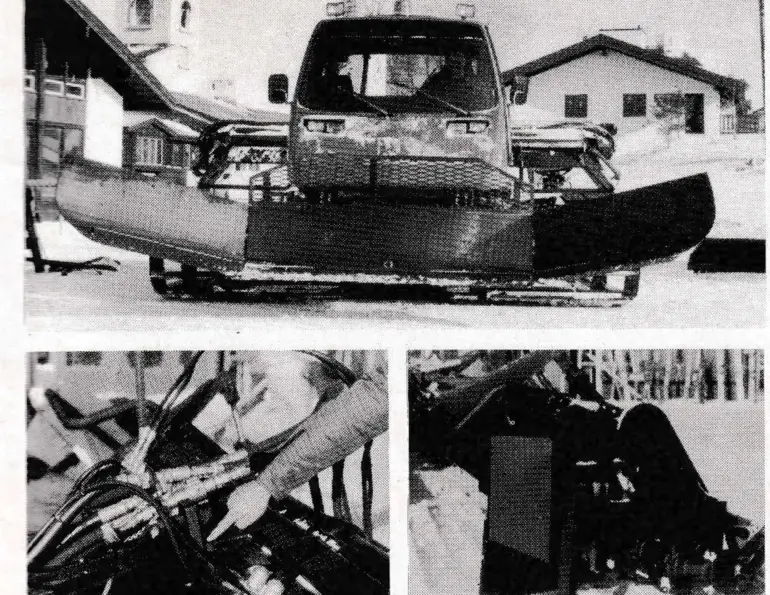
Have you purchased a Class III Vehicle lately? Or, how about a Class I or Class IV? If you aren’t sure then check our tabulated data for this sixth Annual Vehicle Roundup.
You will note, if you have followed these annual compilations, that the classifications for vehicles developed six years ago—compact, standard, etc. —are now also called Class I, II, III and IV. This is being done because many, if not all, of the over-the-snow grooming vehicles are sold internationally. European manufacturers in particular have been trying to develop a classification system for vehicles that would parallel the SAM charts. Interestingly enough, they ran into the same problem we did in making classifications: overlap between vehicle sizes and corresponding classes. For example, how does one classify a 90 horsepower vehicle that has a frame size equal to a 125 horsepower unit?
Regardless of such minor frustrations, their system has merit and over the next year or so, we will incorporate the European classes on our chart and eventually establish a single international classification system.
We have also added a subcompact classification which we call Class 0, though not in an unkind way. This classification has two entries this year in the under-$20,000 range. These vehicles are geared for utility and personnel work, as well as some grooming and certainly track setting.
What else is new? Really new? There are only two brand new vehicles on the market, which were demos last year and will be available for purchase for next ski season. One comes from LMC, the other from Tucker.
The new LMC 1500 is replacing the well-known IMP 1450, which will be retired from service following this ski season. The 1500 is actually a hybrid located between the IMP and LMC Spryte. The sheet metal and cab are new, but do not emulate the sleek fiberglass cosmetics of the larger LMC vehicles. It is powered by the long-proven AMC 258 six cylinder with a Chrysler 3 speed automatic transmission. The undercarriage is new and similar to the Spryte with “drop boxes” for final reduction and torsion-arm suspension. (The IMP was supported on leaf springs with no final drive reduction.) The 1500 also has bigger tires and a larger two-man cab. The back panel of the cab can be unbolted, moved back and either a three-seat or eight-seat addition added to the chassis. This provides a great deal of flexibility for those ski areas with increasing family size. At a price of $10,000 less than the Spryte, with the expansion-type crew cab, this unit should be a competitive utility and cross-country vehicle.
The LMC 3700D with a power plant from Detroit is almost a new version of the very popular Hydromaster 3700 AC. Besides the power plant, which pushes 205 horses and is actually a reduction in horsepower from the 3700, weight reductions and axle modifications contribute to a more compact groomer. The pitch length of the grousers or track sections has been changed from 4 inches to 4 3/4 inches and the number of axles reduced from 5 to 4. The 3700D sports the same hydraulic pumps and motors as the old Hydromaster, but yields a higher net horsepower to the 12-foot tiller.
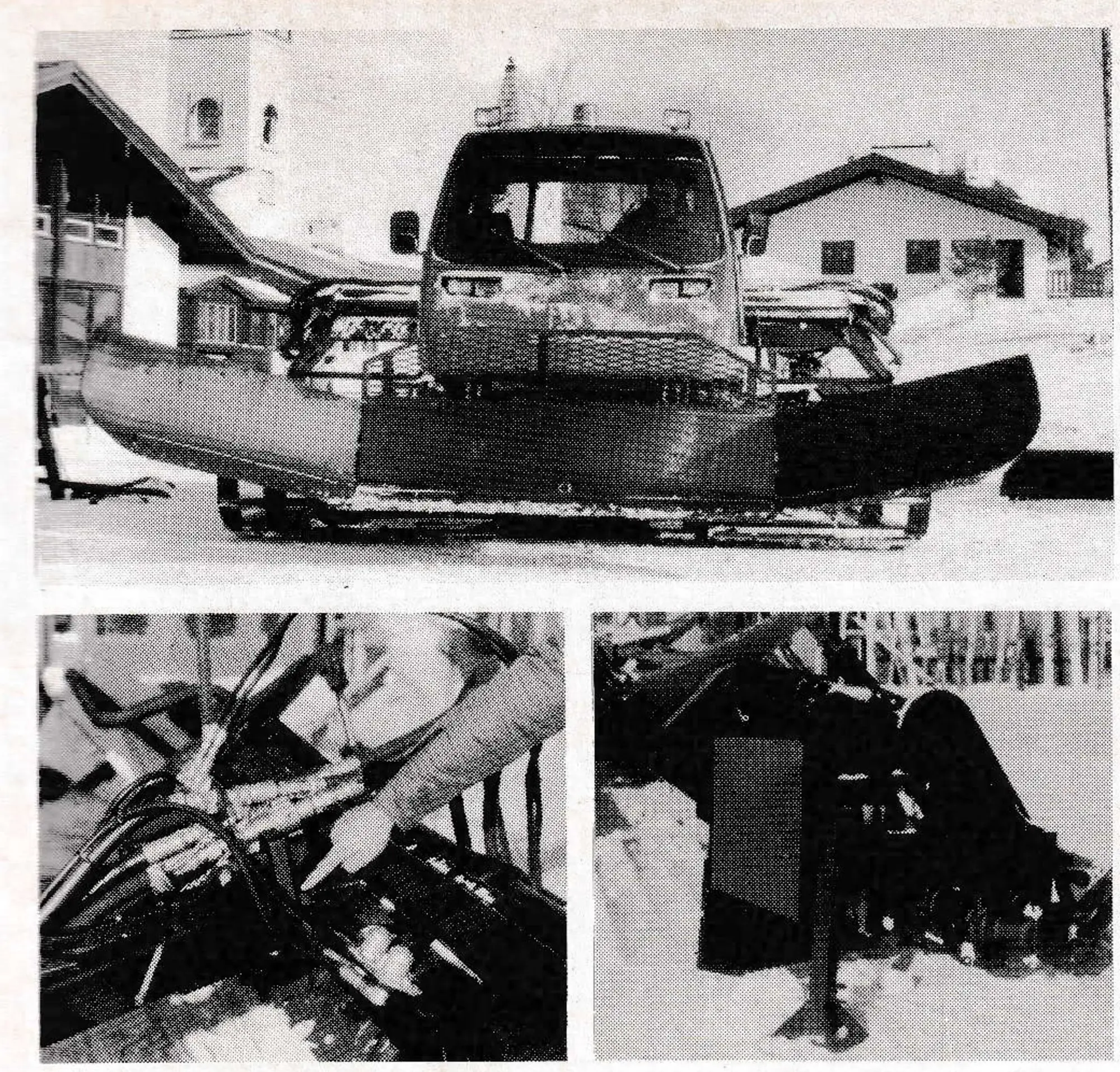
The LMC 4700 which sells for close to $160,000 is powered by a 340 horsepower Scania turbo charged, intercooled Diesel engine with Sundstrand 36 series hydraulic equipment operating the tracks. At a price that is 17 percent more than the 3700C, a new buyer would realize a 36 percent increase in horsepower and reportedly 50 percent more work due to the new horsepower-to-weight ratio of this vehicle. The 14-foot cutting width tiller shuts off automatically when raised and must be reset manually. Changes scheduled for next season are the relocation of the hydraulic fluid reservoir from under the cab to outside eliminating the necessity to raise the cab to check the fluid, a longer engine dip-stick for easier servicing. This new Detroit Diesel engine peaks at 3300 rpm, which is extremely high revs for a Diesel as compared to the 2600 rpm for the Allis Chalmers engine used previously.
New next year for both the 3700C and 4700, will be an electrically modulated three-speed hydrostatic drive. Right now with the “handles ahead at full speed” in low range, five miles an hour is maximum speed; in high range, 11 miles per hour. With the new three-speed drive, anything in between these two speeds can be selected with a knob on the dash.
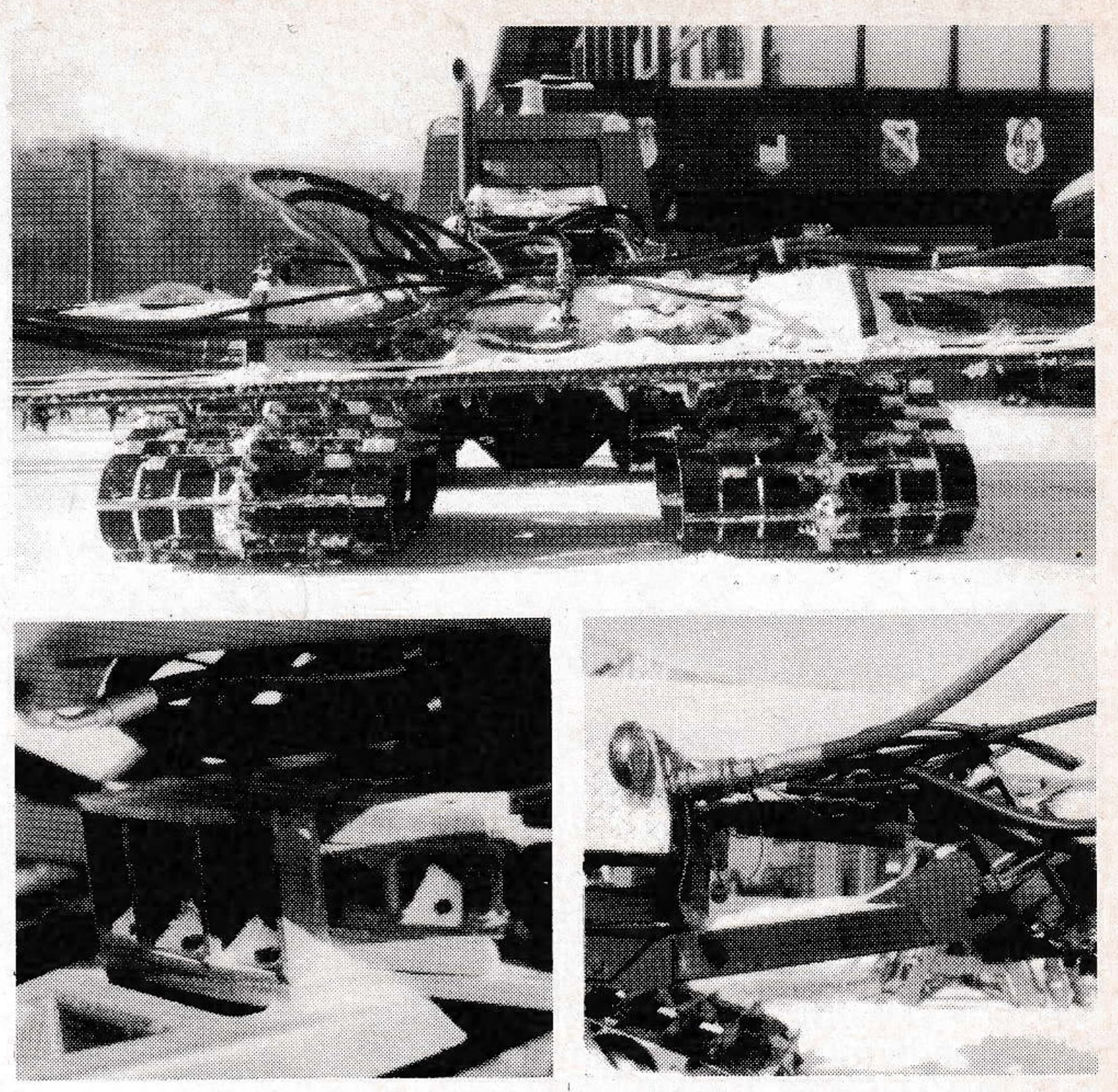
New from Tucker is a major conceptual change in drive and steering assemblies on the 1600 and 1742 machines. Dubbed ICs for independent carriers, both machines now have torsion beam suspension and no differentials, similar to racing-car technology. A new 3/4-inch-thick steel fifth wheel vs. 5/8-inch previously is standard equipment, as is the new Allison 644 4-speed automatic.

The 1742 with a standard 45-inch track and 14-foot blade has as an option the popular Cat 3208 T 250 horsepower Diesel. The whole unit now is supported on 5 1/2-inch-wide belts (an increase of 1 inch over last year) and much heavier springs.
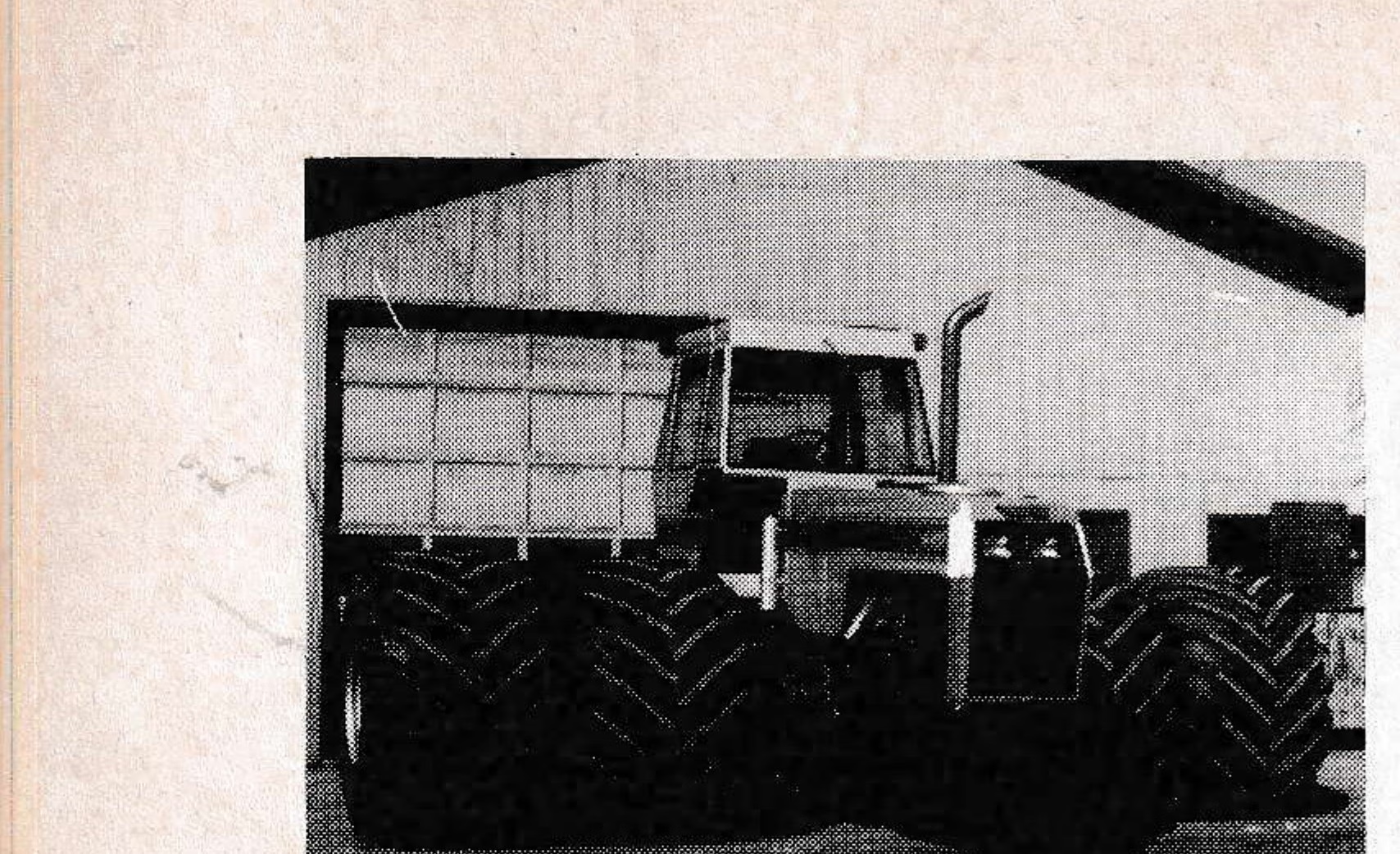
The new 2000 model has a redesigned cab for better blade visibility and has been shortened for a more compact length. It will handle up to a 12-foot self-contained tiller driven from the front of the engine crank for easier servicing. The new 6-way “deep U” blade is mounted a scant 3 inches from the front track for better operator control. The basic machine comes with 28-inch tracks, a front push-frame and hydraulics. The addition of 45-inch tracks, a 6-way blade, Diesel engine and a 10-foot tiller add about $26,000 to the base price.
In both these new IC vehicles, it is important to note that there are no more tie rods. Steering is electronically modulated and controlled hydraulically via the conventional Tucker steering wheel. The standard engine, a Cummins 6 VT 152 horsepower unit, is very close in torque rating to the V-6 170 horsepower unit that is standard equipment on the 1742.
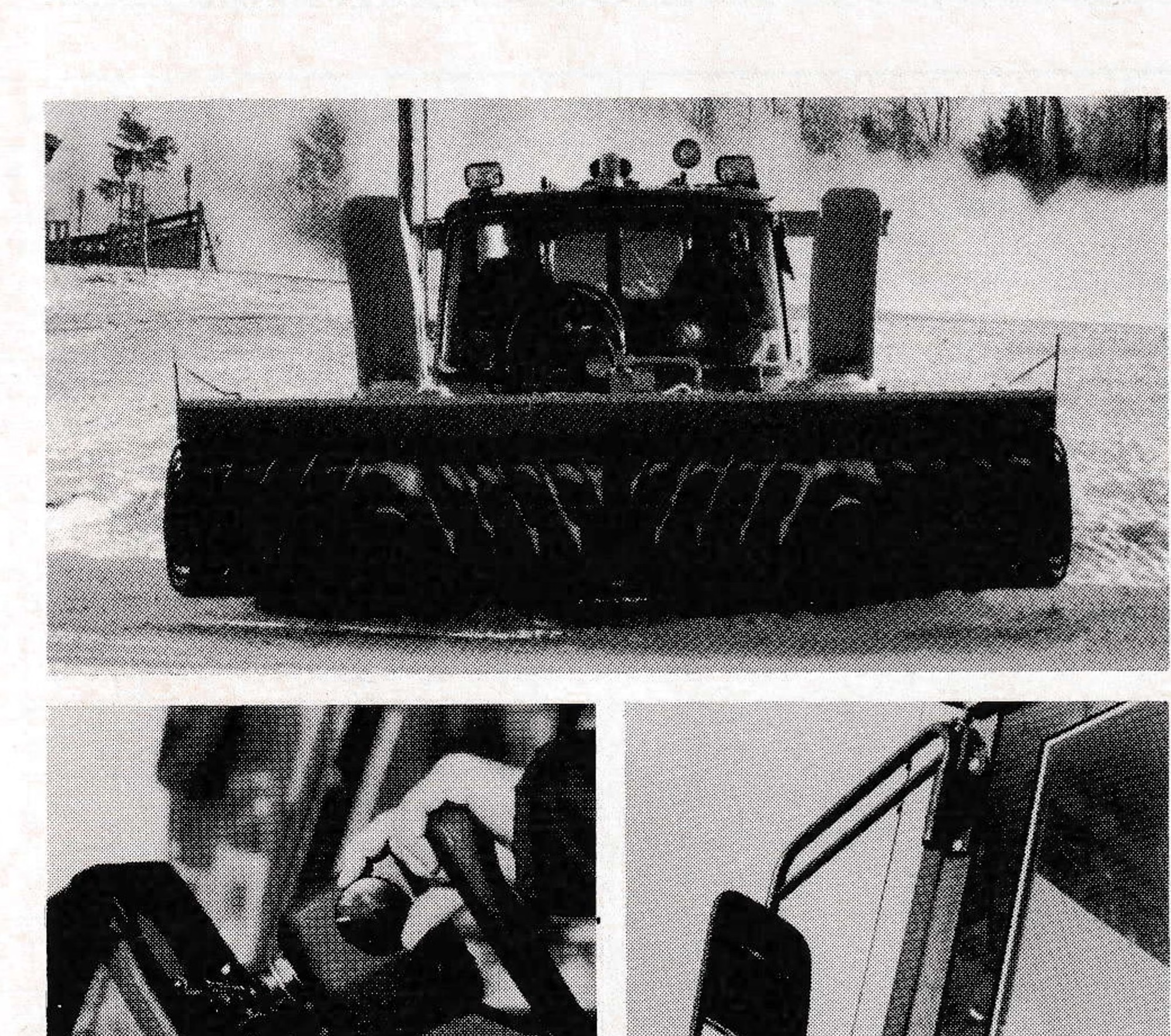
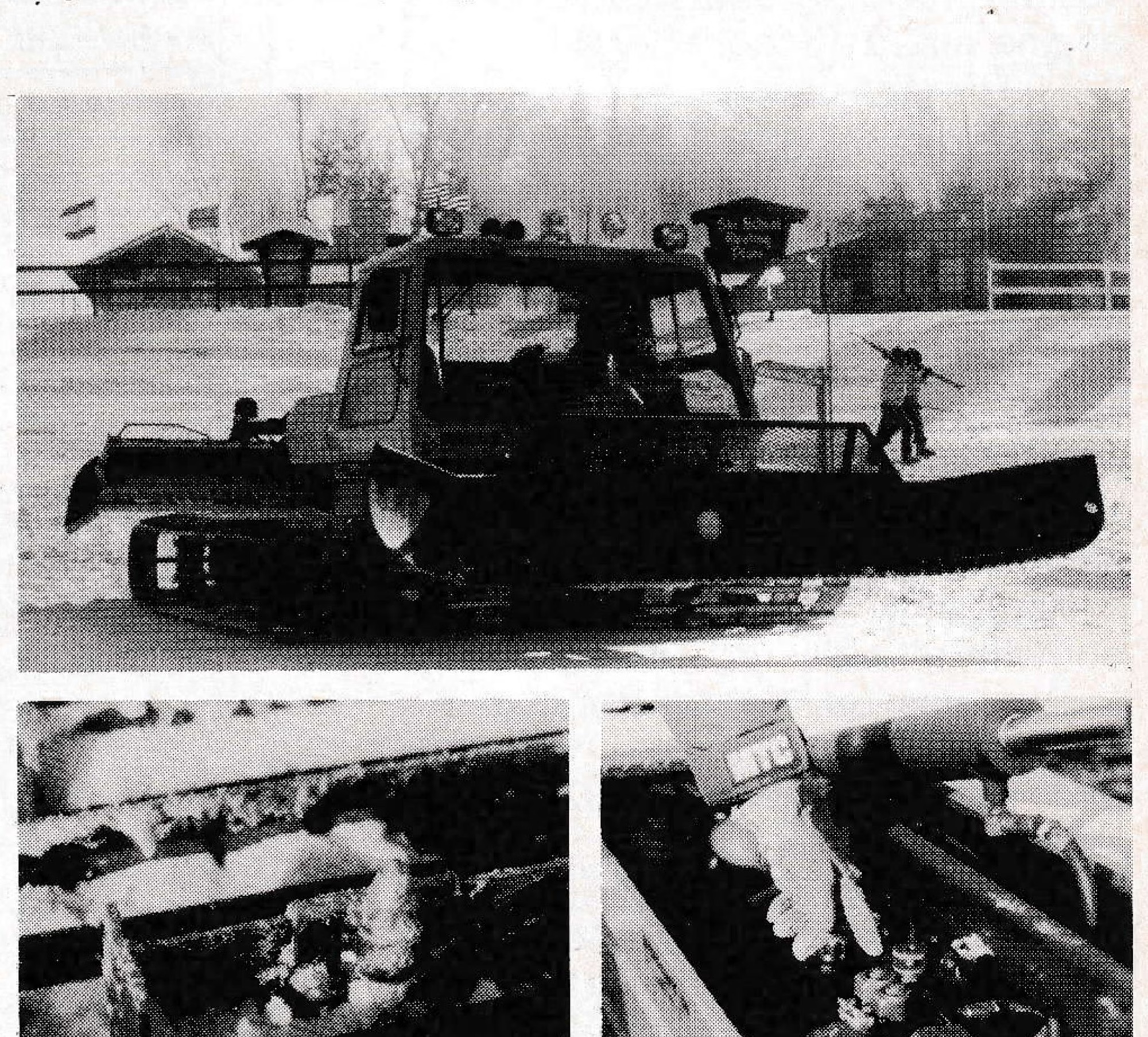
Reportedly, Pisten Bully is coming out with a totally new vehicle in time for next season. In the meantime, this company continues its relentless push towards perfection of the existing line of four vehicles.
The smallest unit, the PB 70, (formerly the PB 60) now has a third hydraulic pump for the new articulated tracksetting tiller, which is also available on the 130.
The PB 130 has easier access to engine components via a tilt cab, increased horsepower from 116 to 123, twin-stick hydraulic steering controls versus the old cable type, Ausco hy- […] (The rest of this article is missing from the archive scan.)
The Table Headings
Here’s a rundown on what the column headings mean. *Number* of cylinders is self-explanatory. The *horsepower* developed is supposed to be SAE which is the U.S. Society of Auto Engineers standard. On certain occasions the suppliers have only the figures of the European equivalent, which is DIN horsepower. The variation is slight. *Engine displacement* is in cubic inches, and the manufacturer’s name follows in abbreviation. The *torque* in foot-pounds is a more important figure than engine horsepower. It is an indicator of the useable power the engine develops, and is especially significant with engines using turbochargers. *Fuel consumption* in gallons per hour is based not only upon manufacturer’s claims, but also adjusted to actual figures supplied by various ski areas. The *dimensions*, length, width and height would be those of a square box within which the vehicle could be contained. *Track width* is what is normally supplied as the standard winter track, even though narrower summer tracks may be available. *Ground pressure* as shown is O penetration, with the belts essentially resting on the snow, even though many manufacturers provide figures showing 6, 8, and 10 inches of penetration which reduces the overall ground pressure. *Clearance* is that space between the lowest point on the machine and the ground surface at O penetration. *Turning radius* is measured to the inside of the vehicle for the actual space required. *Tire size* lists only the size and not type. All tires are pneumatic except for Tucker’s which are solid. The two-track machines in the front (on both sides) usually have a solid or urethane filled tire. The *steering* requirements for each vehicle may be either differential type at the rear of the machine, automotive like that of the Tucker, hydrostatic levers, hydrostatic steering wheel or automotive articulated as in the White Tractor. *Dry weight* in pounds is the weight of the vehicle without passengers or fluids. *Pounds per horsepower* is our contribution to the tabulated data to give an idea of how each piece of equipment may perform under various conditions from a power standpoint. The *approximate prices* are supposed to be for the basic vehicle plus freight and taxes with hydraulics, heater/defroster etc. Some prices include blades, compactor bars and tillers, and we have done our best to annotate accordingly.
1985 Over-snow Vehicle Chart
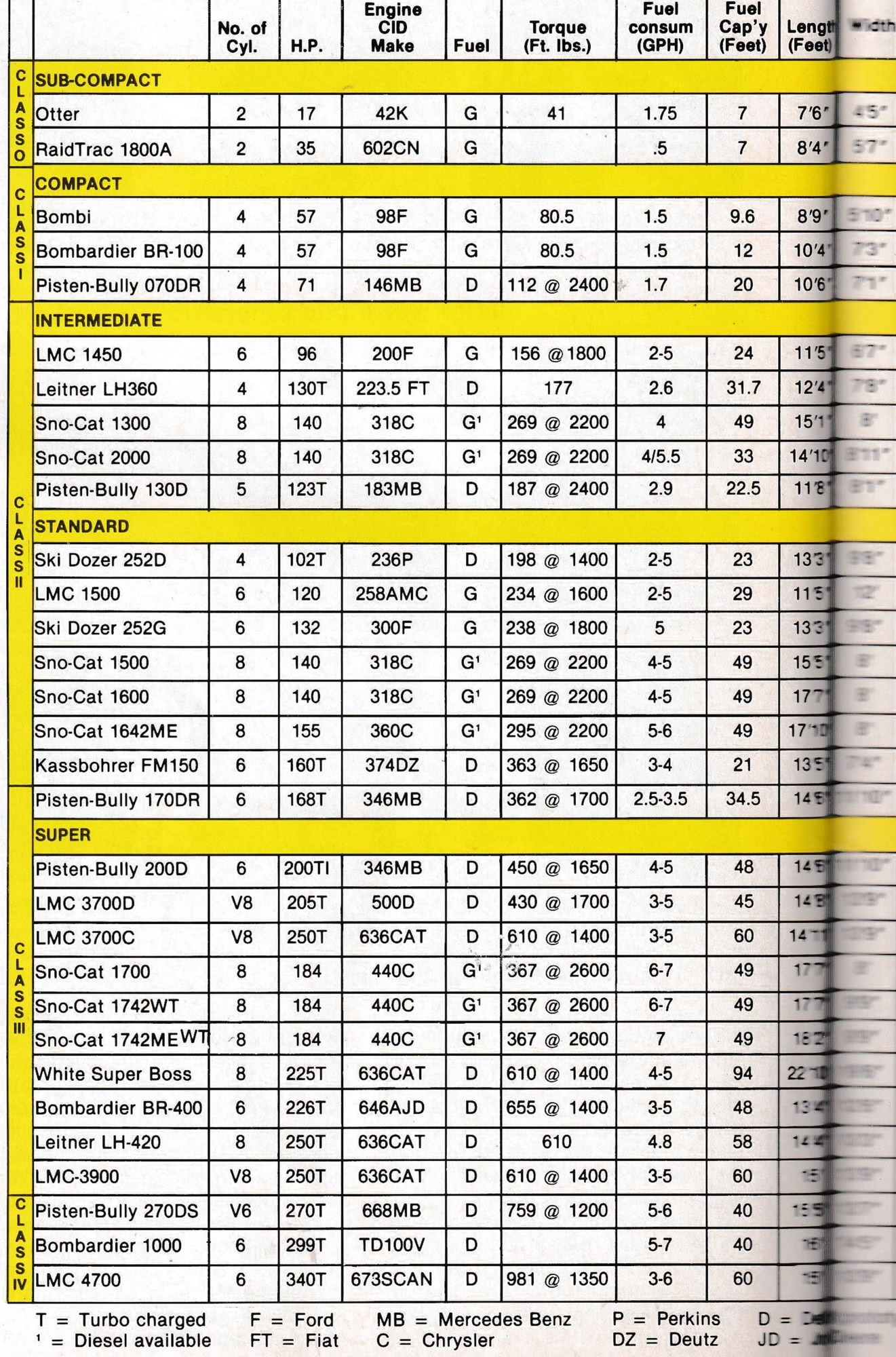
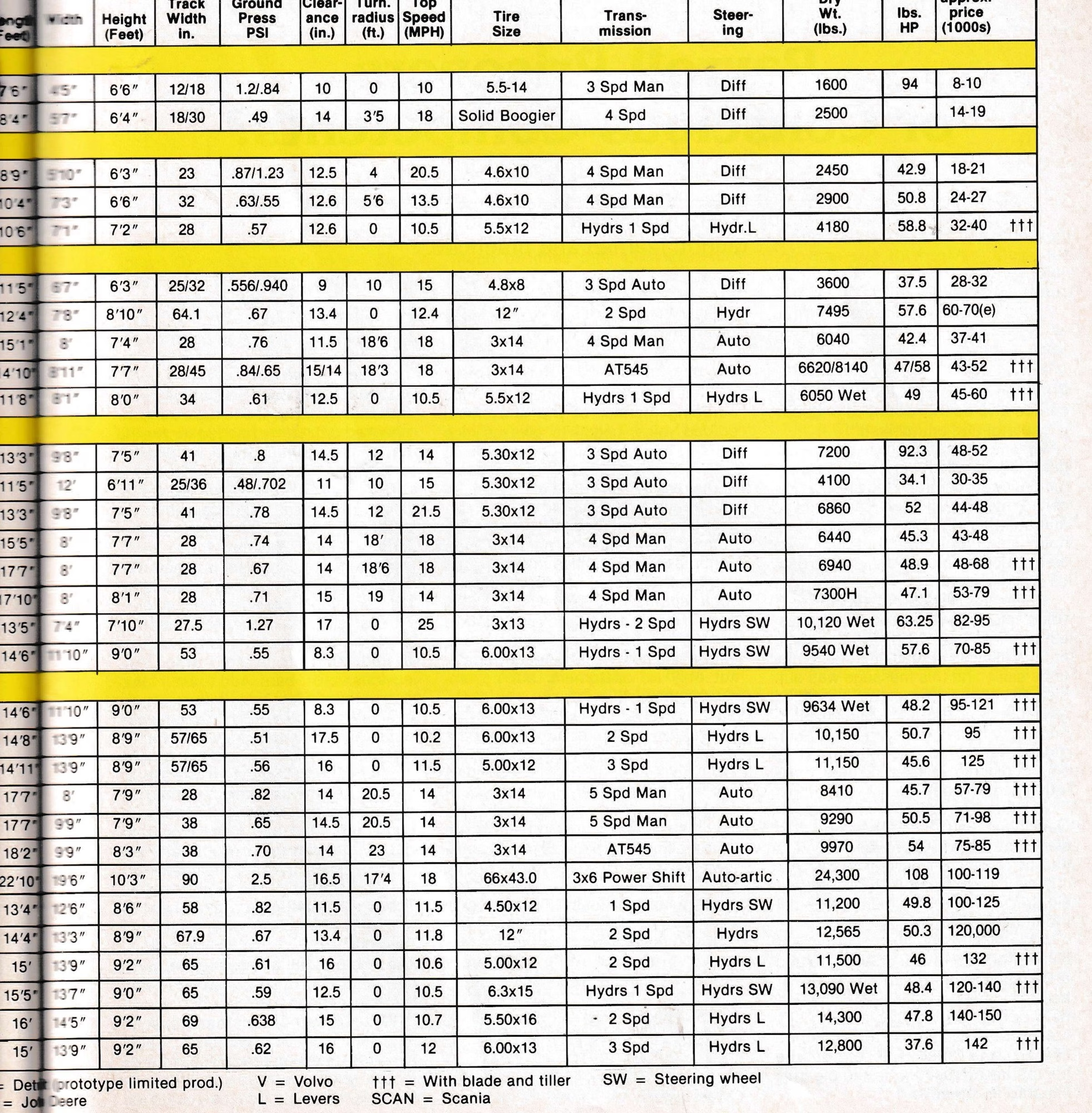
*Key: T = Turbocharged; ‘ = Diesel available; F = Ford; FT = Fiat; MB = Mercedes Benz; C = Chrysler; P = Perkins; DZ = Deutz; JD = John Deere; D = Diesel; V = Volvo; L = Levers; SCAN = Scania; SW = Steering wheel; ††† = With blade and tiller.*

