


One way of keeping bottlenecks to a minimum is to design the unloading area for the lowest ability level of skier who will be using the lift. Keeping this criterion in mind, there are other, more specific considerations.
Unloading slope
An unloading ramp sloping in the direction you want skiers to move is essential. Otherwise, there are sure to be frequent stops when skiers are forced to climb or side-step in order to vacate the unloading area for arriving skiers. The degree of slope should be sufficient to assist the skier in vacating the unloading area and no steeper than the easiest slope or trail served by the lift.
The length of the slope is also important. It must be long enough so that a fallen skier will not obstruct skiers coming off the lift. At novice areas this allows the beginner, who frequently sits on the tails of his skis, to continue to slide away.
Snow depth
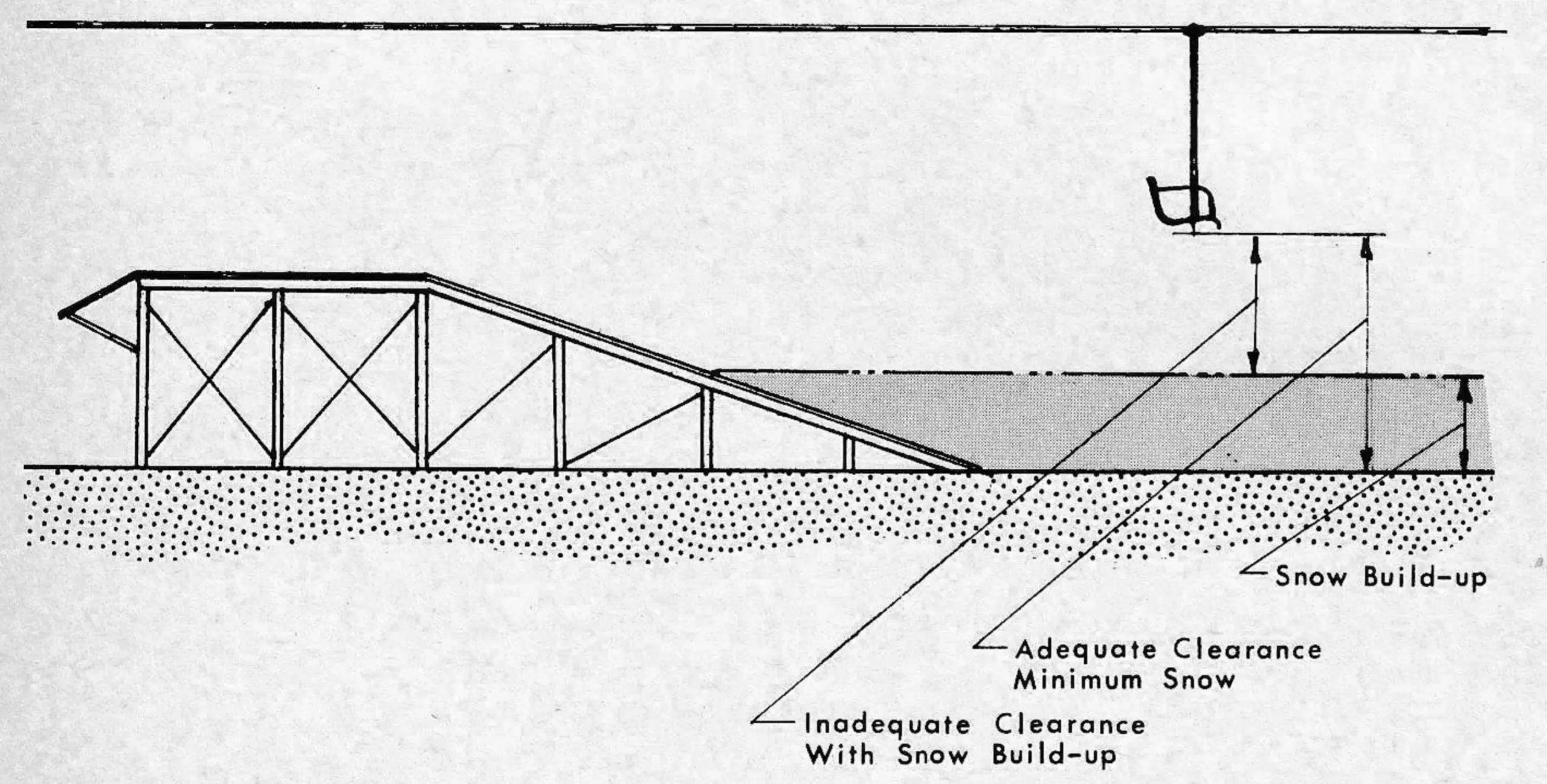
Snow depth must also be watched. If the unloading ramp has a three-foot drop and three feet of snow is permitted to build up, the result will be a level unload. Since it is often difficult to obtain an unload ramp high enough to accommodate the maximum anticipated snow build-up, snow removal may be necessary. This will involve provisions for getting the removal equipment into the area and a place to deposit the snow.
Retaining snow and keeping the ramp surface free from slush may be another problem in warm weather, particularly where the lift faces south. Artificial snow mats filled with snow are the most successful solution, as they keep the friction between skis and the running surface more consistent with the natural snow surface. However, the mats should be extended far enough along the unloading ramp so that the point of transition from mat to snow is in the runout area.
A large “marshaling area” adjacent to the unloading area is also necessary, particularly on lifts serving poorer skiers. This area allows the skier, upon unloading, to replace his pole straps and make a decision as to which route he’s going to ski without forcing skiers behind him to back up.
Surface lifts
Unloading area design is most critical on the J-bar lift with a fixed-length towing outfit because the height of the snow surface at the unload must be maintained at an almost fixed depth. And, since these lifts usually serve beginning skiers, the slope of the unload ramp must be minimal. A pronounced “break-over” point, however, should be established and a 3 to 8 per cent downgrade provided beyond this point to lead the skier gently away from the lift and to the flat marshaling area. If the unloading area is too long and flat, skiers will unload along its entire length, leaving insufficient room for skiers coming up on the lift.
Though telescopic-tube T-bar lifts permit a slightly greater tolerance for snow depth, their unloading areas should be constructed along the same lines as the J-bar. Since two skiers are unloading at the same time, the ramp must permit the inside skier to move along in the direction of lift travel for a short distance while the outside skier moves away.
Spring-box T-bar lifts permit the greatest variance in snow depth at unload, but the first portion of the unload ramp should continue in the lift direction so that skiers will not release the towing bar sideways, making the T-stick sway as it retracts.

Chairlifts
It is essential that the chairlift unloading ramp have an appreciable downward pitch so that skiers can accelerate ahead of the chair and ski away either to the side or straight ahead and under the chairs. Snow build-up can be particularly dangerous here; at least one fatality has occurred where a skier was struck in the head by a chair because overhead clearance was inadequate.
In bull wheel unloading, the skier need move only far enough to permit the chair to swing around the bull wheel. However, if snow is allowed to build up, the ramp will level off and the skier could be struck by the chairs as they swing around the bull wheel. The B77.1 Standard dictates a minimum ramp slope for bull wheel unloading of 12 per cent and maximum slope for any type of unloading of 40 per cent.
The location of the ramp must be designed carefully as well. If it is too near the bull wheel, skiers will not have enough time to accelerate down the ramp ahead of the chair, and the inside skier may be bumped by the chair as it swings around the bull wheel. For slow-speed lifts, this point should be at least four feet downhill of the point where the haul rope first touches the bull wheel. This distance must be increased for higher-speed lifts, and at 500 feet per minute the distance should be at least eight feet.
The B77.1 also requires a nearly level area at least eight feet in length prior to the ramp. It should not be much longer than eight feet or skiers will tend to dismount too early and be pushed by the chair to the ramp.
The entrance to the unloading area must also be designed so passengers do not catch their ski tips as they approach. In general, an earth-filled ramp has the distinct features of low maintenance and better off-season appearance that make initial considerations favor this type of construction if initial costs are not prohibitive.
A great deal of the overall design of any unloading facility is, to repeat, based on basic considerations of the ability of the poorest grade of skier that will be using the lift. The less work and ability that is required of this skier, the more workable will be your unloading design.