

The success of destination ski areas is inevitably linked to the success of the surrounding recreational real estate developments, as each activity promotes the other. It is therefore important that destination ski area managers understand the nuances and possible impacts of proposed income tax reform as it relates to ski area real estate activities.
Income tax reform has been an almost annual event over the past few years whereby thousands of pages of law and regulations are either added or amended. The current proposals, referred to as “Tax Simplification,” would introduce sweeping changes at almost all levels of federal taxation. These changes would ripple through the economy. This article does not intend to pass judgment on any of the current proposals, but rather outline some general provisions and illustrate their application. It must be remembered that the following discussion and case study are based on information available on the proposals at this writing (March, 1985). At this point nothing has been passed and therefore the example is purely hypothetical. However, the following is indicative of the mood of Congress.
Currently there are three major proposals before Congress: 1) The Treasury Proposal proposed November 1984; 2) The Kasten-Kemp Bill reintroduced January 1985; 3) The Bradley-Gephardt Bill proposed June 1983.
There are some general provisions common to all three of the above proposals:
1) General lowering of effective individual income tax rates. The proposed range of brackets or single bracket are as follows: 15% to 35% Treasury Proposal; 25% Kasten-Kemp Bill; 14% to 30% Bradley-Gephardt Bill.
2) General repeal of most tax credits including the Investment Tax Credit; 3) Elimination of the itemized deduction for state and local taxes; 4) Reduction or elimination of interest expense (except interest on a principal residence); 5) Overall reduction of corporate rates generally from 46% to 30%; 6) Increase of standard deduction and personal exemptions.
At this writing the Treasury Proposal would seem to be the odds-on favorite because it embodies most of the administration’s views on tax reform. Accordingly, this article will focus on some of the Treasury measures that could affect investment considerations relative to ski area real estate.
Selected Proposed Provisions
**Mortgage interest on Second Homes.** This interest would be included with other interest not on a principal residence and be deductible to the extent of $5,000 per year plus net investment income. However, mortgage interest on a condominium purchased for “trade or business,” (i.e. placed in a rental pool for general rental) would be deductible. This deduction is under the assumption that the rental is not used for personal purposes in excess of the amount allowed under Section 280A.
*Observation:* The enactment of this provision would limit the deduction of interest expense on second homes when the second home is used principally for personal purposes. The provision does not appear to hinder the deductibility of interest when the rental home or condo is principally a trade or business rental.
**Indexing of depreciable assets for inflation coupled with the proposed real cost recovery system.** Real property (not including land) now depreciable over 18 years, would be assigned a depreciation rate of 3 percent per year applied to the inflation indexed basis of the asset.
*Observation:* This change would substantially reduce current depreciation tax deductions even when inflation indexing is included. This measure reduces the tax motivation with respect to investment property which is consistent with the Treasury’s desire to have investments made on their economic, rather than tax aspects.
**Repeal of capital gains exclusion and indexing of capital assets.** The current 60 percent long-term capital gain exclusion would be repealed. Instead, capital assets would be adjusted annually based on a multiple of increases in the consumer price index.
*Observation:* This provision has the effect of increasing the tax basis of assets based on the rate of inflation. As with the indexing of depreciable assets, the Treasury Proposal is aimed at attempting to arrive at a theoretical real cost of an asset based on annual inflation.
**The “At-risk Limitations” would be extended to real estate activity.** “At-risk” is generally measured by the amount that an investor has funded an activity including recourse debt.
Under current law, the non-recourse debt associated with many real estate activities has provided tax basis. Under the Treasury Proposal non-recourse debt would not provide tax basis and consequently an investor would not be at-risk with respect to non-recourse indebtedness.
*Observation:* The tax features of real estate whereby the write-off exceeds the cash invested plus non-recourse debt, have long been a “sacred cow” of Congress. Again, the Treasury Proposal is trying to insure that investments are not tax motivated.
**Repeal of the Investment Tax Credit.** The Investment Tax Credit currently provides for a direct credit against income taxes equal to 10 percent (subject to a basis reduction) of the adjusted cost of tangible personal property purchases (i.e., ski lifts, lodge furniture, etc.) and placed in service in a taxable year. The ITC as well as most other tax credits would be repealed.
*Observation:* This credit applies to furniture packages in condominiums which are rented as temporary lodging facilities. For example, a $10,000 furniture package would yield a $1,000 tax credit to a condominium buyer who rents out his unit on a regular basis to no single individual for more than 30 days. The drafters of the Treasury Proposal felt that it is unfair to provide tax breaks to capital intensive industries which benefit from the ITC and not provide benefit to other industries. Accordingly, the proposal is to equalize all industries by eliminating tax incentive credits.
**Limited partnerships with more than 35 partners would be taxed as corporations.** The drafters feel that large partnerships have more of the characteristics of a corporation than of a limited partnership. Accordingly, the Treasury believes they should be taxed as corporations with no pass-through of tax benefits to the limited partner.
*Observation:* Under the Treasury Proposal large limited partnerships may become a thing of the past. Generally, limited partnerships would be held to 35 partners or less which also happens to comply with certain SEC registration exemptions.

There are many other proposed changes which would affect ski area real estate, but the above items appear to be some of the major issues. Following is a sample case study which illustrates the tax impact of comparing the existing tax provisions to the proposed Treasury provisions for a ski area condominium buyer, John Skier.
Case Study
John Skier purchases a ski rental condominium for $120,000. He plans to use the condominium less than 14 days per year and will lease the unit through a property management firm. At the end of the fourth year, John Skier assumes that he will be able to sell the unit for at least $20,000 more than he paid for it, or $140,000. The following example reflects the different results obtained under the current law and under the Treasury Proposal.
In addition to those assumptions outlined above, the following assumptions are also made:
- Down payment: 20% of cost
- Interest rate: 14%
- Monthly payment: $1,422
- Management fee: 40% of gross rentals
- Association fee: 1% of original cost
- Rental rate: $150 per night ski season; $60 per night off season
- Days rented: 80 days ski season; 40 days off season
- Inflation rates: 5% year 1; 7% year 2; 6% year 3; 8% year 4
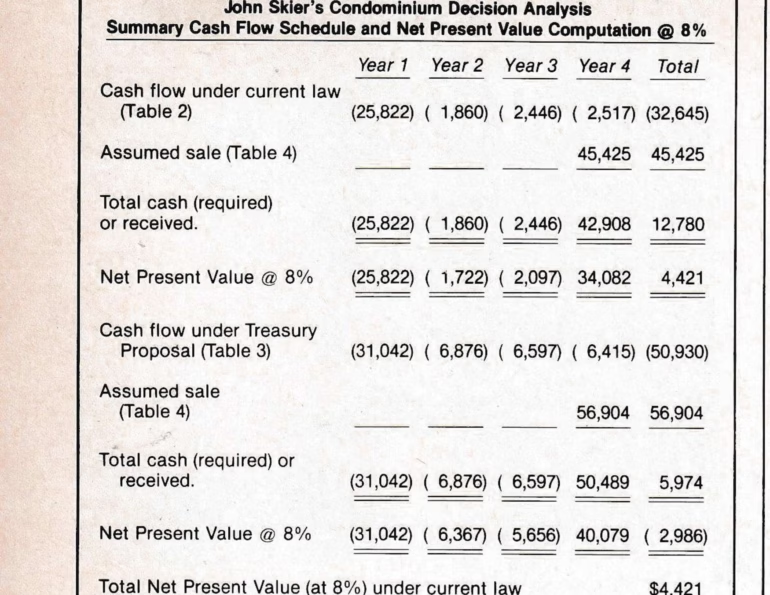
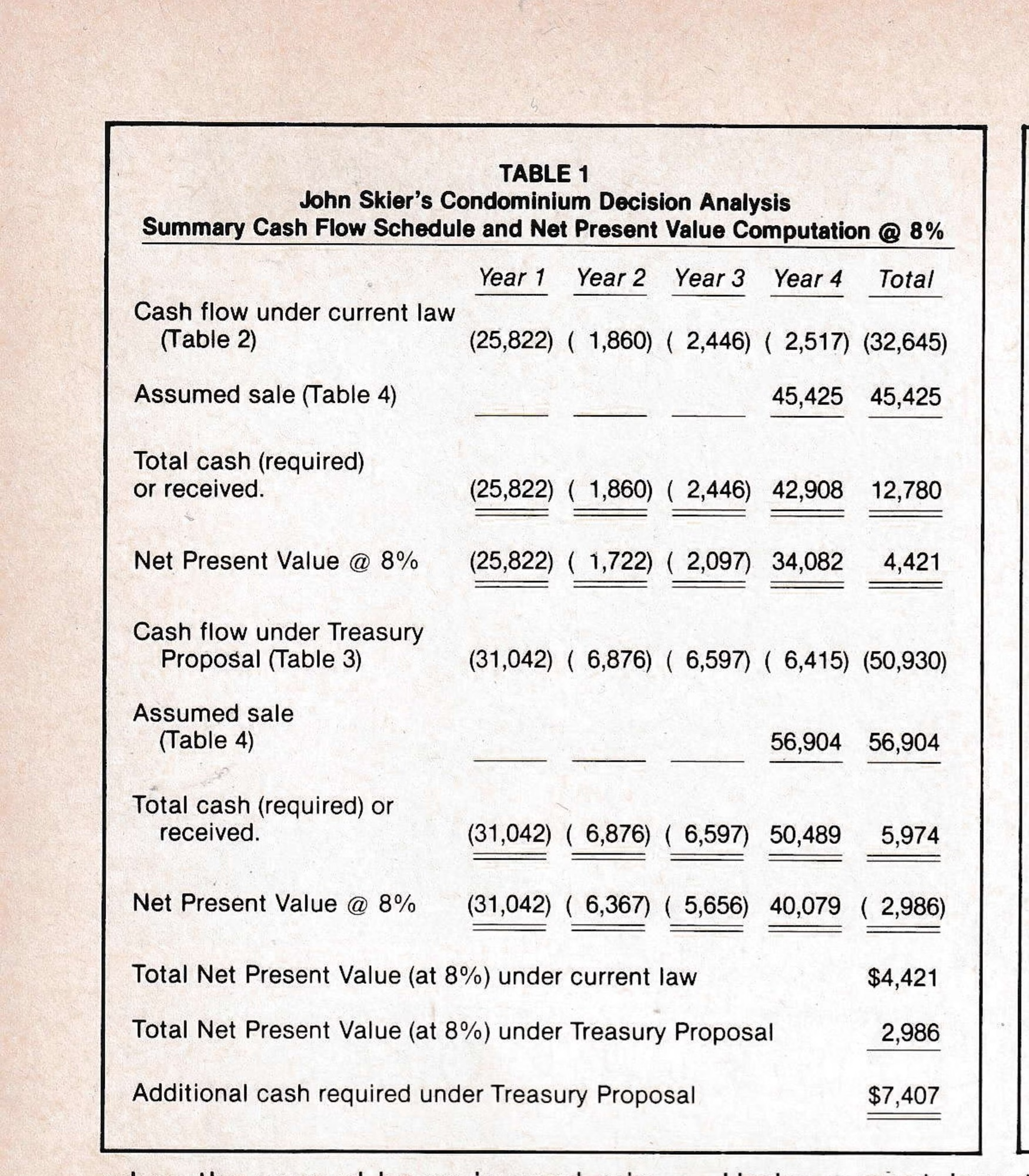
John Skier believes that he can earn 8 percent net after tax on alternative cash investments and therefore utilizes a discount rate of 8 percent to compare investments. Based on the assumptions as outlined above and the 8 percent factor, Table 1 illustrates the cumulative net present value (NPV) of the cash flows under the current law and the Treasury Proposal. The Table reflects that there is a positive NPV under the current law or that based on the assumptions presented, a greater than 8 percent return is achieved. The converse is reflected under the Treasury Proposal where a less-than-8 percent return is made as reflected by the negative net present value calculation. The difference is explained by the fact that in the early years, because of greater depreciation deductions and a higher tax bracket to benefit from the deductions, the current law requires less of a cash outlay than under the Treasury Proposal.
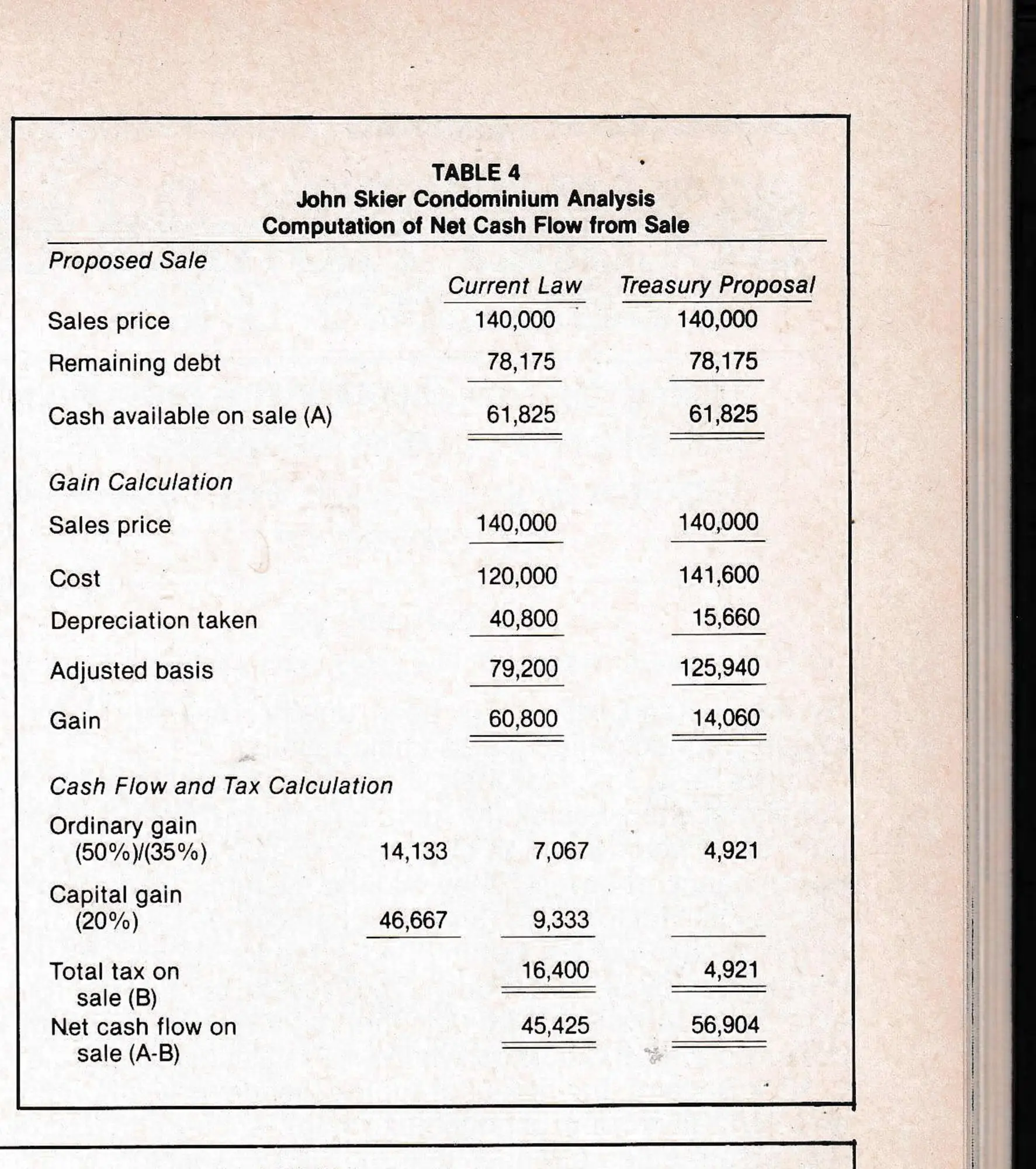
Based on the above assumptions and the net present value on net cash flow (net of taxes), John Skier would pay $7,407 (see Table 1) more under the Treasury Proposal than under current law for his condominium investment. The condominium investment under current law provides an economic advantage as compared to the Treasury Proposal.
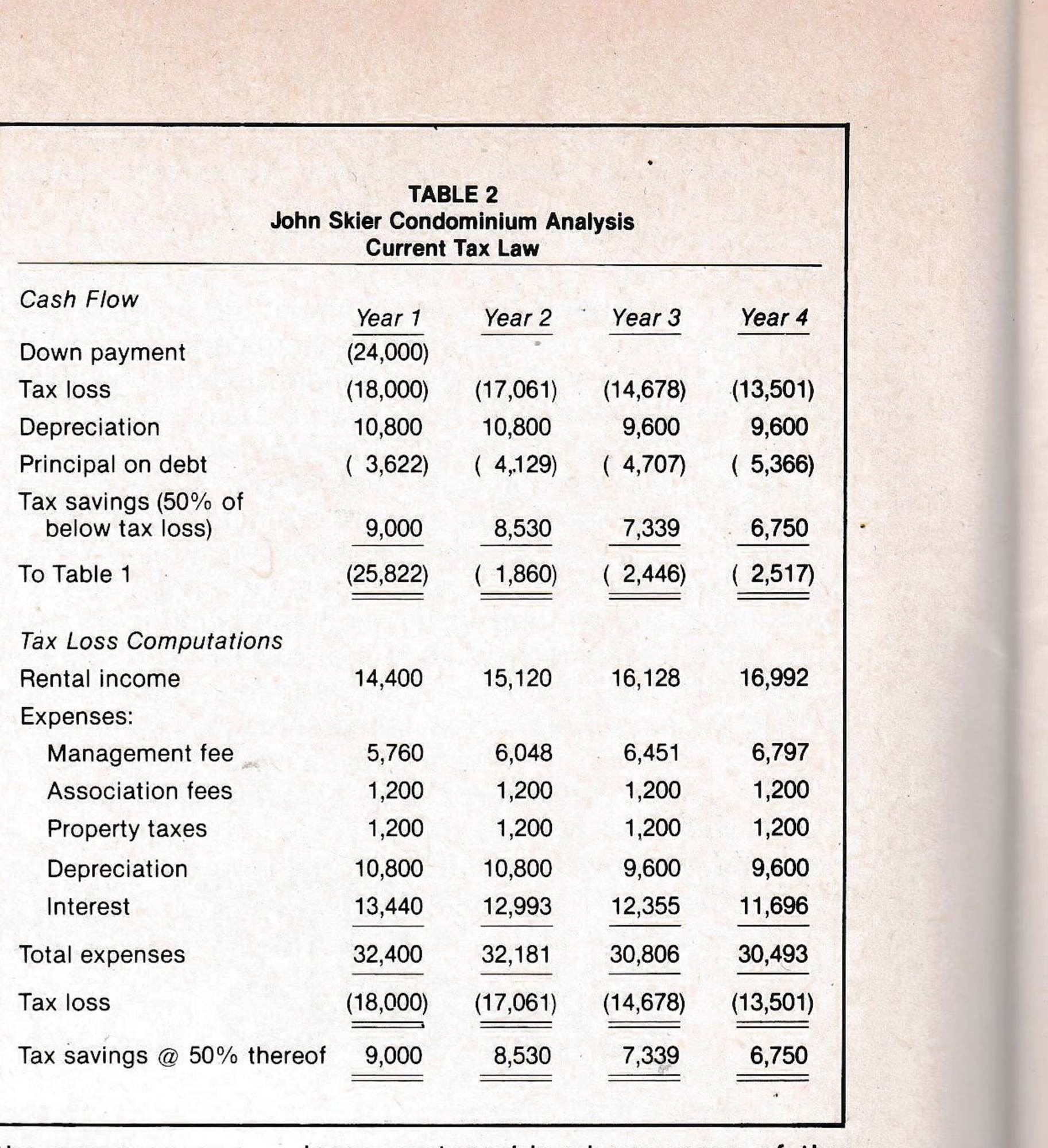
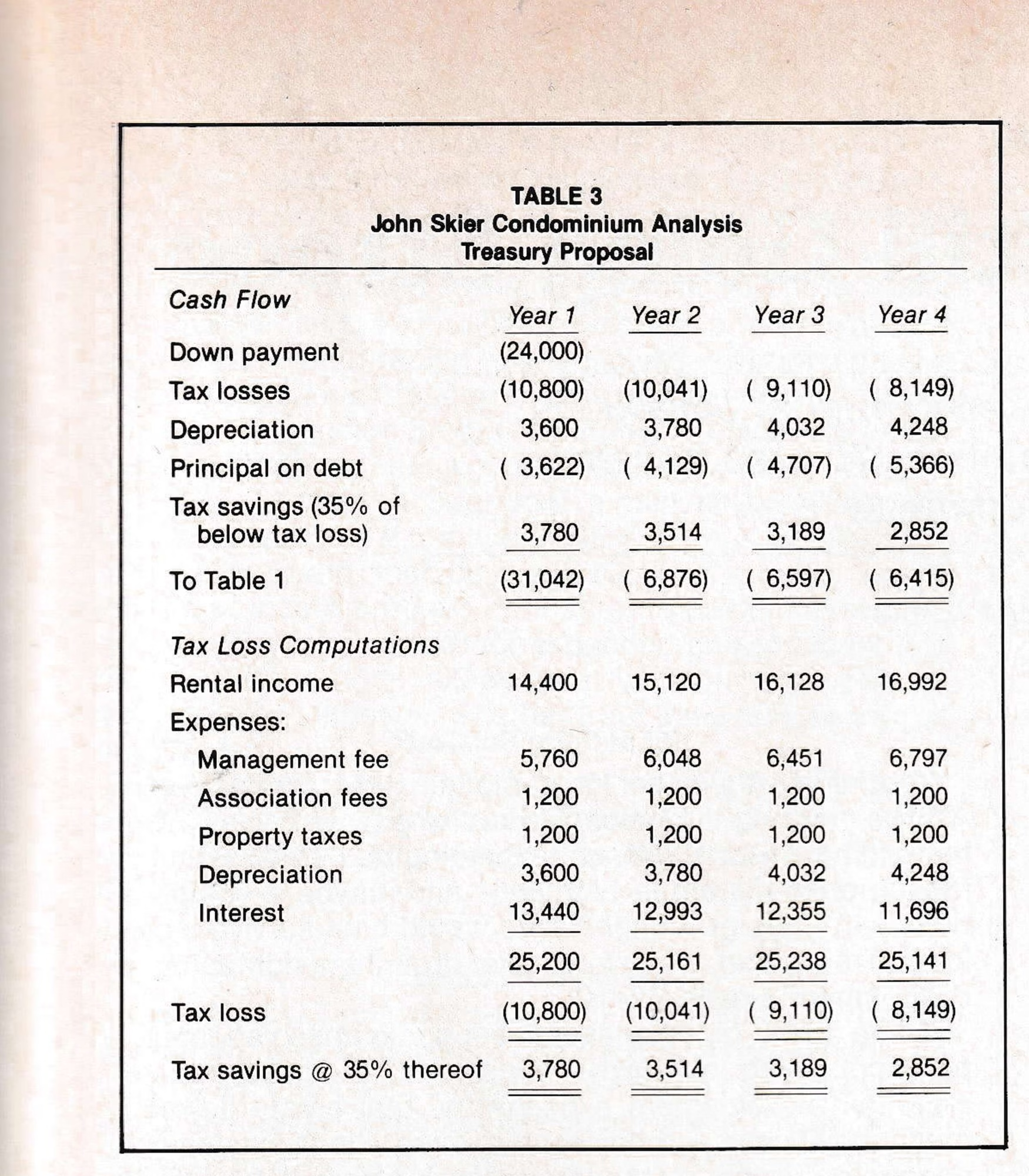
Tables 2 and 3 reflect the assumed cash flow and tax income or loss of the condo investment under both the current law and the Treasury Proposal. Table 4 illustrates the tax effects of the sale under both the current law and Treasury Proposal.
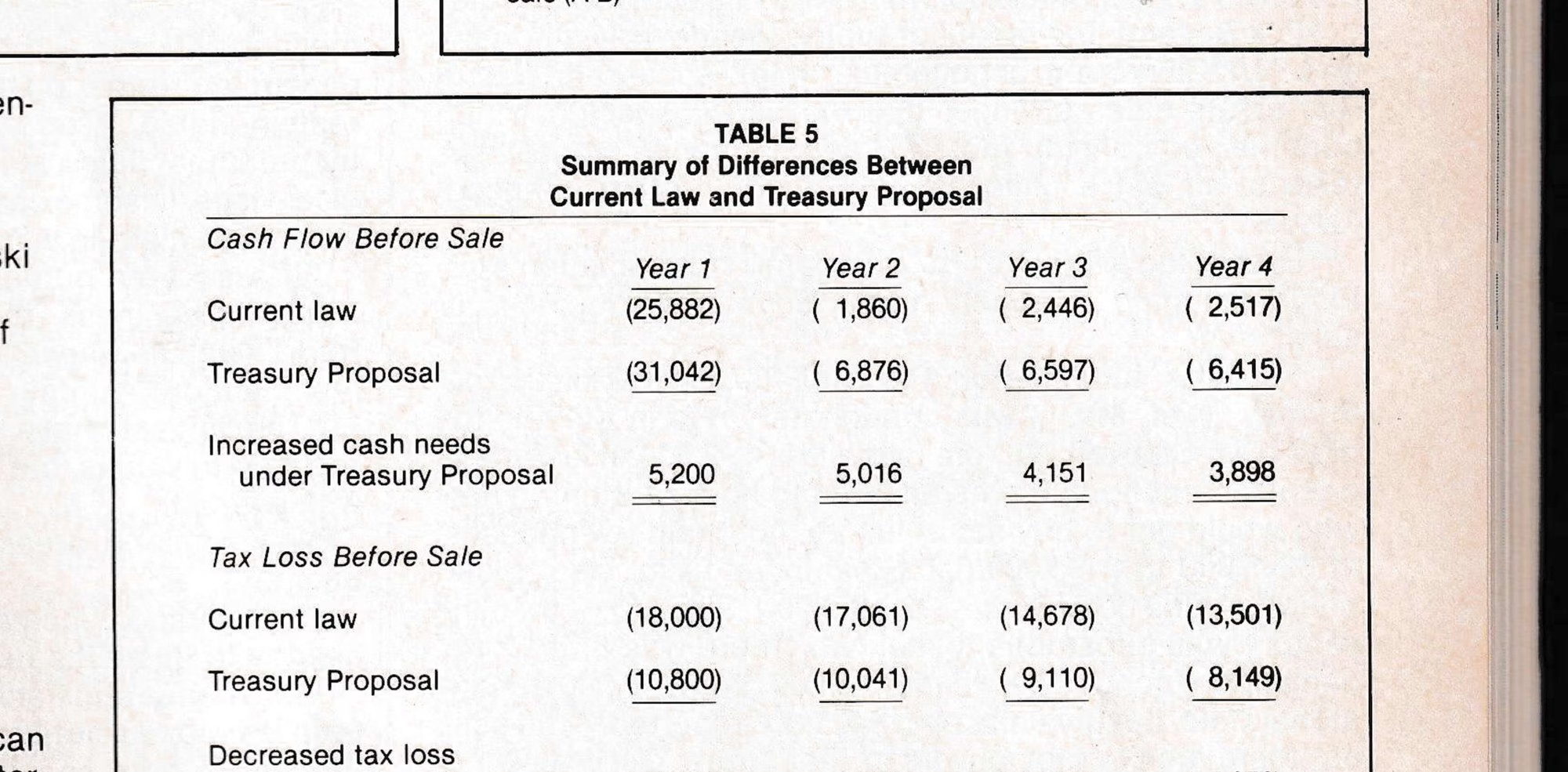
Table 5 summarizes the cash flow and tax loss differences, exclusive of the sale, between current law and the Treasury Proposal. It can be observed that cash flow requirements (cash-out flow) significantly increases under the Treasury Proposal while tax losses significantly decrease.
The case study illustrates the potential impact on ski area real estate of the Treasury’s “tax simplification” Proposal. It should be noted that John Skier achieved his investment objectives by using the tax laws as they currently exist. However, if he were considering buying the same condominium under the Treasury Proposal, modifications would have to be made to achieve his desired return on investment. The Treasury Proposal, as it now stands, could have long reaching impact, not only to ski area real estate developers and investors, but also to ski area operators.
Other General Observations
1) It appears that a simplification act, if enacted, will not generally be in effect until 1986 and probably will not be retroactive (grandfathered). However, effective dates are always uncertain.
2) Whether tax simplification has been achieved under the Treasury Proposal is a challenging question in view of the complicated adjustments that are required to assets based on inflation.
3) The Treasury Proposal, if enacted, would place a substantially increased degree of dependence on the economic viability of condominiums in terms of price, rental income, management fees, etc., by decreasing the tax advantages. These changing requirements will undoubtedly manifest themselves in the form of changing condominium construction, size, management, etc.
4) As long as there are destination ski areas there will be a need for housing. The new Treasury Proposal, if enacted, will establish a new set of ground rules for developers and other ski area real estate people, some of whom will adapt creatively.
5) Early observations indicate that the tax reform proposals have created an “in-limbo” atmosphere among some condominium buyers due to uncertainty.
6) Should a tax simplification proposal be enacted, all investors would have to operate under the same laws.
7) There will always be the swank ski area condominium for the affluent buyer who is beyond caring about tax advantages if that condominium is properly located in his type of ski area.
President Reagan, in his recent State of the Union message, emphasized the importance of tax simplification and tax reform. It will be interesting to see how these objectives develop over the next few months. Significant change is rarely easily accepted and usually generates a great deal of discussion and activity. The tax simplification proposals promise to be an exciting and hotly debated issue in the coming months. *Richard Houlihan, CPA, is president of Solitude Ski Resort Company, Salt Lake City, Utah. Spencer H. Clawson, CPA, is tax manager at Price Waterhouse & Company, Salt Lake City.*