


Judging by today’s standards, Kidd did indeed get off to a late start.
Children’s nursery programs at ski areas have long graduated from the days when children would romp in the snow, eat a stale cracker, drink some warm milk and wait around for Mom and Dad to return from the slopes. At many areas, particularly destination resorts of the northeast and Rocky Mountain states, nurseries have evolved from romper rooms to fullfledged schools that are an important part of the area’s overall appeal. And, at some areas, such as Alpine Meadows, Calif., which last year turned over the whole bottom floor of its new base lodge to the nursery, ski area childcare is definitely a money-making proposition.
“Absolutely,” replied John Pomiroo of the Ski Lake Tahoe marketing department when asked if the nurseries of the five Lake Tahoe resorts make money. “We wouldn’t do it if we didn’t make money.”
Although a nursery by itself can turn a profit for a ski area, examples are rare and limited mainly to the larger resorts. Most small or medium-size areas would be mistaken if they entered the child-care field thinking they could make money from the venture. At the same time, an area without some form of child-care is making even more of a mistake.
“Because a nursery is so labor-intensive, you can’t make any money from it,” says Verlene Belden, business manager of the Pico ski area in central Vermont. “The nursery is a service. What you do is hope to sell a few more lift tickets to the parents of young children because of the nursery.”
At all the areas contacted for this article, skier-demand was the decisive factor in an area’s decision to start a nursery and in determining the size and scope of the nursery program.
At Wild Mountain in Taylors Falls, Minn., the demand for child-care service is based on specific needs. “We only offer a nursery service on Wednesday mornings, which is ‘Ladies Day’,” says Bob Smith of the area’s marketing department. “That’s really the only day we have any demand for it.”
Knowing your clientele then is the first and most important consideration in starting a child-care program. This in turn dictates the type and size of the room or building for the nursery.
Size and Type
“It’s important to provide children with a protected experience,’ says Lynn Bertram, ski school director at Pico. “In this way, you can eliminate any fear of crowds or lifts for the children.”
The size and type of nursery facilities varies widely from area to area. Some of the smaller or mid-size areas provide the best facilities, while at some very large areas, the nurseries are not isolated enough or are too big and confusing to provide a satisfactory experience for the children, according to parents interviewed.
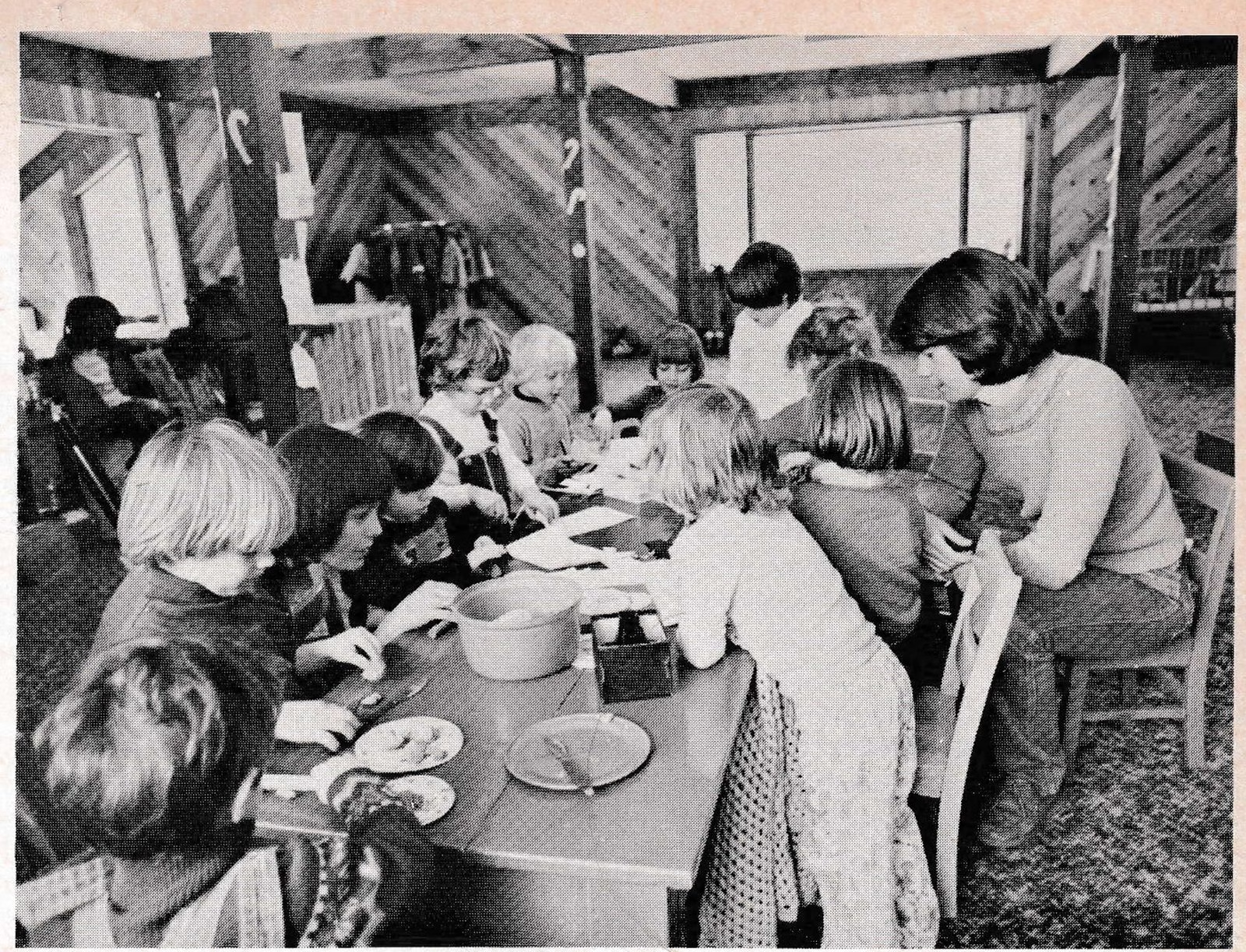
Alpine Meadows helped counteract this problem by confining the nursery in a separate section of the day lodge. Within the nursery is a large open play room, a sleep room, bathrooms, a kitchen, a fitting room for skis and boots, a quiet corner for story-telling and a piano—all specifically designed for children.
“It’s a quiet place that’s comfortable and like home to them so that when the outdoor environment gets too overpowering, they can come inside for awhile,” says Ellen Treseder, who heads the Children’s Snow School at Alpine Meadows.
Stratton Mountain, Vt., has moved the nursery out of the base lodge into a separate, slope-side building constructed four years ago. In the twostory building, the entire upstairs is turned over to three-to-six-year-olds, while the downstairs is divided in half with infants (six weeks to three years) on one side, and six-to-twelve-yearolds on the other.
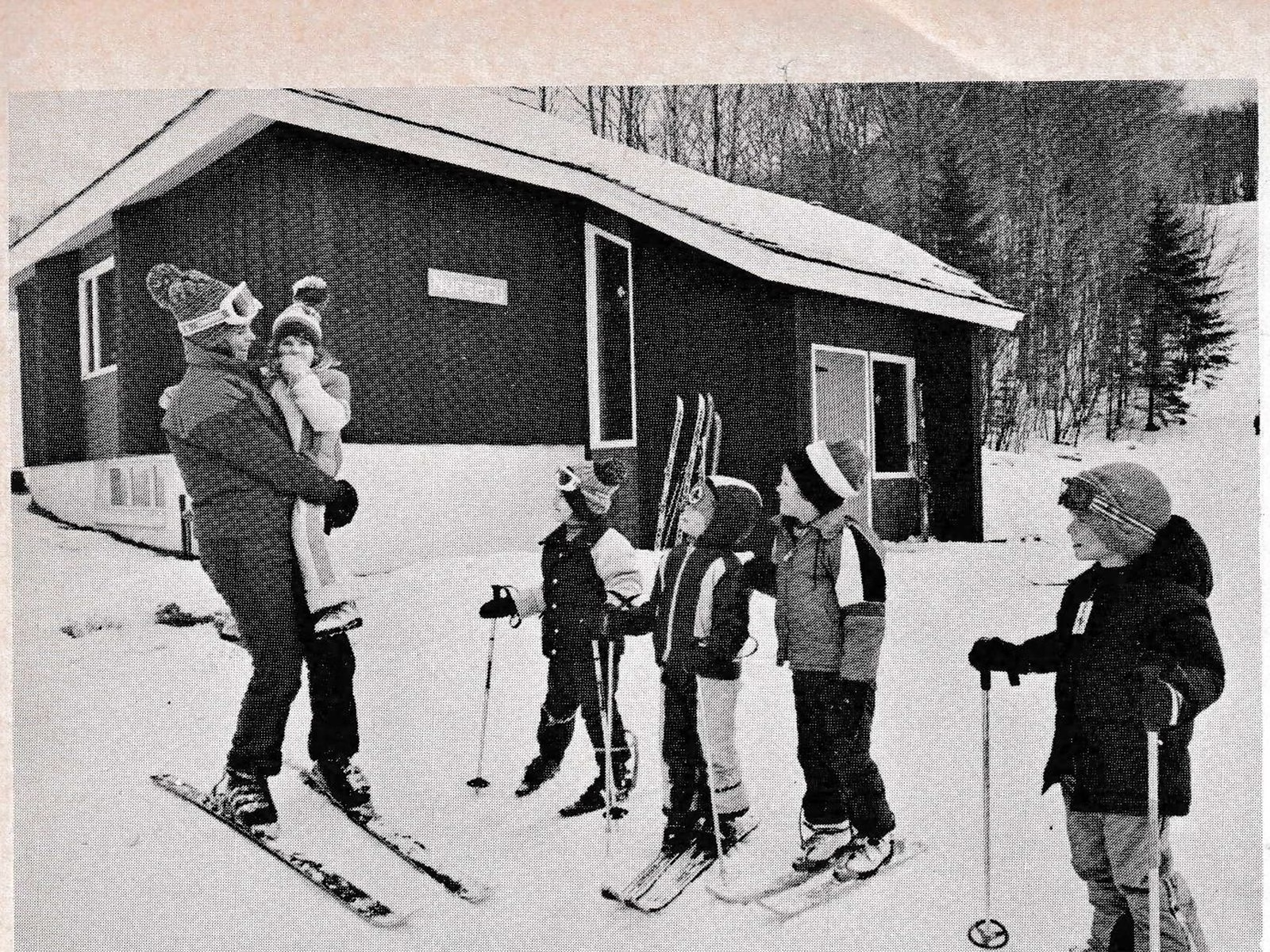
When Pico expanded the one-room nursery in the basement of the base lodge, the move was made more costefficient by building a multi-purpose nursery building. The downstairs of the new building was turned over to the ski school for storage space, while the thick-carpeted upstairs nursery is used by youngsters in the area’s racing program as an early-morning gathering place to stretch and prepare for a day of training. Pico further isolated its nursery children from the hustle and bustle of the nearby base lodge by fencing in a small area outside the nursery building, guaranteeing that the children will begin their ski lessons in complete safety and privacy.
The initial investment in a nursery program can range from a few thousand dollars to upwards of half a million depending on the scope of an area’s proposed facility. Pico spent a modest $60,000 to construct a pleasant, convenient and efficient multipurpose nursery building with a capacity of 30 children. Stratton expanded its nursery facilities into a new, two-story building at a cost of half a million dollars. The Stratton nursery is extremely modern and big enough to handle as many as 150 children a day ranging in age from six weeks to twelve years.
Alpine Meadows, which just finished constructing a 47,000-square-foot addition to its base lodge, made a comparable investment in spacious new nursery facilities. Unlike Stratton, however, with a separate nursery build- ing, the Alpine Meadows Children’s
Snow School is located inside the base lodge on the first floor.
Codes and Regulations
Generally speaking, actual startup costs are not tremendous, particularly if the area has done its homework on regulations. Extremely costly requirements, for instance, can often be circumvented. When Pico expanded its nursery facilities into a new building, the state requirements for day care facilities called for emergency lighting and on-premise firstaid personnel. The area management petitioned the state agencies involved, arguing their facility should be exempted from the emergency lighting provision because the nursery is operated only during daylight hours. Likewise, Pico argued that a first-aid person did not need to be on duty in the nursery because the area’s ski patrol headquarters were only a few yards away.
Pico also saved a potentially costly duplication of effort when a lastminute check of regulations turned up the requirement that a special “$60-a-gallon” fire-retardent paint be used on the walls. Prior to this discovery, Pico had intended painting the walls with normal paint.
Another way that pre-planning pays off is in using existing facilities whenever possible. Costly regulations governing kitchens, for example, can be circumvented by bringing the food in from an already existing kitchen in the base lodge instead of feeding the children from an in-house cafeteria. This kind of decision, in turn, may affect or necessitate a change in the location of the proposed nursery facility.
A check of state regulations also may change the age range of children an area wants to get involved with in its child-care program. In many states infants necessitate many more regulations and may not be worth the extra expense.
The number of regulations involved in the project can often make the difference in cost-effectiveness for an area considering starting or expanding its nursery facilities. According to areas contacted, Vermont, California and Colorado have the strictest regulations governing nurseries, and are very conscientious in enforcing them.
A few of the regulations Pico had to meet when it expanded its nursery facilities included: a specified height for windows; toilets of certain size; one toilet for every 15 children; and installation of a fire-alarm system and emergency lighting system. In addition, all employees connected with the nursery must have a physician’s statement of health and a chest X-ray each year.
Other regulations affecting nurseries concern the adult-child ratio. These too can play a crucial role in determining the scope of a contemplated nursery program.
In many cases, a nursery involves two separate staffs—an indoor group, who take care of the children’s needs in the nursery and an outdoor staff of ski instructors. Some areas simply call on the ski school to provide the children’s ski lessons, others hire special instructors who work only with the nursery children, some employ a combination of the two—hiring nursery instructors and supplementing them on busy days with regular ski school personnel. Still other smaller areas hire a staff to work both indoors and on the slopes with the children.

Compensation usually works the same as with the area’s regular ski school staff: A set hourly rate with a “bonus” or percentage of any private lessons.
In today’s employer’s market, firstrate nursery help is fairly easy to find. Some very large resorts are even beginning to insist on master’s of education degrees for nursery instructors, but usually an abundance of “attitude and desire” make the best teachers.
Although many areas contacted enroll infants and children up to age twelve, the average nursery school age seems to be two to five.
One area that has met with consid- erable success in taking care of in- fants is Stratton. According to the area nursery supervisor, Beth Skei, the nursery enrolled over 1,200 infants (under three) in each of the last two years. Stratton enrolled over 5,500 children age three to six last season, a total of 15,000 children between the age of six weeks and twelve years.
Despite a number of requests from skiers, Pico will not accept children under the age of two into its nursery.
For children over two years of age, the ratio requirements in Vermont is one adult for every six children. For children under 24 months, however, the ratio drops to one to three. Infants also bring with them a set of regulations governing cribs, laundry facil- ties for changing sheets after every nap, dietary restrictions, special refrigeration requirements for baby formulas, strict temperature controls, etc. To get around this, Pico restricts its nursery to “post-diaper and preschool” age children.
The myriad of forms and liability releases each parent must sign in order to enter his child in an area’s nursery program differs from state to state. Such things as disease, allergies, immunizations, emergency phone numbers, etc., may be required on forms.
How an area sets up a rate schedule depends on what it has invested in the facility and what it wants to get out of it. To be competitive and attractive, nurseries for the most part have to be priced below what they’re worth —in the $12 to $18 a day range, including lunch and ski lesson. At some of the bigger areas, where child-care is a profit venture, prices escalate sharply—up to $27 a day at Stratton for kids six to twelve and $3.50 an hour for infants. At Alpine Meadows, daily rates are $30 a day.
Instruction Programs
Along with increasingly modern facilities (the Stratton nursery even contains video games for its older children), most of the advances in nursery child-care have been in the growing sophistication of children’s ski programs. In fact, some kind of ski instruction is almost a prerequisite for any nursery program. Today’s service-oriented parents demand it. Most children’s ski programs do not accept youngsters for on-slope instruction under the age of two and some not until four.
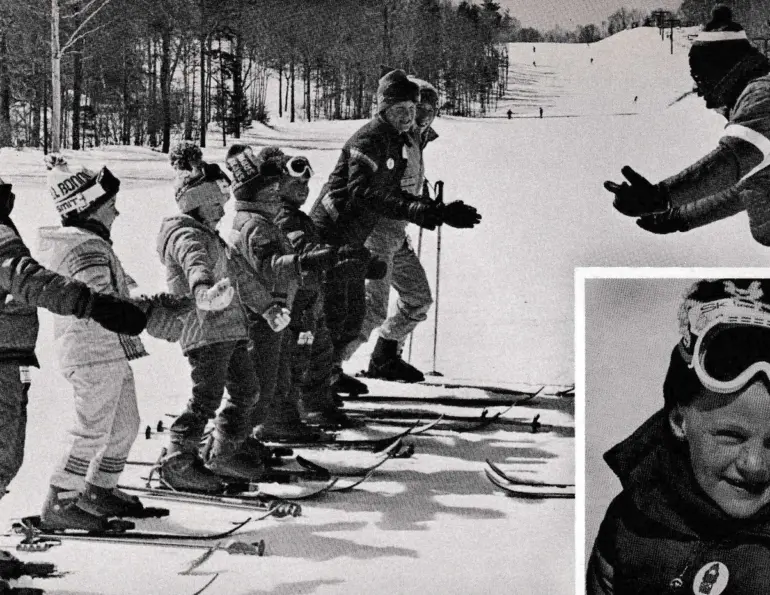
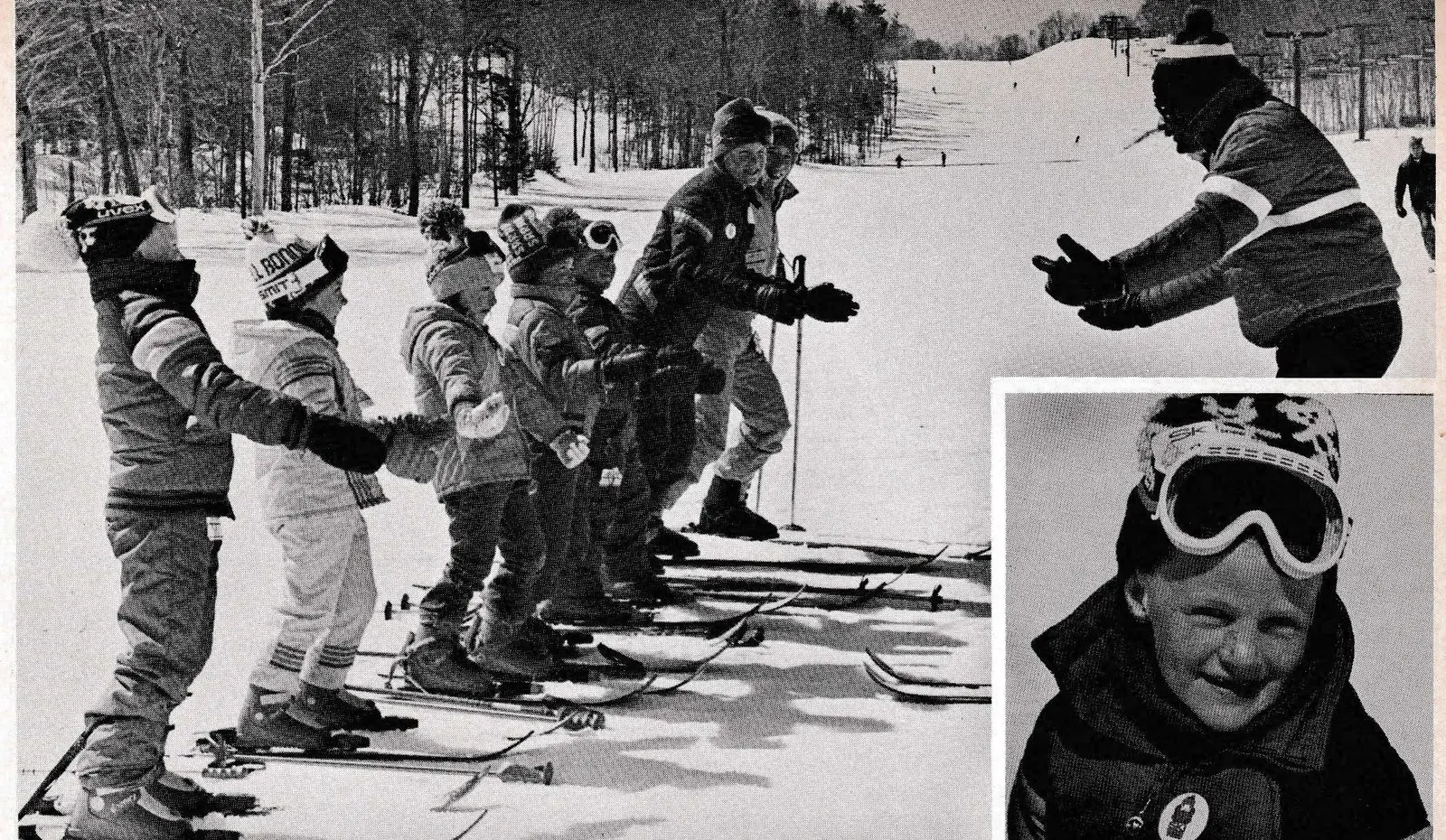
Safety is the most important consideration in a ski lesson says Kim Clark, director of the Skiwee Program at Northstar-at-Tahoe, Calif. She advises these safety points: the children’s beginning-lesson area should be out of the main flow of skiers; the ski school should require the use of safety straps or ski brakes; children should be instructed on the safe way to get onto and off a ski lift; they should be told about the ski area’s basic rules and basic skier courtesies and, in small children’s classes, the children should be paired up to avoid having one wander away or into the path of other skiers.
Proper and safe equipment also is a must. Children should not be enrolled in a nursery ski program in boots or skis that are too big. Parents, usually unreasonably, says Lynn Bertram at Pico, expect their small children to be able to care for, carry and put their own equipment on.
“The first 15 minutes of the lesson, our instructors are usually down on their hands and knees putting the kids’ skis on,” says Bertram. “I don’t demand the children be able to do it themselves or even be able to walk around. A lot of the time the instructors will actually pull the kids up the hill. Climbing is a hard objective to get around. We almost eliminate that in a lot of cases.” some of the children’s ski schools have developed special learning aids. Alpine Meadows has coloring pages which depict what the children learned that day in their ski lesson. Another popular teaching device is the “terrain garden.” These are specially designed hills on which ripples, small drops and small trenches are dug in the snow. The children ski over the through these contours, gaining stability and confidence on skis. But, most areas simply adapt their regular adult ski teaching progression for their nursery programs, incorporating games, team teaching and an extraordinary amount of patience into the routine.
One children’s ski teaching program that has attempted to standardize children’s ski lessons is Ski Magazine’s Skiwee Program, run under much the same concept as the successful Nastar program. An area contracts for the program, and Skiwee provides buttons, banners, pins, charts, etc., and sends two instructors to the area to teach the local ski school staff the Skiwee progression. A child’s progress is recorded on a chart that he or she brings to each Skiwee area, thus plugging into the right level of instruction.
“It’s a lot like McDonald’s for kids and parents,” explains Christi Northrup, coordinator of the Skiwee Program. “In the sense that they know what to expect and what they’re going to get, just like you do every time you see one of those golden arches.”
The Skiwee Program entails only ski instruction and is open to children aged four to twelve. One of the advantages of the program is that it fills a gap that sometimes exists at areas between their pre-school nursery and regular adult ski lessons. Currently, 13 areas around the country are enrolled in the Skiwee Program and most offer it through their regular nursery facilities.
Programs other than skiing are almost impossible for most ski areas to maintain, although some do take a stab at it. “Basically what we have is a non-recurring clientele,” explains Verlene Belden. “Therefore, we can’t really get into any structured programs other than skiing.”
There are some ski areas such as Heavenly Valley, Calif., which are content to let the surrounding community fill the demand for child-care facilities. Heavenly Valley has its own ski programs for nursery-age children, but no on-site child-care facility. The gap is filled by private nursery programs near the area.
Although there is still a hard-core of ski areas which adhere to a traditionalist approach of not taking on anything more than the basic functions of running a ski area, this philosophy is rapidly losing support. The long-standing argument—”we’re in the ski business not the child-care business”—is being heard less frequently in today’s service-oriented skier market.
“There is a profit to be made (in nurseries),” maintains John Pomiroo of Ski Lake Tahoe. “Areas are starting to realize this especially since we’ve got a baby boom going on.”

