


In order to gain an understanding of Zero Base Budgeting, it is necessary to first review the procedure that has been accepted in the past. Assume a ski area accepts 6 percent of the projected gross revenues for the coming season as a palatable figure for it’s coming marketing expense. In most cases the 6 percent of next year’s projection represents a slight increase in marketing dollars to be allocated. Here is where the problem arises.
With few exceptions, marketing personnel take last year’s budget as a starting point and strike out to responsibly allocate new funds to new programs, additional personnel, etc. Whatever cost justification is made in the new marketing document, is centered on the new items. In other words, previous spending is usually accepted as necessary without examination. This type of budgeting immediately creates two dangerous conditions for the marketing department. One, it runs the risk of unnecessarily spending valuable net revenues, and two, it puts itself in a very uncomfortable position when time comes to substantiate needed expenditures at the board of directors review.
Dollar Reviews
With today’s stabilizing skier market and rising costs of operation, it is vital that every dollar spent be closely scrutinized. No one is going to chastise the marketing manager, who, because of hard work and imagination, informs his superior that after close accounting of options available next season’s recommended marketing budget is not increasing as much as previously anticipated.
We all know that when the budget- ing procedure for a ski area is under way and the numbers coming back from accounting don’t seem to project the most wonderful season (net revenues) ever, the wary eye that wields the cost-cutting ax is first cast upon the marketing department. At this point one of two things happen. The marketing manager knuckles under and takes the cuts with a smile (not at all like marketing people), or he or she resists the reduction. However, because only the new expenditures have been substantiated in depth and previous expenditures are accepted as sacred, the board passed down word that they feel the new programs can wait another year before being included and so the budget is simply reduced.
Having sat in the seat of the one who had to accept a reduction, I know this can make for a difficult afternoon. However, having also been on the other side of the fence, I know sometimes it is a necessary evil if the company is going to ride out rough times. Zero Base Budgeting can help overcome both difficult realities.
Now that we have an understanding of past budgeting procedures and the related risks, the following material will center on Zero Base Budgeting and how to apply it to your marketing budget, but it will be necessary to assume that marketing research has been an ongoing practice. Without it, no intelligent decision on marketing expenditures can be made.
Zero Base Budgeting is exactly what the name implies. Instead of using last season’s dollar expenditure as a base, you start at Zero. It is a method of forcing yourself to defend every expenditure before any funds are allocated. It is a budgeting technique for optimizing value received for dollars spent. Nothing is sacred for the upcoming period being planned.
For the purpose of the following exercise, I will use what would be a marketing budget for a medium-size ski area: $125,000. Dollars allocated to each line items should not be used as a percentage relating to the overall budget. I simply allocated them for ease in this exercise. All names of publications, newspapers, etc., have been changed to protect the innocent. Lastly, the number of line items covered are fewer than you would probably use, however, they are sufficient for the purpose intended.
Creating a Budget
It is close to the end of March, the skiing is pleasant, civilized temperatures have finally arrived and an aura of festivity fills the outside air. Because the year-end is fast approaching, it is necessary for you to complete a marketing budget sooner than you would like. You can gather your personnel together (not an easy feat at this time of year) and buckle down to business, or you can ski for a couple of hours and end up burning the midnight oil. You do both.
The season has been average, but you fell slightly short of your projected gross sales. The previous week found you in daily eight-hour meetings projecting next year’s gross revenues and developing a theoretical starting point for budgeting purposes. The figure you are given to work with is 10 percent additional over the present year. You’ve spent $125,000 this season, therefore you are looking at a maximum expenditure of $137,500 for the coming year. However, you sit with a sheet of blank line items in front of you knowing no past ex- penditure is sacred. Along side is the $125,000 expenditure accounting, plus all marketing research compiled since November 26.
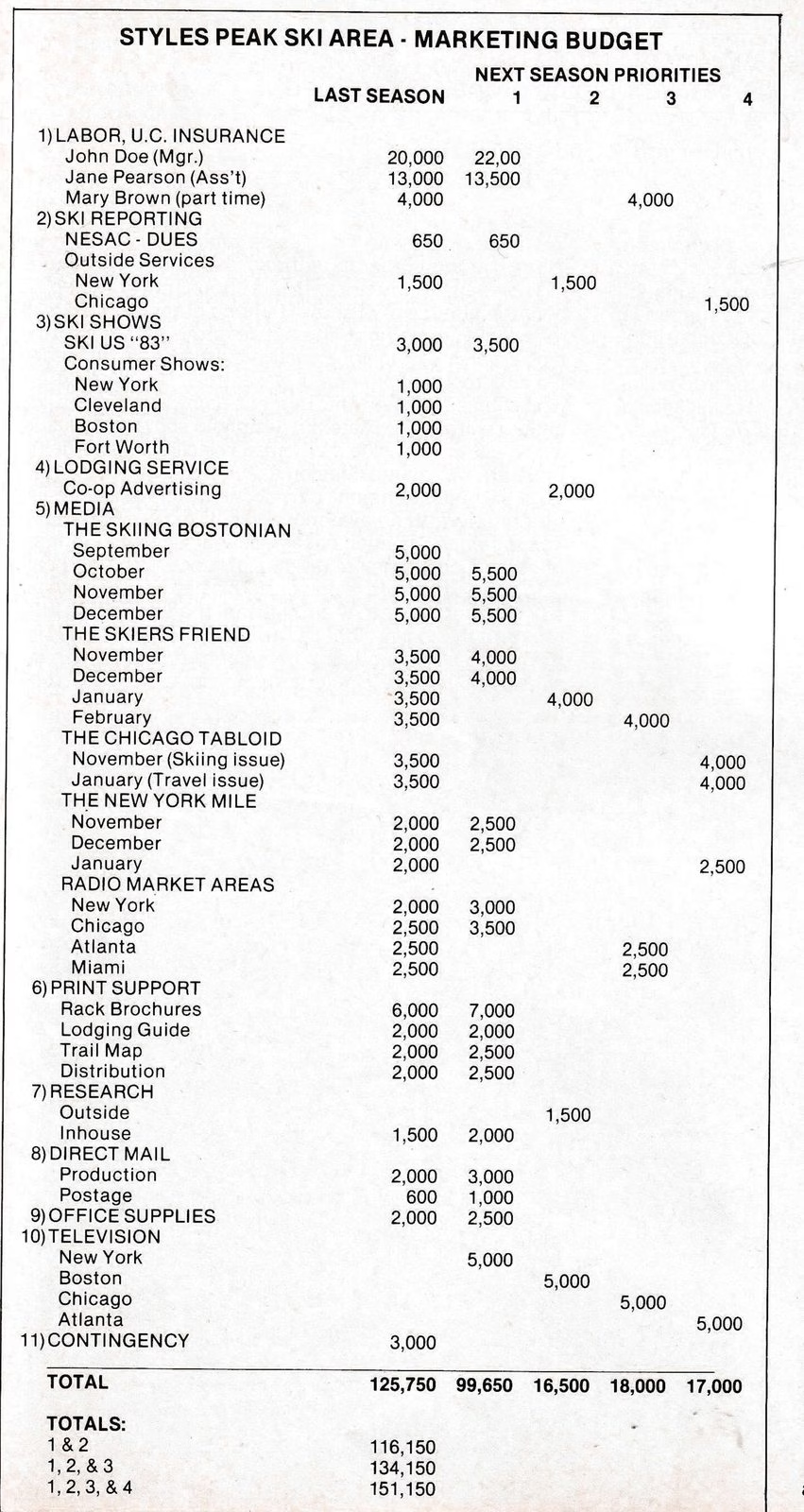
As days turn into weeks you learn some interesting facts about the budget’s past performance. Your expertise says that advertising is an intangible commodity, an investment; however, you have been living with the Chicago Tabloid for three seasons and, although it produces a fair amount of ski week inquiries, the conversion rate is extremely poor.
Although The Skiing Bostonian is a proven vehicle for your area, the last September issue really fell flat—your presence was lost in the montage of hardgoods and soft-goods advertisers. You remember how disgusted you were at the results of that pre-season co-op with two neighboring areas in a marketplace that was termed “exploratory” and then not having enough contingency funds to react to that late snowstorm.

The process goes on and the base for a new budget starts to emerge. As previous expenditures are placed in the new document they are assigned a number from one to four as to their importance to the new plan. In addition, each item is completely explained as to why it is included and how it relates to the success of the new budget, along with financial projections.
The numbering system becomes important when finalizing the budget. If you find that the document exceeds acceptable guidelines, or later you face additional budget reductions, the logical items to be eliminated would be those of the least priority. The documentation of each expenditure and how it contributes financially to company goals positions the marketing department a lot stronger when the final review comes. A board of directors or reviewing committee are not going to take lightly the cutting of marketing expenditures if every expense has been worked from a zero base and each expenditure has documentation on how it relates financially to the company’s overall success.
To achieve an exceptional and accountable marketing budget through applying Zero Base Budgeting concept, remember:
1) Start with no previous expenditure being sacred.
2) Set up a procedure that allows you to feasibly analyze every expense.
3) Assign a number to each expenditure as it emerges into the budget.
4) Substantiate all expenditures in detail and how they relate to the financial goals of the company and how they relate in importance to the plan. I know that marketing people usually write lengthy documents in defense of larger budgets, but that is not what is meant here. Explain what each expenditure does financially, by providing a clear understanding of the costs and the purposes for applying them.
If you already apply Zero Base Budgeting, great. If you don’t, start now and eventually every department in your company will follow your lead.