Over the past two years, Vail Associates has become increasingly aware of the necessity for greater energy efficiency in the operation of lifts, buildings and equipment. In 1984, Vail’s management hired the Energy Institute (EI) to study the company’s energy uses and needs. EI did a total energy audit and installed conventional as well as high-tech systems to cut losses and save money.
To develop a Comprehensive Energy Management Plan, EI undertook a complete energy audit of all the facilities at Vail and Beaver Creek. Over a period of six months, 33 buildings, lifts, snowmaking, sewer and water systems and transportation equipment were audited.
A team of six energy specialists representing the mechanical, electrical, thermal and computer engineering sciences toured the facilities noting the condition of each piece of equipment. Boilers, air handling units, domestic hot water systems and electrical devices were inspected and analyzed as to efficiency and opportunities for energy savings were identified.
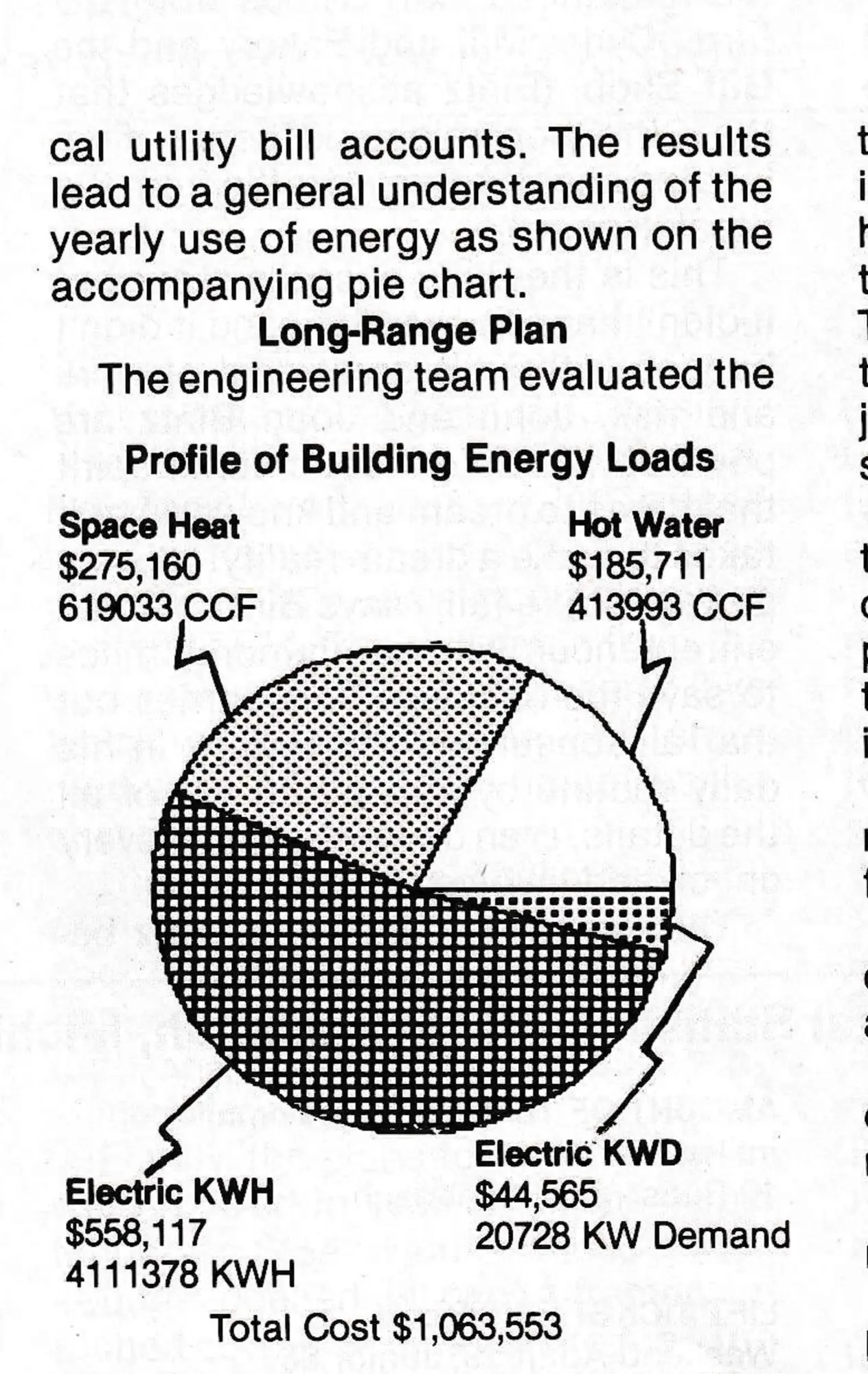
As a part of the energy audit, EI’s team of engineers also conducted an extensive economic analysis of 33 natural gas and more than 10 electrical utility bill accounts. The results lead to a general understanding of the yearly use of energy as shown on the accompanying pie chart.
Long-Range Plan
The engineering team evaluated the findings of the audit and identified specific opportunities for energy saving measures. An extensive list of opportunities were outlined including eight major energy management strategies and 55 individual measures. The team also conducted feasibility studies on the potential for small-scale hydro electricity, wind generated electricity and cogeneration systems. Those strategies and measures were then evaluated in terms of the projected yearly savings and potential installation costs.
As a result of that evaluation, the team selected the most cost effective opportunities. A plan of action was prepared with priorities for implementation. The strategies recommended in the plan included the following:
1) Computerized energy management control and monitoring systems for eight major buildings; 2) A 445 KW natural gas-fired cogeneration system for Village Hall at Beaver Creek; 3) Waste heat recovery systems and other boiler modifications for eight major buildings; 4) High efficiency boiler and furnace replacements for two buildings; 5) Lighting controls in four buildings; 6) Air infiltration controls for all 33 buildings; 7) Thermal energy conservation measures in all buildings; 8) Water conservation measures in six buildings.
Strategies
Computerized Energy Management — Perhaps the most significant measure recommended in the plan was the use of micro-computers to manage and monitor energy use. Using advanced micro-computer technologies, Vail would be able to electronically control and monitor the operation of its major buildings from a desk top terminal. Those “smart” buildings would automatically make adjustments in the operation of boilers and other equipment to save energy in a manner not possible by manual operation. The computers would also be used to monitor specific pieces of equipment for purposes of preventive maintenance and to identify malfunctions. In addition, they could be fitted with alarms to automatically signal equipment failures.
Cogeneration — Opportunities to use cogeneration technologies to simultaneously produce both power and heat were identified for the Lionshead gondola building and the Village Hall at Beaver Creek. Village Hall represented the most immediate potential because it has a large thermal load, a key ingredient in developing a cogeneration unit, due to the fact that the building serves as the central kitchen for both ski areas.
Waste Heat Recovery — Capturing heat that’s usually wasted up the flue stacks of large boilers was recommended in several buildings. This involves installing carefully sized heat exchangers in the exhaust (flue) stacks of boilers in which return water is pumped through the stack to recover otherwise wasted energy. In some cases waste heat from snowmaking compressors can be utilized for this purpose.
Air Infiltration Control and Thermal Conservation Measures — The single most important cause of heat loss — a significant cost of space heating — is air infiltration. Using a calibrated blower door with a large fan to pressurize the building being tested, EI’s engineers scientifically found where they suffered from air infiltration. As a result, the exact locations to caulk and foam cracks and holes, and the precise places to weatherstrip doors and windows were identified. Buildings in need of more insulation were also identified to improve thermal integrity and to reduce heat loss.
Cost/Savings
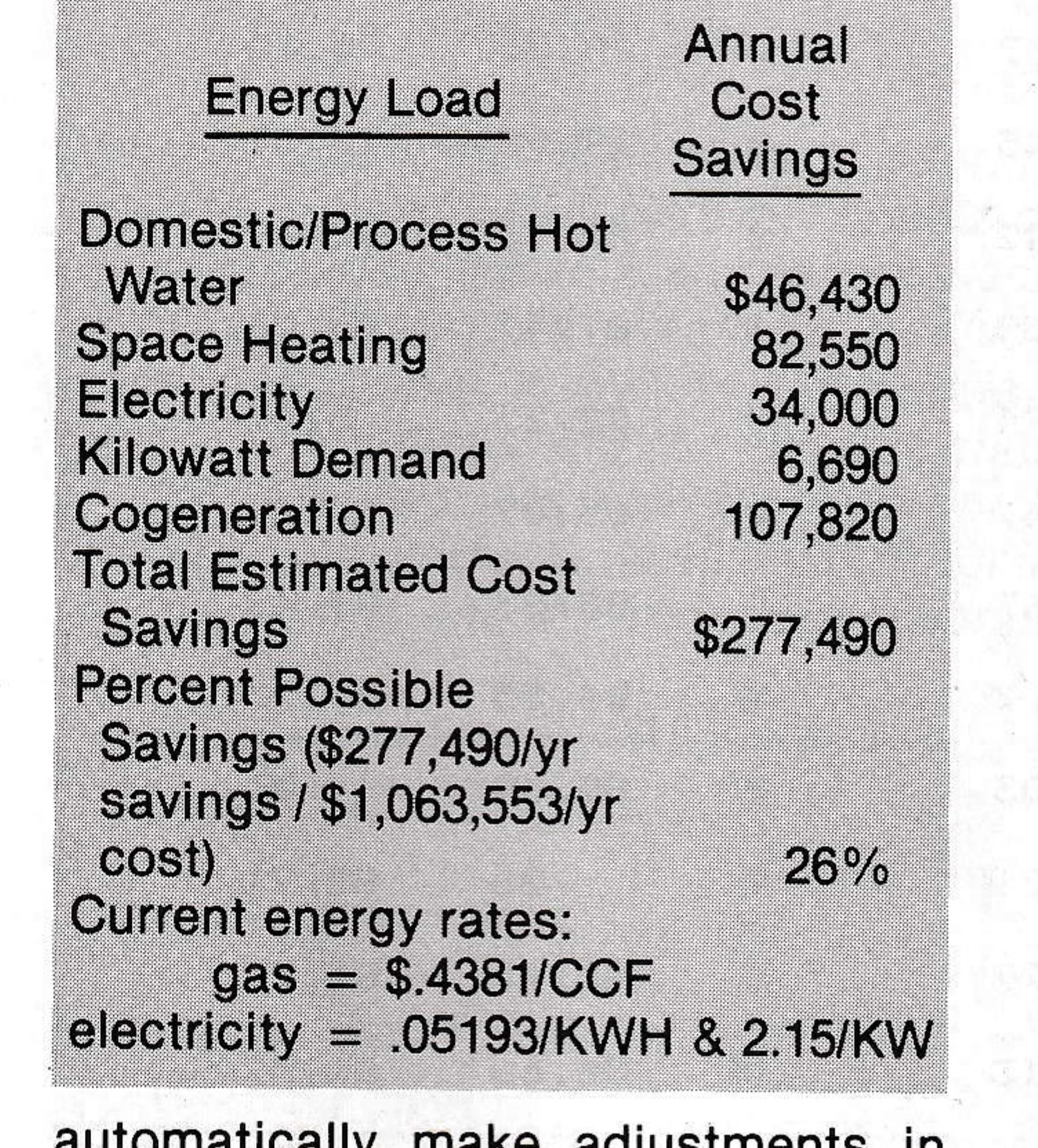
The long-range Comprehensive Management Plan calls for Vail to spend from $458,000 to $1,002,500 in building-related capital improvements. Included in the highest estimate is the cost of a cogeneration system pegged at $544,500.
Based on the specific measures recommended in the plan, a range of energy savings was estimated from $169,700 to $277,500 a year for space heating, domestic/process hot water, electricity consumption and demand, depending on the measures ultimately implemented.
The plan for Vail and Beaver Creek calls for energy saving capital improvements to be installed in three phases. In August, 1985, EI completed financing and installation of Total Energy Management Systems for Vail’s Lionshead and Eagles Nest buildings. The systems installed include computerized energy management control and monitoring systems, waste heat recovery and other boiler modifications and air infiltration control measures.
Those systems are projected and guaranteed to save Vail $55,190 a year out of an annual utility cost of nearly $250,000. The cost to install the systems was $134,000, making the payback a little over two years.

Central to the project was the installation of two Andover Controls energy management computers. As a part of the computer system, dedicated phone lines and modems were installed to permit two-way communication. From a remote terminal located in Vail’s maintenance office or from EI’s office located near Denver, an operator can communicate directly with the Andover computers, or the computers can be programmed to call the operator at specified times with information vital to the proper operation of the buildings. The computers are also programmed to call the proper authorities in the case of emergency equipment failures, such as loss of heat in the motor drive room for the gondola.
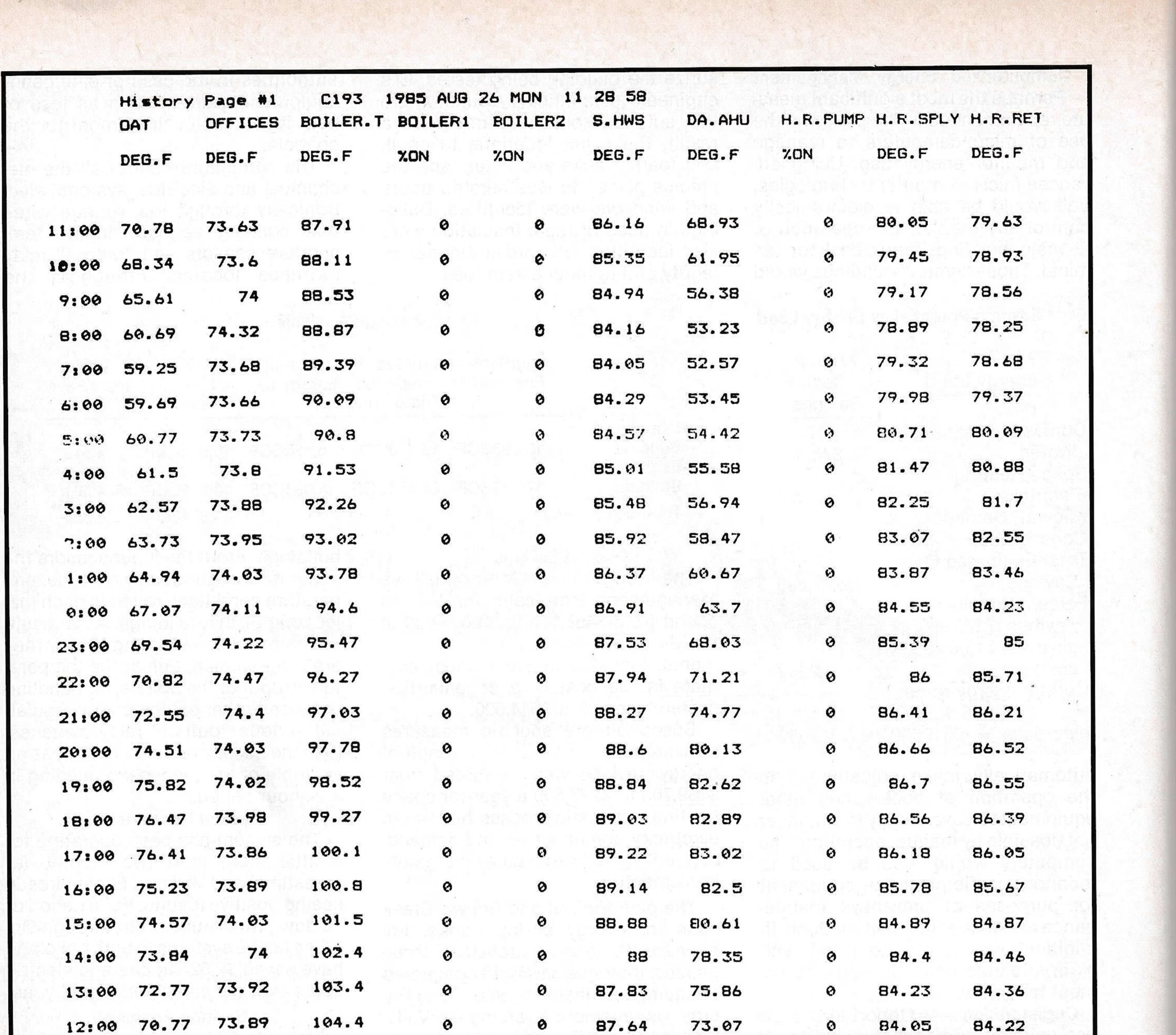
The computers control all the mechanical and electrical systems electronically through low voltage wires that connect various “input” temperature sensors and “output” relay switches located throughout the buildings. From the input sensors the computers continuously read the temperature conditions found in each major zone of the buildings. As a result, the computers, according to how they are programmed, adjust the temperature output of the boilers, air handling units and other equipment by regulating various “output” relay switches. (See the accompanying print out as an example of the Lionshead building in a 24-hour period.)
System Performance
The system has been operating for a little more than two months (at presstime) and Vail and EI are already seeing positive results. For a period of 65 days, from August 6th through October 13, the systems in both buildings have saved $9,524 in gas and electric costs over the same period last year.
Savings Analysis
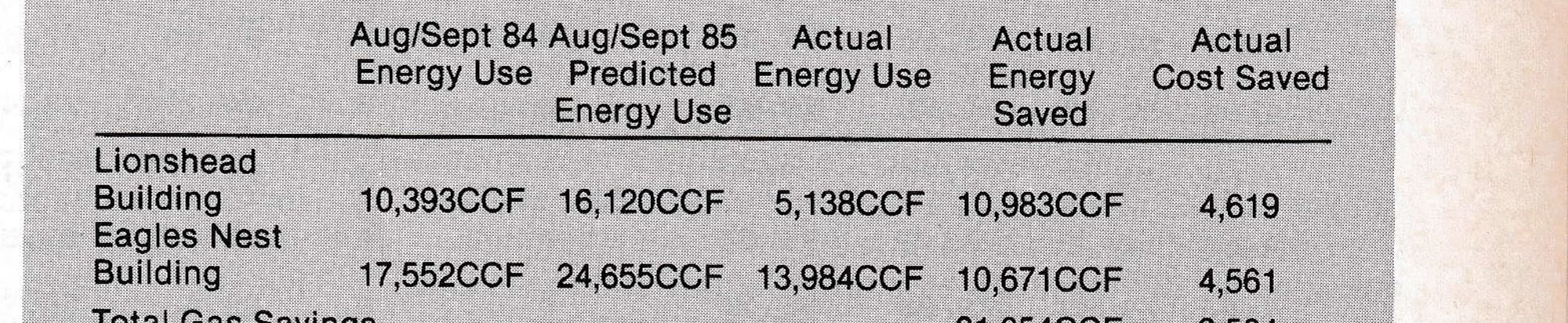
Note that in the Savings Analysis table above, the savings include an additional $344 in electricity savings for reducing use by 6632 kilowatt hours (KWH). However, much larger savings will be realized during the cold winter months ahead.
The column labelled “Predicted Energy Use” denotes what the use would have been had the energy management systems not been installed. This figure is the result of adjusting the 1984 base line data for changes in temperatures, using a regression analysis to calculate the difference in heating degree days for the same August/October period between 1984 and 1985. The resulting figure is then subtracted by the 1985 energy use to get the actual energy saved.
Operations and Maintenance
According to Mike Hubbs, superintendent of maintenance and a computer controls expert, “The system has only taken about eight hours of our time since installation, and that was from minor problems in starting up the system and from time in on-site training provided by EI on how to operate it.” As for maintenance, the system requires very little because much of it is either computers or caulking. And, any costs associated with maintaining or repairing the system for the term of the energy service agreement are the responsibility of EI.
More important, however, is what the system will mean in the way of additional cost savings in manpower and from increased design life of equipment. Hubbs pointed out that with the computerized energy management system, he is able to electronically monitor and trouble shoot the mechanical and electrical systems in the two buildings from his desk with a computer terminal without having to send maintenance technicians on unnecessary trips. “For the first time ever I’m able to have fingertip control of those buildings without wasting time or manpower in operating and maintaining them,” he said.
Financing and Guarantees
The system for the gondola buildings was planned, designed and installed at no cost to Vail Associates under a long-term Energy Service Agreement with the Energy Institute. Under that arrangement — believed to be the first in a major ski resort in the nation — E.I. provided the capital improvements at no initial cost to Vail Associates. In exchange, Vail agreed to give EI a share of the realized money savings over the coming years.
According to Joe Macy, technical planning director for Vail, “The goal for the long-term energy management program for Vail and Beaver Creek is to save some $250,000 per year by carefully managing the company’s 33 buildings. This is a worthwhile effort for Vail Associates in terms of the company’s economic priorities and fits in with our national objectives to conserve energy. There is a big potential for efficiency and cost savings in ski areas and Vail Associates is committed to maximizing energy efficiency.”
EI conducted extensive engineering analyses of the potential energy saving strategies for the two buildings, the most cost effective of which were then submitted to an insurance company which issued a policy guaranteeing the savings. Vail is then guaranteed a portion of the savings of $55,190 annually plus the first-phase.
Macy said that the insurance guarantee was one of the main factors that convinced Vail to undertake the project. “The innovative financing and insurance makes it possible,” he said.