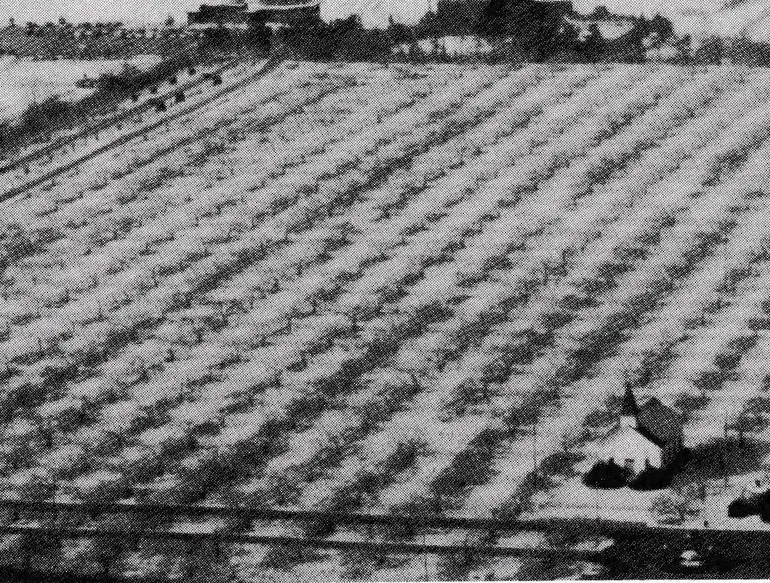
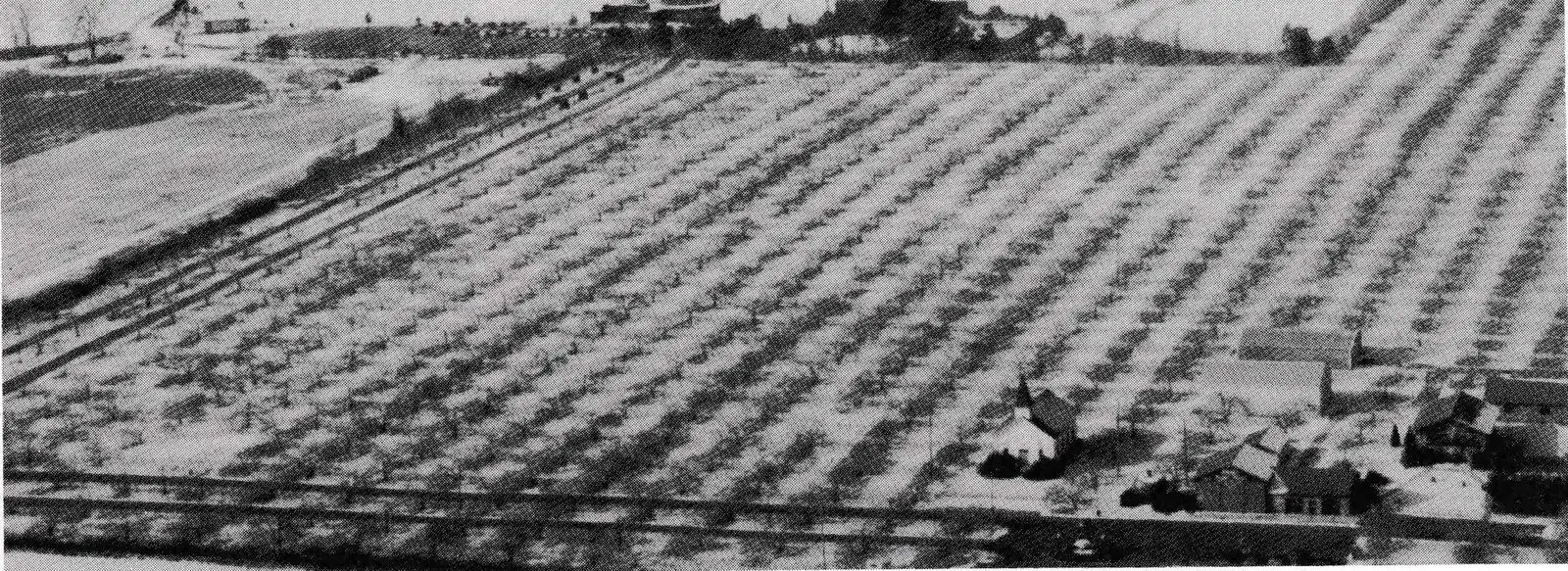
What started out in 1949 as a flat family farm near Freeland, Michigan, planted with two-foot-high apple trees has sprouted into 10 related businesses synergistically feeding each other with customers and revenues. One of the businesses is a ski area.
The first branching off from the original apple sales on the Bintz farm began with the Apple Tree Gift Shop, which was grafted onto the Bintz garage in 1953. A few years later, the season for apple sales was expanded into a year-round operation with the addition of refrigerated storage, followed by the Cyder Mill and Bakery specializing in spiced donuts, cider bread, garlic strips and apple pie. Bintz recalls, “What used to scare me were those cold nights in the spring. I was afraid the whole farm would go. That’s what prompted me to diversify.”
In 1960, Bintz had drawn up tentative plans for a restaurant, but instead he purchased a used tractor and earthmover to make a mountain out of a wheat field. The dirt came from the excavations for an eight-acre lake which would supply the SMI snow machines as well as irrigate the orchard in summer.
The first year the ski hill reached 60 feet and for several years it grew about 30 feet a year to the present vertical rise of 201 feet with 1,000 feet of runs and 10 ski trails accessed by electric tows.
Finally, the plans for the restaurant were utilized in 1968 when the Apple Mountain Steak House and Cocktail Lounge opened in two A-frames attached to the original ski lodge. The limited-menu features steak, lobster and crab legs accompanied by an extensive salad bar. Naturally, desserts bow to the “king of fruits” — the apple. On a peak evening like New Year’s Eve, it is not unusual for the restaurant to serve 1,000 diners. The Cocktail Lounge overlooking the ski hills continues the apple motif in decor, menus and napkins.
The next planting produced the Apple Mountain Ski Shop, offering downhill as well as cross-country equipment for guests who use the Nordic trails in the apple orchard. The good, green harvest from the Ski Shop produced three additional sport shops over the years in prime locations in nearby Midland and at shopping centers. When suppliers tightened credit and restricted ordering, the shops adapted by reducing the number of lines. In summer, the shops sell and rent sailboards and offer lessons on the Bintz Lake.
When the skiers grew out of the first ski building, fondly dubbed the “Apple Core Room,” the Bintzes built a separate, octagon-shaped Ski Lodge with a unique carillon tower. It includes a carpeted cafeteria with large windows providing a view of the ski hills. In the lower level, the lounge pub has rustic and charm and shares space with the ski school and rental shop. This multipurpose structure is also used for banquets, wedding receptions and dances for up to 350 people when the ski poles are put away.
One of the newer shoots at the Bintz farm is a renovated country church, circa 1869, which was transplanted from a nearby township. The picturesque Apple Chapel is the setting for approximately 50 weddings a year.
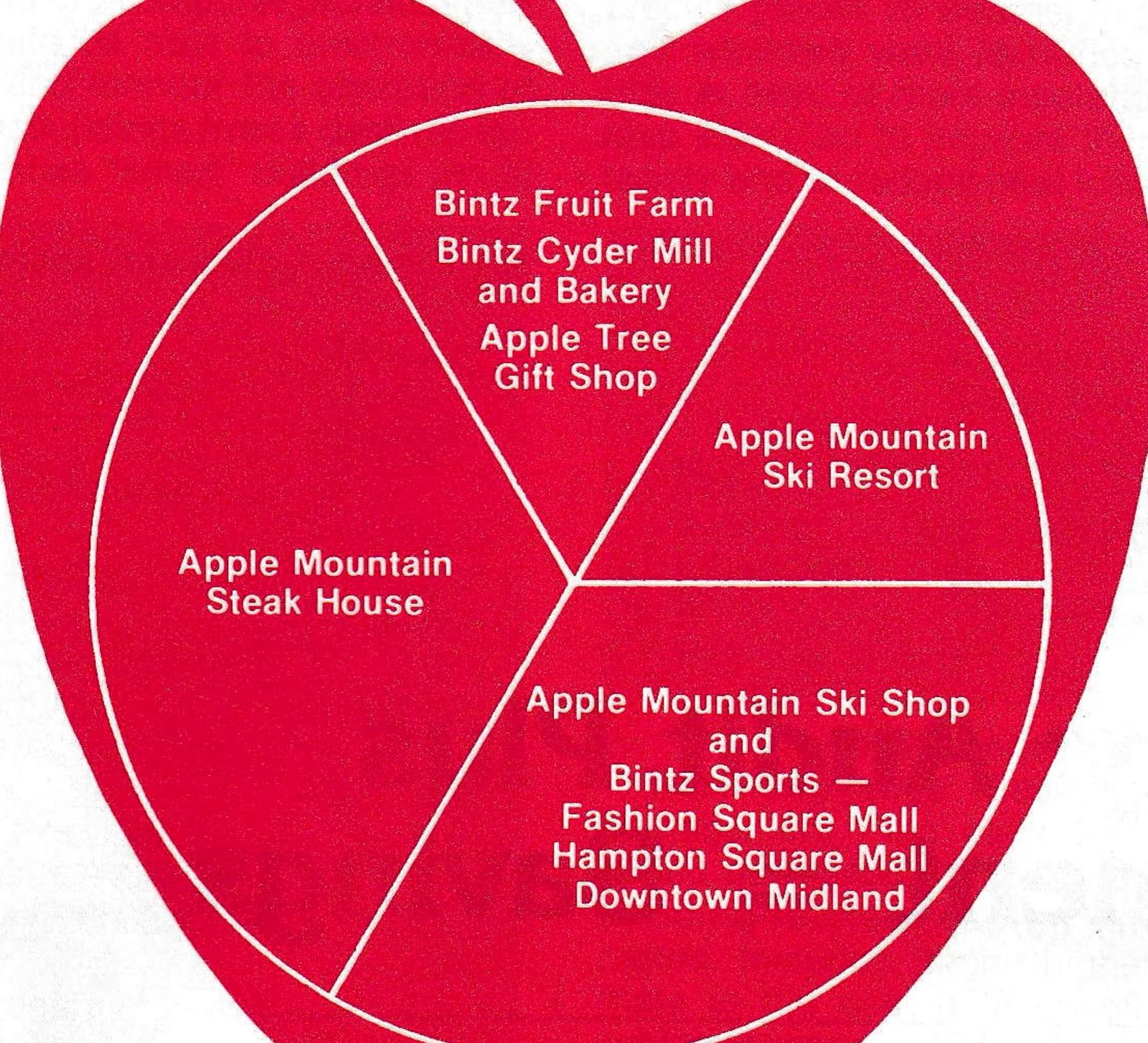
In theory, each of the businesses feeds the others, but a fiscal analysis places the contribution to income in a better perspective (see the financial “apple pie”). Approximately one-third of the overall revenues are derived from the food operations. This consists of the Steak House, Cocktail Lounge, parties and banquets. An equal piece is generated by the Ski and Sport Shops. The Ski Resort is responsible for a one-sixth slice and the remaining sixth comes from the farm, Cyder Mill and Bakery and the Gift Shop. (Bintz acknowledges that the Gift Shop might do better if relocated near the heavy traffic from the Steak House.)
This is the Bintz success story, but it didn’t happen overnight and it didn’t happen without a great deal of work and risk. John and Joan Bintz are powered by the entrepreneurial spirit that dares to dream and knows what it takes to make a dream reality. “It’s important not to fail,” says Bintz. “A true entrepreneur will run a hundred miles to save the business.” He carries out that all-consuming philosophy in his daily routine by staying on top of all the details, even down to signing every check and invoice.
The typical day for John Bintz begins at 8:00 a.m. with a half hour of swimming in his indoor pool followed by a ritual of reading three newspapers. Not far from the front door, he checks the temperature of the apple storage on the way to his office in the lower level of the Steak House. Invariably, Bintz finds two phone calls and one problem waiting along with the morning mail, but he makes time to plow through numerous trade magazines on restaurants and ski resorts before lunch, which usually involves civic or business meetings such as Kiwanis, the hospital board, the Saginaw Club and the Family Federal Savings and Loan Association.
Afternoons are set aside for visiting the three off-site sport shops, delivering merchandise and consulting with the managers. At 6:00 p.m., there’s a respite for supper at home before heading back to work, where Bintz checks all the buildings and tackles more office work. Some nights Bintz serves as acting manager at the restaurant, supporting his belief that no task is too “tedious, uncomfortable and thankless” for the owners and managers to do. When his day ends at midnight, Bintz may steal a moment’s rest in the lounge to sip a brew.

Every Tuesday, Bintz meets with all his managers. Together, they supervise over 200 part and full-time employees during the ski season or as few as 85 in the slower months. Usually promotions are made from within, creating loyalty and longevity in service. The farm manager’s tenure was 21 years, and even the volatile restaurant business has had the same manager for eight years.
Nevertheless, Bintz demands tangible results from managers in order to stay competitive. In Michigan’s tough economic climate during the last three years, Bintz has had to make changes in his management team to find the winning combination. He explained, “If you’re going to survive, you must surround yourself with competent people.”
Fortunately for the Bintz’s business, competence begins at home. Joan Bintz has been an integral part of the team from the start, even teaching school for three years to help finance expansion.
After graduating from The University of Michigan as a speech major and working in radio and television, Joan Bintz used her flair for public relations on the Bintz farm. The 4,000 school children who tour each fall not only learn the details of farming, but also remember the path back to Apple Mountain.
Another early promotional effort was the popular learn-to-ski programs sponsored by the Saginaw News and Bay City Times, which attracted many new skiers to Apple Mountain with a reasonably priced package of lesson, rental and lift ticket. A recent innovation brought two colleges, Delta and Saginaw Valley, to the mountain as part of the curriculum in physical education. Bintz has been able to use these school rivalries in regular racing competitions with feature pick ups on television and in the newspapers.
Daughter Heidi Bintz, 25, is another competent team member. When the peak evening hours bring in 500 to 1,000 skiers, she does a quick change from her occupation as a commodities broker to head of the ski school. Heidi follows the Bintz pattern of achievement. Not only is she the former Michigan Apple Queen, but is also a certified ski instructor directing 20 other certified instructors and has promoted a very popular team racing program for adults on Thursday nights. With these programs and promotions, the resort attracts approximately 40,000 skiers each season, even though the climate averages five to seven days of rain per month.
The Bintz’s are proud of their accomplishments over the last 25 years. “We did it all ourselves,” says Joan Bintz. “No one gave us a business; it was all financed. We designed the buildings, poured the concrete and pounded the nails. Our expansion literally proceeded room by room. Now, we are one of the very few ski resorts in Michigan still owned and operated by the original proprietors.”
John Bintz adds a note of stark reality: “At age 53, I haven’t graduated yet; we’re still struggling. There are always drawbacks to this. You always wish you would have a little more free time. I’m a prisoner of this business, seven days, seven nights.” However, he believes that his family’s struggle is a prime example of the free enterprise system at its best.
In fact, the Bintz story is studied in college textbooks and frequently they are invited to lecture about the trail to the top of the mountain. John Bintz sums it up, “You have to sacrifice a great deal of your life to get somewhere.”
Vital Statistics: Apple Mountain, Michigan
- Vertical rise: 200 ft.
- Top elevation: 800 ft.
- Number of lifts of each type: 10 Rope
- Snowmaking capacity: 6 SMIs
- Grooming fleet: […] 350 Tractor with Powder Maker […] (partly illegible in the scan)
- Amount of terrain: 10 Runs – 1,000 feet each
- Lift ticket prices: Weekend Adult $9, Junior $6; Night Adult $9, Junior $6
- Season pass price (standard individual): Before December 1, $99.99; After December 1, $185.00
- Number of employees: Full-time 6, Part-time 17
- Miles of track-set cross-country trails: 4 miles (300 acres)
- Facility management: Area Owned: Ski School, Ski Shop, Rental Shop, Restaurant, Bar