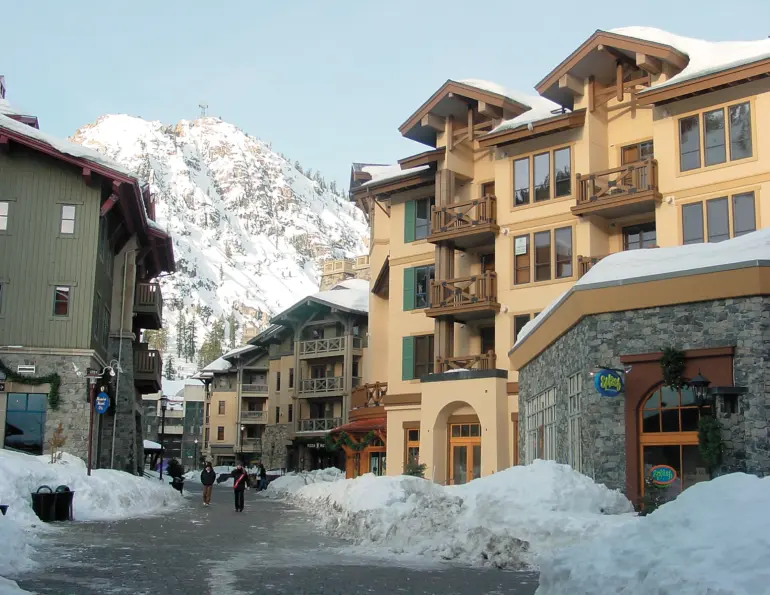
With much fanfare, the new Village at Squaw Valley opened for business last winter in what should have been a slam-dunk season. Shops and restaurants lined the meandering walkways and most of the nearly 300 condominiums had enthusiastic new owners. Rising up from a vast parking lot , this long-awaited base area, two years in the making, was finally ready to greet the throngs of skiers and shoppers that developer Intrawest had envisioned.
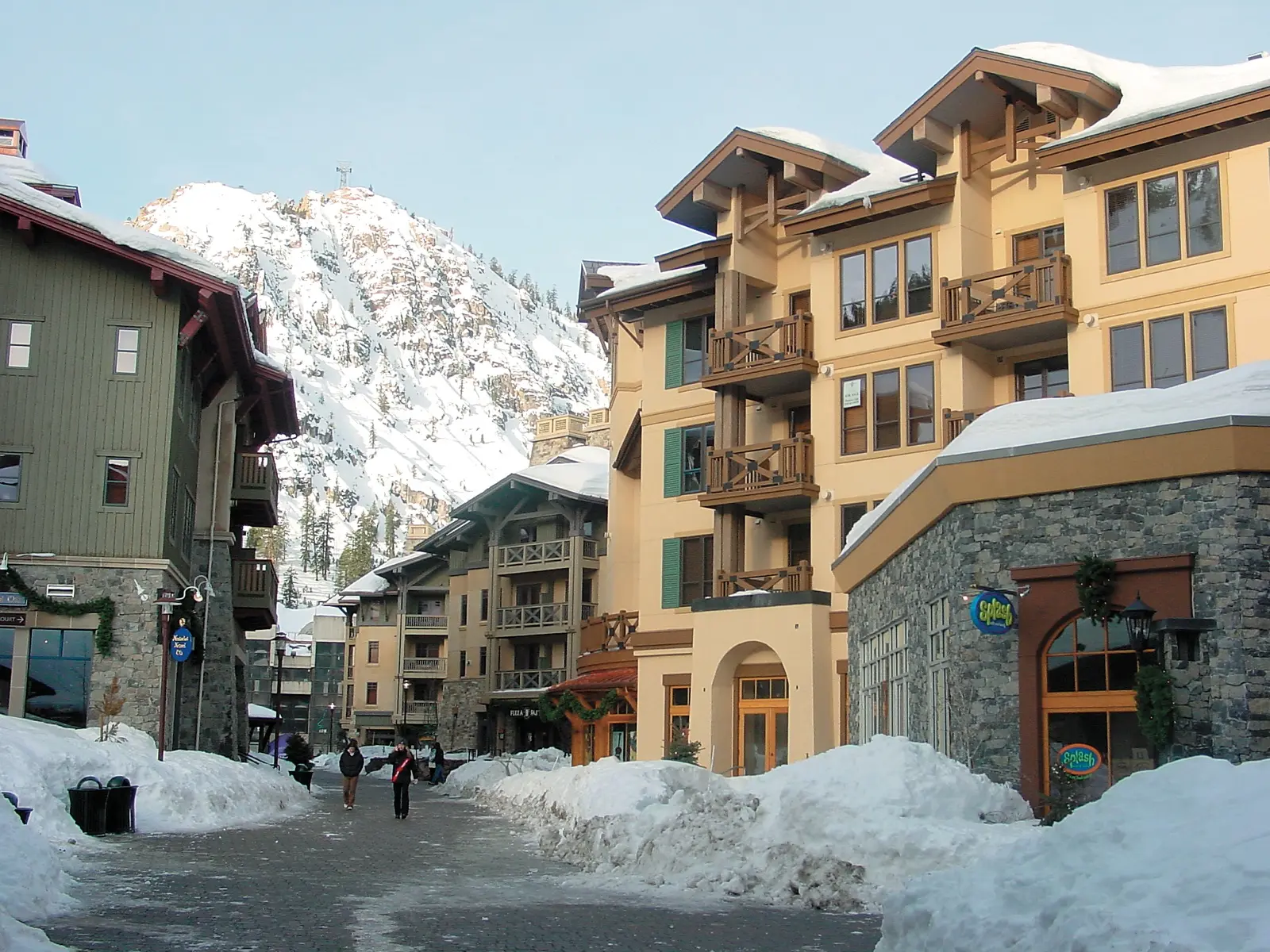
The Village layout is straight from the pages of the company design book, with the wood facades and pastel colors that are typical of similar Intrawest projects at Copper, Whistler and Mammoth. But Squaw had always been a great mountain in search of a village to match, and the Village represents a quantum leap in the area’s dynamics. Replacing the asphalt were a bakery, a smoothie bar, a Starbucks, a Rocky Mountain Chocolate Factory, four themed restaurants, a California wine shop, an art gallery and a dozen boutiques selling aromatic bath salts, decorative candles, Lake Tahoe handicrafts, women’s fashions, sporting goods and upscale pet products. Most of the retail tenants are locals, who were carefully chosen to give the Village character and a sense of place.
So how has the Village panned out?
Image and Reality
On the weekends, the Village is bustling. The condo owners are in residence, après-ski shoppers freely use their credit cards, and lines form at the restaurants. Bands play in the plaza, and there’s plenty of impromptu mingling at a large fire pit with a semi-circle of chairs. It’s a vibrant, energetic environment, the perfect complement to a skier’s mountain that played the starring role in the 1960 Winter Olympics.
But then there’s the rest of the week—and the rest of the year. Often, the Village is largely deserted. Fly-in destination vacationers have not materialized. The condo owners, many of them wealthy Silicon Valley executives from the San Francisco Bay Area, are back home. The locals from Lake Tahoe continue to hang at their usual haunts in Truckee and Tahoe City.
Where are those destination visitors? Many continue to flock to the bright lights and casinos of the South Shore. The Village at Squaw Valley does not offer a similarly diverse menu. Some tour operators refrain from booking ski clubs or families with children because the condos, despite being attractively furnished, lack single beds.
Then there are the shoulder and summer months, when Squaw Valley is pleasant enough but usually takes a back seat to Lake Tahoe’s beaches and cobalt blue waters.
Does the Village simply need more time to catch on—or is it living on borrowed time? Lynne Everling, executive director of the village’s governing Neighborhood Corporation, is optimistic. She says that revenues for the original commercial tenants are up by 30 to 40 percent this year and are approaching the levels needed for ongoing success. She believes the village will be viable in the long run.
So does Tom Jacobson, until recently Intrawest’s project manager for the Village at Squaw. While the village faces challenges, he said, summer traffic will pick up and the village, now only half completed, will become competitive as the buildout continues.
But will the buildout continue? Intrawest appears undeterred. David Greenfield, executive vp of the Resort Development Group, told SAM, “Our plan today is to continue to the next phase of development.” Intrawest has an option agreement with the Squaw Valley Ski Corporation to acquire additional development parcels and is in negotiations to do so, he added.
But Greenfield acknowledges that getting a village right is difficult to do. “Four-season status is not something that you can will into place; it depends on a lot of factors, including community issues, and you can’t lump it all on the developer’s shoulders. Planning needs to be done far in advance. Even at Whistler, the community is still struggling with affordable housing, and may have wished that it had set aside more land for that purpose earlier in the development cycle. Now the town is nearly built out and there isn’t much property left.
“It’s easy to design and build a very pleasing village. It’s more difficult to understand how to operate it,” he says.
Other Troubled Villages
The Village at Squaw Valley is not the only resort village with an uncertain future. The same can be said of many of the projects launched during the giddy, build-it-and-they-will-come era of the 1990s, when ski area developers and real estate speculators predicted that villages would be the engines of growth.
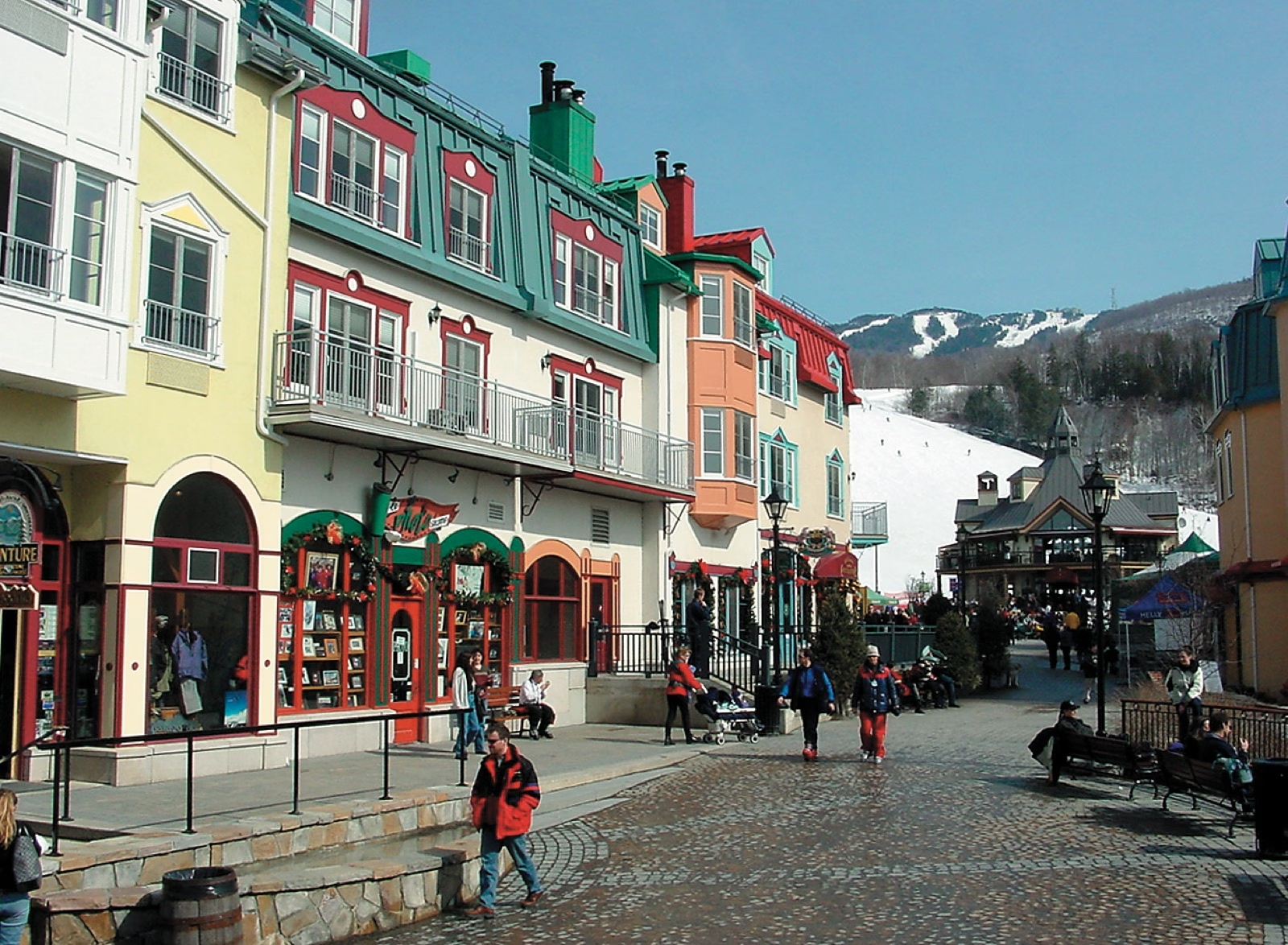
At Copper Mountain, another Intrawest village is experiencing the pains of rapid growth. The highly touted Indian Motorcycle Cafe—an import from Canada that was once the core of the commercial area—has failed. The Denver Post quoted Intrawest officials as saying that they are now in a “re-envisioning” process at Copper.
The Canyons, Utah, has struggled, too. To boost sales of interval ownerships at the Grand Summit Resort Hotel, American Skiing Company put the remaining units up for auction recently. Only 70 new condo units are set for development this summer. Retail growth has been slow; more than a few visitors prefer to spend their evenings a few miles up the road in historic Park City, with its atmosphere and authenticity. Officials hope that improved transit links between town and resort will benefit both.
An experiment in social engineering—mixing penthouses with “affordable” employee flats in the same buildings—has not worked out at the new Aspen Highlands Village, built by Hines Resorts. Apart from the Ritz-Carlton Club, which does not take overnight, non-member guests, there is no other lodging and thus few “warm beds” to provide destination customers for upscale retailers and restaurants once the lifts close. Some of the first businesses there have already failed.
Renovations of other mountain villages have slowed. From Big Mountain, Montana, to a proposed new village at Snowmass, development projects are facing opposition from locals. At Keystone, business failures have dogged River Run village, and “For Sale” signs have sprouted. And at Winter Park, where an ambitious Hines condominium project stalled a couple of years ago, residents are still waiting for newcomer Intrawest to explain how it intends to revive development there.
Why so many issues? It takes a village to make a resort, but as Greenfield hints, it takes more than expensive vacation condos and shops to make a village.
It Takes a Community
To explore this idea, SAM asked a number of resort designers, land-use planners and architects for their opinions. Most volunteered their comments only on condition of anonymity. Here is a summary of the issues they identified:
Locals can’t afford to live there. Creating a genuine community means having a year-around population to give them a constant ebb-and-flow of pedestrian traffic. While second-home owners might someday become permanent retirees, the lack of affordable housing for workers deprives these projects of an organic evolution. At Whistler, which truly functions as a community, locals are quick to point out that Whistler was created in the 1970s as an independent municipality, not as a company town. Intrawest had nothing to do with the village’s creation and has no control over its retail tenants. The municipality has ensured that there are thousands of permanent residents.
New villages compete with real towns. Nothing draws the ire of locals faster than a project that is designed to bottle up visitors at the mountain and siphon business away from existing merchants down the road. Rather than working at cross purposes, a ski area should design a village that complements—or at least doesn’t compete with—a close-at-hand community. Locals should get first crack at retail and restaurant spaces to provide authenticity and community involvement. Too often, lease rates are so exorbitant that only chain operations can afford them. And do visitors really crave a strip mall experience at a resort?
Mass transit opportunities go begging. Moving people between points of interest can stimulate the economy of an entire region. But too often village builders don’t think of linking their projects with nearby towns. People-movers such as gondolas and trams can provide a synergistic relationship in which both sides prosper. In the U.S., one successful example is the free gondola that connects the town of Telluride with the new Mountain Village at mid-slope.
Authenticity is lacking. “A village needs to have a sense of place, not appear to be contrived. You can easily fool a destination guest for a while, but for sustained prosperity you have to put the pieces together so that the place will still be real in five years or 20 years,” says one designer. “Authentic elements are necessary to keep a village from looking dated and tired.”

Real estate trumps operations. “There is too much emphasis on designing real estate instead of designing villages,” says one planner. “Real estate is an amenity for the ski area, not the other way around.” What areas need are warm beds—traffic. “Without warm beds, the villages die. More emphasis needs to be placed on generating profits from operations, not from real estate,” the planner says.
Resort-developer partnerships aren’t working. In theory, a ski operator knows how to run a mountain and a developer knows how to build villages. But in reality, the concept has often proved unworkable. “The best scenario is to have a single owner for the ski area and the village, so that the village can be designed with a long-term view of creating quality and full beds, shops, bars, restaurants and lifts,” said one designer.
Site planning suffers. Greed has too often led to high density at the expense of aesthetics and functional design. “I have yet to see an architecture group do a good site plan, which is the single most important element of a village. There is an overemphasis on buildings and not enough attention to the layout,” said one planner. “Too much density and poor design equal a completely bad village.”
Guest ergonomics are overlooked. Builders who obsess with maximizing their return per square foot often fail to factor in the guest experience. The result: Bedrooms that are too small, bathrooms that are cramped, walls that have poor sound insulation, and kitchens that are ridiculously large.
Projects are not completed. “Too many projects have been started but not finished, and when this happens it threatens the future viability of the village,” says one planner. “There has to be a finished project at each phase of development. If there is any sense that the project is incomplete, then it is doomed.”
Conference facilities get short shrift. After 9/11, the slump in business travel caused such a downturn in conventions and conferences that developers tended to scratch such facilities from their new village plans. But without such facilities, a ski area cannot draw crucial low season and off-season business that fills beds and keeps restaurants and retailers alive.
Success Stories
While many of the 40-odd village projects proposed or in development in North America are experiencing setbacks, there are some success stories. Most of them are in Canada, which has a huge advantage over the U.S. in their ability to generate “warm” beds. Canadian resort builders rely heavily on a type of property ownership model called “strata,” which allows developers to “sell” a fee-simple title to a condo-hotel unit but requires owners to put their units into a rental program when unused—which is most of the time. These programs have contributed greatly to the occupancy levels, and therefore to the economic viability, of Canadian resorts such as Whistler and Tremblant.
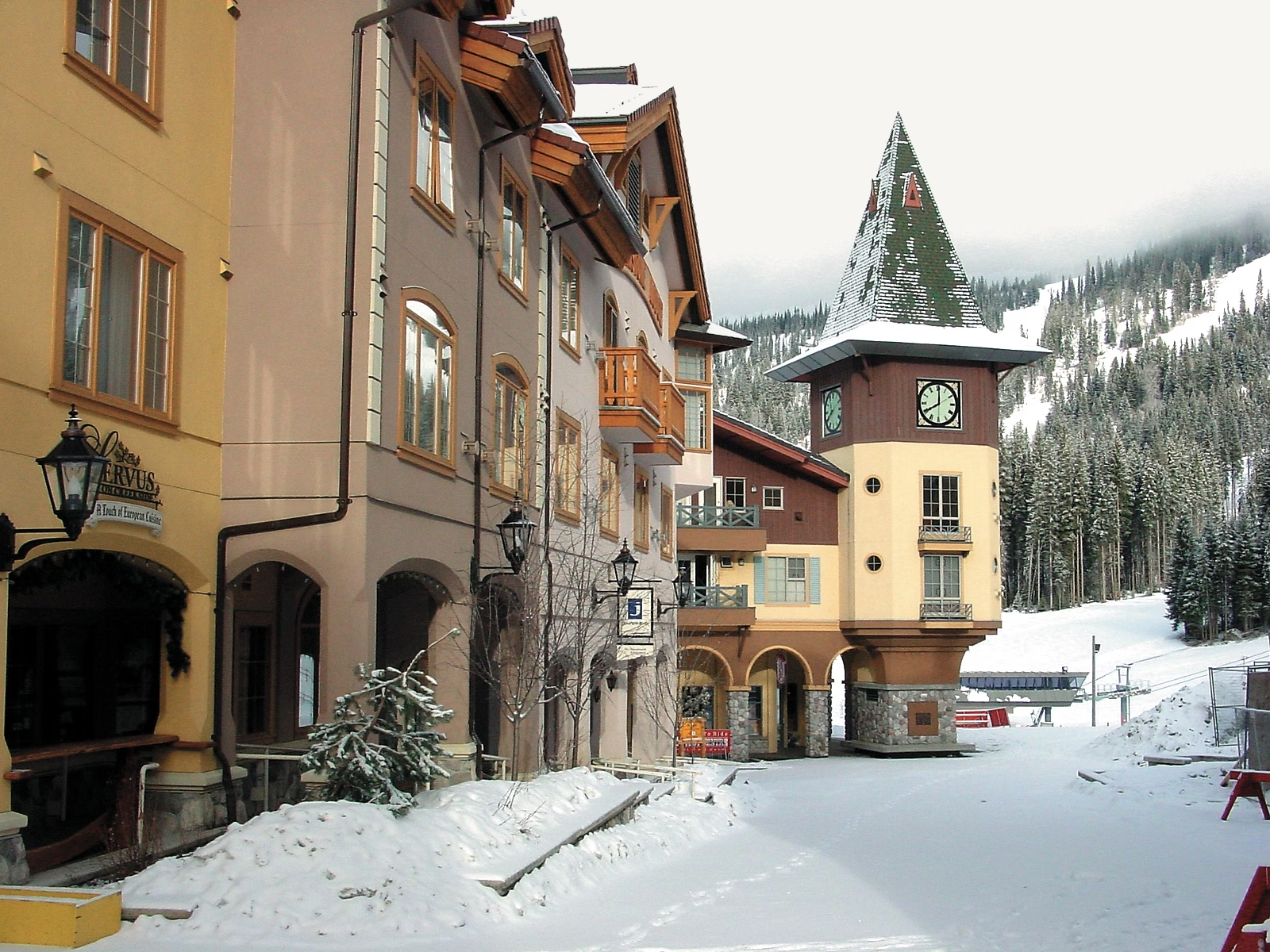
One new village that is prospering is B.C.’s Sun Peaks Resort. Having suffered from a series of bankruptcies as Tod Mountain, the property was acquired by a Japanese company in the mid-1990s, and its rebirth began. During its short tenure as Sun Peaks, the resort has become hugely popular with families, who love its well-integrated village and mountain operations.
Paul Mathews of Ecosign Mountain Resort Planners of Whistler led the new owners’ design team. Rather than devote most of its slopeside lands to pricey home sites and upscale condos for the rich, Sun Peaks aimed squarely at middle-class families. This is one of the most affordable resorts in North America for entry-level second-home buyers and casual renters, with a variety of accommodations that ranges from hostels to three-bedroom cottages.
The first things that a visitor notices about the Village are the European influences. Yes, there’s the requisite clock tower, and the solid, stucco and stone construction. “We avoided materials such as painted wood siding because it ages too quickly,” says Mathews. “Our vision has held because some of these buildings are nine years old but they still look new.” The village walkways meander and have a sense of intimacy, and there are plenty of view corridors of the snow-covered slopes. There’s a mix of small inns—resembling European pensions—and moderate-sized hotels and condotels.
Sun Peaks has other advantages. Although the area has just a half-dozen chairlifts, these serve a vast expanse of skiing that stretches over several mountain faces. Close proximity to the metropolitan drive-up markets of Vancouver and Seattle helps, too, as do direct flights from the States into Kamloops Airport, 45 minutes from the mountain. More recently, a new 18-hole golf course, combined with the conference facilities, have created a break-even point for off-season business.
“Fortunately,” says Mathews, “our Japanese owner took the long-term view that it was better to do things methodically and correctly than to do them overnight.”
The Guest Editor’s Take
The title speaks for itself—Ghost Towns. Who wants to stay at a place where there is no action, half the restaurants are closed, construction is in many different phases of completion and there is the feeling you’re the only one there? Other than the 25 to 30 peak days of the season, this is what you find at most resort villages that are not part of a traditional town.
I agree that “the emphasis needs to placed on generating profits from operations, not from real estate.” We have seen the consequences of forgetting this several times. In the late 80’s everything was booming and we couldn’t build it fast enough, then in the early 90’s it couldn’t be auctioned off quickly enough.
There are way too many cookie cutter villages in resorts around the country. What works in Maine very well may not work in Utah. What works in Colorado may be a bust in Lake Tahoe.
Before entering into the planning and subsequent development of a resort village community, management needs to understand the project’s long-term impact on the resort. Too many times, good intentions are overcome by expectations of large profits that can be generated. It seems like easy money! A sound vision will include and integrate the local community. And it will happen at resorts that have already figured out how to be profitable without large real estate developments.
—Karl Kapuscinski, Mountain High