

SAM Magazine—Canmore, Alberta, April 20, 2026—The Cross Country Ski Areas Association (CCSAA) Annual Conference drew 72 attendees from across North America to 1988 Winter Olympic venue Canmore Nordic Centre in Alberta, Canada, April 8-10, 2026. Attendance was up compared to the last three years and folks came from as far away as Newfoundland in Canada and New England in the U.S.
The meeting, which typically takes place in the West, included a variety of hands-on and classroom educational opportunities, networking, a vendor expo and, of course, some skiing. As always, the agenda included a strong grooming component as well as discussions on snowmaking and a growing interest in snow storage.
Winter 2025-26
This past winter was good-to-great for Nordic operations in northeastern North America, a mixed bag in the Midwest, and difficult to disastrous in western North America, where record low snowfall, warm temperatures, and rain events shortened the season for many operators, including those with snowmaking.
For example, Oak Hill Outdoor Center, N.H., operated for 125 days thanks to cold weather and a new snowmaking system along with lights for night skiing, compared to 40-50 days before these installations two years ago. Resort Municipality of Whistler, British Columbia, had a 77-day season, down from its customary 90 days, with around a third of its trails open, even with snowmaking. Crosscut Mountain Sports Center, Mont., usually operates for more than 100 days but was at least partially open only 68 days in 2025-26, often with a minimal base. Plain Valley Trails, Wash., opened some trails for 72 days rather than the normal 100.
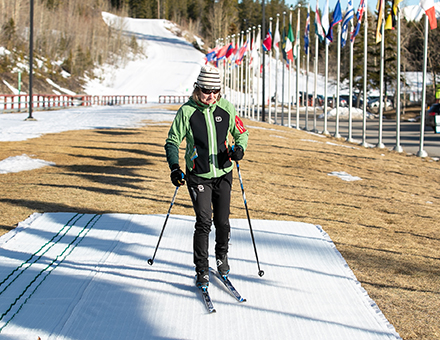 Testing Mr. Snow synthetic XC skate surface. Credit: Reese Brown.Austin Weiss of Aspen Snowmass Nordic Trail System, Colo., summed up the winter as “entirely draining,” and an “eye opener” that demonstrated they truly need snowmaking to operate, not just as a seasonal extender.
In response to the challenging winter, an unprecedented number of attendees were exploring snowmaking (at least 8) and/or snow storage (minimum 10). During the conference, Whistler Sports Legacies in British Columbia took its first shipment of Snow Secure insulating blankets (represented in North America by SMI Snowmakers). Inter-Mtn. Enterprises introduced German-made synthetic surface Mr. Snow for both classic and skate skiing for operators to try.
Still, attendees felt positive about both the industry and the conference. “I came home this year with grooming and trail-preparation tips that I have already shared with my outside operations staff,” said Aaron Johnson of Bear Valley Adventure Company, Calif., which was one of a few operations that sent multiple staff to get and give different perspectives. “Having our business manager present to see and hear the importance of snowmaking was invaluable in helping our organization plan and prepare for the future.”
Suppliers shared that optimism. Steve Visona, Canadian distributor for Italian-made Alpina snowmobiles, said he was grateful for the experience. “This was the first time Pro Alpine Ventures attended the CCSAA Conference, and I am still absorbing this event. From the camaraderie to the learning curve about what it takes for so many different operations to make cross country skiing available to the masses, I feel energized and inspired to play my part.”
Agenda
This year’s conference introduced a new format, beginning with snowmaking and grooming workshops and continuing through the two days of indoor sessions. Karen Plank of California’s Royal Gorge Cross Country Ski Resort noted that “it feels to me like the organizing committee is trying different formats each year, which is great,” she said. “All we need to do now is get more people involved. With new people come new ideas, enthusiasm, and a fresh set of eyes.”
The first element in the schedule was a hands-on introduction to Canmore’s snowmaking and snow storage systems, where they use wood products for summer insulation so they can open Frozen Thunder—a 4-kilometer track used for early-season training—well before natural snowfall would allow.
For the grooming workshops, participants were divided into PistenBully and Prinoth operator groups. A top operator, along with a manufacturer’s representative, led each group through a pre-operation check before demonstrating grooming techniques. The machine would lay down product and stop so the group could examine results and discuss the approach together. A two-way communication system using phones with speakers allowed snowcat operators and attendees to talk to one another during demonstrations enhanced interactive learning.
Indoors, the goal was to create conversational experiences rather than rely on a single speaker. The schedule included two simultaneous panels, followed by four small-group discussions.
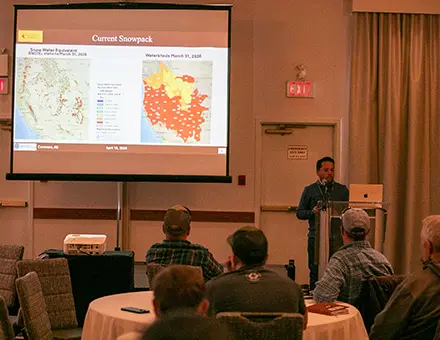
There was emphasis on nonprofit status, collaborating with communities and landowners, risk management, staff training, and more. It was a wide-ranging but practical topic selection for attendees who had many different backgrounds and goals. One of the presentations included a somber assessment of climate change.
Connections and Takeaways
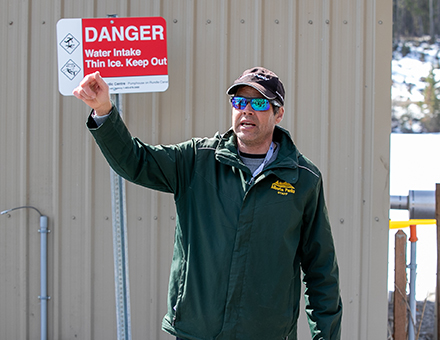 Alaric Fish, Canmore Nordic Centre manager, presents pumphouse and snowmaking pond. Credit: Reese Brown.“This was my first CCSAA conference. The most valuable part was the opportunity for connections through one-on-one and small group conversations,” said Angie Weikert of Montana multi-season operation Crosscut Mountain Sports Center. “After a challenging winter in the West, it was especially impactful to share both struggles and successes, find common ground, and collaboratively explore solutions.”
Laurie Penton drove 900 miles to Canmore from Windsor Park Nordic Centre in Winnipeg, Manitoba, and found the trip worthwhile. “Networking with others was our best takeaway,” she said. “Ideas on marketing and community engagement inspired us with growth ideas for the season ahead.”
Hedda Peterson of Crested Butte Nordic, Colo., noted that, “A key takeaway for our staff was the growing need to adapt to a warming climate by getting more strategic and creative through efforts like snow storage, targeted marketing to nearby drive markets, and proactive trail management to ensure consistent early-season skiing and sustain engagement with our core community.
“Our team left feeling energized by ideas for both immediate and long-term implementation,” she continued, “and especially valued the unique opportunity to learn from peer organizations across North America.”
Report by Jonathan Wiesel, Nordic Group International