



A guest may try your resort for the terrain and amenities, but the decision to return is largely influenced by emotional factors such as feeling happy, welcome, valued, and connected, which are often the result of positive interactions they had with employees. Small acts of kindness and swift resolution to issues make a good impression. And those actions are greatly influenced by the resort’s leadership.
The emotions that matter most: Not all emotions carry the same weight. Colin Shaw of Beyond Philosophy, in collaboration with London Business School, mapped 20 emotions in his Hierarchy of Emotional Value (Fig. 1). His research demonstrates that positive emotions create value while negative emotions destroy it, and some emotions influence loyalty far more than others.
In our work with mountain resorts, six emotions consistently emerge as the strongest drivers of guest loyalty and satisfaction: Happiness, Fun, Feeling Valued, Loyalty, Trust to Be Treated Fairly, and Overall Safety and Security.
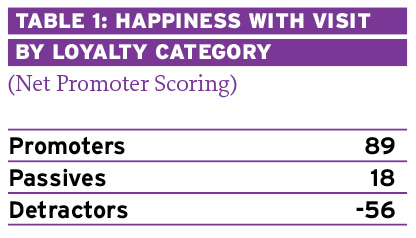 Source: Guest Research, Inc. client data for the 2025-26 winter season.Among these emotions, happiness stands out as the strongest predictor of guest loyalty. When guests leave happy, they are far more likely to recommend the resort, return for future visits, and become long-term advocates. The impact of happiness on NPS is clearly demonstrated in Table 1.
On average, Promoters rated their happiness with their visit at a net score of 89, compared to just 18 for Passives and -56 for Detractors. The lesson is simple: guests who are unhappy with their experience rarely become loyal guests.
The Mountain and the Staff
The mountain sets the stage. Nature provides the setting, and the mountain is the main draw. When guests are asked what they liked best about their visit, they frequently mention the scenery, terrain, snow conditions, mountain atmosphere, and time spent with family and friends. These elements form the foundation of a great day on the mountain and often become the memories guests cherish most.
People bring the experience to life. Employees contribute something equally important: a human connection that can elevate the experience beyond skiing or riding itself. Whether they offer a warm welcome, happily answer a question, help resolve an issue, or take a moment to engage with a guest, staff interactions can create feelings of comfort, confidence, and belonging for people. Those moments of personal connection also influence whether guests feel valued, welcomed, and excited to return. Real guest comments illustrate this impact:
“When my daughter’s skis were taken by mistake, the customer service desk told me to just go rent some skis for free, and that it would all work out in the end of the day. We got my daughter’s skis back, and he told the other woman not to worry; hers would be found. He was so understanding and made the day much better.”
“The sincere and honest welcome at check-in made us feel cared for. Truly great ladies who cared about our stay. This has increased our level of loyalty. We feel valued and treated fairly. We also feel great about spending money at your resort.”
“The staff was so supportive and kind. They took care of my son when he needed them. He was exceptionally cold, and they let him borrow a phone to call me and warmed him up with cocoa and hand warmers. Absolute best staff I’ve ever experienced. I will definitely return.”
None of these moments involved perfect snow or new infrastructure. They were created by employees who made guests feel supported and cared for. Those are the experiences guests remember and the stories they share with others.
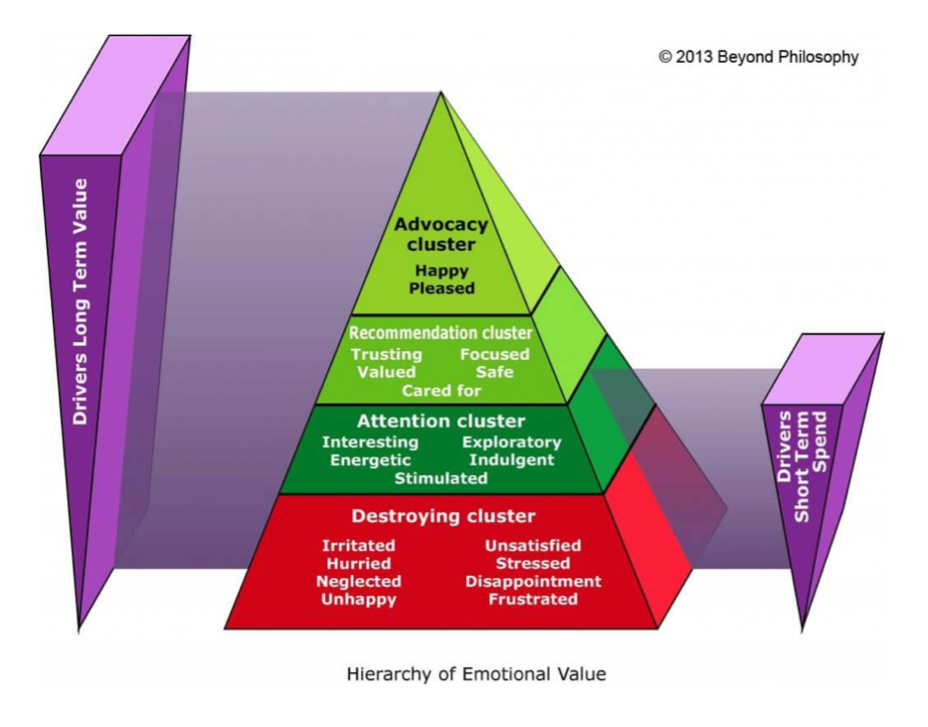 Research by Colin Shaw of Beyond Philosophy, in collaboration with London Business School, shows that positive emotions create value, negative emotions destroy value, and some emotions have an outsized influence on loyalty compared to others.
Where Employee and Guest Experience Meet
Many organizations view employee satisfaction and guest satisfaction as separate initiatives. Our research suggests they are deeply connected.
We analyzed a decade of employee and guest survey data, including open-ended comments, emotional themes, and likelihood-to-recommend ratings. Across multiple resorts and multiple years, a consistent pattern emerged. When employees feel supported, trusted, and valued, guests are more likely to feel happy, cared for, and loyal.
Four employee factors consistently showed significant relationships with guests’ emotional outcomes. The strongest relationships appeared in areas that shape how employees experience their workplace: leadership quality, empowerment and autonomy, pay and housing satisfaction, and adequate staffing.
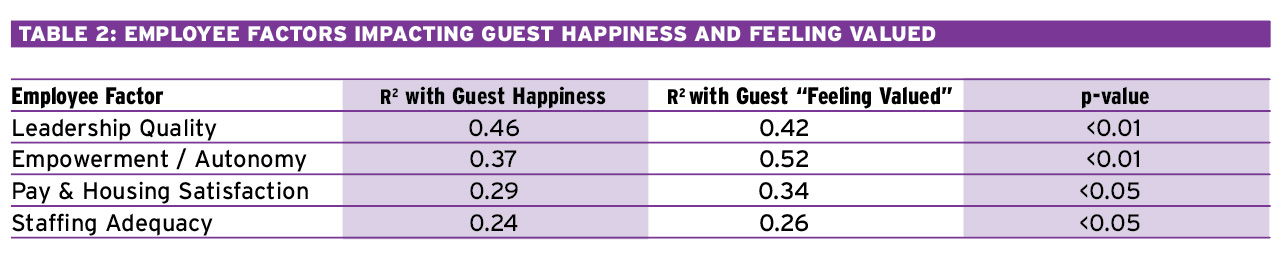 Note: This time series analysis looks at data across multiple resorts from 2016–2026. Pearson correlations, which measure the strength and direction of a relationship between two variables, indicate the degree to which employee scores and guest emotional ratings are related. R2 indicates how much of the variation in guest emotional ratings can be explained by changes in employee scores. Higher R2 values indicate a stronger connection. P-values indicate how likely it is that the observed relationship occurred by chance; lower p-values mean greater confidence in the result (p < .05 = significant; p < .01 = very strong evidence).
Leadership Matters
Leadership quality had the strongest relationship with guest happiness. This remarkable finding suggests that the guest experience is influenced long before an employee interacts with a guest. Effective leaders create conditions that allow employees to succeed by providing clear communication, recognition, support, and adequate resources.
Empowerment also has an outsized impact on guests. An environment where employees are given autonomy and are empowered to make decisions also stems from a ski area’s leadership. Those factors are most highly correlated with a guest “feeling valued” and have the second strongest relationship with guest happiness. In these environments, employees are more confident in their decisions, more willing to take ownership of problems, and better equipped to focus on hospitality rather than simply managing workloads.
Strong leadership shapes workplace culture, and that culture ultimately shapes the guest experience. When employees feel valued, supported, and connected to their work, they are more likely to extend those same feelings to guests through authentic service, problem-solving, and personal engagement.
Real employee comments regarding what they like about work capture this connection particularly well:
“The (employer) is my second family. I feel like we are creating real, positive impact on lives.”
“The best part is definitely my manager and coworkers. I love coming to work!”
“A very small (supported team). Telling visitors our story. Knowing the facilities have the potential to fulfill dreams.”
The Snowball Effect
The most successful resorts understand that loyalty begins long before a guest arrives. When employees are well-led, not stretched too thin, are fairly compensated, have access to housing, and are empowered to act, they create better guest experiences. Better guest experiences lead to higher satisfaction and Net Promoter Scores, more repeat visits, and more positive word-of-mouth. Investing in employees is not simply an HR initiative. It is a guest loyalty strategy.
A guest may come for the mountain but return because of how the experience made them feel. Those lasting impressions are often shaped by the people wearing a nametag at your ski area. The most successful resorts treat employee experience as a leading sign of guest loyalty. They measure employee and guest feedback together, act on what they learn, and celebrate the employees who create exceptional moments.
When employees thrive, guests thrive. Resorts that recognize and act on this connection build stronger loyalty for both parties and produce experiences guests remember long after the snow has melted.
9 Ways to Strengthen Guest Loyalty
Based on employee and guest feedback, several opportunities arise:
1. Prioritize competitive pay, transparent compensation methods, and housing support to build trust and stability.
2. Invest in leadership development and supervisory training. Equip managers with coaching, communication, recognition, and conflict-resolution skills so they can better support and empower their teams while reinforcing a culture of hospitality.
3. Align staffing levels with peak demand so employees can focus on service rather than simply managing workloads.
4. Give frontline employees authority, tools, and training to resolve issues in the moment. This empowerment helps staff feel competent and valued, leading to more genuine guest care.
5. Hire for both technical skills and hospitality aptitude, especially for guest-facing positions.
6. Encourage employees to look for opportunities to exceed expectations through small acts of kindness and recovery.
7. Reinforce hospitality and service recovery skills while helping employees understand their role in building guest loyalty.
8. Review employee and guest feedback side by side to identify shared trends and opportunities.
9. Celebrate guest compliments and recognize employees who create memorable service moments.
None of these actions requires a major capital project. Yet each can have a meaningful impact on the emotions guests experience during their visit.