




There are two universal truths in ski area management: First, everything that happens on a mountain (550 vertical feet in our case) happens fast. Second, writing things down usually happens… later. Sometimes a whole lot later.
For more than 60 years, when it came to ensuring best practices for everything from customer service standards to how to inspect a snowmobile, Mount St. Louis Moonstone (MSLM) relied on experience, trust, gut instincts, and the comforting phrase, “this is how we’ve always done it.” And for a long time, that worked. Until one day, it didn’t.
Our wake-up call came after someone got hurt. A lawsuit implying the incident resulted from employee inexperience fell on us like a snowstorm. That moment forced us to pause and ask: What if our biggest operational risk wasn’t our documentation process, but how clearly that work—and who did it—was being captured? And how can we fix this?
The answer led us somewhere unexpected: gamification.
The Why
Every ski area takes safety seriously, but seriousness alone doesn’t stand up to scrutiny. What matters, whether you’re talking about insurance, incident review, training validation, or internal accountability, is evidence. Who inspected what? When? Using which standard? With what outcome? And with what qualifications?
Historically, much of this evidence lived in binders, clipboards, filing cabinets, banker’s boxes in an attic, or most dangerously, in people’s heads.
Invisible work. The challenge was that staff were doing the work—training, inspections, maintenance, etc.—but it wasn’t attached to them, so to speak, with consistent, time-stamped, standardized documentation, so their experience was effectively invisible. There might be a record for the work done on a piece of equipment, but no record tied to the employee completing the work or how often they’d done it.
We also weren’t formally capturing the deep knowledge of our veteran staff. Our team at MSLM is stacked with legends that have spent decades mastering their respective crafts—grooming machine operators, snowmobile drivers, ski and snowboard technicians, patrollers, instructors. Many of them are true subject-matter experts who have accumulated more than 10,000 hours of hands-on experience. They demonstrate their expertise through consistency, judgment, and accountability.
However, if that knowledge and experience isn’t documented, it can’t be measured, verified, or improved. It can’t be shared consistently. It can’t scale. And when someone retires, gets promoted, or takes a season off, their knowledge disappears with them.
Plus, being able to document and attribute that experience is important not only for operational accountability, but also because it helps protect both the employee and the resort in the face of potential lawsuits.
We realized we had been relying on something dangerously informal. We were buried under manual processes and piles of paperwork. Teams duplicated effort across departments.
At the same time, we were facing familiar industry pressures: increasing regulatory expectations, rising insurance scrutiny, a transient seasonal workforce, and the constant need to onboard, train, and validate competence quickly.
We needed a better system.
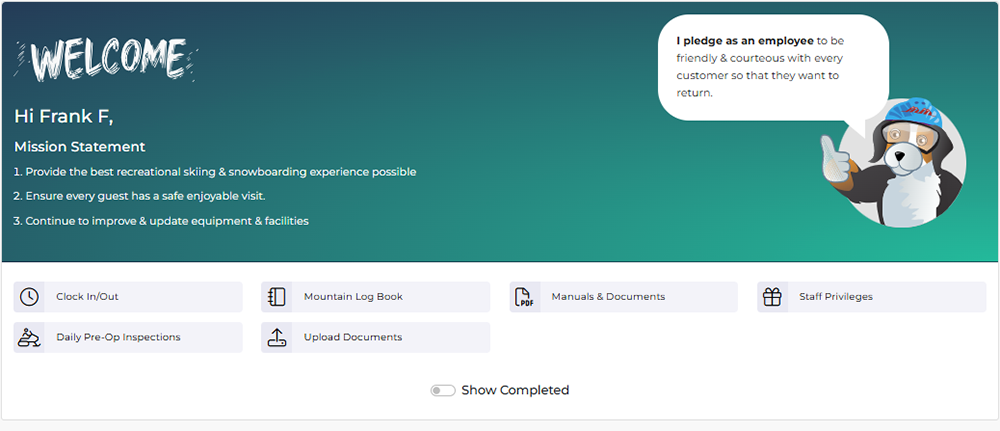 The home screen of MSLM’s employee portal highlights the resort’s mission statement and provides quick access to daily tools, staff resources, and key functions, like the Mountain Log Book. Through the logbook, employees—many of whom are subject matter experts—own their work record.
The What
Our goal wasn’t to turn seasoned operators into box-checkers. It was the opposite. We wanted a system to capture real operational knowledge, make competence visible, protect our people by proving what they do, and, critically, make it something staff wouldn’t hate using.
That’s how we arrived at developing the Mountain Log Book.
A custom solution. At its core, the Mountain Log Book is a digital system attached to an employee that logs vehicle and equipment inspections, snowmobile and snowcat operations, task completion, and experience accumulation. We digitized the work people were already doing and made the system smart enough to help them do it better.
The Mountain Log Book was created as a function of the custom-built digital hub on which MSLM operates. The hub began as a content management system for our website and has evolved to include HR, health and safety, Axess RFID tools and databases, snow school scheduling and reporting, rental inventory, e-commerce, partner gateways, guest communications, and now operations. It’s a fully integrated ecosystem built specifically for our resort.
Smart functions. This system allowed us to customize the logbook’s functions. For example, pre-operational vehicle inspections are connected to the operator and now follow standardized digital workflows with required fields specific to each piece of equipment, photo uploads, time stamps, and automated flags.
For ski and snowboard instructors, lessons taught and requests are logged automatically.
Incident reports can be completed from anywhere—on-hill, in the office, or the ER—using a mobile device, and the process is expedited with guided prompts and real-time weather pulled directly from Environment Canada. Witness statements focus on real-time data, not assumptions. Ski patrol and snow school incident reports live in the same system, reducing silos.
Everything feeds into dynamic, intelligent reports. Unlike paper forms where half the checkboxes don’t apply, our system knows if you’re inspecting a Kubota versus a PB 400 and only asks relevant questions. Forms are structured by equipment or task, are searchable, actionable and all connected to the employee who completed them.
We have also expanded the logbook to include rental technicians; we now log DINs set, waxes performed, and repairs conducted.
The technology is intentionally practical: mobile-friendly and usable on the hill, with minimal clicks and clear prompts. It’s designed for cold fingers and busy shifts during real operations.
But none of these great functions mattered if using the system felt like paperwork—because if it did, we knew this new logbook would die a quiet, unloved death somewhere between a glove box and a clipboard.
So, we did something radical. We made it fun.
Gamifying the System
Let’s talk demographics. A large portion of our operations team identify as men. And men aged 15 to 65 play video games. A lot of video games. Studies have found that those under age 34 average up to 21 hours a week. Even elder millennials and Gen X are still clocking 8 or 9 hours weekly.
They understand progress bars, levels, achievements, unlocks, and feedback loops. They’re already wired for systems that reward mastery. So instead of saying, “Please remember to log your inspection,” we built a system that says, “Nice work. You just leveled up.”
Unlocking rewards. Completing inspections builds experience. Operating equipment builds verified hours. Mastery unlocks recognition. Consistency earns rewards. The logbook tracks all of this and includes leaderboards that highlight performance so staff can see where they stack up and reach goals that are worth bragging about.
“I hit 200 hours on the Skandic.”
“I set the most DINs this week.”
“I was the most visible patroller based on scans and reports.”
In addition to instilling pride and providing motivation as staff see their measurables add up, there are perks for good performance, including e-money bonuses loaded to Louis Xpress RFID cards that can be used for on-mountain purchases. Staff also earn recognition from both the system and leadership for, among other things, finding safer or smarter ways to work. It’s no longer intuition that tells a manager someone hustles, the Mountain Log Book proves it.
Gamification isn’t childish, it’s exactly how skill development already works. Our system simply makes it visible and rewarding.
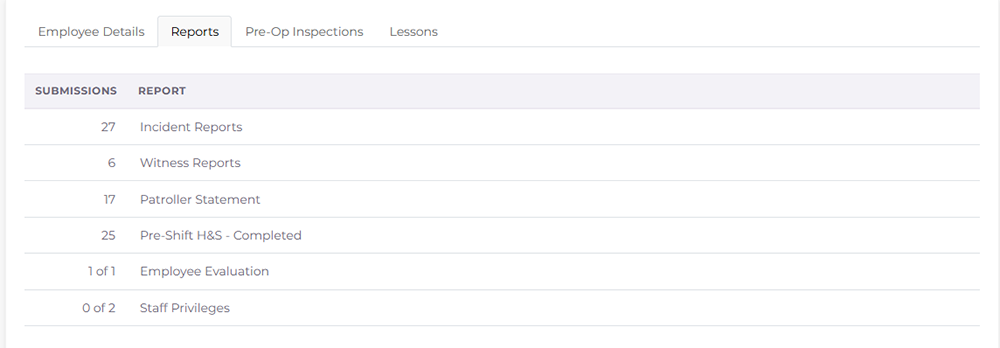 The Mountain Log Book centralizes incident reports, witness statements, patroller notes, and employee evaluations in one system, where reports are time-stamped, standardized, and impossible to lose in the bottom of a patroller jacket pocket.
What Changed
The impact was immediate and a little surprising.
People started caring about accuracy because the system shows them the benefit of it by tracking and displaying their effort, growth, and expertise. The Mountain Log Book doesn’t exist to catch mistakes. It exists to show excellence, and when excellence becomes visible, people rise to it.
The payoff. Supervisors now have clearer visibility into performance without micromanaging. Training gaps are easier to spot and fix. Experience is no longer assumed, it’s documented. Machines are inspected more consistently, issues are flagged earlier, and procedures become habits because the system creates champions, not compliance.
And one of the most powerful outcomes: our culture shifted.
Work at a ski resort will always be physical, early, cold, and occasionally chaotic. No app changes that. But culture can change. The Mountain Log Book helped move us from “just get through the shift” to “I’m building something here.”
Carrying experience forward. Seasonal work can feel temporary and transactional. Now, it feels cumulative. The system is two years old, and staff can see progress season over season. Returning employees don’t start at zero. Experience carries forward and competence is recognized.
And employees own their records. Need to prove to a summer construction employer that you’ve run a dozer? Show them your Mountain Log Book just like a pilot shows logged hours. Experience is portable, verifiable, and real.
Buy-in. Critically, none of these positive changes or shifts would have been possible without buy-in from the people using the system. That’s why we didn’t roll this out top-down. Grooming, lift ops, patrol, snow school, HR, and health and safety all helped shape their own workflows. That ownership matters because people are more likely to resist systems built for them instead of with them.
Serious Fun
We’re not done. The Mountain Log Book will evolve as we expand it across departments, introduce seasonal missions, build smarter reporting, and keep refining how we recognize experience and growth, because a ski resort is nothing without its people, and people deserve systems that see them not just when something goes wrong, but every day they get it right.
The Mountain Log Book was developed in response to a serious situation. The process helped us realize that safety doesn’t always have to feel serious; and risk management isn’t about fear, it’s about clarity. We made the typically mundane task of reporting more fun, engaging, and even motivating, not by trivializing it, but by respecting the people who live it every day.
The result? Better documentation. Stronger culture. Smarter operations. And a mountain that learns from itself. If a leaderboard helps get us there, we’ll take the win.