

April 13, 2026
At midafternoon on the first Saturday in March, with the sun occasionally breaking through the heavy, low cloud cover, Black Mountain’s mid-mountain Alpine Cabin is already going off, and the Veuve Clicquot is flowing. Owner Erik Mogensen, whose many roles today include director of champagne, DJ and emcee for the festivities, thanks the crowd for “taking a stand.”
“This is what skiing is all about,” he says. “It’s a cultural sport, not a corporate sport.”
This Euro-inspired celebration is an ode to independent skiing and supporting the resorts less traveled. It reflects a deliberate repositioning of Black Mountain—which was facing permanent closure in 2023 before Mogensen, who is also the owner of Indy Pass and Entabeni Systems, stepped in—as a blueprint for a thriving small ski area.
Black, whose circa-1935 J-Bar was the first overhead lift in the country and whose ski school was a national pioneer, now generates a record number of headlines per skier volume in its improbable rebirth. It is indeed “back and better than ever.” Even Mogensen’s skeptics marvel at the turnaround he has led in the idyllic New Hampshire village of Jackson, in the cradle of the sport.
Find Your Niche
Now 38 years old, Mogensen had never even visited Black, much less run a ski resort, when his companies Entabeni Systems and Indy Pass acquired the ski area in October 2024 with plans to transform it into a community-owned operation. He received a baptism in fire, dealing with a fatality in his first season and then seeing both his key chairlifts go down during the busy holidays in December 2025, which, to his credit, were soon back up and running. Mogensen also found himself in the crosshairs of the Jackson police and town selectboard in late 2025, but eventually the dust settled.
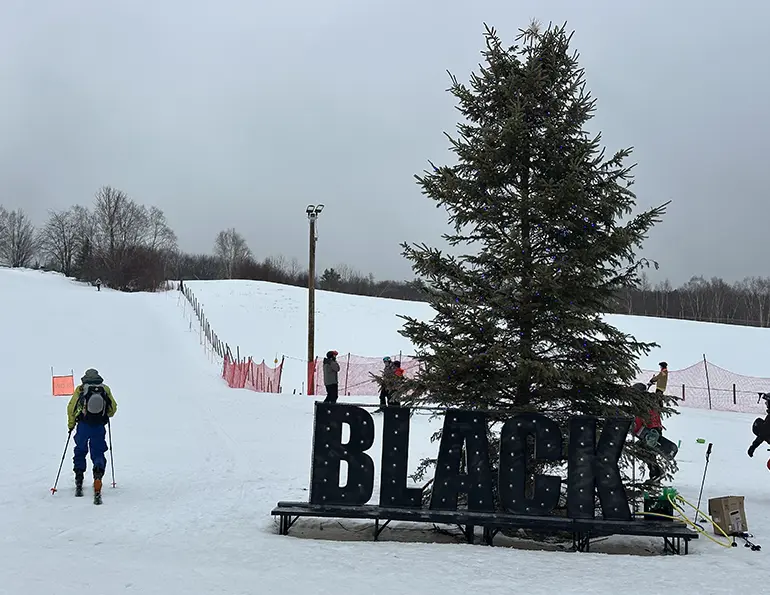
Black Mountain’s turnaround really began with Mogensen prioritizing the ailing infrastructure and wielding the capital to do improve it. This included a rebuilt lodge, a 30-percent parking lot expansion, 28,000 feet of new snowmaking pipe, 200 more SMI snow guns, and three new PistenBullys. The pocket-sized mountain is mostly south-facing but skis well, with small or non-existent lift lines leading to 1,100 feet of vertical, 45 trails spread over some 145 acres, plus inviting glades.
Champagne sales play an outsized role at Black. Adult lift tickets, if bought in advance, can be had for about $70, while the bottles of Clicquot run $99, more than the lift privileges but much less pricy than elsewhere. Total cabin proceeds for the season, including the brats, pretzels and headlining fondue, will almost equal what pre-Mogensen Black did in total.
Mogensen expects to surpass $4 million in total revenue for 2025-26. That is a roughly five-fold increase from when he began, while he’s also delivering a solid EBITDA. He does not believe high speed lifts are necessary here, and he just bought three “new-old” lifts with plans to install them for the 2027-28 season. He’s again stockpiling snow and planning to operate through May, in search of the big revenue that weekends can provide. Absent are the terrain parks and the investment needed to create that scene.
“The park doesn’t pay here. The champagne does,” Mogensen says.
At the top of his circa-1960s Summit double-chair, Mogensen stands next to the steep, down-and-then-up entry to the three hike-to trails he created, including “Champagne Problems.” The new trails are another sign that Black is offering something new. As chair after chair unloads at the summit, the happy occupants, usually toting the Indy Pass, profusely thank him for offering an alternative.
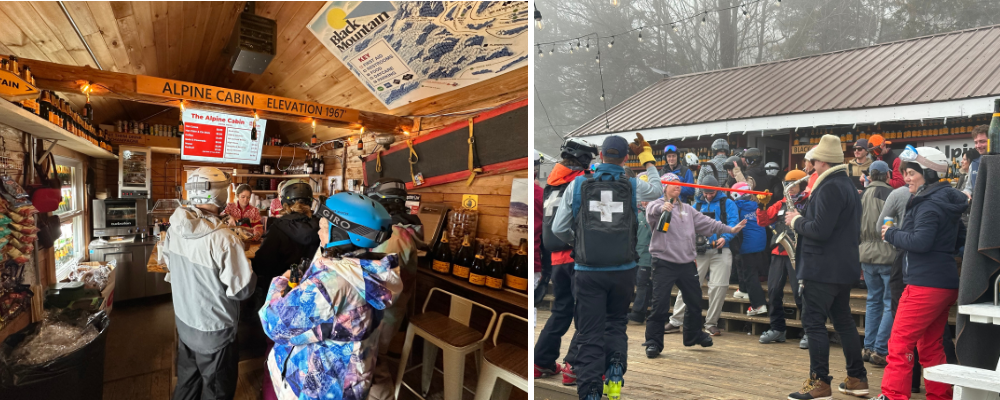 Inside the Alpine Cabin; Limbo on the Alpine Cabin Deck
Community Ownership Nixed
On the national landscape, Black is just one area among almost 500. Mogensen’s effort to create and sell Black as a three-class, $16.25 million community foundation had big potential, though. Billed as a future model of ownership for resorts seeking a rebirth, it was the result of 18 months of research and clearance by the Securities and Exchange Commission.
This ownership structure could be applied to other endangered ski areas, a scalable model beyond Black, a template for others to follow. I came to Black at least partly to see how this could work, and to meet some of the 15 individuals who pledged $250,000 to buy Class A shares and thereby take a seat on the 21-member board. Or some of the 100 who would invest $25,000 each (with four seats on the board), or perhaps a few among the 2,000 who would kick in $5,000 (with two seats).
Instead, Mogensen became the owner of Black himself in March 2026, buying out the early investors. He has declared Black as his small skiing laboratory, particularly focusing on the high costs of lifts and insurance, with plans to hire a GM to handle the day-to-day. “I don’t want to be an operator, just an innovator,” he says.
Mogensen doubled down, moving Indy and Entabeni from Granby, Colo., to Jackson, too. He already has plenty of help in Jackson but plans to build a 20,000-square foot facility on-site at the ski area, in the vicinity of the historic J-Bar, to house some 30 additional employees.
Entabeni and Indy
Mogensen earned his name recognition from Indy and Black, but it is no surprise Entabeni Systems is his focus, with expanded resort technology driving the largest growth potential and revenue generation. Ski resort technology is a crowded, fast-moving, ever-evolving segment, and Entabeni’s future success is far from guaranteed. Meanwhile, Mogensen continues to be a disrupter in the field and one of many options. (Now, he’s even run a print advertisement in SAM, declaring “All ski resort software sucks. But ours sucks the least.”)
Mogensen acquired Indy Pass from founder Doug Fish in 2023 through Entabeni, which had been providing the pass with its backend technology.

Doug Fish launched Indy Pass from his marketing shop in Portland, Ore. Signing 30 resort partners for the 2019-20 season, amid the Vail Resorts and Alterra Mountain Co. buying sprees. No longer the owner, Fish has stayed on as a part-time resort conduit while Mogensen has assumed the role of director.
One of the major perks of this painstaking business is the “float” and the value of OPM, or “other people’s money.” Indy requires buying decisions in early March and most payments relatively up front, which means the considerable cash it receives in the spring doesn’t have to be dispersed until Indy makes the first redemption payment to resorts at the end of February. Even if the money is invested conservatively, the interest or other uses are substantial. The system, where resorts receive 85 percent of the pass revenue and the remainder goes for overhead and marketing, calls for two resort payments: one that covers pass redemptions through Jan. 31, and the second after the close of the season.
In Mogensen, Indy has a tech-savvy and ambitious owner with the apparent financial power to take it to the next level; he has already increased the participating resorts to nearly 300 for the 2026-27 season (though less than half are alpine resorts in the U.S.). Indy sales are capped, and it has just introduced an aggressive auto-renew function. After the renewal period, followed by a waitlist, sales are opened to the public; Indy said the remaining 2026-27 inventory sold out in just 37 minutes.
Demand for a limited supply is strong, and Indy’s total pass sales are the subject of endless fascination.
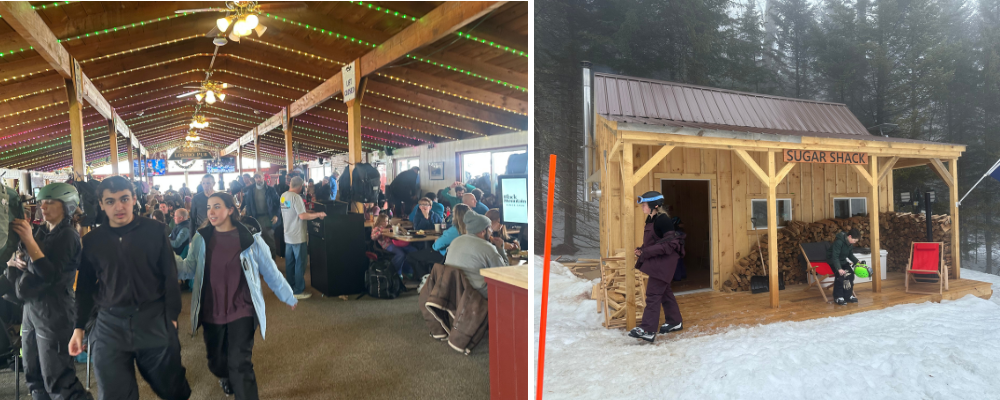 Inside the base lodge; the Sugar Shack
It Must Be a Million?
From all the headlines plus the energy on Facebook’s cult-like Indy Pass Snowboard & Ski Group page, where the posters are passionate believers, it seems this pass clientele must number a million, maybe a third of the mega-passes sold. But best estimates from knowledgeable sources peg Indy at less than 100,000 pass holders.
New England, and particularly New Hampshire and Vermont, are fittingly the epicenter of this “Indy revolution,” with Boston-area skiers a top target. Waterville Valley, Cannon Mountain, Ragged Mountain, Pats Peak, Tenney Mountain and now Mogensen’s Black Mountain are all major New Hampshire contributors. Jay Peak is at the top of Vermont and the Indy Pass, particularly in the 2025-26 season, when the Canadians stayed home but the snow fell and the Indies drove north in significant numbers. Bolton Valley is an important cog and so is Magic Mountain, both in Vermont, while Saddleback in Maine is billed as the largest independent in the East.
Jon Schaefer’s Berkshire East and Catamount in Massachusetts have always been important players. Now the family has teamed with the Ken Graham investment firm under the Bear Den Partners banner, adding Burke Mountain and then Smugglers’ Notch to its ownership-management fold. Burke became a strong Indy destination for 2025-26, will Smuggs soon follow?
But other than with cross-country ski areas, the Indy Pass doesn’t have a lot of room to grow domestically. Its responsibility to its customers and partners, meanwhile, is significant, despite its relatively small footprint.
“It’s Bigger Than Us”
The job of keeping hundreds of independent ski area owners happy and content is near impossible. The heavy-duty lineup of Midwest Family Ski Resorts (Lutsen, Minn., Granite Peak, Wis., and Snowriver, Mich.) opted to leave Indy this spring for the limited two-day Ikon. (A business decision, presumably, and not necessarily a statement.) Meanwhile, Indy did add three-peaked Whitecap Mountain in Upson, Wis., for the 2026-27 season.
There will be grumbling and some departures, especially as longtime supporting areas see their nearby competitors added to the pass without any prior notification. A few high-profile resort owners were mulling moves, mostly because of a lack of transparency and communication, all of which can and should be addressed. In a perfect world, the resort owners would see all the numbers and plans and even have input through an advisory board. This isn’t a perfect world, but perhaps there is a middle ground.
As he juggles Black, Entabeni and Indy, Mogensen is a critical and passionate voice for the future of small ski areas. It is inspiring and just plain fun to see him at work. The lessons he’s learning will help Black and Entabeni’s efforts, an ideal synergy. But they can’t be applied across the board to Indy partners, and he must wear a different hat for a movement that in its own promotional material declares “It’s Bigger Than Us.” Ensuring that the resorts will all get paid on schedule and that he’s always accessible is part of the job description, as is continuing to inspire the Indy constituency.
“It’s about results,” Mogensen says. “The results are unimpeachable.” That’s certainly true, but setting the foundation for that success requires resort relationships, and that’s a work in progress.
Chronicling big and small resorts for more than 40 years, Andy Bigford is the former editor-in-chief and publisher of SKI magazine and the GM of Warren Miller Entertainment. He has written and/or edited six books, including collaborating with the late Chris Diamond on his Ski Inc. book series. He is at work on a third Ski Inc. edition for publication in late summer 2027.