




By mid-February, winter in the West felt upside down. Rain had fallen at destination resorts in Colorado and Utah on Christmas Day. In parts of Oregon and California, snowpack hovered at less than half of normal. Across the region, ski areas opened late, operated with limited terrain or, in some cases, did not open at all.
The lean season echoed a difficult chapter from nearly 50 years ago, when bare-ground winters in the late 1970s and early 1980s forced Colorado resorts to rethink their dependence on natural snowfall. That period ushered in the era of modern snowmaking in the region. The question now: Will this winter’s drought do the same?
“I would bet my next few paychecks on western operators investing in snowmaking after this winter,” said Ryan Schramm, general manager of Powderhorn Mountain Resort, Colo.
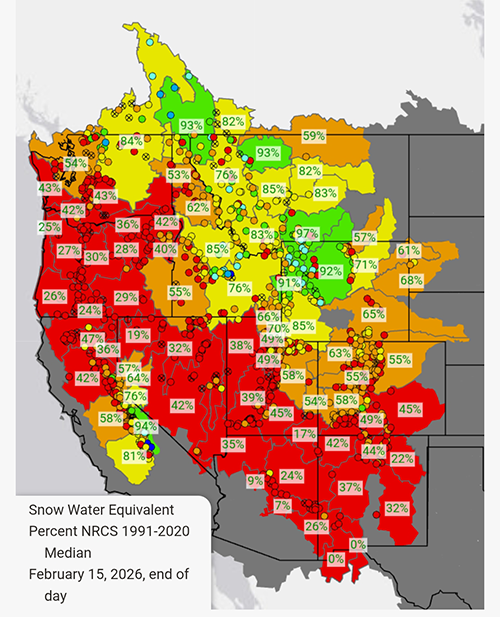 Snow water equivalent map from the NRCS as of Feb. 15 shows much of the West in the red, or at less than 50 percent of the historical median.Schramm said Powderhorn is already evaluating doubling the number of hydrants on the mountain. In much of the West, he noted, snowmaking has traditionally supplemented early-season natural snowfall at higher elevations, resulting in wider hydrant spacing than is typical at eastern resorts. “A logical and cost-effective way to combat record-low snowfall would be to add hydrants to decrease the spacing to add more ‘firepower’,” he said.
Not every resort is responding the same way, but most are responding.
In Utah, Alta environmental center director Jennifer Melton said the ski area is studying surface protection and water storage options to preserve snow and help provide a reliable product. “Low-snow years and precipitation falling as rain rather than snow is a concern and something we want to be ready for,” she said.
Powder Mountain, which does not currently have snowmaking, is “looking at expediting some of our projects, particularly a (snowmaking) system that would help us get open earlier,” said COO Kevin Mitchell.
Snowbasin COO and general manager Davy Ratchford framed the season as a test of operational creativity rather than simply a snow deficit. “This winter kicked us in the teeth, but we determined if we couldn’t control the weather, we would control how we respond,” he said. Despite low snow, the resort delivered strong guest satisfaction scores, and Ratchford said the team will review lessons from the season moving forward.
Some investments were already in motion before the drought.
Copper Mountain, Colo., is in the middle of a multi-year snowmaking modernization project that includes new fan guns, towers, and hydrants with full automation, according to communications manager Olivia Butrymovich, who said additional upgrades already planned for this summer will proceed as scheduled.
A La Niña winter typically rewards operators in the Cascades, but no region was hit harder this season than the Pacific Northwest.
At Willamette Pass, Ore., general manager Mindy Ingebretson-Wolowicz said the season strengthened plans to expand snowmaking and other snow preservation strategies. “We are absolutely looking to invest in snowmaking, snow farming and slope management,” she said. Creative efforts allowed the resort to operate and keep key employees working this winter, she added.
At Mt. Hood Skibowl, Ore., vice president and general manager Mike Quinn said low-snow winters are not unprecedented. “If we go back 40 years, statistically, we typically get an anomaly every 10 years or so,” he said. Because of that, Skibowl has continued to invest in non-ski activities. “It’s more ingrained in how we operate versus reacting to this winter’s lack of snowfall,” Quinn said.
Whether this season proves to be a turning point remains unclear. But as Colorado’s experience decades ago showed, prolonged drought has a way of reshaping the business. And it is likely that Ryan Schramm will win his bet.