



For most of its history, the ski industry was never all that industrialized—or even particularly capitalistic. Skiers wound spliced ropes around pulleys and powered them with Model Ts to help other skiers get a few more runs in than they could walking. We packed our own cheeses and salamis and shared them slopeside with botabag wines and thermosed coffees. The family wagon served as shelter, day care, and locker until base lodges built from creosote-slathered timbers welcomed more skiers to their fireplaces. In good years, ski areas broke even. In great years, maybe the owners put some money away for the inevitable bad seasons when war, recession, or rain hit.
Then our world changed. A few financial wizards got the idea of conglomerating resorts, especially big, popular destinations. Instead of 10th Mountain Division vets and hardened outdoors types running things, we got acronyms—MBA, CEO, CFO, CMO, SMH, WTF. The new breed of “resort executive” would have struggled to teach a stem christie turn, get the backup diesel generator running when the power went down, clear a clogged snow gun, or ask a guest what they wanted from a day on the hill.
Because so many of the acronym people came from other fields, they didn’t know their customers. They set about building Winter Oz via heavy industrialization and a deprioritization of the traditional skiing experience in favor of the revenue streams perfected in other travel and service verticals. They conceptualized what skiing should look like: “Thou shall not flinch at pricing.” Commence the evil grooming. Kill tailgating with shuttles from distant lots. “We are not a ski area anymore,” one famous if famously disliked mega-pass resort executive told me in an interview 20-plus years ago. “We are a destination resort.”
Working class skiers were jettisoned by the new economics: Pay $180 per ticket a day at the window, or let the kiddos go without braces and hand over three or five grand for the family pass in July. Or, just go away and don’t come back. We don’t need the blistered class growing future skiers. We have Count de Monet, Spaulding Smails, the Howells, and Ginger (forget Mary Ann). As for the lifties and the housekeepers, we can bus them in from down valley and redefine down valley as we go.
Please see our ad campaign that reveals our deep love of inclusivity. Let’s not talk about economic diversity, though.
“Yawn,” some might say. “Skiing’s great soul extraction is old news. There’s nothing to be done about it now.”
To which I say: Well, actually, there are hundreds of what a CEO would call “mid-market” ski areas and I would call “home” that have not forgotten their customers—all their customers. These operators are not financial bumpkins staving off foreclosure. We’ve seen our share of shuttered ski areas, but the ones that remain have largely figured out the business sustainability game.
A Case For Fixed Grips
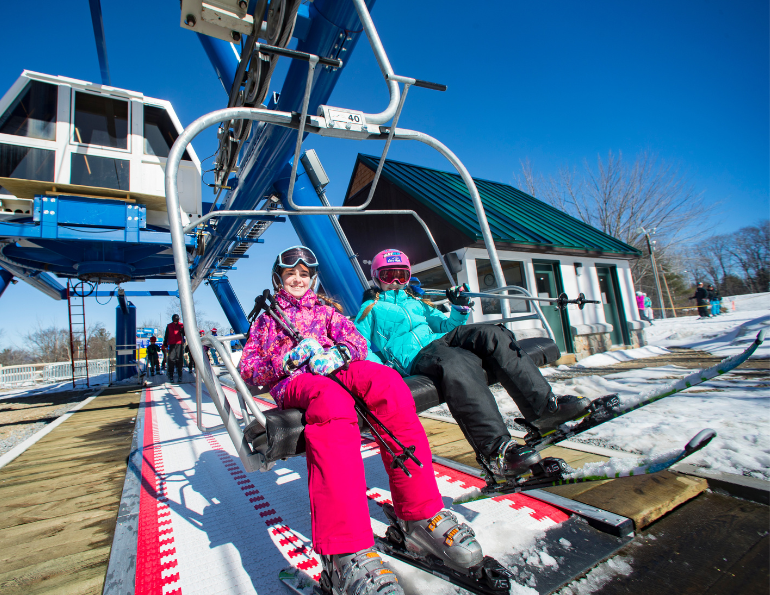
Take lift infrastructure, for instance. Here’s a funny fact that most of the skiing public doesn’t know: High-speed chairlifts don’t always change uphill capacity. They have fewer carriers that are more spread out compared to fixed grips, so the same number of skiers are unloading each hour. What detachables do is shorten ride times. That’s a welcome development on big mountains where a fixed-grip ride might take 20 minutes or more. That’s a long, cold trip. But on smaller hills, the breakeven point on such an investment gets muddy quick.
Kris Blomback, general manager of Pats Peak Ski Area in New Hampshire, did that math 15 years ago. He had seen a small regional ski area go out of business after gambling on a spendy detachable. His calculus? The minimum span that a high-speed quad makes sense is 4,200 feet.
“To go from a seven-minute ride to four minutes doesn’t make sense,” says Blomback. And the investment doesn’t make sense either. “If I have a 50-year-old chair that I need to replace, I can do it with a refurbished fixed-grip chair for $2.5 million versus spending $10 million on a detachable. It’s more of an indie ski area thing, but we can make those decisions because we know our market. And we’d rather spend that money on snowmaking, which is our insurance policy.”
That’s the math, but there are other arguments against detachables. Probably the most compelling one that Blomback makes goes like this: When you put in that first detachable, it’s going to draw a ton of skier traffic. That will increase pressure on that lift line and terrain as your fixed grips get overlooked. What results is a vicious cycle. To spread out skiers again, you install more detachables at great expense, until your mountain’s infrastructure has outpaced your market position.
Fixed-grip chairs over short to moderate spans are not a problem that needs fixing. And you can still be a capitalist and admit that. Mid-sized and small ski areas everywhere remain profitable by thinking carefully about the infrastructure they buy. A 50-year-old Riblet that you can’t find parts for? It probably needs to go. But you can replace it with a refurbed double or triple from the 1990s—or a state-of-the-art new fixed-grip for that matter. Those two approaches, plus maintenance, constitute the fixed-grip lift specialist Skytrac’s entire business model.
My arguments are less algebraic, though. As a teenager, I actually spoke to my parents on double chairs. In college, I courted my wife on fixed grips. When my kids were young, slow triples allowed me the time to tell free-form serial narratives of goofy fiction, trying to time each cliffhanger before we unloaded. Those connections do not happen on eight-packs where uncomfortable commingling with strangers on aerial sofas results in everyone pulling out their phones.
I’m also not ashamed to admit that I love skiing so much, I’ve always been happy to go alone. I ride by myself, lost in thought, thinking about my next run, communing with circling ravens, or watching spindrift explode from pine boughs. Skiing is also about being in the natural world.
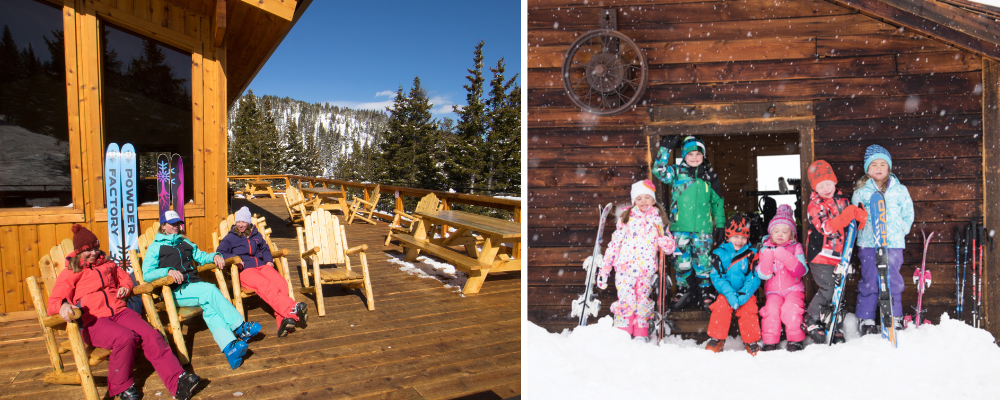 Loveland’s E-Tow Cabin (above) was built in the 1940s and is one of several warming huts on the mountain that don’t require reservations, including the Ginny Lee (left) built in 2014.
The Great Outdoors
The outdoor ethos includes the uncomfortable parts. We taught our kids to ski at Loveland in Colorado. Some of the lifts top out above 13,000 feet on the Continental Divide. On those bubbleless lift rides, I thought of Tolkien’s riddle: Voiceless it cries, wingless flutters, toothless bites, mouthless mutters.
Ski guides like to say that there is no bad weather, just bad clothing. I suffered a bit of frostbite on one of those thin-air rides because I was hyper-focused on making sure the spawns’ skin wasn’t exposed, but day after day, winter after winter we skied true winter temperatures together. Now as adults, my kids aren’t afraid of the seasons.
Much of that cold weather skiing was possible because Loveland didn’t turn its warming huts into formal dining establishments. Still today, Loveland maintains four warming huts on its expansive terrain. My tactic was to drop a bag of thermoses in one of the huts and then duck in for hot chocolate breaks and gumbo by the belching wood stoves. In the spring, families bring burger patties and dogs to grill. Loveland has teams that ensure the propane tanks are full and the fires roaring.
Are you seeing the theme here? As with fixed grips, which nobody thought of as slow until faster lifts came along, so with out-buildings without cash registers.
That’s not to say Loveland hasn’t monetized the huts at all. The E-Tow Cabin, a popular warming hut built in the ’40s and renovated in 2012, can be rented for events and private groups throughout the season. Ptarmigan Roost has food service, and Ginny Lee has a vending machine (undoubtedly high impact on the P&L). As an amenity, though, the huts remain largely free. And the ski area has continued to invest in them, renovating the three old-school huts dating from 1940-1964 in 2012 and 2013 and building a new one, Ginny Lee, in 2014.
Management—people who ski—see the huts as part of what makes Loveland what it is. “One of the many things that makes this place great,” says Loveland director of marketing Loryn Roberson, “is that it’s independently owned and focused on the guest experience. The intention is to keep that amenity for skiers.”
More Than A Lot
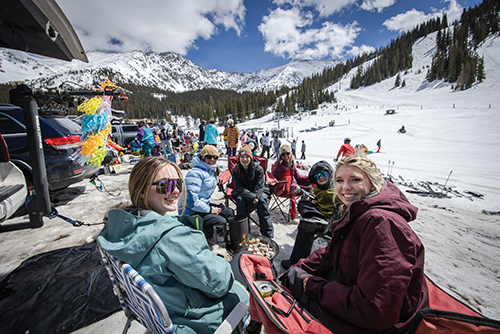 The Beach at A-Basin is part party-scene, part rite of passage, and all tradition—one that COO Alan Henceroth recognizes as an important part of the ski area’s culture.Parking lots are a similar legacy deal that can in some places coexist with revenue. I once listened to a mega resort executive complain that the locals in Tahoe were angry that a dirt parking lot at Palisades was going away. He couldn’t understand why they were upset. But parking lots are fundamental to skiing. Warren Miller used to tow a teardrop trailer from mountain to mountain and camp in the lots at night. College ski days are parking lot affairs. Little kids need car naps after riding the magic carpet. Dogs need to get run. At my adopted home hill in Montana, I walk by tailgate coffee, eggs, and sausage most powder-day mornings.
It was during the pandemic that busy regional ski areas started experimenting with reserved parking. At first it seemed like a short-term Covid fix, but as remote work in mountain towns followed and crowds grew, ski areas like Alta in Utah adopted reservation systems as a form of crowd control. Later, Arapahoe Basin, Colo., instituted weekend reservations for all its lots. For some of the spots, a reservation is about getting a prime location at the famed beach for the party, but for everyone else it means they can rest easy if the interstate is gridlocked.
Maybe someday, our busiest ski areas will be served by light rail—and the ski areas will build base lodges for detraining guests again. But until that time, slopeside parking lots are not blights.
Nobody knows this better than A-Basin. I first visited there in 1988, and the party scene in the lot was vibrant back then. Today it is a rite of passage.
“The energy grows every year,” says A-Basin COO Alan Henceroth. “They love the setup. They love the bratwurst and the beverage with friends. We had to put an end to overnight camping for obvious reasons. And, occasionally, we have to push back on entrepreneurial folks looking to sell food and merch like it was a festival. But our goal is to get our skiers as close as we can to the skiing and let them have some fun.
“I’m sure if I announced that I was going to build condos in our lots, I would be tarred and feathered.”
As you should be, Alan, as you should be.
The Bubble
Skiing has always been entrepreneurial. But gouging the economic elites is neither entrepreneurial nor particularly sustainable. If you hadn’t noticed, the rich aren’t having many kids these days. When there’s nobody inside that bubble chair in 10 years, skiing’s bubble economy will burst.
What if skiing is about something bigger than transporting customers up hills so they can slide down? What if there is more to this thing? Like, say, human connection, nature, athleticism, glisse, beauty, and freedom?
All the accoutrements—lifts, snowmaking, cafeterias, ski schools—exist to serve a shared experience. They do not in themselves make the experience.