




For decades, ski area management degree and certificate programs served as a steady pipeline for resort talent. While many folks learned (and still learn) on the job, aspiring lift mechanics, snowsports school managers, and mountain operations directors can also find a clear path into the industry through college-level training.
“I don’t need to tell mountain managers this,” says Jim Vander Spoel, director of Gogebic Community College’s ski area management associate degree program. “But I’m telling our students (and their parents) that you can make a career in this business.”
The ski area management (SAM) program at Gogebic in Ironwood, Mich., is one of several across North America. Gogebic’s students learn, in part, by running Mount Zion, the school’s own fully-functioning, open-to-the-public alpine ski area, tubing park, and XC ski center—or “learning lab,” as Vander Spoel calls it.
For all that, programs like Gogebic’s are facing headwinds. Enrollment is down across nearly every program we spoke with, schools are contending with funding and staffing pressures, and students increasingly opt to go straight into the workforce rather than spend time in classrooms.
Despite those challenges, the programs are adapting and evolving to meet the needs of the industry.
Where Things Stand
Ski area management and operations training programs began appearing in the early 1970s as snowsports and recreation became solidified as an industry. Since that time, more programs have emerged. Over the years, some have rebuilt or rebranded, and others, such as the one at the former Sierra Nevada College, have disappeared entirely.
The long-running associate degree at Gogebic continues to anchor the Midwest. Colorado Mountain College (CMC) offers Associate of Applied Science degrees in ski area operations and ski area business across multiple campuses in mountain towns throughout the state. Vermont State University (VSU), created in 2023 by merging several small colleges, maintains the legacy of the former Lyndon State College SAM program, founded in 1973, with a mountain resort management concentration in its outdoor education, leadership, and tourism degree. The University of Maine at Farmington (UMF) has offered a SAM program in various forms since 1980; currently, it awards graduates a certificate in alpine operations to go with their bachelor’s degree in outdoor recreation and business administration.
Selkirk College’s two-year diploma program (known as SROAM, i.e., Ski Resort Operations and Management) in Nelson, B.C., is the only one of its kind in Canada. It was initiated decades ago in conjunction with the Canada West Ski Areas Association and Canadian resorts that saw the need for educated graduates.
Newer entrants are emerging, too. Lees-McRae College in Banner Elk, N.C., introduced a ski industry business and instruction minor within its outdoor recreation management degree in 2019 in partnership with Beech Mountain Resort. Wyoming’s Northwest College partnered with Antelope Butte Mountain to roll out a two-semester ski area operations certificate in 2025. That same year, Salt Lake Community College also added a more niche 10-week lift maintenance certificate program in partnership with Ski Utah and the state’s ski areas.
Hands-On Approach
The programs vary in scale and structure, but all share the same foundation: hands-on, industry-connected education.
Internships remain a key part of the curriculum in most of the programs. For example, Gogebic’s calls for 880 employment hours—basically a ski season. CMC students visit nearby resorts and also intern at a host of resorts across the globe. “In their second year, students are only on campus until about October when the leaves turn brown,” says Ben Cairns, vice president and dean of CMC’s Leadville and Salida campuses. “Then any classes are online, and they are onsite doing internships at any number of partner resorts.”
At VSU, students benefit from partnerships with a wide range of local ski areas. “Some are independent; there’s Vail and Alterra; one is owned by a hotel company,” says VSU professor Sean Doll. “It gives students a taste of different management models.”
Delivering what resorts want. Lees-McRae’s collaboration with Beech Mountain underscores how regional needs shape curricula. “There had already been a close tie between the resort and the college; graduates wanted to stay in North Carolina, and we wanted to formalize a program,” says Beech marketing director Talia Freeman. After the program launched in 2019, Beech built a large on-site classroom to support it in 2020.
UMF followed “strong and constructive feedback” from the snowsports industry and relaunched a modified version of its program, says director of the UMF alpine operations certificate program Meghan Price.
“We all feed each other,” says Gogebic’s Vander Spoel. The schools provide educated and qualified employees, suppliers provide equipment, and resorts donate spaces, people, and time.
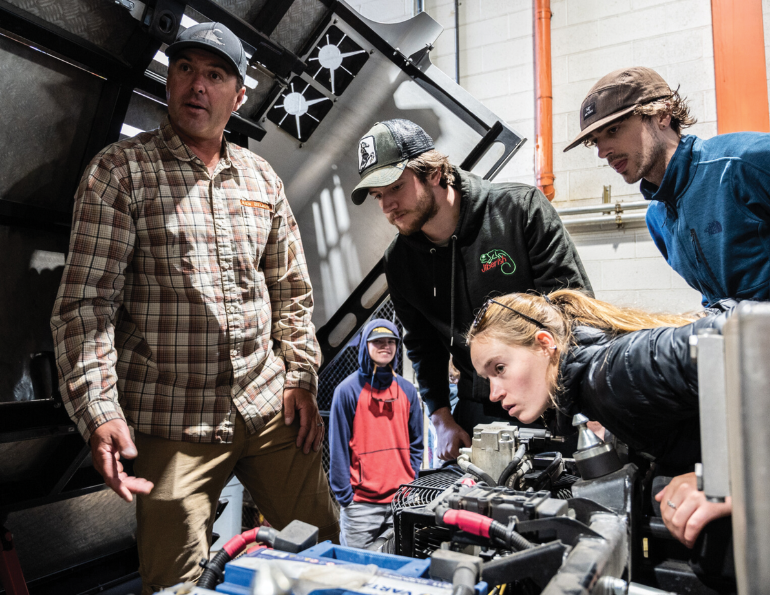
Sometimes, resorts even provide the students. For example, resorts send—and pay the tuition for—many of the students enrolled in Gogebic’s summertime lift maintenance class. In turn, Vander Spoel gets feedback from mountain managers on course content. While the basics don’t change, he says, “some years we’re heavy into electrical. Another year it’s rigging or hydraulics.”
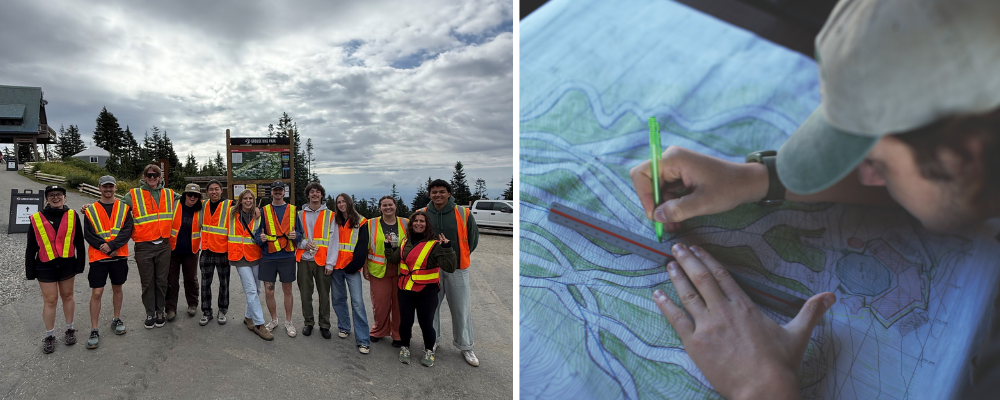 Left to right: Selkirk students take a field trip to Grouse Mountain, B.C., for a safety class; Map building class at Gogebic Community College.
Changing Curriculum
The curriculum for each program has evolved with the industry. “There have been massive changes in technology, direct-drive lifts and detachables, patrols requiring more training, remote avalanche systems, automated snowmaking and grooming systems, climate change—there is nothing that hasn’t changed, and it’s all continually changing,” says Cairns.
Staying current. CMC is redesigning its ski area operations curriculum—and working with industry partners such as Vail Resorts, Alterra, and the National Ski Areas Association to do so. The overhaul includes new continuing education programs for current ski area employees, and a new used lift, which students will be assembling on CMC’s own hill, the revitalized Dutch Henry ski area, which will be student run.
At VSU, Doll has added a technology component in response to widespread changes in the industry. “One day we’re covering POS systems, and the next day LIDAR,” he says. “We cover SNOWsat, and more. Everything is becoming more automated.”
UMF’s Price adds that resort businesses want people with writing skills and the ability to manage developing technology, such as AI models.
Programs have also developed curriculum around summer operations. “We know resorts emphasize career pathways and people who will be able to stick around, so we have emphasized that seasonality,” says Cairns.
Knowledgeable instructors. The people who teach these programs have a deep understanding of the industry, and many of them are technical and regulatory experts. Vander Spoel, for example, serves on the board of the Midwest Ski Areas Association, as an advisor to the state of Michigan Ski Area Safety Board, on the ANSI B77.1 committee that writes ski lift safety standards, on the National Tramway Safety Board, and on the ASTM committee F27 on Snow and Water Sports.
Enrollment Challenges
Despite the modernized coursework and strong industry partnerships, every program director we spoke with reported decreased enrollment in 2025. The reasons for the decline vary. Among them:
Colleges generally are struggling. In the case of VSU’s concentration (which has two tracks, one in mountain operations and the other in resort management), the enrollment numbers reflect the general enrollment struggles of small New England colleges, not a flagging interest in entering the ski business, says Doll. Plus, the name change to VSU eliminated the name recognition for the well-known Lyndon State program. “We’re in rebuild mode,” he says of the program getting back on its feet under the new name.
Choosing work over education. CMC also had a smaller-than-usual program enrollment last year. “Modern students want to get into the workforce,” says Cairns. And many students have jobs in the ski business already. “Students are saying, ‘if I have a job, why am I staying in school?’” he adds. Rather than compete with mountains for students, Cairns has worked with resorts, who want—and, in many cases, need—employees who are certified, qualified, and educated.
Cairns also reports a trend toward “one-off” students—those who take a course (for example, in lift maintenance), because their employer required it or sent them to take it. “Resorts are willing to invest in their employees’ education if those workers are going to stay,” he says. Meanwhile, graduates of many of these programs walk away with more than a certificate or diploma—they’ll have completed PSIA, OEC, and other technical certifications, too.
Immigration restrictions. The 13 students enrolled in last year’s Selkirk College SROAM program was the lowest ever. “We usually have a number in the twenties,” says Martin Keyserlingk, chair of Selkirk’s School of Hospitality and Tourism. He notes that changes in Canadian immigration rules have strongly affected Selkirk College, which historically included many international students across its general student population.
Growth Opportunities
Still, Keyserlingk is confident that recruitment efforts from CWSAA and other regional ski associations, combined with the comparatively low cost of college in Canada, will see the program through. “We are well-respected and well-connected in western Canada,” he says.
In the East, there’s potential in scholarship opportunities like those offered by the New England Board of Higher Education (NEBHE), which offers scholarships to students looking to attend out-of-state state schools for majors not available from their home state school. “We get a lot of students from Connecticut and Massachusetts,” says Doll.
A role for alumni. Every program leader says alumni are key to recruitment. Plus, since they now populate every level of management at ski areas, graduates provide valuable feedback, donate time to give talks or teach a session, and donate spaces and equipment.
“I see them in the field all the time,” says VSU’s Doll. “It’s quite rewarding when you listen to former students and realize they have surpassed you in their knowledge of the industry.”
Knowledge Is Power
With tracks focused on operations, business, and technical skills development, these programs prepare people for not just entry, but also advancement, in the ski business. Even with smaller cohorts, SAM college degree and certificate programs continue to produce well-rounded graduates eager to make their mark on the industry.
Beech Mountain just hired three new graduates of the Lees-McRae program into manager roles across retail, rental, and terrain parks. “We are seeing the fruits of our labor with the program,” says Freeman. “We are all so proud.”
“Everyone has a role to play in the industry,” Vander Spoel muses. “I think we play a large one.”