

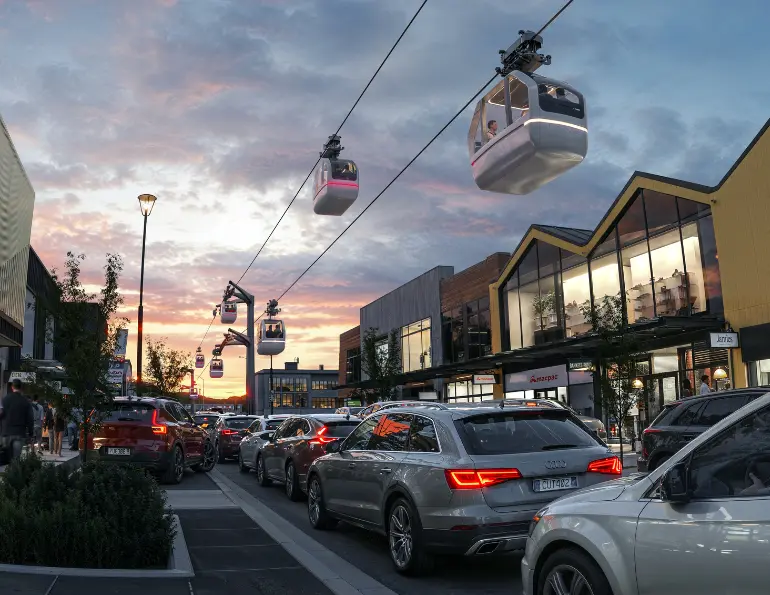
New aerial transport systems can reshape the future of mountain towns.
Anyone who’s lived in a mountain town knows congestion is an issue. Populations increase exponentially during peak winter periods and busy summers, with visitors and locals forced to sit in traffic jams that would be more “on-brand” for midtown Manhattan. Businesses struggle to maintain staffing because workers can’t afford the inflated housing prices on service economy wages. Locals curse out-of-towners for exacerbating (or, to some, causing) the issues, despite their financial contributions to the local economy.
Well, there may soon be a solution, at least on the transportation front.
Over the last decade, “supergondolas,” or gondola networks that build upon existing technology to function autonomously as an aerial transportation solution, have been gaining traction in cities and resort towns worldwide. As they become more mainstream, they could be used to transport people from surrounding (and cheaper) towns to resort towns, around mountain towns, and between towns and ski areas.
Chris Allington, CEO of Whoosh, a supergondola company formed to develop technology initially conceived by his engineering firm, Holmes Solutions, envisions a world that may have existed in a 1980s episode of The Jetsons.
“[We’ll have aerial] cableways, which are visually low impact and could span long distances without many towers, with corners and merge and diverge points, and little stations where vehicles can be parked for passengers to load and unload while other vehicles are still carrying on along the network,” Allington says. “We’ll have small stations where the vehicle spirals down the column to ground level. If we can create all that, then we can make a system that would allow you to call a vehicle on your app, the doors will open up and close behind you, it’ll lift you onto the network, and then take you exactly where you want to go.”
The Technology
Origins. The idea of using an app to hail an on-demand personal gondola service draws inspiration from ride-sharing apps—but it hasn’t yet been implemented at scale. What Holmes Solutions has proved is that an aerial vehicle can transition between straight cables and curved tracks, one of the company’s major innovations.
“One thing we initially were trying to solve was transitioning from cable to rail at speed, which required a tremendous amount of engineering breakthroughs,” says John Schaefer, a product director at Holmes Solutions. “And the amusement park space is willing to embrace new technology earlier than transportation systems. So we found someone who wanted to [install a new ride], allowing us to prove the concept in a space that’s about thrills and excitement.”
The company’s cable-to-rail zip line ride, the Flying Ox, at Paula Deen’s Lumberjack Feud in Pigeon Forge, Tenn., was the first of its kind when it opened in 2019 (and was part of the SAM Summer Ops experience that year). The attraction, which marked the debut of Holmes Solutions’ early Switchback ride system, uses static cables and tracks to incorporate turns and bends while minimizing staff requirements.
The Whoosh team sought to scale the Switchback technology, eventually attracting the attention of Google executives, who commissioned the company to showcase its tech as a potential solution to transportation issues at Google’s California campuses. While the Covid-19 pandemic prevented the completion of that project, Whoosh pushed on.
Unlike a traditional gondola, Whoosh’s system uses a combination of static cable and track on which autonomous cabins ride, each propelled by a small battery-powered motor. This reduces the required footprint and makes the technology energy-efficient—energy is only expended when the cabins are in use. Whoosh claims a 75 percent reduction in energy use compared to commuter rail or transit buses.
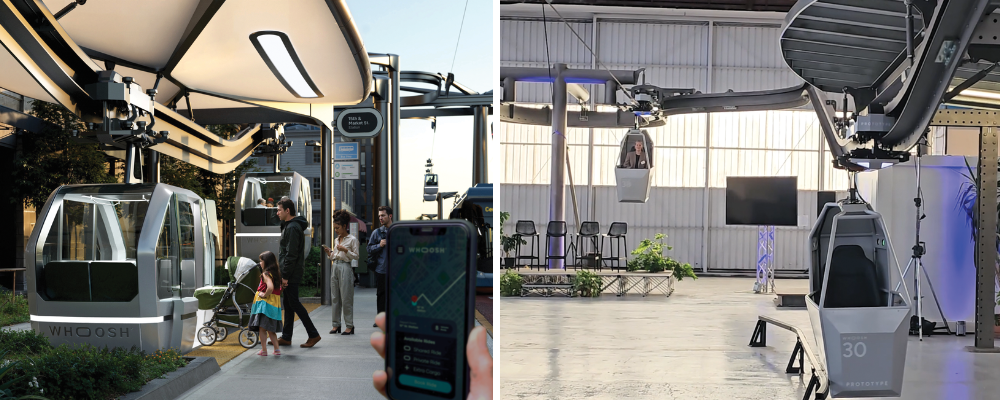 Left to right: Renderings show Whoosh picking up passengers; Whoosh built a quarter-scale prototype at its headquarters in Christchurch, New Zealand
Current plans. Today, a quarter-scale Whoosh prototype is functioning in New Zealand, and plans are in place for a test track to be operational at Christchurch International Airport by early 2026. Once that’s complete, a three-stop, 2-kilometer prototype connecting the Queenstown Airport to the shopping and hospitality district in Frankton will be built and rolled out to the public. The plan, which remains subject to approvals, is one option for a larger network throughout the town. A more traditional gondola system is also being explored.
While the proposed Queenstown-Lakes District Whoosh network would be built in phases, once a new section is connected to the network, riders won’t be limited to pre-determined routes but will be able to take direct trips to any stop or station along the completed network, which will link the airport and Frankton area to residential neighborhoods, new real estate developments, The Remarkables Ski Area access road, and eventually, downtown Queenstown.
The Whoosh cabins, which will reach a maximum speed of 40 miles per hour, can be hailed using an app that functions like Uber and Lyft, allowing for customizable, non-stop trips from point to point. Alternatively, ticketing machines can replace the app.
The network would cost Queenstown roughly NZ$10 million per kilometer (roughly US$10 million per mile), comparable to, and in many cases cheaper than, traditional urban gondola solutions, which can run upwards of $30 million a mile or more.
The project could be completed by 2030, fueled by the town’s goal to meet lofty decarbonization targets.
The perfect test lab. Queenstown sprawls along the shore of Lake Wakatipu and is hemmed in by mountains, making space scarce and aerial transport attractive. While its permanent population is about 29,000—47,800 in the wider district—tourism can swell that number to more than 100,000 during peak periods. The town sees roughly 3 million visits annually, including about 400,000 for skiing and riding in the winter. For the New Zealand-based Holmes Solutions, it’s the perfect place to prove its concept is viable.
“Queenstown has some really unique challenges,” says Allington, who had long been thinking of ways to solve the town’s congestion issue. “It’s sandwiched between mountains and a lake and has a number of rivers around the city, so there’s no more room for roads. And the existing roads are completely clogged. Doing anything new is expensive because of the geographic issues.”
Mat Woods, Destination Queenstown’s chief executive officer, had also been searching for options to solve the town’s congestion issues when he discovered Whoosh’s technology.
“Before Covid, tourism was booming, and the local community was pushing back on the visitor economy, saying it feels too busy and they aren’t seeing the benefits,” Woods says. “But New Zealand closed its borders for two and a half years during Covid, and suddenly the community realized, ‘maybe we do benefit from tourism.’” Plus, the town still suffered from traffic congestion. “There was a real ‘aha’ moment where we realized we were actually a part of the problem,” he added.
Considering all angles. The town, with support from the New Zealand Transport Authority, is considering multiple aerial solutions to tackle its growth, congestion, and sustainability goals. In parallel to the Whoosh proposal, a Regional Deal plan to develop a network of more traditional gondola links is also seeking approvals. Doppelmayr has been named the preferred supplier for a proposed line connecting the Frankton bus depot to the growing Ladies Mile area northwest of town, while Leitner has been named as the partner on a line linking Queenstown Airport with the town center.
A traditional gondola would provide a higher-capacity solution for some of the town’s major arteries (it’s expected that Whoosh will be limited to 5,000 people per hour in each direction). The projects aren’t necessarily in competition, though. If traditional gondolas are installed, Whoosh says it could help expand travel to a broader network through connections between systems.
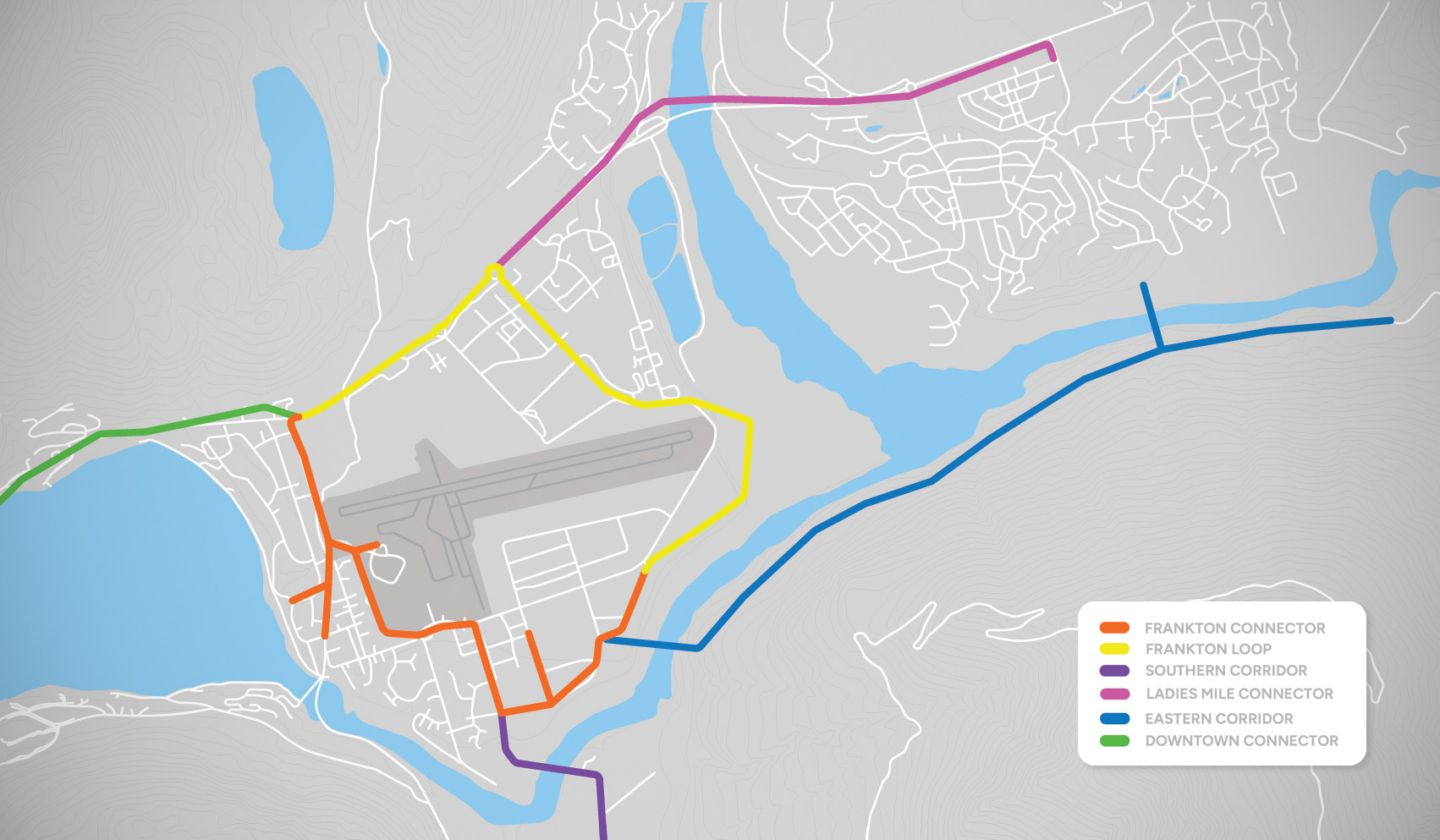 Whoosh has proposed a multiphased build for a network that would start with a connector serving the airport and Frankton business district, at the bottom of Lake Wakatipu , southeast of downtown Queenstown.

Supergondolas vs. Traditional Transit
For Queenstown, rail-based options, buses, or other forms of public transportation are either costly, require unavailable space, are time-consuming to build, or a combination of the three. Supergondola systems can be built along existing roadways and through canyons where infrastructure already exists, and don’t require nearly as much space or infrastructure. “Plus, ropeway systems are something we have experience with because of our ski fields,” says Destination Queenstown’s Woods.
A competitive landscape. While Whoosh is gaining momentum with its supergondola technology (it has several other projects in the works, including one at Great Park in Irvine, Calif.), it isn’t the only company working on this type of solution. Recent investments and technological advances in batteries for electric vehicles, motors, and autonomous control systems are sparking a movement toward supergondolas.
“I think there’s a realization that our current ways of solving transport issues aren’t working, and it’s not getting better when you build more roads,” says Allington. “What we’re doing is utilizing a lot of these new technologies, so you’re getting the benefits of billions of dollars of investment in those technologies applied to a new application.”
The lift companies. Both Leitner and Doppelmayr have proven the concept of gondola networks for urban transportation. Leitner incorporated gondolas into the transit system in Medellín, Colombia, in 2004. Doppelmayr’s largest installation, operating in La Paz, Bolivia, since 2014, utilizes safety and monitoring systems that minimize staffing and enable 24/7 operation—technology that could be mirrored in mountain towns. The 10-line network is integrated into the city’s public transit system and serves around 300,000 passengers per day. Doppelmayr and Leitner are both also developing supergondola transit solutions.
Other innovators. The Japanese company Zip Infrastructure, founded in 2018, has designed a gondola system called Zippar, which is similar to Whoosh’s technology. Like Whoosh, Zippar will be an on-call system that utilizes an app. Gondolas are propelled by attaching to small electric vehicles on overhead tracks and cables, and are expected to handle around 3,600 people per hour. A prototype is already operating in Fukushima, with several additional projects in Japan in the works.
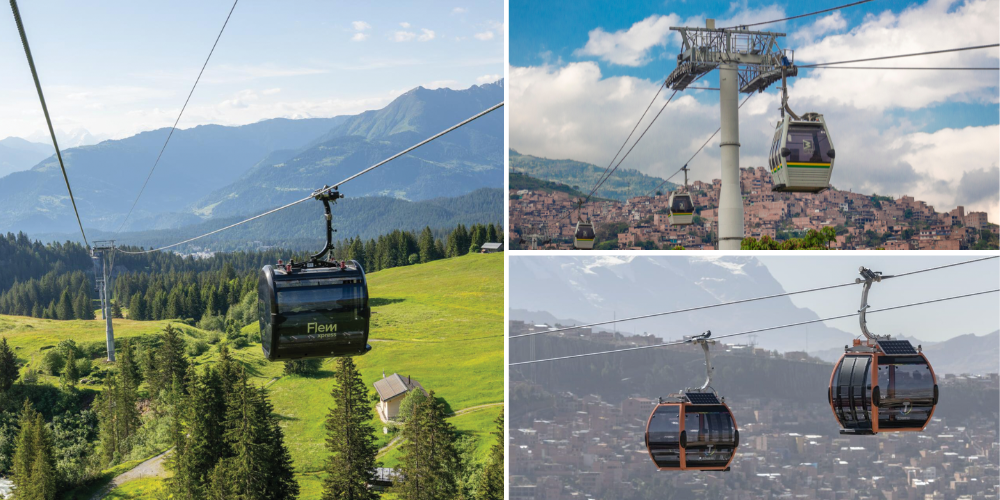 A Weisse Arena / Bartholet ropetaxi, the FlemXpress, installed in 2023 and expanded in 2024 and 2025 (left), uses new autonomous, on-demand technology to connect multiple stops across Switzerland’s Flims Laax Falera area (Credit: Weisse Arena Gruppe). Leitner’s gondola network has been serving Medellín, Columbia, since 2004 (top), and Doppelmayr’s largest urban installation has been operating in La Paz, Bolivia, since 2014 (bottom right).
In Switzerland, the FlemXpress, an autonomous gondola that connects the town of Flims to different stations on the surrounding ski area, has been operating since 2023. An additional segment was added in 2024, and a final one opened in December. The gondola system uses a traditional moving cable when in use, but is propelled by an autonomous electric drive system at each station, allowing cars to remain parked when not in use and reducing overall energy and staff requirements. The FlemXpress was designed by Weisse Arena Group and Bartholet Maschinenbau AG.
Gondolas for U.S. transportation. Using gondolas as transportation isn’t exactly new in the U.S., either. The Mountain Village gondola transports three million riders annually between the town of Telluride and Mountain Village at the base of Telluride Ski & Golf in Colorado. It’s been in operation since 1996 and has been successful enough to warrant planning for an upgrade to expand capacity and update the technology. In Utah, significant congestion in Little Cottonwood Canyon has prompted exploration of a gondola system to address it. Proposals for commuter gondolas in Austin, Albany, and Los Angeles all exist, too—but many have met opposition related to perceived cost, viewshed, and construction disruption and damage implications.
Challenges Ahead
The installation of a new aerial transport solution comes with challenges.
Applicability. Supergondola and ropetaxi systems that use static cables, such as Whoosh and Zippar, can’t operate on extreme grades. Zippar’s maximum grade is around 10 percent, which can be limiting in mountainous areas.
Funding. Queenstown’s gondola system will likely be funded by a combination of private investors, central government, and, potentially, a lodging tax, which hasn’t yet been implemented anywhere in New Zealand. Depending on how the project is categorized, there could even be operational subsidies, which are available to “roading” systems, to help keep costs down for riders. In Flims, the FlemXpress was primarily funded by the private ski area, with a smaller contribution from the town.
Public perception. With any new technology or projects that alter the landscape, community buy-in is critical. According to Shawn Marquardt, Doppelmayr senior director of sales, community buy-in is one of the biggest obstacles. But urban projects, like the one that’s been operating in La Paz, prove that normalization is achievable.
In Queenstown, where congestion was the bane of the community’s existence, getting locals to buy in wasn’t hard.
“I was in a cab as a passenger going from town to the airport, and the driver didn’t know what I do,” recalls Woods. “And she said, ‘I hate this drive. I can’t wait for them to build the gondola.’ And so here we have a cab driver who technically would be losing some business once the gondola goes in, and she can’t wait for it to happen. I think people really see this as an innovative way to get the town moving again.”
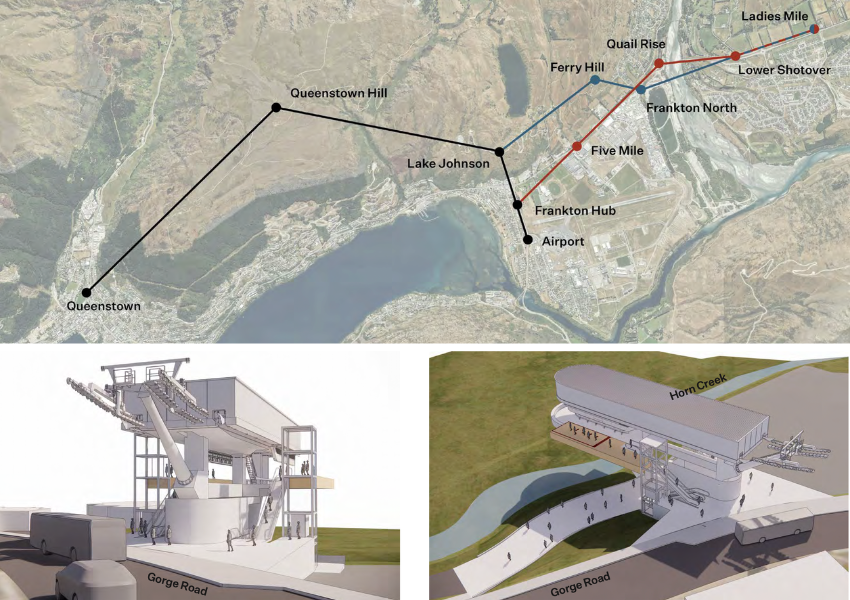 In addition to Whoosh’s proposal, Queenstown officials are also assessing a proposal for a more traditional rapid cable-car network that would serve sites across central Queenstown, Frankton, the airport, and Ladies Mile (top). Renderings of potential gondola stations from a project application submitted to the NZ government (above).
Shaping the Future of Mountain Towns
The silver lining of working to normalize gondola systems for transport around mountain towns is that gondolas are a familiar concept, and the persistent issues of congestion, climate change, employee shortages, and housing shortages are problems everyone wants to solve.
“What we can do is free up land by floating above it with a minimum footprint,” says Allington. For example, ski areas, which often struggle with parking, could connect off-site parking areas and the resort base with an autonomous gondola. This technology could also make it possible for the workforce in popular mountain towns to live in cheaper towns nearby, connected by a supergondola that allows them to get to work without a car or sitting in traffic.
And these autonomous gondola systems aren’t some far-fetched futuristic pipe dream—they’re already becoming reality.