



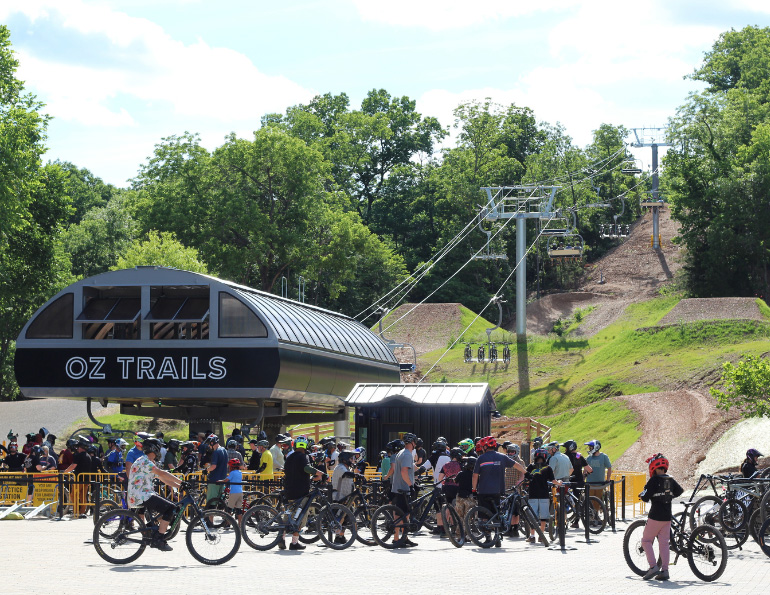
“Spirit Mountain is a good Midwest ski resort and a solid bike park at the national level,” said Jon Regenold of Spirit Mountain, Minn., at this year’s NSAA Bike Park Summit. This sentiment, that a smaller-scale operation can hold its own with the biggest players in the bike park industry, is becoming realized. The OZ Trails Bike Park in Bella Vista, Ark., has emerged as the ultimate proof of this concept.
OZ is one of several “disruptors” that are challenging the traditional bike park model—defined as being lift served and at a ski area. Owned and operated by the Walton family’s Runway Group under the OZ Trails brand, the OZ Trails Bike Park is the first lift-served mountain bike park in Arkansas, with more than 20 miles of purpose-built gravity trails serving beginner to pro-level riders.
OZ reflects parts of the ski area model: it has a brand-new detachable chairlift, gravity trails, a bike shop, rentals, instruction, and dining. It invites riders of all levels and strives to make them all feel welcome and accommodated. While OZ is not especially small-scale, it has just 300 feet of vertical. That’s less than, say, Spirit Mountain, or most all ski area bike parks.
Vive la Différence
OZ departs from the ski area model in a few ways, such as adding art installations at a plaza that very intentionally provides a place for the community to gather. And it welcomes everyone, including non-riders, to enjoy the overall scene, the art, a pump track, and the restaurant. Rather than opening a bike park at a ski area, they opened a destination optimized for an experience of its own and not one struggling to emerge from skiing’s shadow.
The operation describes the concept as a place where “trails, friends, food [and] art” come together. Conversely, most bike parks in the United States follow a much different concept—a summer revenue opportunity that uses existing ski area infrastructure to meet its needs (and better have limited impact on winter operations!). One of the biggest pitfalls of bike park operations at ski areas, it seems, is the ski areas themselves.
Ingredients for success. OZ opened June 12, 2026, coinciding with Bentonville Bike Fest, and achieved daily visitation in its opening weekends on par with that of Trestle at Winter Park Resort, Colo., and others regarded as the top bike parks in North America. There are a few factors that can be cited for this success.
First and foremost, OZ is located within the already famous “mountain bike capital of the world” ecosystem of Bentonville. You can’t run extra PSI in your tires there without the bike world knowing about it.
Within that ecosystem, the Runway team built something that was genuinely newsworthy. This is a “first of its kind” product, not another trail opening in an already trail-rich area. Anticipation was manufactured before opening by providing founding members with early access and giving influencers and riders sneak peeks, so content about the park circulated well before June.
Not to mention, the park photographs extremely well. This was not an accident. Iconic features, pristine trails, a chairlift, modern architecture and large-scale art provide visual content that travels exceptionally well through mountain bike media and social channels.
Ready-made advantages. Before you cite the Waltons’ (of the Walmart empire) financial backing of OZ bike park for its success—with a capital infusion that provided for a new detachable chairlift, trails built by the best builders in the world, and high-end facilities—note that ski areas already have an operational leg up when opening a bike park. Chairlifts, facilities, and supporting infrastructure are already present to support a best-in-class bike park experience.
So, why are so many bike parks at ski areas struggling while newer offerings outside of ski areas are seeing success?
Because successful bike parks focus on the experience above all else, not on how to use their existing infrastructure to open an ancillary line of business, as many ski resorts do. To realize the success places like OZ have seen, planning must start from scratch and create an identity uniquely centered on biking.
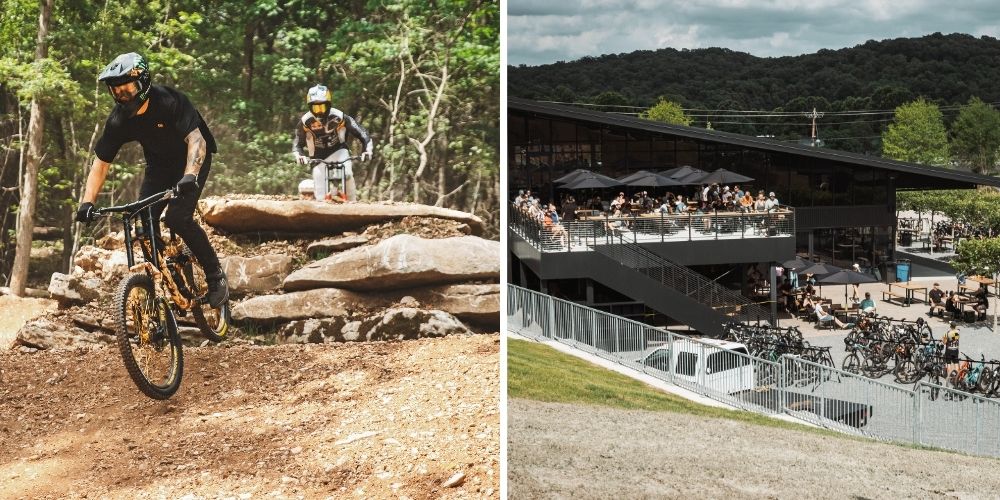 A compelling trail mix (left) and facilities (right) make OZ Trails Bike Park a best-in-class experience with right-sized infrastructure.
The Evolving Scene
Ten years ago, if someone said, "destination bike park," everyone pictured the same thing: a ski resort spinning lifts during its “off season” with mountain bike trails across its winter operating area. Today, that’s an outdated definition. Some of the fastest-growing gravity riding destinations aren't defined by chairlifts or sprawling terrain at all. They're defined by the right mix of quality-built trails that are accessed by means other than a chairlift. And many aren’t located at ski areas.
Trail mix. Generally, the right mix of trails will serve a variety of ability levels, with an emphasis on a top-notch beginner and intermediate rider experience. Many of the best builders say your beginner (or green) trail is the most important, followed by trails and features that foster an incremental, safe, and predictable learning progression from easier to more advanced. This mix defines the best bike parks in the world.
The disruptors. Examples? Windrock (Tenn.), Ride Rock Creek (N.C.), Ride Kanuga (N.C.), Jarrod’s Place (Ga.), and even Maydena Bike Park in Tasmania. While these operations vary in scope and scale, they all have a couple of things in common: None have chairlifts or operate at ski areas.
Yet, each has made an impact on the sport. Maydena proved that the biggest events in the sport (Red Bull Hardline) can be drawn to one of the most remote places in the world, a town of less than 200 people on a tiny Australian island. Windrock, Ride Rock Creek, and Kanuga are established epicenters of the U.S. competitive downhill scene and are doing so entirely with shuttles and e-bikes. Jarrod’s Place has features that are on par with the biggest lines at any park in the country.
Lift-served Highland, N.H., and Spider Mountain, Texas, should be included in this conversation, too.
Highland is an exemplar of a dedicated bike park that only blended into the ski industry conference crowd for so long because it took over a defunct ski area, but skiing is now a ghost of the past. Mark Hayes and his team at Highland have been living and breathing the bike destination model for two decades, focused on a quality bike park and trail experience above anything else.
Of note, Highland’s Central Park progression area is served by a surface lift, allowing riders to lap a smaller, concentrated zone separate from the chairlift-served terrain. Benefits of this setup include much lower capital and operating costs than running another aerial lift, high lap frequency, separation of progression/jump-park users from the main lift queue, and efficient activation of relatively low-vertical terrain.
Spider Mountain is open year-round, and while its focus is on the bike park experience, it’s inviting to all with scenic chairlift rides, a wedding and events venue, dedicated hiking trails, and more.
Right-sized infrastructure. The disruptors challenge the idea that bike parks don’t make money. Skiing, of course, is not financially propping them up because it doesn’t exist at any of these locations. This highlights that while ski area infrastructure is in many cases the greatest asset to a bike park operation, it may also be an Achilles heel.
The importance of ski areas in bike park history cannot be overstated, but too often, it seems that oversized infrastructure, which is scaled to winter skier visitation, baits resorts into the pitfall of trying to build a "final bike park" immediately. Bike parks that don’t make money often fail because they are not right-sized, are built for the wrong audience, or were conceived without a disciplined growth strategy. Trestle and Highland did not become the largest names in the U.S. bike park scene overnight; they did so by growing ridership through phased trail development that supported a learning progression and developed its rider base from within.
So, as you evaluate a new or existing bike park, ask yourself: Even though we have a chairlift, should we use it? Just because we have thousands of acres of steep and rocky terrain, should we develop all of it? Do we really need to use our entire cafeteria? How can we turn our base of bike park operations into an attractive, appealing location for summer guests that may not be riding a bike?
It pays to take this big-picture approach. Operations that are pursuing well-planned, phased growth with disciplined investment, and that match development to operational capacity, are seeing great success.
The Experience Matters Most
When it comes to bike parks, the ski industry has been optimizing around infrastructure. The next generation of successful operators will optimize around the experience.
Recognize that not every bike park needs to have the same purpose. There is potential success in models that range from destination revenue driver to community recreation asset to summer diversification platform.
With many Midwestern ski areas facing climate realities that have significantly reduced their number of operating days, there is hope that we will see the success of the disruptor group extend to some of these ski areas and elsewhere across the country. Perhaps the days of a “destination” being measured in vertical feet or sheer mileage of trail are numbered. And gone is the connection of bike park visitation to lift ticket sales. In its place, guests are paying for trail experiences.
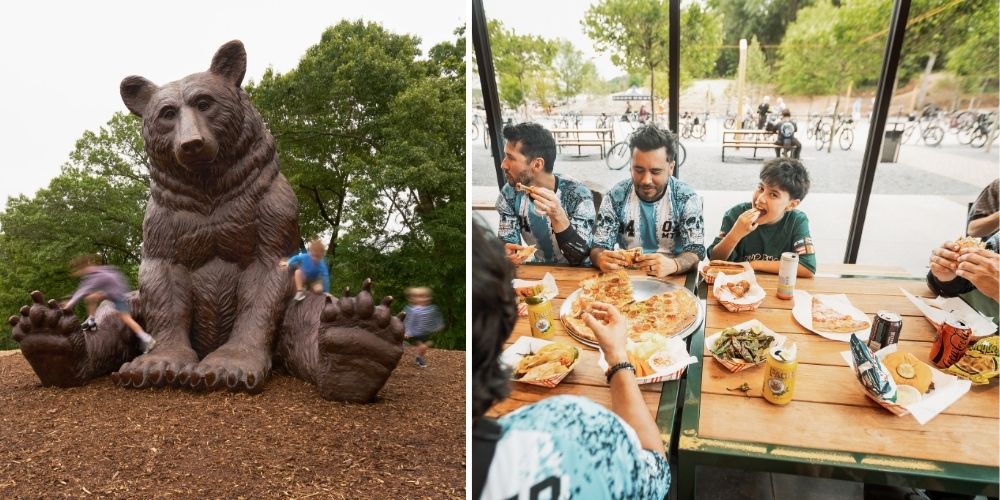 Art (left) and food (right) make OZ an attractive gathering space for mountain bikers, families, and the wider community.
What’s the Potential?
A recent Trust for Public Land green paper, Economic Benefits of Mountain Biking, serves as the scripture for the golden era of bike parks prophecy. This report highlights that almost 3 percent of the U.S. population (more than 9 million people) mountain bike, and it’s an affluent user group. They are willing to travel, they spend money when they do, and a lot of this spending occurs off the bike.
The statistics are similar to those of recent ski industry studies, yet bike park visitation pales in comparison to that of winter skier visits nationwide. This can be attributed to the vast array of no-fee trail networks available to mountain bikers, and potentially the stigma that bike parks are only for upper ability-level riders. However, the potential is there, and others beyond the ski industry are meeting the demands of this user group.
Change your perspective. The ski industry invented the modern bike park. The next step in the industry’s bike-park evolution is recognizing that the chairlift is no longer the defining feature of the experience; it is simply one way to deliver it. Existing infrastructure cannot be ignored entirely when planning a bike park at a ski area, of course, but it shouldn’t get in the way of developing a bike park vision that is distinct from winter operations.
We can learn from the disruptor group and break the mold for the traditional bike park at a ski area. It starts by following three simple tenets:
1. Collect and use your data.
2. Know your audience.
3. Plan for disciplined growth.
Scale and grow for the park you want to be and use what you know to craft the best possible experience for your audience. These pillars, not your infrastructure, should guide your visioning.
A strategic business plan founded on these pillars can change the trajectory of ski area bike park operations. We’re hopeful it does and that the future is bright and full of bike parks.