



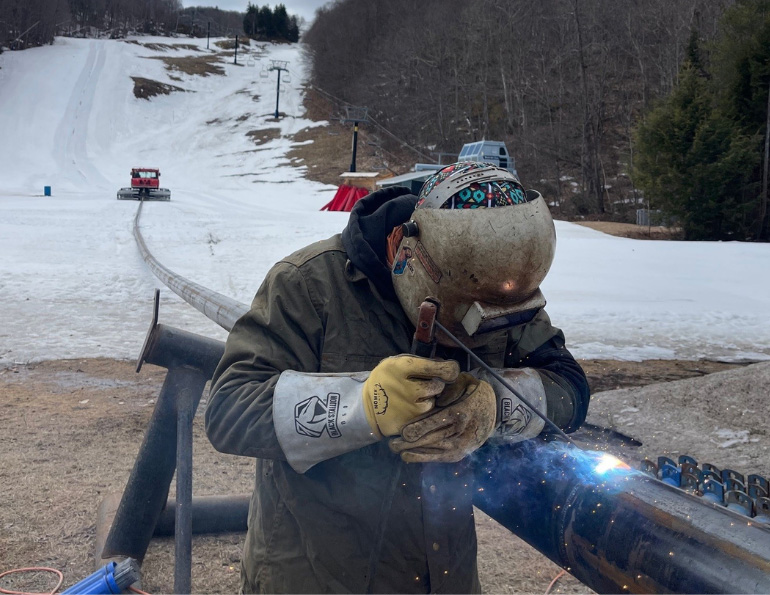
I’ve spent 25 years in and around snowmaking in the Northeast. First as a snowmaker, now as a contractor building and modernizing the infrastructure. Different mountains, different owners, different budgets. Same challenges, season after season, capital cycle after capital cycle.
The good news is, the challenges are fixable, and it mostly comes down to how far ahead you plan. The next 20 years of skiing in North America may depend on what we build in the next five.
Align with Your Business
Snowmaking used to be how you opened. Now, it’s how you have a season between the Christmas thaws, MLK rain, and February vacation rebuilds. Making snow after Presidents’ Week was close to unheard of not long ago. Last season, several areas were still making snow in April.
The bar moved because the customer moved it, the same way it moved for lifts in the ’90s. Once a few resorts put in detachables, fixed grips became the source of complaints. If one mountain is running guns in March and another down the road isn’t, skiers see both in the same afternoon.
If you’re making snow in March, though, you need pipe and guns on the terrain where the season gets saved, not just where it gets started.
With our industry’s aging infrastructure, most of the systems I walk into aren’t aligned with the business anymore. The pipe goes the same place it did in the 1980s rather than where the skiers go now. The crew fights the system instead of running it.
Follow the business. The work is putting the business back in front: pipe where the skiers go; capacity sized for the season you actually have; and your bread-and-butter trail open top-to-bottom within the first two weather windows.
When planning snowmaking upgrades, build the system to support your business. Don’t let the system dictate your business.
Use Systems Thinking
Modernizing a snowmaking system means matching the infrastructure to what the equipment requires and designing it around the people who run it. For example, a modern stick gun runs around 40 CFM. An internal mix air-water gun from the ’80s uses around 400. That’s a 90 percent cut in compressed air and a simultaneous increase in water to make more snow.
Most foundational Northeast snowmaking went in between the early 1970s and the late 1980s, then expanded through the 1990s and early 2000s. Most of us are running all three eras stacked together.
But pipe spec’d for the old math is doing the new math now, and it can’t finish the equation. The ’80s feed lines weren’t sized for the ’90s expansions tied into them. The ’90s pressure zones weren’t intended for the low-energy guns that came later. Combined, it’s a system from which the new equipment asks too much.
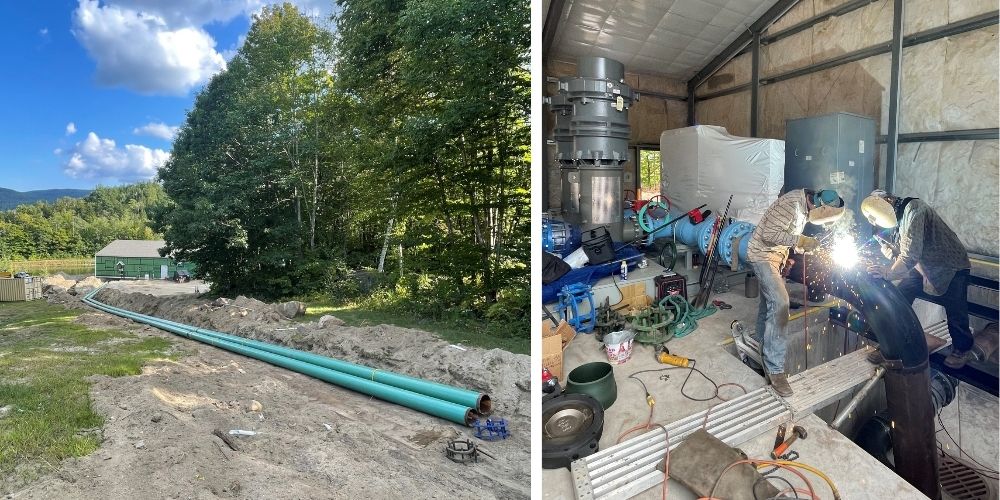 Left to right: Installing new, larger feed lines out of a new pump station is one component of a phased rebuild of the entire snowmaking system at Tenney Mountain, N.H; Welders work on a new booster station at Boyne Mountain, Mich., as part of a major infrastructure upgrade.
Design with Snowmakers in Mind
Ergonomics is a cornerstone of good system design, and it isn’t so much a matter of comfort as it is efficiency. When snowmakers have to crawl into holes to reach a valve or hunt a buried hydrant behind a rock nobody flagged, that costs time. Time is production. Production is snow on the ground.
As Sunday River (Maine) general manager Brian Heon put it: the days of 35 or 40 snowmakers running around a mountain are over, and nobody should be wrestling a gun with a hundred pounds of air behind it.
Remove barriers. When you remove the barriers, the same crew of snowmakers will put down more snow in the same window of time.
Sunday River embraced this idea during a 2023 multi-phase snowmaking upgrade that started with my Summit Resources team constructing a booster pump house and installing several new valve stations to serve the mountain’s Outback area. Previously, distribution was a significant constraint. Water had to travel from Barker on the east side of the resort to Jordan, the system’s westernmost point, along a convoluted route. Charging the line meant torching frozen valves and digging out buried valve stations.
The fix was a buried feed line that stays frost-free and full, with the new valve stations tapped directly into it.
“We went from hours and multiple valve stations to streamlined valve stations and minutes to get water and pressure to that area of the mountain,” says Heon. The changes gave the crew back three to four hours each night, tripled the water flow, and made room for four times the gun count.
Locating the pump house at mid-mountain rather than at one end of the system provided another benefit: it became a functional base for the snowmaking crew, with dryers, workspace to repair hydrants and roll hose, and a warm place to take breaks.
Of course, construction always reveals surprises—ledge, unmarked pipe, contours nobody drew. Involving the builder during design to read the ground can help uncover those issues early.
Invest in People
Snowmakers are critical to any snowmaking enterprise. “It’s pipe, it’s valve houses, it’s guns,” says Heon, “but those are only as good as the people that make the snow.”
Snowmaking is one of the most technical jobs on the mountain and one of the least credentialed. Lift maintenance answers to state tram boards and has a defined ladder a technician can climb. Patrol has certifications that mean the same thing across the country. Snowmaking has no ladder, and no handoff that travels from one hill to the next.
That’s not for lack of effort. Manufacturers run service schools. NSAA and state and regional associations put snowmaking sessions on their conference agendas. There’s even a “Snowmakers of the World Unite” Facebook group with a real community, working through real problems, and sharing fixes that hold.
Ski New Hampshire association president Jessyca Keeler started a Snowmakers Seminar three years ago, after someone pointed out that lift mechanics had a training program and snowmakers didn’t. The pilot drew 15 people. The next year, 40. This past April, it ran for two days, in person and hands on, and pulled nearly 70 snowmakers from five states. Sessions included electrical theory, print reading, pump house controls, troubleshooting, snow gun maintenance, and math for snowmakers.
Capture institutional knowledge. While there is no credential for snowmakers, the industry doesn’t lack for content. The challenge is that the lifers who built these systems are aging out and not all of them are handing their knowledge down.
For ski area leaders, the move is simple: put training money in the same budget conversation as equipment money, and send your snowmakers to the programs that already exist.
Training is only part of the equation. The industry’s mid-career snowmakers are already carrying much of its institutional knowledge, often without much recognition. Keeping those employees means valuing both their expertise and work. Then make sure that expertise doesn’t leave with them: label it, number it, document it, and create a system the next crew can understand without starting from scratch.
Think Beyond the Annual Budget
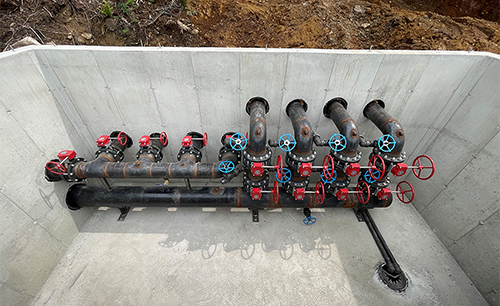 One of the new valve stations installed at Sunday River, Maine, as part of a multi-phase upgrade that saves snowmakers hours of time compared to the previous setup.Loon Mountain, N.H., has been planning to replace its gondola for at least five years. The Forest Service application went in this past May and ground breaks in 2027 or 2028. Five to seven years from concept to operating a lift, which is not unusual. Now ask a GM how far out they plan snowmaking capital. The honest answer is often six to eight months. So, we’re making six-month plans for a system expected to last 20 years.
Some of that gap is driven by regulation, since lifts answer to tram boards and permitting that force long horizons. The rest is decision-making. Just because snowmaking can move on a shorter timeline doesn’t mean it should.
I’ve worked with everything from small independents to large corporate operators. What separates them isn’t the date the budgeting process begins. It’s whether somebody can pull the trigger on a multi-year capital plan.
Commit early. Additionally, the earlier a ski area commits to a project, the better it typically goes. Middlebury Snowbowl, Vt., for example, committed to a pipe project in February, which allowed us to start welding in April and pull 10,000 feet of pipe up the hill on the snow that same month, which saved roughly $25,000.
As a side note, spring is also when you learn what to plan for. Walk the mountain as the snow melts and the weak spots show. Take note of those spots, because by August everybody’s forgotten what they saw.
And, of course, nobody wants a contractor installing pipe while the crew is getting ready to make snow. The work we do in April through June is work the snowmakers don’t have to fight in November.
Phased design. Tenney Mountain in Plymouth, N.H., sat closed for years until Steven Kelly bought it in 2022, reopened it, and began investing in revitalizing the ski area. One of the first projects was to begin rebuilding the snowmaking system from scratch. Snomatic’s Scott Barthold did the design, a phased approach to be built piece by piece over multiple seasons (see “Snow Plan,” SAM, July 2026, Snowmaking Mountain Department Supplement, for more from Barthold on snowmaking master planning). Summit Resources did the install, working closely with HKD on pipe spacing and placement, while snow surface manager Mark Evans oversaw the project from the resort side.
“Tenney’s installation was unique because it was a complete modernization of the mountain’s snowmaking system,” says Evans, noting the original system relied on diesel-powered pumps, thin and undersized pipes, and vintage snowmaking equipment. “The project included new electrical infrastructure, pump stations [with updated vertical turbine pumps run by electric motors with variable frequency drives], a mid-mountain booster station, piping, hydrants, and high-efficiency snow guns, all supported by modern automation control software and hardware.”
Takeaways. Most operators don’t have Tenney’s opportunity to start with a clean slate, but the discipline transfers. Sequence the work so each year sets up the next, and document it so it survives staff changes. Resist buying the latest technology until the infrastructure is ready to support it (automation is a real gain when the pipe and pumping are ready, and a waste when they aren’t), and carry a 10 percent contingency, because the more you dig, the more you find.
Many of the systems we’re running today were built for a different climate, a different operating model, and by people who are now retiring. Ski areas that plan for decades rather than budget cycles—investing in infrastructure, training, and phased improvements—will be the ones still making snow in 2046.
The next 20 years of snowmaking won’t be determined by the next gun you buy. They’ll be determined by the systems, people, and planning you invest in today.