



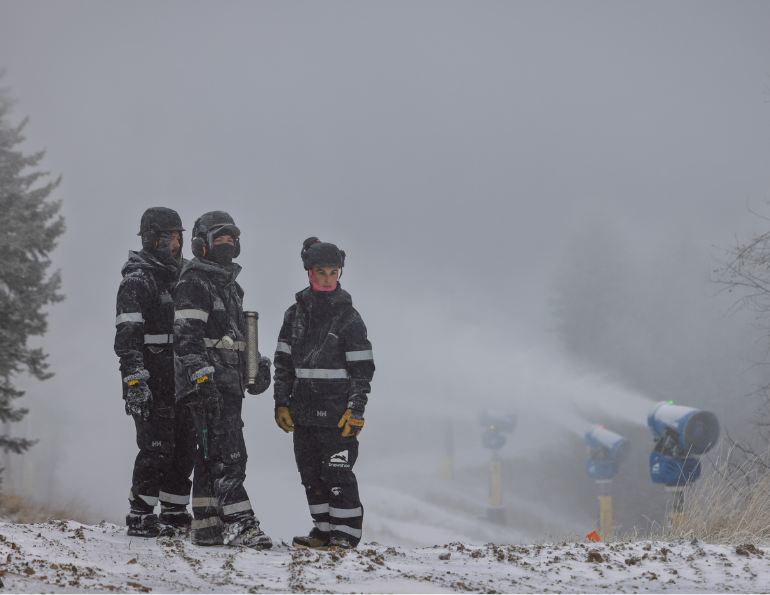
“The secret of getting ahead is getting started. The secret of getting started is breaking your complex, overwhelming tasks into small manageable tasks and starting on the first one.” Mark Twain makes “getting started” sound easy. But when it comes to snowmaking improvements, where to start can be a daunting question—new snow guns, reservoirs, replaced piping, additional pumping and compressed air capacity, automation, the list goes on and on. Twain the snowmaking engineer would likely advise that the secret of getting started is first creating a detailed snowmaking master plan.
Long-term planning is not new to the ski business, of course. The Forest Service requires an updated master development plan every 10 years to ensure its leaseholders think ahead. These plans typically include potential snowmaking pipeline routing additions for a “new coverage wish list,” but rarely get into the complexities of improving and expanding the snowmaking infrastructure. That’s what snowmaking-specific plans are for, and recent winters have underscored the need for ski areas to be forward-thinking. Climate change, energy costs, and evolving customer demands suggest that, in the future, business as usual may not cut it.
So, what is a snowmaking master plan? Fundamentally, a snowmaking master plan outlines a phased implementation of physical improvements and capital outlays that will be required to achieve the ski area’s objectives over time. That requires defining those objectives, determining what steps are required to achieve them, and prioritizing those steps during a planned timeline. Sounds simple. But back to the question: Where do you start?
Know Where You Are
An old adage says, “If it ain’t broke, don’t fix it.” But if it is, you probably should. Having a realistic assessment of the strengths and weaknesses of existing snowmaking systems is the critical first step of prioritizing investments for the future.
You can obtain opinions from the snowmaking crew on “what’s broke,” and many of those opinions are well grounded. But here is where some external help can be invaluable. Some of the typical problems facing snowmaking operations lie outside the experience and knowledge base of the operators and may actually result from the supervision or structure of the crews themselves. Also, the way the managers and supervisors assume the system is operated is often not borne out by actual operating data logs.
Some of the common weaknesses of snowmaking operations that a master plan needs to consider:
1. The inability to provide enough snowmaking coverage to open desired terrain by critical dates.
2. Areas where water pressure is insufficient to support modern, high-efficiency snow guns.
3. Pipelines that are undersized, or are at risk of failure due to age, corrosion, or high pressure.
4. Pump stations that are incapable of reaching their design capacity.
5. Insufficient numbers of modern, high-efficiency snow guns.
6. Difficulty hiring and retaining staff for snowmaking operations.
Benchmarking. When reviewing an existing snowmaking operation, historical operating logs can be used to calculate some basic benchmarking metrics, both as a starting point for analysis and as a method to quantify the impacts of improvements. These metrics include:
1. Application Rate. The total gallons of water used per season divided by the snowmaking area in acres provides a real-world number that can be used to define water needs for future expansion. This also provides a metric that can be used to assess the impact of management practices and technologies like snow depth measurement on snowmaking water efficiency.
2. Utilization Rate. The utilization rate is the ratio of the average water flow rate (total water pumped/hours of operation) to the full snowmaking pumping system capacity. A low utilization rate (<60%) indicates that the potential of the water system is underutilized. A high utilization rate (>80%) suggests that additional pumping capacity may be justified for cold periods when snowmaking conditions are ideal.
3. SEI (Snow Energy Index). The energy consumed (kWh) per 1,000 gallons of water used to make snow provides a metric on the overall energy efficiency of the snowmaking operation. The consistency of this index when plotted against temperature is an excellent indication of how well the system and crews optimize snowmaking operations over the season.
Know Where You Want to Go
The next step is to formulate a realistic plan for future snowmaking coverage objectives. This includes quantifying the existing snowmaking coverage, estimating future expansion coverage, and developing realistic targets for opening dates.
It’s easy to be overzealous on early opening coverage without realizing how this impacts the size and expense of the snowmaking system. Therefore, start by focusing on how much snow must be produced to achieve complete coverage of all the snowmaking terrain by a set date (typically Christmas), then work backwards to determine what kind of opening package this will provide. If this is inadequate and there are compelling business reasons to accelerate early-season opening, the snowmaking system can be upsized accordingly.
Determining capacity. There are two considerations for determining the necessary snowmaking capacity to achieve these objectives:
1. How much water needs to be converted to snow to achieve the desired coverage? Water requirements can be calculated by multiplying an assumed conversion density (typically 180,000–200,000 gallons per acre-foot of snow) by the assumed depth of snow required. However, using the existing system’s historical records of water consumed per acre covered is often easier and more accurate.
2. How many hours and at what temperatures will the snow guns be able to operate prior to the established target date? Using at least 10 years of data, if available, develop a matrix of the number of hours that occur within wet-bulb temperature ranges (i.e., 28-25, 25-20, etc.). This analysis ideally uses on-site temperature records, though translations can be made from other nearby weather stations that have reliable, long-term data. Given the changing climate, some adjustment needs to be made to existing temperatures since the plan’s timeline is typically 10–25 years in the future.
Cost/benefit strategy. Ski area operators often select a system capacity that will achieve the target coverage in 8 out of 10 years. This assumes that the economic gains of achieving 100-percent coverage in the worst 2 out of 10 years are not worth the additional cost of upsizing the snowmaking system to reach that coverage. But in some cases, the investment in sizing up can be justified in terms of improved revenue, marketing, and reputation.
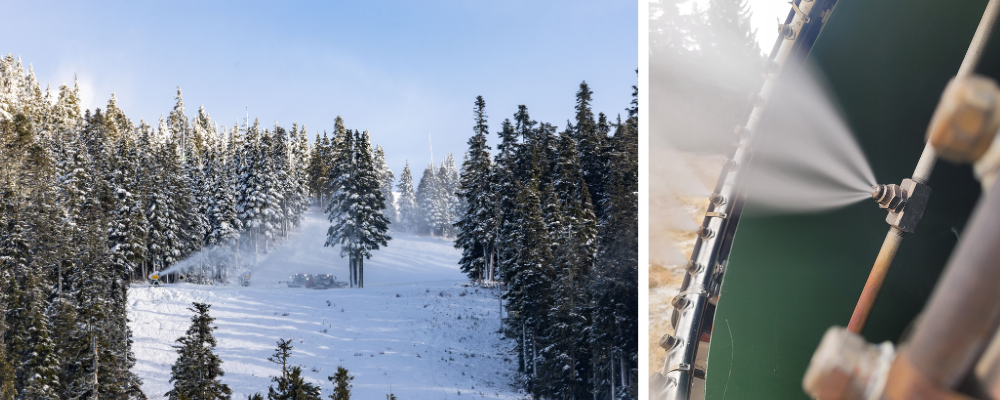 Left to right: Fan guns lay down coverage on the slopes of Mount Washington Alpine Resort, B.C; A fan gun fires-up early season at Sun Peaks, B.C.
Evaluate Constraints
When you boil it down, snowmaking is a recipe with four physical ingredients: favorable temperatures, water, power, and money. Any of these elements can act as a constraint to snowmaking expansion and each one needs to be addressed in the snowmaking master plan.
Water is probably the most common concern, given over-allocation of water rights in the West and environmental constraints on withdrawal rates in the East. This often drives the need for storage reservoirs, which are expensive and consume valuable land and/or long pipelines to access water a distance from the resort.
A water balance study can quantify the amount of storage required. This study juxtaposes daily snowmaking water demand against the daily water supply potential to determine how much storage is needed to make up the difference. Given land constraints, wetland impacts, and the high cost of reservoir construction, this is critical information.
Power is a frequently overlooked element, despite how energy-intensive snowmaking is. If the resort is at or near the power company’s maximum delivery capacity, it can be prohibitively expensive to increase that capacity. Furthermore, many utilities charge a high monthly demand charge to compensate for their cost of providing power to the resort. In response, ski areas can focus snowmaking production during off-peak time periods or take advantage of load-shedding programs that provide significant rebates to customers that can reduce or eliminate loads during a utility peak. In these cases, the system will need to be upsized to accommodate for lost hours during peak or load shedding periods.
ROI. Finally, it is important that the snowmaking “eyes” aren’t bigger than the financial “stomach.” In other words, don’t develop a snowmaking system that can answer the call of the most aggressive targets if the cost of that system will not provide a reasonable return on your capital expenditure.
Develop a Snow Gun Implementation Plan
A snowmaking master plan needs to consider what types of snow guns are best suited for the terrain being considered. This is both an objective and subjective determination, depending on the conditions and operational history at the resort.
Fans and sticks. For the most part, fan guns and low-energy air–water guns (sticks) have become ubiquitous over the last 20 years.
Each has different strengths and potential limitations. For example, fan guns, with their longer throw, are generally better suited for wide trails and stick guns are better suited for narrow trails, though these selections depend greatly on site-specific considerations such as desired coverage speed, proximity to lift infrastructure, typical temperatures when the trail is operating, and wind.
Needed infrastructure for each type of gun will factor into your choices, too. Fan guns are more difficult to install on very long trails due to power delivery requirements, and stick guns are more difficult to have in isolated areas with no adjoining compressed air support.
Spacing. Regardless of the type of guns, spacing is an important consideration when developing a snow gun layout plan. Reduced spacing on primary, early-opening trails can get the ski area open quicker. Also, areas of a trail that need more snow (wider sections, drop offs, high traffic zones) should have tighter gun spacing than the rest of the trail.
Mobile or fixed? Finally, one of the most critical elements in the snow gun implementation plan is deciding between mobile vs. fixed snow guns.
Fixed guns significantly reduce labor requirements, can be turned on and off quickly, and can be equipped with automatic actuators or have the flexibility to be automated in the future. On the other hand, it is expensive to populate each hydrant with a permanent gun. And since fixed guns are usually installed on towers by the side of the trail, the piles they create are also concentrated on the side of the trail, so it’s more work for a groomer to push out.
Conversely, one mobile gun can be used in multiple locations and positioned to optimize snow deposition. However, even with multiple setups, labor requirements and system start-up and shutdown times are significantly increased with mobile guns.
In general, the larger the system, the greater the percentage of fixed snow guns needed. Moving 30 snow guns can be manageable, moving 400 is unrealistic.
Establish the System Configuration
Once the desired capacity has been lined up with the constraints, the next step is to configure the pumping, piping, power distribution, and compressed air infrastructure needed to achieve the desired snowmaking coverage. This ideally will integrate with the existing system, when possible, both for financial and phasing purposes.
The critical elements of snowmaking system configuration include:
- a pumping system that provides adequate water pressure at all locations to allow low-energy guns to operate efficiently (typically 300 psi minimum pressure);
- a piping distribution network that delivers the necessary capacity to the far points of the mountain;
- integrated valve isolation that allows the system to continue operating when a hydrant or old pipeline section fails;
- compressed-air system capacity that is adequate for the expanded water system, the configuration of which allows for efficient operation during periods that air demands are low (high fan gun use or cold ambient temps); and
- with fan gun systems, an electrical network to power pedestals along the trails.
Develop a budget. Use the resulting configuration to develop a budget for the snowmaking upgrades, which also serves as a reality check against reasonable funding expectations. If necessary, the concept design can be modified to bring costs down to a financially justifiable level.
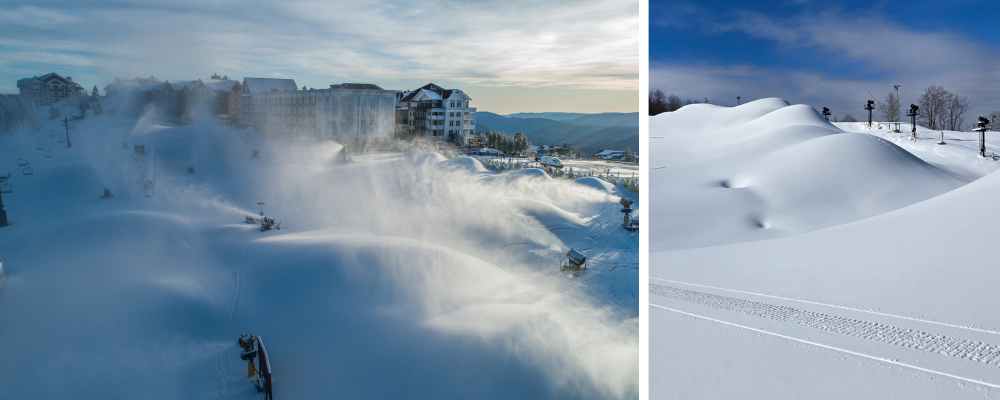 Left to right: Careful master planning helped optimize Snowshoe’s (W.Va.) snowmaking coverage; Tight spacing equals big whales in the snow-tubing park at Winterplace, Va.
Prioritizing and Phasing
One of the goals of the snowmaking master plan is to develop an overall design framework that works for the long term, then follow Twain’s advice and break down the various elements of the plan into bite-sized projects spanning multiple phases in a sensible sequence. Tasks that provide the biggest bang for the buck should be prioritized first. This will be unique to each project, but there are some guiding principles to follow:
1. Proportional upgrades. Investing in additional pumping capacity will not magically increase the system’s production by itself. Piping infrastructure must be able to accommodate the increased flow, there need to be enough guns and compressed air to handle the additional water, and the snowmaking crews need to be able to handle additional guns. Hence pumping capacity expansion, piping upgrades, and snow gun additions/updates should all be addressed in proportion.
2. Replacing old and/or undersized pipe needs to be prioritized unless the pipe can be isolated from the rest of the system. Otherwise, the water/air flow will be restricted, or the operators will be unwilling to push the system for fear of blowing up pipe.
3. Adequate water supply is the critical foundation to all snowmaking expansion efforts. An initial system review will reveal whether the existing water sources are adequate to cover the proposed snowmaking terrain, and if not, whether additional water could be obtained from these existing sources. If this supply is inadequate for existing acreage or proposed expansion, prioritize the development of additional water supplies/storage.
Snow Gun Automation
A snowmaking plan that may extend for 5–15 years should consider automation. Automation has been driven by both advances in technology and chronic difficulties in finding and retaining snowmakers. Skier expectations and climate change have combined to push resorts toward larger snowmaking systems that can make more snow in less time, but operations struggle with the large gun counts these systems require. As such, more automation will be implemented in the years to come, and any plan needs to account for that. Some of the implications include:
1. Pipe and gun location. When automating a tower-based snow gun (fan or stick), it is important to have a hydrant located right next to the tower so that the water and air hose can drain when the gun is shut off. This often impacts pipe location, especially with surface piping that does not have laterals running to hydrants. Pipe being replaced or upgraded should be positioned so that it could directly feed future tower guns without hose extensions.
2. Communication and power infrastructure. When installing a new (or replaced) pipeline underground, consider adding conduit to the trench to support future automation. This is mostly applicable to stick gun automation since fan guns already have power and most vendors use radio communication.
While automating snow guns provides significant gains, it is tempered by the fact that tower-based automatic guns (stick or fan) are fixed at a location. When enough snow has been produced at that location, the automation investment can lie dormant for most or all of the remaining season. That does not suggest that snow gun automation is a bad idea, it just means that the priority of investments in automation needs to be weighed against other pressing system needs that will benefit the operation over the entire season (additional guns, water improvements, pipe replacement, etc.).
Pipe Replacement Planning
Many ski areas with existing snowmaking systems have a significant amount of pipe in poor condition. Most have adopted a “replace a small section when it fails” approach, often allocating a set annual budget for pipe repair projects.
As a pipe ages and corrodes, the weakest portions will fail first—typically areas where the pipe rubs on a rock, has a bad weld, or is in a corrosion hotspot. Subsequent breaks will occur with increasing frequency as the pipe corrodes further until the repair process becomes a game of whack-a-mole and the entire line needs to be replaced. For systems that have large amounts of similarly aged pipe, this can lead to catastrophic costs if the lines fail at roughly the same time.
Risk assessment. A snowmaking master plan should identify pipelines that are at medium to high risk of failure and develop a general schedule for replacing those lines. This is difficult since pipelines corrode at widely different rates depending on soil, installation, and coatings, but pipeline replacements are expensive and this needs to be considered when prioritizing capital investments on snowmaking improvements.
Most importantly, review pipe sizes before blindly replacing what was there before. A 30-year-old rotting pipe may have been the right size in the mid-’90s, but probably isn’t today.
Summary
It is very easy for a resort to spend a great deal of money replacing existing or adding new snowmaking equipment without considering priorities or impacts of those expenditures. A snowmaking master plan will provide resorts with a 10–25-year roadmap of steps that lead to a well-defined snowmaking goal.
The study needs to consider existing snowmaking system performance, future objectives, current snowmaking technology options, changing weather patterns, and site constraints to develop a conceptual design that matches the coverage and financial requirements of the resort. Once the long-term improvement and expansion requirements have been defined, investment needs can be estimated and phased into smaller manageable parts. Then, like Mark Twain, you will know where to start.
Scott Barthold is a professional engineer with more than 45 years of global experience in snowmaking system design. He is the founder and principal of Snomatic Controls and Engineering.