




PAJARITO MOUNTAIN, NM: MUTUALLY BENEFICIAL PARTNERSHIP
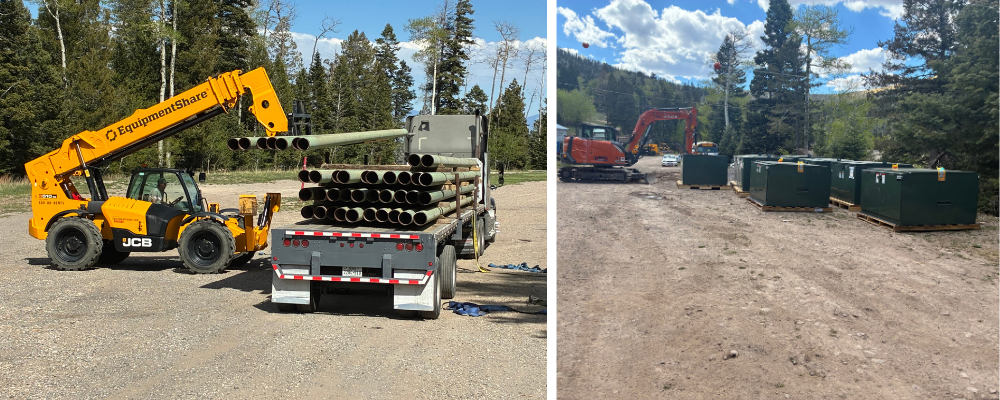 Pajarito Mountain is increasing its electrical capacity for snowmaking (right), and boosting its water supply (left) through a public/private pipeline partnership that also supports wildfire resilience.
New Mexico’s Pajarito Mountain Ski Area has suffered several significant wildfires over the years, and the resulting sun-exposed burn scars have made it difficult for the mountain to retain snow. The ski area relies largely on surface runoff to fill its 10-million-gallon snowmaking reservoir, which has proven challenging during low-snow years. But the installation of a nearly five-mile pipeline from Los Alamos to Pajarito—the Jemez Mountain Fire Protection Project—seeks to address the issues for both the state and the resort by providing consistent water for snowmaking at Pajarito and firefighting in the Jemez Mountains.
“The first wildfire hit Pajarito in 2001 and did tremendous damage,” says general manager Jasen Bellomy. “Then there was another in the early teens. The ski season was getting shorter and shorter, so [Mountain Capital Partners] started looking at this project around 2014” after acquiring the ski area and has been trying to get it done ever since.
The pipeline, which will transport potable water from Los Alamos to Pajarito, inspired a multi-year build-out of the ski area’s snowmaking facility. Ongoing upgrades, which include 1,500 kVA of transformers, five 300-amp snowmaking circuits, tripling or quadrupling snow gun inventory, new piping, and the addition of four pump houses, will result in a 50 percent increase in Pajarito’s snowmaking coverage by acreage in time for the 2026-27 ski season. A dedicated feed line from one of its pump stations to the pond will allow the team to produce snow and fill the pond simultaneously. As of press time, all the pipe and conduits had been installed, and pump house construction began in June.
“These upgrades should allow us to fill the pond at least six to eight times per winter,” says Bellomy. “Out of the past seven years, Pajarito has only been open during Christmas two or three times. With the inconsistent seasons, the ski hill has only been open historically on Wednesday and Friday through Sunday.”
Moving forward, Bellomy anticipates a full operating schedule of around 120 days per season, a stark contrast to the historical average of 60 days.
What makes this project unique is its collaborative nature. Because it protects both “skiing for the community as well as the physical danger of fire and the recreational danger of climate change,” as Bellomy puts it, there has been significant buy-in from locals. And the approximately $25.9 million bill is shared among private, state, federal, and county entities.
“This project really is a win all the way around,” says Bellomy. “The community has lost hundreds of millions of dollars in assets due to wildfires, and the willingness of the state and federal government to help support this project to protect the community is just really cool. Not to mention, without this project, skiing would not be sustainable at Pajarito moving forward.”
PATS PEAK, NH: PAYOFF FOR LONG-TERM PLANNING
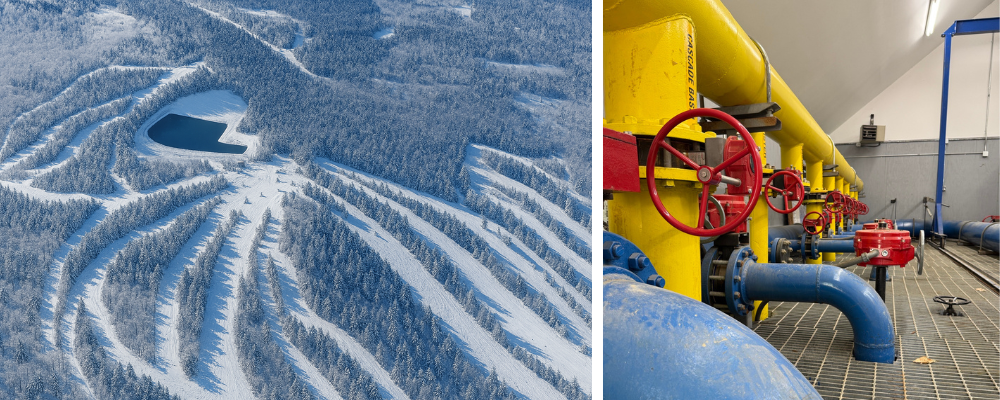 A new pump station (right) was sized in preparation for the additional capacity from a 21-million-gallon pond (left) that Pats Peak is building this summer.
Like many ski areas, Pats Peak has struggled with water limitations. A study conducted by Snomatic Engineering and Controls in the early 2000s concluded that Pats Peak’s snowmaking system would need to pump around 10,000 gallons per minute (gpm) to open 80 to 100 percent of the mountain’s terrain in 48 to 96 hours, a flow rate that well exceeds its permit limitations. The workaround was a reservoir that can be filled over time, allowing the team to maximize snowmaking when it’s most efficient.
“Right now, we only have a storage capacity of about 5 million gallons,” says Pats Peak general manager Kris Blomback. “So, we’re forced to make snow when we have water, which sometimes means we’re making it inefficiently at 27 or 28 degrees.”
The decision to build the reservoir at the summit came down to available space—the resort’s location in a residential area didn’t allow for much flexibility. But the benefit of gravity doesn’t hurt and will combine for a dramatic increase in capacity. Blomback estimates they can achieve around 3,000 gpm with gravity alone, which allowed them to go with a 6,000-gpm pumping station at the summit. This, combined with the 3,800 gpm from the existing pump house, will allow them to move up to 12,800 gpm for snowmaking with maximum system utilization when the project is completed in two years.
Blomback stresses these are all theoretical capacities, and he does not underestimate the learning curve that will be in front of the team as they figure out how to effectively use the system.
The 21-million-gallon reservoir, construction for which began this summer, is the final big step in a series of upgrades outlined in the ski area’s snowmaking master plan that have been completed over the last 20 years, all with the reservoir in mind. Upgrades have included new Ratnik hydrants; putting snowmaking equipment, including SMI fans and HKD sticks, at every hydrant; repairing the distribution system; building valve stations around the hill; and building a new pump station. The overall system has been built across the mountain to handle higher flow rates, with primary trails having the most capacity.
“The hydrants are super close” on learning areas and popular trails, says Blomback. Most of these can be covered with around 12 hours of snowmaking. “We have one trail that can be opened edge-to-edge with eight hours of snowmaking. It’s not unlike what Sunday River (Maine) and Killington (Vt.) do.”
The snowmaking plan has been largely implemented without modifications, except for replacing many of the original guns with low-energy equipment. This change will likely allow the ski area to build a smaller air plant than initially expected.
One of the biggest operational impacts Blomback anticipates the reservoir having will be on staff utilization. “Having this water capacity to blow snow will actually decompress fall startup, because right now, we’re making snow right up to Christmas week,” he says. “The team is pulling big days, trying to get the terrain rolled out. Now, we’re going to go from running 100 to up to 275 guns at once—we could be making snow on as much as 40 percent of our terrain at any given time.”
At the end of a snowmaking window, the team might have five or seven trails ready to be pushed out compared to the one or two they had pre-reservoir. That will allow them to build terrain parks and tubing lanes earlier in December, rather than scrambling days before vacation.
“We’ll be able to get better utilization of our team because now there are days where we don’t have the temperatures, and we don’t have the water, and the crew might not be working as efficiently as they could,” he says. “But if they have five other trails that are done, they can be pushing and blading those while waiting for the next weather window.”
BIG SKY, MT: COMMUNITY-SUPPORTED RECLAIMED WATER USE
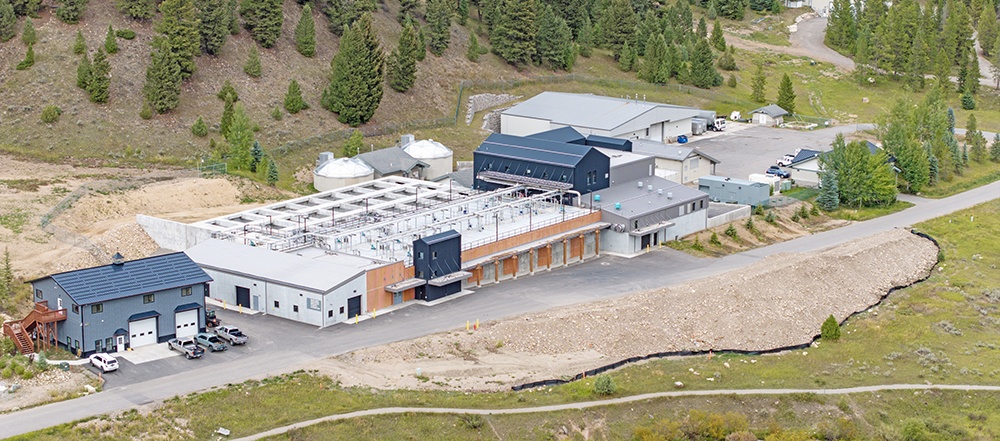 A Big Sky reclaimed-water facility will help to nearly double snowmaking capacity at Spanish Peaks.
The community of Big Sky, Mont., uses a lot of water, much of which is treated in septic systems before returning to the aquifer. But as the largest “zero-discharge” community in the state, town managers, engineers, resort operators, and conservation groups are always searching for new ways to conserve increasingly precious water and keep their natural waterways clean.
One way the Spanish Peaks Mountain Club—a private membership club at Big Sky Resort—is tackling both waterway conservation and limited water availability is by constructing a $50-million wastewater treatment plant that will restore community wastewater to near-drinkable standards and then use the reclaimed water for snowmaking.
“This started almost 20 years ago with an initiative by our neighbors at the Yellowstone Club and the Army Corps of Engineers to determine if this was possible,” says Big Sky Resort vice president of operations Adam West. “That evolved slowly but picked up steam over the last five years with the Yellowstone Club working with the Montana Department of Environmental Quality [DEQ] to create a permit process and standards the rest of us will have to abide by.”
The groundwork laid by the Yellowstone Club, which implemented its own reclaimed-water system for snowmaking during the 2023-24 ski season, ultimately led to the Spanish Peaks project.
“This is our first taste of reclaimed water use, and we love it,” says West. “From here, the sky’s the limit. We’re going to continue to push this across our property in years to come.”
Prior to the reclaimed water project, the Spanish Peaks section of Big Sky Resort relied on well water for snowmaking, an unsustainable long-term practice. This project will eventually permit 43 million gallons of reclaimed water to be used for snowmaking per year, nearly doubling the current capacity.
“This was the opportunity to increase the [snowmaking] footprint so we can open and close on time, stay open through the course of the season, and give the guests who are staying and coming out of that base area a reliable surface to ski over and make it to the rest of the resort,” says West.
Wastewater is treated at the plant to extremely high standards using biological nutrient removal, membrane filtration, and advanced oxidation at a volume of 910,000 gallons per day, monitored at multiple points by a third-party engineering firm, before being used for snowmaking. The freezing that occurs during the snowmaking process provides an additional layer of treatment.
Not only does this facility provide a good use for the community’s used water and expand the resort’s snowmaking capabilities, but as the snow made with the reclaimed water melts in the spring it also helps recharge the aquifer with clean water. And during peak runoff, which is when much of the melting occurs, the reclaimed water is diluted even further.
While the resort hasn’t yet used reclaimed water for snowmaking because some engineering controls weren’t ready for the 2025-26 season, treated water is currently stored and ready for the start of the 2026-27 ski season. Over time, the resort plans to install more pipe and build more retention ponds to maximize the treatment plant’s potential.
Thanks to the community’s buy-in, the financial burden is shared between Spanish Peaks Mountain Club and the town of Big Sky. The community’s responsibility is to get the water up to the resort through a series of pump houses and piping systems, and for the treatment plant itself, paid for with tax dollars. The resort is responsible for the storage facilities and retention ponds.
“Having water we can use for snowmaking makes us a reliable destination, especially early and late in the season, and is a huge boon for the rest of the community,” says West. “With the onset of climate change, snowmaking will become more important. And if we want to sustain this community for the long term, the ski area needs to remain a viable business.”
OBER GATLINBURG, TN: ALL-WEATHER SNOWMAKING EXPANSION
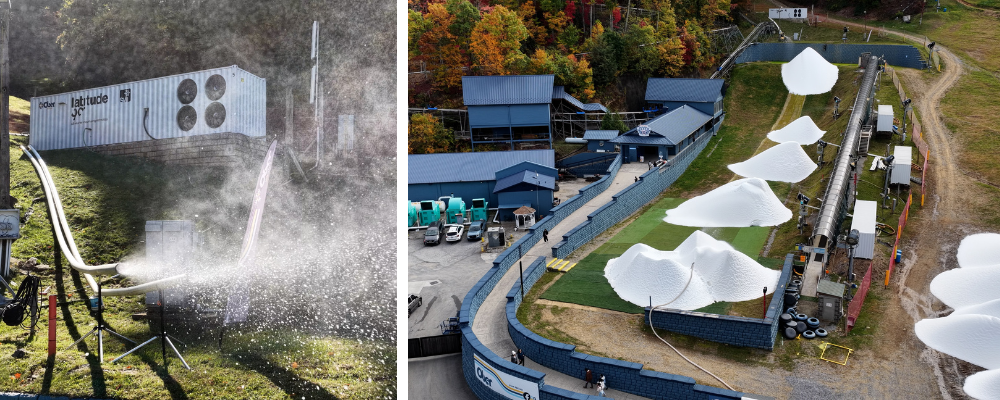 At Ober Gatlinburg, a mix of SnowMagic (center three) and Latitude90 (right) all-weather snow machines ensures a long, reliable season.
Tennessee is an unlikely place for a reliable, long-lasting ski season. Yet, Ober Gatlinburg, Tennessee’s only ski area, is making it happen thanks to a significant investment in all-weather snowmaking machines.
Ober has taken a phased approach to expanding its all-weather snowmaking infrastructure. The team installed its first two 50-ton SnowMagic machines in 2010. Now, more than 15 years later, most of the lower half of the mountain is serviced by 11 Latitude90 and three SnowMagic all-weather machines, the latter of which are leased because of their older technology and more difficult-to-obtain parts, though they do have a slightly larger snowmaking footprint, according to Ober director of maintenance Marshall Felker. Ten of the 14 machines were installed in the last three years alone.
“The biggest thing was to make sure we get open on time,” says Felker. “When we first built our tubing park [in 2009], we had to wait until the temperature was low enough to make snow with our regular machines. But that first winter wasn’t very cold, so to make sure it would stay open in the future, we found these all-weather machines to help keep everything running.”
The success of those first machines inspired the team to continue adding all-weather systems across the mountain. The result has been a confidence-inducing predictability in opening dates, allowing Ober’s team to consistently start making snow in October and build a base for when snowmaking temperatures arrive.
“We positioned the machines based on an estimate of how much product they make and where we can push out the piles to meet each other over a certain time,” says Felker.
Traditional snowmaking guns cover the upper mountain since it has more frequent cold temps at elevation. But the lower mountain, which historically experiences eight or 10 snowmaking windows per season, is mostly covered by all-weather machines and supplemented by traditional snow guns, ensuring with almost complete certainty that Ober will operate 100 days per season.
“I don’t know if the [all-weather machines] have extended our season, but it’s helped us keep operating,” says Felker, noting stretches of warm weather in seasons past had forced Ober to shut down for multiple days on end. “Now, we can ensure we’re going to stay open.”
Within the last three years, Ober has also purchased and installed 40 automated SMI Polecat fan guns across the upper and lower mountain, both in areas not covered by the all-weather machines and to supplement areas with them, allowing the ski area to take advantage of increasingly stingy weather windows.
Installation of the self-contained all-weather units required only the addition of transformers—which cost a few hundred thousand dollars—and a flat space with concrete, stone, or railroad ties for the snowmaking units to sit on. Initially, there was enough power for the first few machines, but the last 10 required an increase in power capacity. Most of the machines are positioned right next to existing hydrants.
Operating the all-weather machines, which run at about 200 amps each, does come at a cost—the power bill equals about 10 percent of total revenue, but the team thinks the payoff is worthwhile. “Not only are we gaining traffic that we would otherwise lose on a day we would have been closed, but we’re also gaining higher reliability, which helps encourage guests to feel confident that we’ll have snow,” says senior director of marketing Tyler Schultz.
According to general manager Todd Clarke, reliable work for the snowmaking team and an economic boost are added benefits to the all-weather machines as well.
“Not only do they allow you as an employer to be able to regularly employ staff without too many setbacks, but it’s also a large [community] tool,” says Clarke. “The Gatlinburg area is a destination town. And the reliability of our winter season now makes it even more viable for businesses.”
THREDBO, AUSTRALIA: MULTI-FACETED UPGRADES
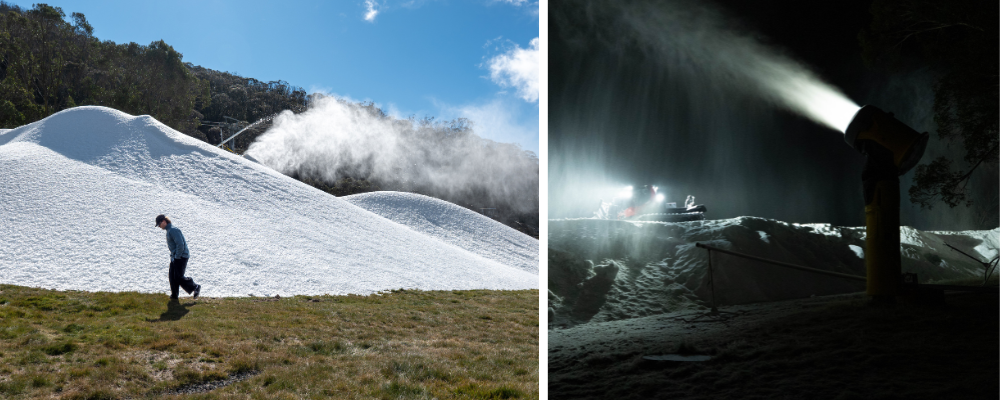 Thredbo combines traditional and all-weather snowmaking infrastructure to ensure its season. An eight-year upgrade plan will increase capacity and efficiency.
Measured by the square meters of runs covered by snowmaking, Thredbo has the largest snowmaking system in the Southern Hemisphere, rivaled only by Perisher. The earliest phases of the system’s installation were in the late 1980s and early 1990s, and the infrastructure was beginning to show its age in recent years as pipes began to fail. When the largest section of pipe, nearly two feet in diameter, sprang a leak around five years ago, Thredbo decided it was time to embark on major snowmaking upgrades.
Snowmaking, which covers about 60 percent of Thredbo’s main runs but only 15 percent of the entire resort, is critical for the first and last three weeks of the resort’s 16-week season. Typically, crews will start blowing snow six weeks before opening in early June to build what eventually becomes a 6- or 7-foot base, including natural snowfall.
The upgrade project is three years into an eight-year plan that includes installation of several all-weather snowmaking units, upgrades to pumps and compressors, additional lances and fan guns, and the replacement of more than 12.5 miles (20 kilometers) of old pipe with steel, high-pressure ductile iron, and polyethylene pipe. So far, 4.6 miles (7.5 kilometers) of pipe has been replaced with ASTM grade A53/A106B or API 5L grade X42 steel.
While much of the overall pipe routing and hydrant locations will remain the same, some changes are being made. General manager Stuart Diver says it’s an opportunity for the team to relocate certain hydrants they didn’t like the location of, run lines to parts of the mountain where they eventually plan to install power and snow guns, and beef up snowmaking around chairlifts that will be upgraded in the future.
“Our goal is to increase our capacity and efficiency,” says Diver. “Thirty-five-year-old compressors and pumps suck a lot of power, whereas the new ones are twice as efficient.”
The pump and compressor upgrades, which Thredbo plans to start in two years, are intended solely to increase efficiency. The new guns are also about efficiency. While the current equipment is in decent shape, the new guns require less water and air.
The first all-weather unit, a Demac-Lenko Snowpro 260 that was delivered toward the beginning of the 2025 season and covers the beginner area, is the start of a longer-term plan to install nine or 10 all-weather machines that will help keep beginner, intermediate, and advanced runs open for the duration of the season.
“The majority of our snowmaking system is TechnoAlpin,” says Diver, “but we went with the DemacLenko [all-weather] machine because it is the plate-ice style (which utilizes water droplets frozen onto a plate system and then shaken onto a conveyor belt); it can run 24 hours a day, seven days a week. From what we’ve seen in its first three weeks of operation, it’s putting out an enormous amount of product.”
Diver says, eventually, they’ll get a mix of both TechnoAlpin and DemacLenko all-weather machines because, in their experience, the TechnoAlpin makes a better, skiable product, while the DemacLenko is better for building a base.
“We’re going to expand the [all-weather] snowmaking system because we want to be able to say we have snowmaking in our beginner area—that’s a big market early season,” he says. “But we also know that skiers and snowboarders will come early and stay later in the season if there’s a good, skiable product.”
The area of beginner, intermediate, and advanced runs Thredbo intends to cover with all-weather machines, known at the resort as “the golden triangle,” is connected by two lifts. If the resort can get those open early and keep them open, Diver expects visitation to go through the roof.
The machines, which can deliver snow up to 400 meters (about 1,300 feet) uphill or downhill, are about four times as expensive to operate as a traditional fan gun. But for Thredbo, which is powered entirely by renewable energy, elevated consumption is unlikely to pose a problem.
“My belief is that as renewable energy becomes cheaper, which it will because Australia’s government is investing hugely in renewable energy, [these costs] won’t be as big an issue in the future,” says Diver. “We’re running it during the day when the grid is overflowing with cheap power.”
The team is exploring the possibility of eventually running the units on batteries, which can be charged by solar during the day and used at night.
OAK HILL OUTDOOR CENTER, NH: CROSS-COUNTRY SKI AREA REVITILIZATION
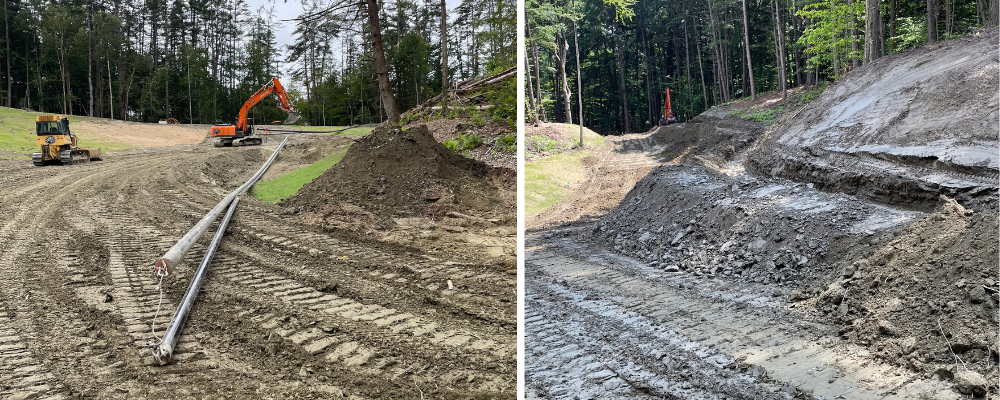 Snowmaking pipe installation.
At New Hampshire’s Oak Hill Outdoor Center, which is owned and managed by Dartmouth College, shorter, less reliable winters had made operation difficult in recent years. And despite Dartmouth having one of the best Nordic teams in the country, the Nordic trail system at Oak Hill had fallen by the wayside over the decades.
Peter Melikin, a local community member and founder of Oak Hill Outdoor Center, recognized the importance of these trails and the need to invest in them, so he wrote a letter to the college proposing a joint fundraising effort to create a center with upgraded facilities and a snowmaking system to be managed by the community as a nonprofit. Ultimately, the college was receptive.
Prior to the installation of the snowmaking system three seasons ago, the cross-country trails were skiable around 60 days per season on average. Since the system has been operational, operating days have roughly doubled.
The upgrades include three miles of lit trails for night skiing, three-phase power, a new parking lot, an equipment shop, a small lodge, and 3 kilometers of snowmaking on a 3.3-kilometer homologated cross-country loop. An HKD fan gun and 40 HKD Phazers, the latter of which are designed for narrower trails, pull water from a small lake on an adjacent property via sub-surface pipes that become exposed on the Oak Hill property.
“A bunch of piping that goes through the adjacent property is buried to keep it out of sight and out of the way,” says Oak Hill general manager Mike Hussey. “But it’s exposed at long bench cuts and areas where we don’t need to bury it since it’s a lot cheaper to install pipe that isn’t buried.”
Like many ski areas, Oak Hill faces water availability concerns. The permitting process for land manipulation and water use was significant, according to Melikin.
“There are certain times when the water levels determine when and how we can draw [water],” he says. “In a dry year, we have to consider how much snow we can blow early. This past season, there were times when we had to blow snow at half power.”
The lake Oak Hill pulls from is fed by reservoirs that are periodically released when there’s extra water—a factor that has made collaboration between Oak Hill and the town to determine the best times to release the water especially important. When the pond reaches a minimum level, the snowmaking system can no longer be used. To mitigate the impact of that, Oak Hill developed a powerful snowmaking system that pumps 800 gpm and allows it to achieve full coverage with just over 100 hours of operation per season.
Despite the water constraint, the project has been a success. During the 2025-26 ski season, Oak Hill recorded 42,000 skier visits (thanks in part to the lighting system, which allows the center to remain open until 8 p.m.), significantly more than before snowmaking. Now, the next issue to tackle is keeping up with demand.
“We doubled student usage in just one year,” says Hussey. “But there’s no transportation system from the college, so if we could solve that, usage will go up even further.”
Melikin sees their project as a small piece of the larger puzzle that is skiing.
“I look at this center as a piece of the overall ecosystem that will make skiing successful and sustainable,” he says. “And that ecosystem is what’s going to keep skiing relevant for the next generation.”
PASS POWDERKEG, AB: USING THIRD-PARTY MASTER PLAN
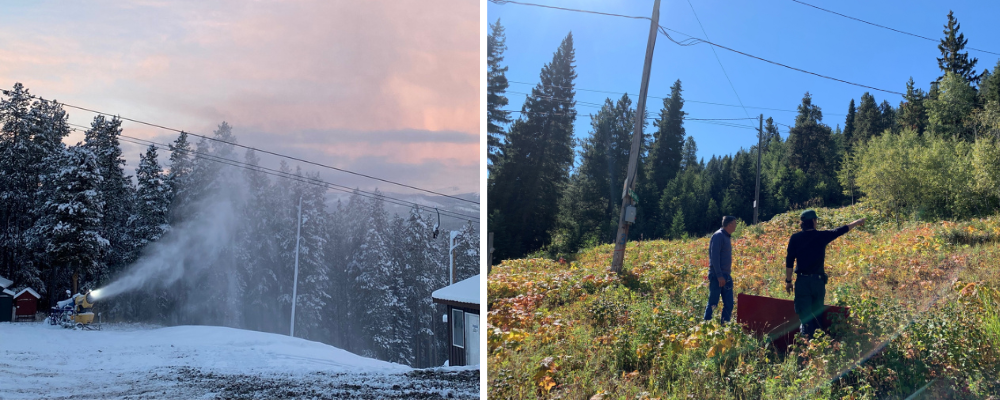 Left to right: Early season snowmaking; SMI onsite planning in September 2021.
When the team at Pass Powderkeg decided it was time to upgrade its snowmaking system, they realized the documentation outlining the existing infrastructure and capacities had been lost over time, hindering their ability to develop a snowmaking plan. Rather than take on the near-impossible task of inventorying the system and determining what was needed to achieve its long-term goals on their own, they hired an outside consultant to develop a snowmaking master plan.
Though the team had discussed areas for future coverage and overall timeline and process goals, a third party—in this case, SMI—was able to provide an unbiased view "from 10,000 feet above," as Katherine Seleski, former manager of Pass Powderkeg who oversaw the project, puts it, helping prioritize long-term, sustainable investments.
"They've seen snowmaking systems from all over the world. It was really useful to get that bird's-eye view from someone who hasn't been in the trenches, suffering during those minus-40-degree nights, that can look at things more objectively," says Seleski.
Because the project was funded by the municipal government, the team also wanted a master plan that would support funding decisions. SMI's experience with municipal projects helped provide additional confidence in the recommendations.
Ultimately, the 20-year plan, crafted over eight months, considered a number of variables, including weather, water constraints, and electrical constraints, to determine what would provide the best return on investment in both the short and long term.
"We used our operational knowledge to determine our priorities and then considered operational opportunities," says Seleski, adding that priorities are often different at a small area compared to a destination resort/
A key difference between ski areas like Pass Powderkeg and larger destination resorts is access to capital and the ability to move quickly on major projects. Smaller ski areas often rely on municipal partnerships or grant funding.
The plan—which would increase the resort's 400-gpm system with 30 percent terrain coverage to 1,800 gpm and 70 percent coverage—included pipe sizing, pump selection, the efficiencies achievable with variable-frequency drives and remote-controlled pumps, and snow gun requirements.
The master plan quantified the improved results specific pumps, piping, and configurations would yield, and gave the resort enough detail to move forward with a request for proposals and evaluate construction costs. According to Seleski, dialing in those details to achieve the most efficient system possible was something they couldn't have done on their own.
"Getting the most efficient movement within your snowmaking system is absurdly expensive, but without [efficient snowmaking], we didn't have an operation," says Seleski. "The plan provided that efficiency piece to make sure water was routed in the fastest and easiest way."
Additionally, the plan considered access to components such as hydrants, snowmaker safety, and the utilization of existing equipment—pieces of the puzzle that the team could have spent years debating on its own.
Seleski notes, however, that there are components that a third party might not be able to figure out. "In Canada, we deal with a lot of water licensing," she says. "Your master plan doesn't mean much if you'll never be able to get the required amount of water. Getting a handle on that, and things like power constraints, and handing them over before starting to plan is huge."
Seleski also says having a consultant that could help the project transition from planning into procurement and implementation was valuable, particularly for a small, under-resourced team. "Having a third party that can support that is huge," she says.
SOLITUDE MOUNTAIN RESORT, UT: WORKING WITH GRAVITY, NOT AGAINST IT
By Scott Towsley, TW&C
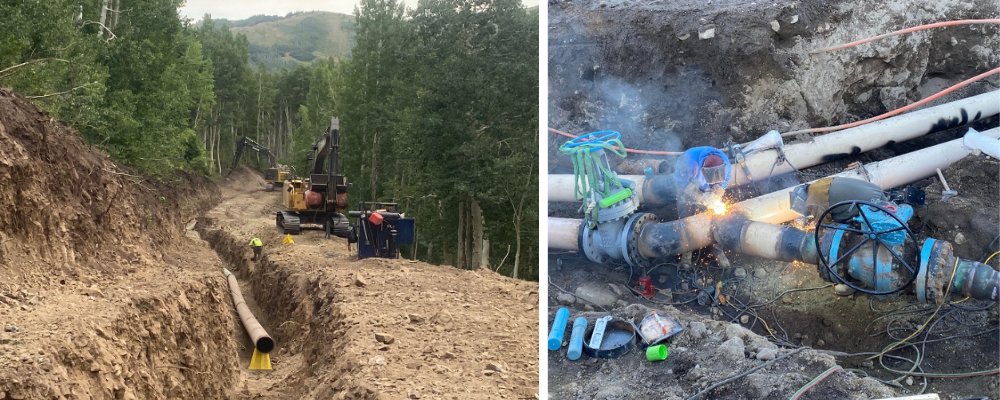 Left to right: Solitude installed a 16-inch high-pressure supply line from a new stilling pond; A welder completes a tie-in on a new distribution pipeline.
Despite averaging roughly 500 inches of snowfall annually, Utah’s Solitude Mountain Resort faces the same challenge as many resorts: natural snowfall doesn’t always arrive when it’s needed most. To create a more reliable early season, Solitude has completed a major overhaul of the mountain’s snowmaking infrastructure, part of more than $25 million in resort improvements over the past four years.
Solitude first installed snowmaking in the early 1990s, building a network that provided coverage around the lower mountain Eagle Express, Moonbeam, Link, and Apex lifts. For years, the system relied on a base-area pump house that diverted water directly from Big Cottonwood Creek and pumped it uphill at a capacity of 1,200 gpm.
The arrangement created several challenges. Pumping all snowmaking water uphill increased energy consumption and operational costs. At the same time, organic material and rocks carried by the creek frequently clogged filter screens, causing icing, reduced water intake, equipment damage, and regular system downtime.
Physical and zoning limitations, such as stringent building regulations and lack of space next to the creek, made it impossible to build a stilling pond or a more dynamic screening system nearby. Searching for a long-term solution, Solitude’s planning team identified a site for a mid-mountain intake and stilling pond in 2021.
Located at 9,400 feet, adjacent to an existing reservoir, the new stilling pond would provide clean, cold water for snowmaking through a concrete weir equipped with control valves and flow meters. Alterra and Solitude began permitting and design work in 2022.
Supporting a larger and more reliable water supply required substantial upgrades throughout the system. The existing pump house was retrofitted with larger piping and valves, increasing manifold size from 8 inches to 12 inches. More than a mile of larger-diameter distribution pipe was installed around the mountain, along with new hydrants, electrical distribution, isolation valves, and cathodic protection to guard against corrosion.
To support future expansion, the two-mile supply line was sized as a 16-inch high-pressure FBE/ARO-coated steel pipeline capable of delivering up to 5,000 gpm.
Construction began in July 2025 after Towsley Welding & Construction was awarded the project. Crews installed the new steel piping using the company’s Zap-Lok connection system, with certified welders handling tie-ins, valve stations, hydrants, and pump connections. The entire project was completed, tested, and placed into service by Nov. 1, 2025.
Benefits from the upgraded system include gravity-fed water pressure of 300 psi, realized up to an elevation of 8,600 feet, which means approximately 70 percent of the snowmaking system is gravity-fed and can be run without turning on the pumps, thus saving significant energy and operational resources.
The project was not without challenges, says Todd Dohman, Solitude slopes maintenance manager. “From rock excavation, blasting, narrow pipe corridors, steep pitches, as well as balancing construction with summer events and operations, the crews willingly worked around all of this” and the project was still completed on time and within budget.
The biggest impact may be on early-season operations. According to Ian Reddell, director of planning and projects at Solitude, the resort has gone from expecting to open with one lift serving four acres of terrain to the potential of opening four lifts, including a surface lift, serving 37 acres.
“This represents a year-over-year access increase of 825-percent to early-season terrain,” says Reddell. “Not to mention the operational efficiencies of a predominantly gravity-fed system.”