




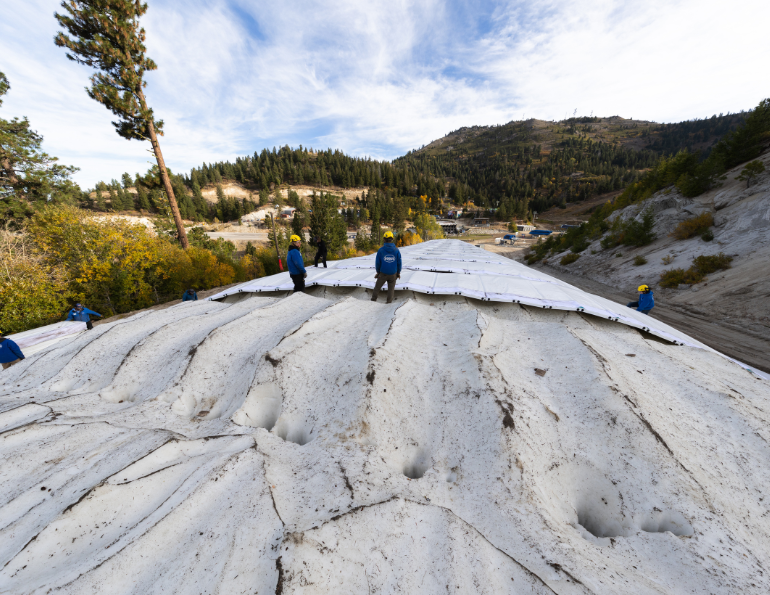
By the time the mound of snow at Boise’s Bogus Basin was uncovered near the Easy Rider conveyor lift in early October, the pile had endured summer surface temperatures of 119 degrees. Before it spent six straight weeks uncovered and exposed to the elements, of the roughly 11 acre-feet of snow that was pushed into a mound in mid-April to store over the summer, approximately 8 acre-feet remained when it was uncovered in October.
Increasingly fleeting winters are adding a burden to ski areas trying to keep their trails covered in snow. According to a study published in the American Geophysical Union (AGU), winter in the Northern Hemisphere mid-latitudes is projected to decrease to fewer than two months by 2100, while summer is projected to last almost six months. Ski area operators are looking for ways to adapt. Some are turning to all-weather snowmaking systems, while others are bulking up their traditional snowmaking infrastructure. And a growing number are looking into snow storage.
The early days of snow storage. Snow storage goes back centuries. In the early 19th century, for example, New England states began harvesting ice and shipping it to the rest of the country for use in ice pits and, eventually, in iceboxes to keep perishable food cold. More recently, ski areas have been experimenting with the age-old concept, using hay, wood chips, geotextiles, or a combination of those to preserve snow over the summer for the following season.
Snow Storage Tech
Bogus Basin is one such ski area. In January 2025, it began blowing snow on a portion of trail that had become a “dead zone” after a lift terminal was relocated. The pile grew, eventually reaching an estimated water equivalent of 3.5 million gallons. Bogus Basin director of operations Nate Shake stumbled upon the Snow Secure snow storage solution while scrolling through social media. By spring, the ski area had received a pilot snow storage system for testing.
“We had been blowing snow in an unused area on the mountain with the intention of tracking the melt rate and maybe seeing what it would be like to throw straw on it,” says Bogus Basin director of innovation and marketing Austin Smith. “[Shake] did some digging, and we all watched the [Snow Secure] videos and thought it was pretty crazy. But after having a meeting with them, we decided to give it a try.”
Having a base of stored snow to start the season played a pivotal role in Bogus Basin’s early-season operations, especially given the almost non-existent snowmaking opportunities it faced ahead of Thanksgiving weekend.
Not only did starting with a layer of last season’s snow above the conveyor save the ski area a couple million gallons of water and energy costs, but it also allowed the team to focus its snowmaking efforts elsewhere.
“Even above where we had pushed the snow, where the pile originally resided, there was a good base layer because obviously we didn’t scrape it down to the dirt,” says Smith. “And we didn’t really have to go back and make snow in that area until much later in December because when we pushed the snow out, we pushed it to around a depth of two or three feet to make sure it would withstand grooming even though it wasn’t freezing at night.”
Modern solution. Snow Secure, which started as a snow storage consulting company focused on using woodchips as insulation in the early 2000s, began using an engineered insulation system at Finland’s Ruka ski area in 2016 and Levi ski area in 2019—Levi holds an early-season World Cup alpine event and Ruka opens in October on snow stored from the season before—and offered it to others in 2022.
The technology uses extruded polystyrene (XPS) insulation, available in panels of various shapes and sizes. XPS, often used to insulate floors and roofs, is relatively impermeable, making it suitable for applications where it may be wet.
Snow Secure is designed to preserve large mounds of snow that are harvested in the spring from the previous winter’s snowfall and/or snowmaking. The panels, packed in cubes and attached using a strap-and-Velcro system, are brought to the top of a mound and then unfolded down the sides. They are designed to fall short of the bottom of the pile, at which point a geotextile fabric is draped from the panels to ground level, allowing for melting without bunching and creating gaps between the snow surface and insulating materials. Another impermeable fabric is laid over the top to minimize wind and water ingress. Built-in temperature probes allow for monitoring of ambient air temperature on the system’s surface and at the snow surface.
“The installation itself is extremely quick because the cubes are not very heavy,” says Snow Secure CEO Antti Lauslahti. “It takes less than a day. They go down with gravity, and the pads just stick together.” At Bogus Basin, fewer than 10 people installed the system in less than a day. The removal effort was similar.
Factors contributing to melting. Surprisingly, perhaps, wind has a more detrimental impact on the snow than rain, according to Lauslahti. He estimates that of the 20 percent of melting Snow Secure anticipates, only one quarter is due to rain, and the rest is from heat transferred by wind.
Paul Bierman, professor of geology and natural resources at the University of Vermont (UVM), who led a study about snow storage at Vermont’s Nordic-focused Craftsbury Outdoor Center, explained that relative humidity is also a major factor.
“If you have a warm, moist air mass and you condense that moisture onto the snow, then you have the latent heat of condensation available to melt the snow,” Bierman said one day in January. “Right now, it’s 40 degrees in Burlington, and the snow isn’t doing much. There’s no wind or sun. But a couple of days ago, we had really high winds at 40 degrees, and the snow evaporated in eight hours.”
Cost and savings. Snow Secure estimates its system costs less than $2 per cubic meter of snow retained on average over a 10-year period (the geotextile cover’s expected lifespan) and provides approximately 70 percent cost savings in energy and water use.
“The exact cost depends a bit on the shape and size of the pile,” says Lauslahti. “You get some savings from electricity and water, and then you have the cost of grooming hours and the benefit [of selling] lift tickets. That’s how we calculate the ROI.”
The team at Bogus Basin, which spent between $100,000 and $150,000 on its Snow Secure system, was able to justify the cost because it’s a nonprofit ski area, meaning all proceeds must be reinvested in the mountain as capital improvements. Given the warm start to the season and that Bogus Basin wouldn’t have been able to open its learning terrain sans stored snow, the timing of the investment was good.
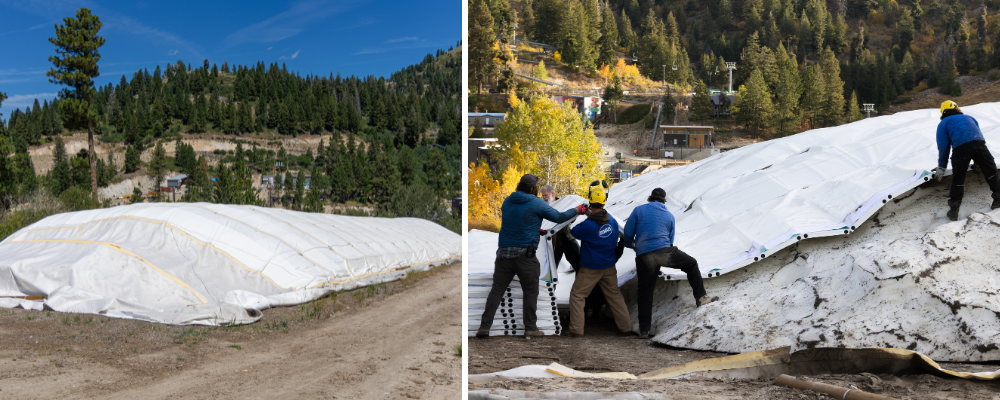 Bogus Basin covered a massive snow pile with Snow Secure in spring (left) (Credit Bridgette Johnson), then removed the cover in fall (right). The stored snow helped Bogus open its learning terrain during a warm spell.
Traditional Methods
Not all ski areas exploring snow storage are investing six figures in advanced insulation technology. Snow can be stored by simply piling organic material on top of a mound of snow.
Back to the basics. Wisconsin’s Trollhaugen has been experimenting with snow storage for the last five years. “We used to haul snow in from hockey rinks for a (rail jam) we have each fall,” says Trollhaugen mountain manager Adam Mahler. The constant trips to haul snow from ice rink parking lots to the ski area began two weeks prior to the event, and it was a ton of work. “We did that for almost 15 years, and then I saw some articles about snow storage. I saw other resorts storing snow. Tyrol Basin, just south of us, would fill their halfpipe with snow just before closing, cover it with hay, and then push it off in June for an event.”
Mahler was inspired. So, in 2021, he bought silage tarps and bales of hay from a local farmer, which he and his team used to cover a big mound of snow they harvested at the end of that season to store for the event—and it worked. “At the Open Haugen Rail Jam in 2021, we realized we don’t need to haul snow in anymore,” he recalls. “It saved money on vehicles, wear and tear, fuel, and hours spent getting snow.”
The following year, the Troll team relocated the pile to a shadier spot to maximize retention. They kept doing it each season, and in spring of 2025, they went big with a pile roughly 200 feet long, 100 feet wide, and 30 feet tall, and covered it with a few inches of hay and a baseball infield tarp for the summer.
Mahler estimates they lost roughly 40 percent of the pile over six months by the time it was uncovered Oct. 2, but what remained was more than enough to cover an entire run with at least three feet of snow and build a full, rope-tow-served terrain park on it. “And some spots were quite a bit deeper—there was one spot that was over your head,” recalls Mahler.
The 20th annual Open Haugen Rail Jam was the most successful in the event’s history, spanning two days, Oct. 4 and 5, with 340 participants, including pros and local riders alike. The social media content from Open Haugen produced millions of views, including one 60-second Instagram video of riders loading the rope tow that’s up to 2.2 million views alone. So, while the event has always been a solid spreader of stoke in the community, last year, it also earned Troll a ton of exposure.
Pros, cons of organic insulation. Troll spends approximately $3,500 per year on the hay. Some years the tarps have been donated, other years they’ve been purchased either out of pocket or with sponsorship dollars. In 2025, the total cost of two infield tarps and hay to cover the pile was about $12,000, “but the tarps were covered by sponsorships,” says Mahler.
Troll had plenty of snow to run its event, but estimates snow loss from its storage method at about double that of what Snow Secure estimates. And using organic materials can be a little messy, says Mahler, but he doesn’t consider that a significant issue.
“The snow isn’t the cleanest when it gets pushed into the pile anyway. There are leaves and sticks and organics and people’s garbage that get tilled in,” he says. “But when it gets pushed out, the snow is nice. If your operator is good, you can get underneath the top layer and easily push the hay off because there is an ice layer that forms between the snow pile and hay (from speading salt on it).”
The experiment has been successful enough for Mahler and his team to stay the course, using the hay and tarp every season. For the 2026 pile, the team plans on tracking actual snowmelt using a LiDAR drone.
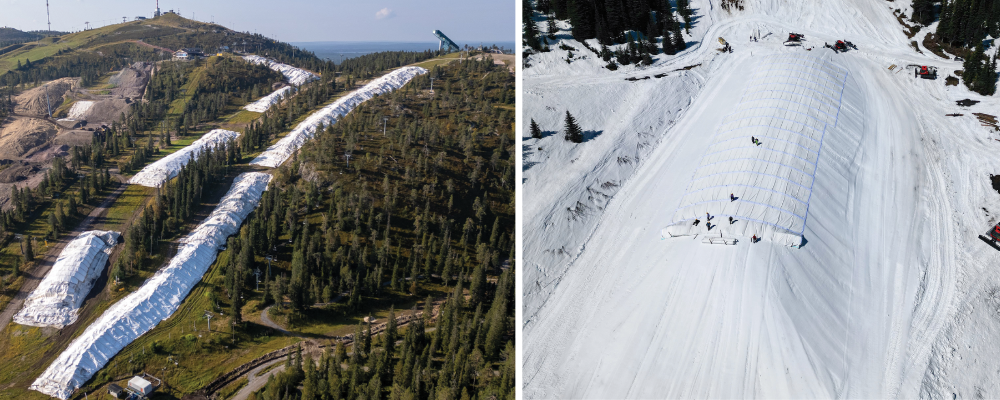 Left to right: Ruka, Finland, uses Snow Secure to open in October on stored snow that covers several trails (Credit: Ruka Ski Resort); Sun Peaks, B.C., is one of the most recent Snow Secure customers (Credit: Sun Peaks).
Snow Storage Science
In March 2018, UVM’s Bierman spearheaded a study focused on snow storage using organic materials.
How to best insulate snow? Initially, Bierman and his team made two small snow piles at the Craftsbury Outdoor Center, tracking and logging ground, snow, and ambient air temperatures, as well as snow-pile volumes. They experimented with a variety of coverings, including reflective covers and thermal blankets typically used for curing concrete. The following year, they used a much larger pile of snow stored in an old agricultural pond.
“We zeroed in on what we thought was the best strategy, which was to pile the snow in February and March, let it ‘ripen’ in the spring so it becomes denser, then cover it with wood chips,” Bierman says. “Ideally, you would also include a thermal blanket with a reflective cover on top, but we tried that during the first summer, and after a big windstorm, the reflective cover blew away, and that was the end of the white covers.”
Aside from wind, says Bierman, the reflective Tyvek cover filtered water along the seams, which eventually infiltrated the snow and caused localized melting. And while there isn’t enough heat in rainwater to cause significant melting overall, it did cause some erosion. Ultimately, a simple 1.5-foot layer of wood chips did the trick.
“What we really want to do is to avoid warm, moist air condensing on the snow,” Bierman says. When the snow is covered in wood chips, “there’s no air movement at the snow surface. There’s no transport of air, and therefore moisture and heat, to the snow. So it acts as both an insulating layer and a protective layer, preventing warm summer winds from getting to the snow.”
When to cover the snow. Deciding when to cover a snow pile is a delicate decision. Snow Secure recommends doing it when the snow is relatively cold, whereas some ski areas simply do it whenever their season ends. Bierman takes a more scientific approach.
Craftsbury intentionally blew wet snow for storage, he says, because “melting occurs based on grams of water in the snow, so the energy needed to melt snow is based on mass, not volume. Our goal was to make the material stored as high a density as possible without making it a brick of ice, although it would take a lot more energy to reduce the volume of [ice] than the same volume of snow.”
In the end, the study concluded that a combination of a concrete curing blanket, an 8-inch layer of woodchips, and a reflective covering was optimal for snow storage, but costly and difficult to implement at scale. More practical and cheaper was an 18-inch layer of woodchips. While the melt rate was higher, it still resulted in 60- 70 percent snow retention by volume when the time came to excavate and spread it in the fall.
“We’re now on year five of Craftsbury opening up a couple kilometers of Nordic track with stored snow by Thanksgiving,” says Bierman. “Local college teams train there—there are hundreds of skiers from around New England, ready for first tracks. Craftsbury is almost always the only place open that time of year for Nordic skiing.”
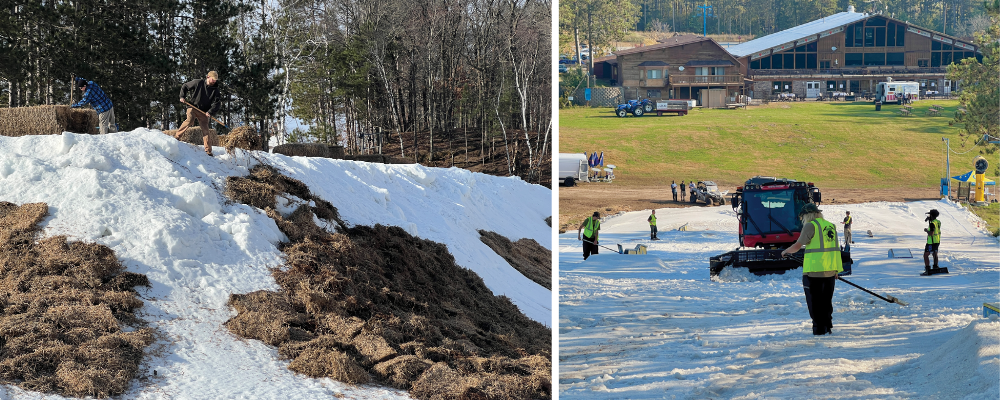 Left to right: The Trollhaugen crew covered a huge pile of snow with hay and an infield tarp to insulate it for summer storage; In October, the crew spread the stored snow and built a full park for Troll’s annual Open Haugen Rail Jam.
The Future of Snow Storage
The benefits of snow storage are catching on. This year, Snow Secure partnered with SMI Snow Makers to distribute its product in North America.
“We partnered with Snow Secure because [the technology] has evolved so much and become such a professional-grade product that you can really put math behind it,” says Brooke Alba, vice president of sales and marketing at SMI. “We watched a few pilot programs at some of our customers’ ski areas, and they were very successful. We also saw a need in the market.”
According to Alba, a major benefit of the Snow Secure system is its easier setup compared to spreading wood chips. But in reality, she sees it as most suitable for larger ski areas that may need to enhance their snowmaking to ensure early-season operation on a piste. Customers who want to host a rail jam or open a small tubing hill might be better off going with the organic route.
The bottom line. Regardless of the method a ski area chooses, snow storage may become more popular as our winters shorten and become less reliable. Ski areas are starting to realize the benefit of reusing the snow they’ve already made, rather than watching it all melt away, only to find themselves trying to make more in the fall.
SAMMY Guest Editor says …
 People have been storing ice and snow underground to keep food from spoiling for centuries, but as ski area operators seek greater surety for early season starts, we’re finding new strategic purpose in the old concept of stashing snow.
The snow storage efforts highlighted here are great examples of the range of solutions ski areas have come up with to an enduring problem—how do we guarantee our most important product, which is a safe and fun surface to slide on, when the weather isn’t always on our side?
This article does a great job talking about the lessons learned from these attempts as well as the cost benefits, which feel tangible and relevant given the wild and wacky weather patterns that many of us have experienced this season. I’ve seen Canadian ski resorts getting in on the trend, too, with British Columbia’s Sun Peaks rolling out snow farming and storage technology last spring to great success this fall.
One thing worth thinking about with any project is: will there be unintended consequences? For example, will using hay from the local farmer bring invasive species onto your slopes? Or does this planned snow storage location use up valuable summer activities real estate? This kind of assessment can help surface possible trade-offs or impacts before implementation.
Unfortunately, despite our best efforts, we as an industry have not yet found a way to control the weather. But with a little ingenuity, we sure are giving it our best shot. Whether or not you are using the latest and greatest technology or tried-and-true methods like hay and woodchip layers, storing snow is a smart way to guarantee your snowpack for early season.
— Katherine Seleski, Project Manager, Castle Mountain, Alberta
2025 SAMMY Leadership Award Honoree