

After a winter that played out unevenly across North America—early melt outs in some regions, extreme cold in others, and shifting visitation patterns in many markets—ski areas turned quickly toward summer and head into the season with new attractions and expanded activities, as well as a more deliberate strategy to attract and engage visitors year-round.
This year’s lineup includes reimagined waterpark features, new bike events, revived zip lines, expanded racquet facilities, upgraded campgrounds, fresh food and beverage concepts, destination marinas, pricing specials, summer concerts, weddings, youth camps, archery events, scenic lifts, day care programs and even troll sculptures. New experiences for families with young children are a common theme, too.
No Single Model
The summer operations landscape increasingly reflects the idea that not every ski area needs the same summer product mix. Instead, ski areas are building programming that complements their market, brand, and existing assets.
Crystal Mountain, Mich., continues to show what a fully developed summer business can look like after decades of deliberate investment. CEO John Melcher said summer and winter now represent roughly equal parts of the resort’s business, the result of a steady, incremental strategy that began about 35 years ago. Crystal’s summer mix includes two golf courses, a 32,000-square-foot conference center, weddings, corporate events, and activities for multigenerational families. This summer, the resort is adding a new mountain bike race, continuing its golf partnership with the Michigan Women’s Open, and offering farm-to-table dinners at the summit yurt.
Angel Fire, N.M., is also expanding around its established all-season resort model. Director of marketing Wolfe Ashcraft said Angel Fire is reengaging its wedding and conference business, opening a new racquet facility that nearly triples the number of courts, including designated pickleball courts, and operating the Chili Express lift for scenic rides and bike uplift 170 days this summer. Ashcraft estimated the resort’s visitation split at roughly 40 percent summer and 60 percent winter.
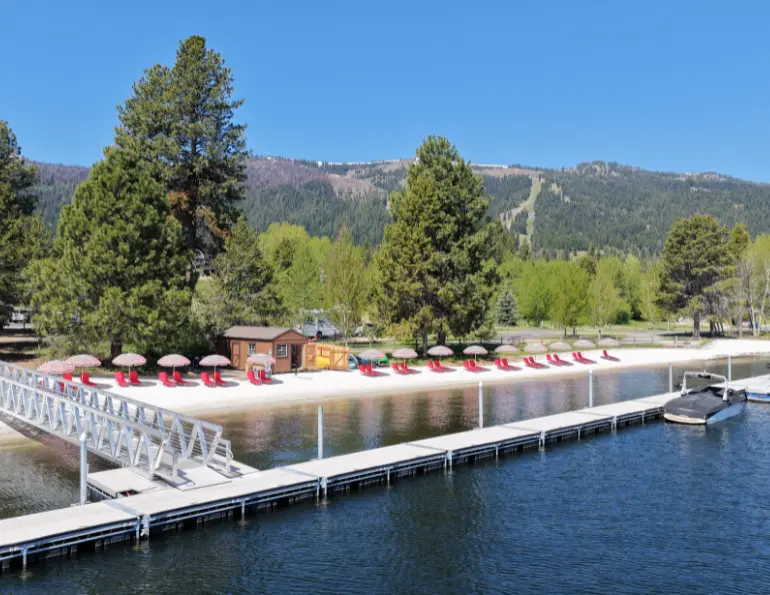
Tamarack, Idaho, is adding one of the more distinctive destination amenities this year: a new marina on Lake Cascade. Tamarack spokesperson Zander Smith said the marina helps solidify the resort’s position as a ski, golf, and lake resort. The public facility, located within a unit of Cascade Lake State Park, includes 100 seasonal boat slips, a beachfront, boat rentals, a Hawaiian barbecue-themed food truck, and retail store. The project was completed in partnership with the state of Idaho and the Bureau of Reclamation.
Family Business
Many investments are aimed at families and multigenerational groups, with summer growth increasingly tied to broadening the appeal of mountain resorts beyond core outdoor participants.
With the opening of Kircliff, a scenic observatory with 360-degree views at 11,166 feet, Big Sky Resort, Mont., is expanding high alpine access for all ages and abilities. Public relations manager Megan Munley said the full experience—from the base of the Explorer Gondola to the top of the tram and the second story of Kircliff—is ADA accessible. “We wanted to expand our summer offerings for families by offering an experience not found anywhere else in the American West,” Munley said. She expects Kircliff to increase scenic lift ticket demand and strengthen Big Sky’s position as a quieter Yellowstone-area base camp for visitors.
Northern neighbor Whitefish Mountain Resort, Mont., is seeing a trend toward younger families, which the mountain appeals to with the Yeti scavenger hunt, free yard games and kids sliding and climbing activity Spider Monkey Mountain, said marketing director Matt Gebo. That sense of play extends to summit weddings, where the wedding party has the option to ride the Alpine Slide down to the lodge for the reception.
At Canyon Ski Resort, Alberta, general manager and co-owner David Martel said the resort added the Crystal Canyon Mining Company as an experience for families with kids too young for some of Canyon’s other adventure attractions. Summer visitation now equates to about half of Canyon’s winter visitation and is growing, with guests traveling farther for summer than for winter.
One notable family-friendly addition at Brundage Mountain Resort, Idaho, is a day care program, aimed at giving families more flexibility while visiting the mountain.
The Bike Park Question
Bike parks remain one of the industry’s biggest summer bets, but the return on investment varies from operation to operation.
At Mammoth Mountain, Calif., marketing manager Gabe Taylor said the resort is operating Chair 4 and has built a connecting trail to make lapping easier for beginner and intermediate mountain bikers. Mammoth is also adding a new zip line at Woolly’s Adventure Summit. Taylor said bike pass sales and early advance reservations were up after a slightly below average snow winter.
Purgatory, Colo., is bringing back its bike park and uplift operation after a one-year hiatus for lift construction. Matt Ericksen, director of marketing, sales and events, said the focus this summer is on trail maintenance and preparing for major mountain bike events, including the return of the Mountain States Cup. Purgatory is also adding the Total Archery Challenge, an event which Ericksen said can draw 4,000 to 5,000 participants per day.
Aspen Snowmass, Colo., is expanding its summer mountain experiences with several key upgrades. The new Elk Camp Chair doubles bike haul capacity at Snowmass Bike Park, while the resort is piloting e-bike access on select westside trails from June 21 to Sept. 7, both in response to growing guest demand.
“We’re building out more layers of experiences across the mountain,” said Aspen Skiing Company VP of mountain operations Susan Cross. “That means investing in bike infrastructure with the Elk Camp Chair, expanding our sightseeing options with new pricing, and broadening our on-mountain dining offerings to match what guests are looking for.” The enhancements include new family packages that bundle activities, gondola rides, and discounted three-day bike rentals.
Brundage is expanding its mountain bike shuttle service this summer, adding a new Goose Creek Trail pickup to its existing Brundage to Bear Basin route to give riders easier access to backcountry singletrack experiences in Idaho’s Payette National Forest, including some nearly 3,000-vertical-foot descents from the Brundage summit.
On the other hand, California Mountain Resort Company properties are largely phasing out lift-served mountain biking. Mountain High has put its lift-served bike park on hiatus after one season, Dodge Ridge is stepping away from mountain biking after several years of underperforming results, China Peak is scaling back to select bike weekends and legacy events, and Bear Valley exited lift-served biking after joining CMRC in 2023.
“After a year like this last year, we weren’t in a position to subsidize summer with winter,” explained CEO Karl Kapuscinski, “hence the decision to back away from mountain biking.”
Kapuscinski said the company is shifting toward more reliable lines of summer business, including campground management and the Pinecrest outdoor movie theater at Dodge Ridge, Bear Valley’s wedding and camp business, China Peak’s marina and rentals, and Mountain High’s campgrounds, restaurant, and disc golf. The decision reflects his broader assessment: for remote, non-destination ski areas without lodging or a larger resort ecosystem, lift-served mountain biking has become harder to justify as a standalone summer anchor amid the rise of e-bikes, free trail networks, limited rider spending, and a softer post-Covid recreation market.
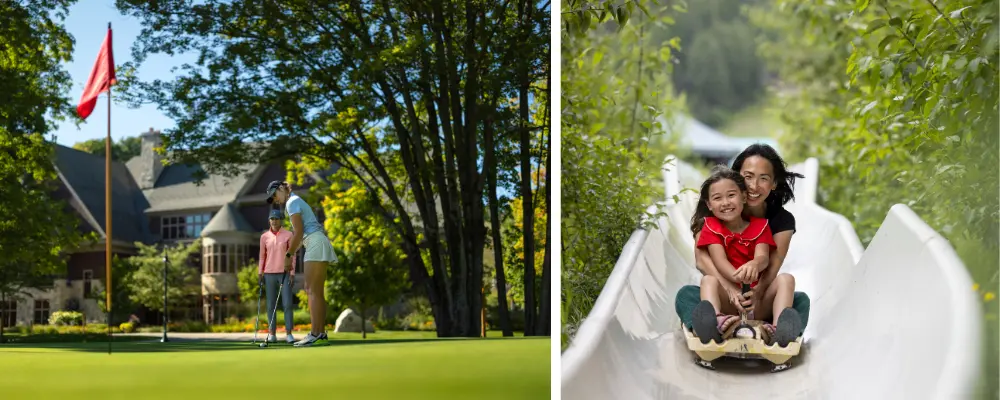 Left to right: Golf partnerships are part of the robust summer mix at Crystal Mountain, Mich; Activities and offerings aimed at young families and multigenerational groups, like the Alpine Slide at Whitefish, Mont., remain a growing segment of resort summer business, with many resorts continuing to invest in a wide array of family-focused additions.
Events, Weddings, and Local Draw
For many resorts, the most reliable summer revenue derives from events and group business.
Powderhorn, Colo., is focusing on weddings, catering, a summer music series and dinner series. General manager Ryan Schramm said those offerings make use of the resort’s setting and facilities and are less weather dependent than some outdoor adventure activities.
A summer concert series at Nub’s Nob Ski Area, Mich., has become a meaningful off-season touchpoint for the area’s winter guests, said general manager Ben Doornbos. The concerts, launched two years ago with help from a local promoter, draw about 500-700 people, with expectations for growth this summer.
This summer marks the 10th anniversary of summer operations at Bogus Basin, Idaho. New to its day-visit mix this year is The Outpost, a Sprung Structure that seats 250 for corporate events and weddings.
Weddings, private events, and its blueberry festival activate Ski Land, Alaska, outside the winter months. GM Bryson DeRonde said summer revenue helps to offset winter operating costs like the high price of diesel fuel. The blueberry festival gives Ski Land a locally rooted summer event tied directly to its landscape—a sensible consideration.
Sugar Mountain Resort, N.C., remains heavily events-oriented in summer while operating its bike park and scenic chairlift on weekends from the Fourth of July through Labor Day. Vice president Kimberley Jochl said Oktoberfest is the resort’s major fall anchor, rivaling the attendance of a three-day winter holiday weekend.
A mix of biking, events, food and beverage, and two Thomas Dambo troll sculptures draw summer guests to Detroit Mountain, Minn. GM Tom Theil said the area has 14 miles of singletrack and a major concert event that draws about 3,500 people, generating more than $150,000. The troll sculptures have become a major draw as well, supporting sales of ice cream and other F&B from Memorial Day through Labor Day.
At Gore Mountain, N.Y., sales and marketing manager Ian Tomasch said summer base-area activity is moving to the North Creek Ski Bowl, where a new lodge, year-round restaurant, chairlift rides, hiking and biking access, and a unique zip-line ride (currently under construction) are intended to make the ski area a more active part of the North Creek community. A major Columbus Day weekend music event also draws about 5,000 people per day.
External Forces
While operators are optimistic about summer demand, many are keeping a close eye on factors beyond their control, from travel spending to wildfire risk.
After losing roughly 50 days of winter business, including a very early end to the season, Solitude, Utah, was able to open for summer about four weeks early. Solitude is leaning into the second full summer of its Gravity Logic-designed bike park. President and COO Amber Broadaway is watching summer travel patterns closely, including the possible effects of gas prices, the economy, and destination travel demand.
Sunrise Park Resort, Ariz., is making a major summer push after a short winter allowed the area to open summer operations early, on April 22. Krista Warner, marketing and special events director, said the biggest change is that Sunrise is “actually promoting” its summer activities this year. Those include a new downhill mountain bike series, a renovated hotel with all 100 rooms reopening, a major campground cleanup and the return of the Apache High Flyer, a 2,300-foot zip line.
Mt. Hood Meadows, Ore., is continuing to emphasize nature-based summer experiences, including nine miles of interpretive hiking trails connected to U.S. Forest Service trails, dark-sky camping, youth camps, weekend parking lot camping, and running events.
To that end, wildfire preparedness, said president and GM Greg Pack, has become a critical operational pillar, centered on specialized wildland fire training for staff and the strategic placement of equipment across the mountain—including fire boxes, water tanks, two fire trucks, a six-wheel water tanker, and a high-capacity Oshkosh truck equipped with sub-pumps.
These efforts are bolstered by a proactive wildfire watch program and a strong, collaborative partnership with the Forest Service.
In the West, wildfire and smoke remain the most significant operational wildcards. Ski areas are increasingly treating wildfire readiness as part of summer operations, with proactive measures such as defensible-space work, pre-staged fire response equipment and water sources, stronger coordination with local agencies, and wildland fire training for summer team members.
The biggest shared concerns heading into summer are uncertainties around gas prices and the broader economy. Several operators speculated that higher travel costs could soften destination visitation or shorten trips, while others noted the same pressure may benefit resorts within easy driving distance as families choose to stay closer to home—a trend often proven out in winter.
The Resilience Equation
For some ski areas, summer operations are becoming part of a broader response to climate uncertainty, volatile snowfall and the financial risk of depending too heavily on one season.
Mt. Bohemia, Mich., president Lonie Glieberman said climate change is a legitimate concern. “We at Bohemia believe climate change is real, and we’ve been addressing this issue the best we can” from a business standpoint, he said, pointing to the 2019 opening of the Nordic Spa and the resort’s growing summer and fall business. Bohemia is adding summer amenities, including a new sauna and cold pool, a tiki bar and a rooftop Beach Bar, attracting a warmer-weather audience that includes a significant share of non-skiers. “We are now a year-round operation,” he said, adding that Bohemia is trying to get in front of “unfortunately warmer winters ahead.”
Great Bear Ski Valley, S.D., assistant general manager Alexa Jerstad said that after the 2023-24 season, the area can no longer rely on winter alone. Great Bear is expanding public events, activities, partnerships and sponsorships, while adding food and beverage staff and two salespeople to support event sales. Its location about 10 minutes from downtown Sioux Falls gives it a chance to become a year-round community venue, not just a ski area waiting for cold weather.
But summer resilience does not always mean adding activities. At Pajarito Mountain, N.M., the expert downhill mountain bike park will not operate this summer because of a major snowmaking infrastructure project. The short-term result is less summer programming; the long-term goal is stronger winter reliability and wildfire preparedness. (Read more about the project in the SAM “Snowmaking Mountain Department Supplement.”)
That tension is not unique. At Arapahoe Basin Ski Area, Colo., Tony Cammarata, vice president of planning and development, said if it had to choose, A-Basin would prioritize snowmaking over developing summer revenues. While the ski area is adding more non-winter events, including Brewfest and Gay Basin, a summertime Pride event, and offers a via ferrata and aerial adventure park, it does not monetize its high-alpine cross-country bike trails through uplift.
The emerging lesson is not that summer will save ski areas from the effects of climate change. It is that summer is becoming part of a broader resilience portfolio alongside snowmaking improvements, lift upgrades, wildfire preparation, staff retention, community partnerships and smarter capital planning. The challenge is building summer strength without distracting from the winter business that still defines the industry.