

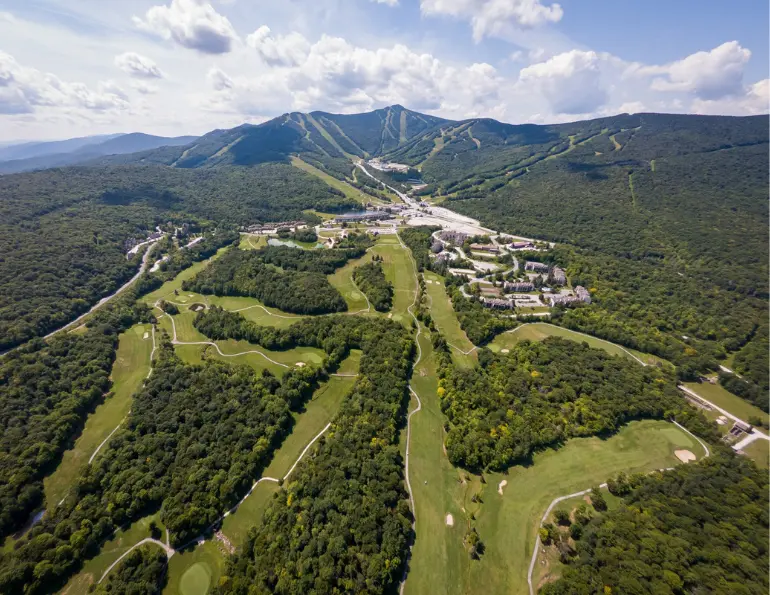
Killington Resort, the town of Killington, and developer Great Gulf are in the initial phases of a multi-year, multi-million-dollar public–private development partnership that will, when completed, transform the Snowshed and Ramshead base areas, Killington Road, and the entire resort community of Vermont’s largest ski area. The partnership, decades in the making, weaves together resort, private developer, and local municipality along with a creative state financing plan that uses property tax revenues to pay for the development’s infrastructure.
The project, called Killington Forward, was kick-started in March 2023, when Killington voters approved a $47-million bond at a town meeting. The project has four main goals: to develop municipal water infrastructure; create a newly designed and rebuilt Killington Road with significant enhancements; create workforce housing; and pave the way for the development of the long-planned 1,500-unit Six Peaks village. The bond will pay for the water infrastructure and road improvements.
“This has been a collaborative effort from the onset with the town of Killington, Killington Resort, state agencies, and Great Gulf,” says Michael Sneyd, president of resort residential for Toronto-based Great Gulf, which purchased the land where Six Peaks is to be developed in 2023. “The town, supported by regional and state economic development partners, has led the public infrastructure, municipal planning, and approvals process, while Great Gulf has focused on advancing the private development vision and associated project planning.”
Jim Haff, chair of the town’s selectboard, Killington’s municipal governing body, says the resort and Great Gulf have been good partners. “Killington Resort is one of the best-run resorts around; it’s fantastic,” says Haff. “Great Gulf, they are great to work with as far as coming to agreements that take away any of the risk to town voters and taxpayers.”
Decades of Development Dreams
The project is the culmination of years of hopes, dreams, and planning.
“The concept of a village at Killington has been nearly 60 years in the making, dating back to Killington founder Preston Smith’s initial plan for a 44-acre Killington Center in 1967,” says Sneyd. “Over time, that vision evolved alongside the resort’s growth, visitor expectations, and the broader shift toward year-round destination communities.”
The lands that form the basis of the village were acquired through a land exchange with the state of Vermont in 1999. Formal planning applications for the village concept began in 2008, followed by the submission of an Act 250 application—Vermont’s strict land-use and development law—in 2012 and receipt of final approvals in 2017.
The cost. “The real problem, why things never got built, was the infrastructure costs,” says Killington Resort general manager Mike Solimano. “The idea was there for 30 years, but no one wanted to put the money in. This is the perfect example of why you do a TIF district. And once it’s paid, the town and state will get the tax revenue back.”
A TIF (tax increment financing) district allows a Vermont municipality to direct tax revenues toward revitalization projects and is the creative funding process that allowed the village to move closer to reality.
Ideal Partners
Great Gulf is one of the largest private builders in North America and has extensive experience developing large-scale, four-season resort and lifestyle communities. It operates Taboo, a four-season golf and recreational resort community in Ontario, and has developments adjacent to Georgian Peaks and Blue Mountain.
“Our leadership team brings direct, hands-on resort and village development experience,” says Sneyd, who previously served as CEO of Skyline Investments, which was involved in village developments at Bear Valley in California and Blue Mountain in Ontario.
“Killington is unique in the Northeast in terms of scale and potential,” he adds, “and this project builds on that broader experience rather than replicating any single precedent.”
Great Gulf management believed so much in the Killington project that it became a minority investor in the Killington Independence Group, which bought Killington and Pico resorts in 2024.
Selectboard chair Haff is happy with the resort ownership group. “The new Killington owners, you couldn’t ask for a better group. They’ve owned houses here, skied here, their kids went to Killington Mountain School. This is their passion.”
A Comprehensive Plan
The partnership is working to address the four parts of the overall plan.
Access road. The fabled five-mile Killington access road is lined by numerous inns, restaurants, ski shops, and assorted businesses, and is legendary for its nightlife—and also weekend traffic snarls. Road upgrades address safety concerns and accommodate multiple modes of transportation. The rebuilt Killington Road will include a multi-use path, sidewalks, bus pullouts, pedestrian crosswalks, and eliminates an unsafe grade at the intersection with Vermont Route 4, along with various other improvements.
Water. Access to safe and reliable water to provide services, retail, and hospitality to residents and visitors, as well as a reliable source of water for local schools, justified the water line upgrades.
Stephanie Clarke, vice president at White & Burke, a Burlington, Vt., real estate development firm, has been working with the town for five years on the project. She says public–private partnerships are complicated, but the Killington one is working.
“It’s close to a shovel in the ground on the private side,” says Clarke. “The public side is already started.”
Housing. As part of the partnership, Killington Resort and Great Gulf pledged $700,000 total for affordable housing along the road. That allowed the town to purchase land at the bottom of the access road, which will eventually be developed into affordable housing by a third party.
“Housing is a major issue,” says Clarke. “We need housing at all price points.”
Funding structure. The bond for the water and road projects will be repaid from a variety of sources, according to the town website. Those include the TIF district, ARPA, the State Revolving Fund, a Catalyst Grant, a Community Recovery & Revitalization Program grant, and USDA Rural Development financing. Additional federal grants reserved for safe water will also contribute to the overall financing of the project.
The funding mechanisms and new property taxes from the Six Peaks development, which will subsume the Snowshed and Ramshead base areas, will eventually pay for the entire public infrastructure project, according to Clarke. “The town takes over development of infrastructure, and pays for it with taxes from the village.”
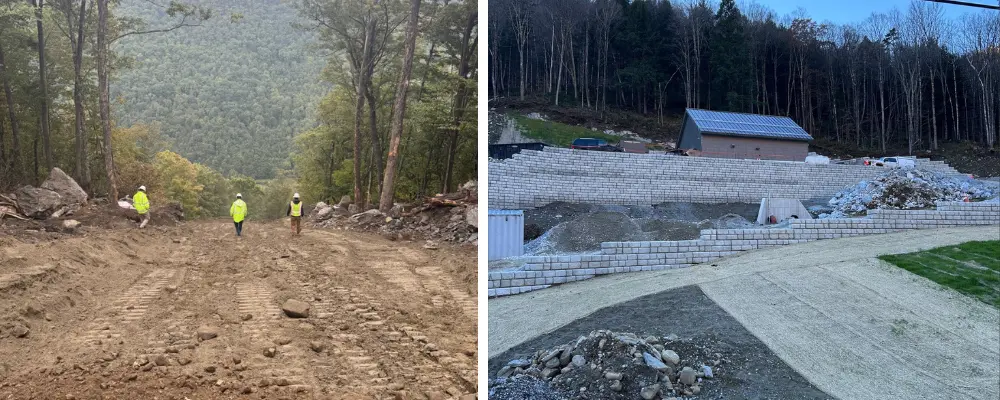 A key component of the Killington Forward development plan is a municipal water upgrade. Left to right: looking down the steep installation drop off of the transmission main; construction progress on a new pump station.
Public Concerns
Who shoulders the cost? Killington residents and voters have been wary of the costs, and in particular what happens if Great Gulf backs out of the proposed village development. That’s been addressed.

The local Mountain Times newspaper reported in March that the development agreement with Great Gulf includes protections for the town and taxpayers, including a “minimum taxable value” and a cash-flow backstop that will, if needed, start paying enough taxes to cover the debt service by 2028. The agreement basically says if town expenses, including out-of-pocket expenses and debt service, exceed $2 million within FY26 and FY27, Great Gulf will start paying taxes to cover that excess. And if construction hasn’t started by 2028, the cash-flow backstop kicks in.
“The TIF is intended to be repaid through the incremental property tax revenue generated by new development within the village,” says Sneyd. “If development timing is delayed and those incremental revenues are not yet being generated at the anticipated level, Great Gulf is responsible for covering property tax payments equal to the associated TIF bond obligations during that period.”
Haff says he “would never put the town and taxpayers in the position to pay. That’s my job. That is what the selectboard is supposed to do: protect the community and grow the community.”
Haff has played a key role in the overall project. “He’s one of the people who is really trying to get something done,” Solimano says. “He’s thinking about the town; he’s trying to come up with creative ideas to make the place better. We wouldn’t have the TIF without him.” Haff’s leadership contributed to 74 percent of voters approving the TIF in March 2023.
Public outreach has been a recurring concern for the town, too. At the March 10, 2026, town meeting, selectboard members stressed the need for better communication tools. The meeting ended with an agreement to post the recording on the town website and to present updated financial projections and clearer communication materials as Killington Forward moves into its next phases.
“The town has recognized the importance of continued community engagement around both the development and the TIF structure, and Great Gulf has worked to support those efforts,” says Sneyd. “That has included participation in public meetings, sharing project information, and engaging directly with community members as plans continue to evolve,” adding that ongoing education and dialogue are important parts of any long-term project.
Progress Up to Now
According to the Mountain Times, Road Phase 1B (lower Killington Road/Route 4 area) is finished. Water Phases 1-3 will be complete this summer. Water Phase 4 (through the village and to Ravine Road) will be completed in the fall.
Road Phase 1A (the village area road and roundabout) was being bid in the spring. It’s going to take about two construction seasons, 18 to 24 months, to build out. Progress is contingent on resolving Act 250 issues, final easements, and lining up interim financing before USDA’s long-term loan converts to permanent financing. That roadwork is expected to start late summer or fall.
Updating plans. In the new village, the first phase is expected to result in about 180 new housing units and 30,000 square feet of commercial space. Great Gulf is currently updating its plans and waiting for state approval. Once that is secured, construction can begin.
Eyes on the Future
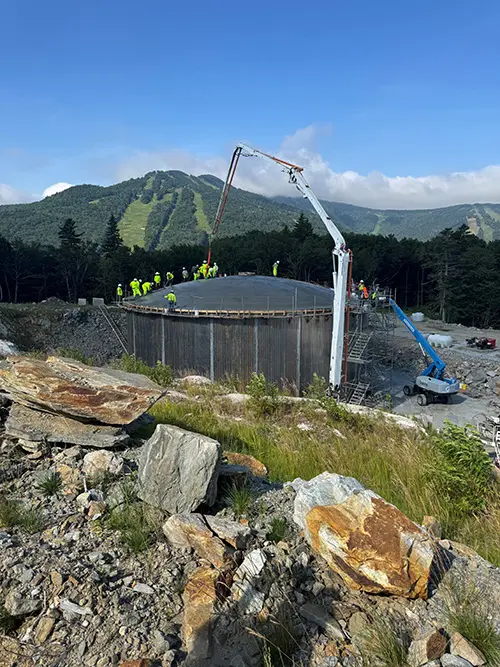 Pouring the dome section for a new water storage tank.Everyone involved with the Killington Forward project sees it as the key to Killington’s long-term success.
Polly Mikula, who lives in Killington and has edited the Mountain Times for 15 years, says the project is a win for everyone.
“Because of this infrastructure, we’ve been held back,” she says. “Our access road looks like it did in the ’80s, because of the limitations of water and roads. The village needs the water and the roads and they’re moving forward either way, whether or not the [new] village gets built.”
Clarke sees the project as a model for future public–private partnerships. “Municipalities across the country are looking to be more entrepreneurial, and more invested in how the future is developed,” she says. “They need to be in the driver’s seat, and a public–private partnership puts them in the driver’s seat, where they can’t be otherwise.”
Clarke adds, “Municipalities are not developers. This is the only way they can drive that kind of development.”
Cooperation. For Sneyd, it’s about cooperation among parties.
“There is a shared recognition among stakeholders that strengthening Killington as a year-round destination is a long-term priority for the region. Projects of this scale require sustained partnership, coordination, and trust among all parties involved, and that has been a consistent feature of the process.”
Solimano agrees it all comes down to working together.
“We helped the town get the TIF financing,” he says. “If they didn’t trust the mountain, nobody would have voted for that. I think most people feel like we’re moving in the right direction. My point is, stuff’s going to change no matter what. Let’s try to do the best we can.”
Pursuing a Similar Path
Water systems have become a focus for Vermont resort towns. South of Killington, at the base of Mount Snow, the town of Dover is in the study phase of developing a municipal water system. Spurred on by a 2024 revision to its town plan, Dover has updated a two-decade-old water study. The new plan could be developed over time to include the base area around Mount Snow and the Route 100 commercial district south of the resort. The town’s selectboard will decide whether to continue the project later this summer.
Further to the south of Dover, neighboring Wilmington—also part of the Mount Snow support orbit—recently brought its formerly independent water district under the town’s governance. The town is looking at an expansion of the village water district east along Vermont Route 9, which is a main corridor for potential development.
While the scale and scope of these projects differ from Killington Forward, they show that winter resort communities are willing to upgrade current infrastructure and position themselves for whatever opportunities come down the pipeline in the future.